Can the United Nations Help Slow the AI Race?
Chris Stokel-Walker / Sep 21, 2026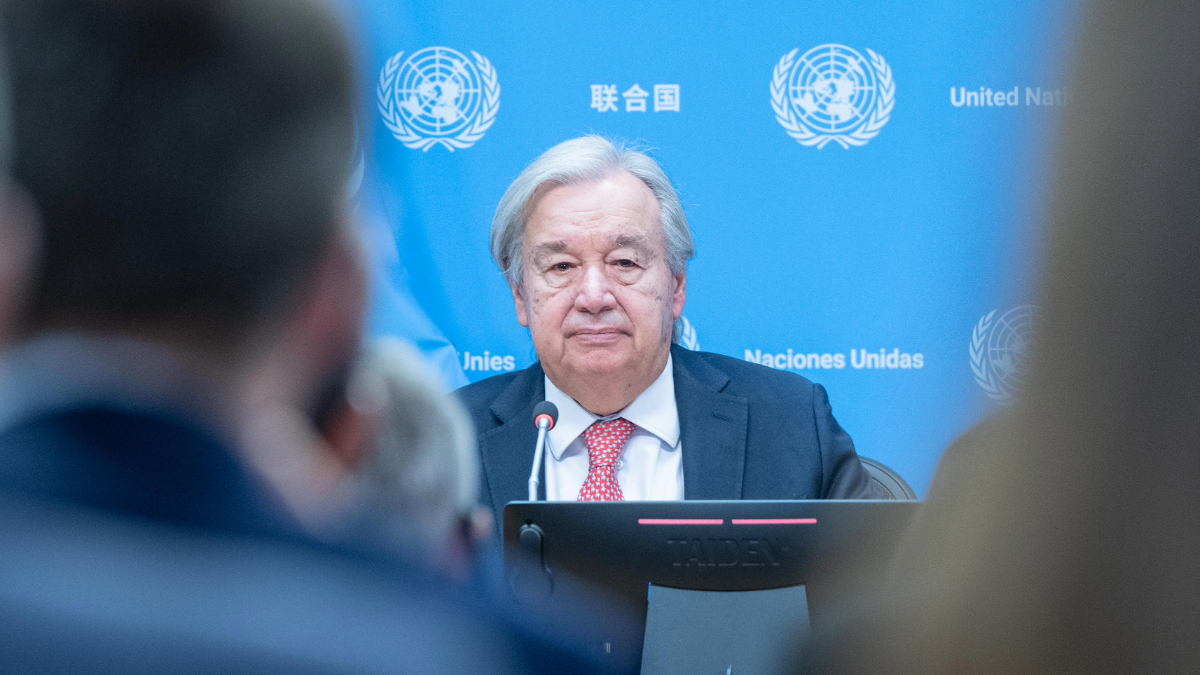
Secretary-General Antonio Guterres speaks during press conference ahead of General Assembly High-level Week 2026 at UN Headquarters in New York, NY on September 16, 2026.(Sipa via AP Images)
AI will be hard to avoid at the United Nations this week. World leaders are gathering in New York with AI high on the agenda, with OpenAI CEO Sam Altman due to brief the Security Council on the technology’s implications for international security.
In generative AI’s brief history, the companies building the frontier models used by millions across the world have tended to argue governments need to move quickly to control the technology, but must not do so in ways that slow down its development.
Now, that position may be shifting. Anthropic’s Dario Amodei has called for AI developers to “pace the frontier”— slowing the speed of development until safety work, and independent oversight can catch up. Sam Altman, Elon Musk and Google DeepMind’s Demis Hassabis have said they back that idea, while stopping short of helping sketch out the details.
The argument AI lab chiefs and the general public are making is that governments around the world need to get together to act on AI— something the UN is designed to do.
Building global cooperation on AI
The UN has spent years working to develop its capabilities on AI. António Guterres convened a High-level Advisory Body on AI in 2023. The following year, all 193 member states adopted the Global Digital Compact, committing themselves to greater international cooperation on AI. And in August 2025, the General Assembly formally established two new bodies — the Independent International Scientific Panel on AI and the Global Dialogue on AI Governance — to assess evidence and build shared agreement across countries.
The first Global Dialogue took place in Geneva in July, attracting more than 3,000 participants, delegations from 163 countries and more than 1,000 stakeholder organizations. The scientific panel convened for the task presented its first report, intended to give governments a common evidence base from which to work.
But the UN works more slowly than AI labs.
Still, there are industry inputs. The ITU’s AI for Good Global Commission, launched around the same Geneva meetings, has more than 40 founding members, including figures from Anthropic, Amazon, Cohere, Google, Microsoft and Nvidia. Its first meeting called for action on trust, access and real-world AI uses.
“The brakes sit with a handful of AI companies and the few governments that host them. What the UN can do is make sure the rest of the world is not simply the track that the AI race is run on,” said Nighat Dad, who was a member of the UN’s Scientific Panel.
Friederike Schüür, a senior policy researcher at the Ada Lovelace Institute, attended the first Global Dialogue in Geneva in July. She wants the high-level week to act as a catalyst for meaningful change on AI. It’s about “being clear about what the UN must provide because only the UN can,” she says. “That’s the critical question right now.”
Coordination is needed. But so is action — and the question is whether the UN can do more of the latter than the former.
The latest developments “create more political impetus towards action,” explains Tony Oweke, a research fellow at the Council of Foreign Relations and former digital adviser to Kenya’s UN mission who helped secure the creation of the Scientific Panel on AI and the AI Governance Dialogue.
“But as far as the United Nations is concerned, it isn't likely to change anything materially, at least in the short run,” he says. The body has already formed its architecture for how it plans to tackle AI, and the only point at which both the panel and dialogue can be reviewed — to “potentially give it more teeth to start working on norms and principle-building,” says Oweke — is next year or 2028.
That does not mean the UN has to wait. “Member states are free to introduce resolutions to the General Assembly at any time, as we have seen with the United States producing the first resolution on AI at the UN and China following suit,” says Oweke.
At the same time, coalitions can be formed to tackle urgent issues, as was done with France, Spain and UNICEF over child safety at a recent dialogue. And there are other international forums, including the OECD and G7, which could all be used to try and pressure tech firms to think twice. “I think the net effect will be increased frontier lab engagement with the United Nations,” reckons Oweke.
Where the UN could have an edge
The latest developments have also crystallized what the UN can offer. “[Tech companies] have been making calls for governments in the international community to band together to tackle AI safety, but have failed to show up in any meaningful ways while AI is being discussed at the United Nations,” says Oweke.
“This is an opportunity for frontier labs to work with governments to bridge the gaps in understanding needed to take effective collective action.”
Bridging those gaps will be vital because there’s an asymmetry between the level of expertise within the companies leading the charge and the governments and supragovernmental bodies tasked with trying to keep them in check, says Oweke.
“If measures for AI governance can be provided at national level, they should be provided at national level,” she says. The same applies regionally, or even through effective industry self-regulation. Schüür reckons the UN should concentrate on the problems that spill across those boundaries, using AI incident monitoring as one example.
Rather than every country building a surveillance system for issues, Schüür suggests that detecting and sharing information about AI incidents is where international action might actually be achievable.
Doreen Bogdan-Martin, secretary-general of the UN’s International Telecommunication Union, argued last week that standards can translate broad commitments on AI safety into practical requirements.
That breadth may be one reason the UN still matters. For all its shortcomings, Schüür says, it remains the forum that brings together the widest range of countries — and AI governance cuts across all three of the UN's traditional concerns: peace, development and human rights.
But that breadth creates its own problem. Governments around the world are talking at cross purposes and pursuing different goals for their individual countries. Some countries benefit more from a quicker pace of AI development than others.
Similarly, within the United States, for instance, there’s skepticism about the role of the UN.“Any role for the UN beyond convening blunt discussions will entirely depend on shared political will, which means convincing the US government and, in turn, US allies, to place currency in the UN,” he explains.
That’s, in Oweke’s own words, “an extremely uphill task.”
Authors