Can the United Nations Bring the World Together on AI?
Chris Stokel-Walker / Jul 10, 2026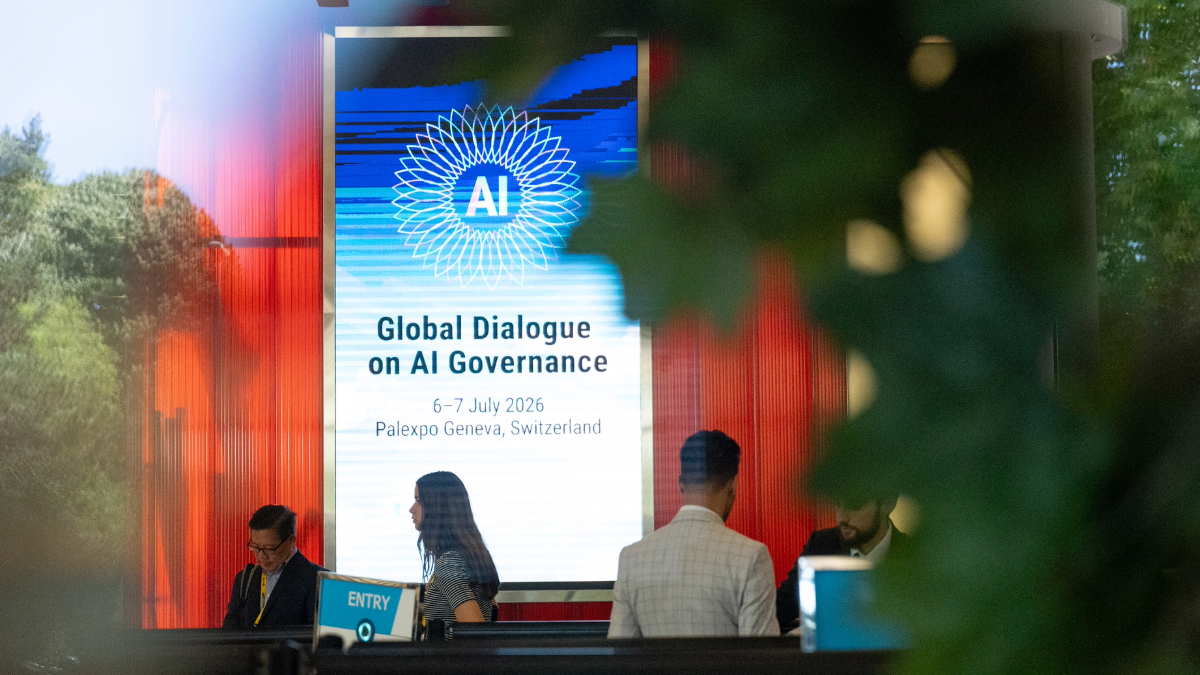
One of the most honest admissions in this year's United Nations AI for Good Global Summit came from a diplomat, rather than a technologist — exposing the difficulty of governing AI for humanity’s benefit.
Annalena Baerbock, president of the 80th session of the UN General Assembly, was asked on stage how the UN could give the Global South real power over AI's rules rather than “a performative seat at the table.”
Her answer began with a concession designed to address criticism that the UN is slow to fix problems, but which underscored the challenge of doing anything at all. “The UN is always the sum of 193 member states,” she told the audience gathered in Geneva at the Palexpo conference center, and finding agreement among them “is not only not easy, but this is also almost impossible”. Looking at a world where AI capability is concentrated in a handful of states, she went further: “We would never be able to build this again.”
The 2026 edition was underpinned by one question, which also hangs over the UN's entire AI agenda: at a moment when Washington, Brussels and Beijing are pursuing openly competing visions of AI governance, what can this institution feasibly do? “It’s a much more fragmented world,” says Philippe Metzger, secretary-general of standards-setting organization the International Electrotechnical Commission (IEC). “It’s much more difficult to reach consensus.”
The UN’s proposed solution has two key prongs: a new leaders’ club at the top, and, below the attention of most eyes, the technical rules that any future rulebook would need.
A commission of the willing
Days before the summit, the UN’s 40-member scientific panel warned that policymakers need evidence to govern AI, but may not get it until it is too late to act. The inaugural Global Dialogue on AI Governance then convened in Geneva.
After the political confab, the UN launched its AI for Good Global Commission, unveiled by the Rwandan president Paul Kagame, Salesforce chief executive Marc Benioff and ITU secretary-general Doreen Bogdan-Martin. Its 40-plus members include heads of state, UN leaders and executives from Nvidia, Amazon, Microsoft and ZTE.
Missing from the commission are civil society and academic voices — as highlighted by an open letter to UN Secretary-General Doreen Bogdan-Martin. The letter had a clear message: “AI governance cannot be shaped solely by state and corporate perspectives.”
While civil society was represented at the Geneva event, it was excluded from the commission, says Sonia Livingstone, a professor and child safety expert at the London School of Economics, and one of the signatories to the letter. “I'm sure governments are doing their best, but I think it is civil society organizations working on the ground, often with marginalized or vulnerable populations or in extreme conditions, who are quickest to hear the voices of those who are affected by AI uses and abuses,” she says. To exclude them from the process is to miss out on the perspectives of the people most likely to notice any failures of the technology.
That’s a worry shared by Giulio Coppi, senior humanitarian officer at Access Now, which is convening its own ‘Not AI for Good’ summit next week in direct response to what it saw at the UN. “Just like most international and local experts, the Global Dialogue sounded the alarm bells of humanitarian impacts and risks of AI but the actual AI for Good Summit spent the week listening to what the industry say 'good' means,” he says.
The commission’s mandate is deliberately practical rather than regulatory. It’s tasked with expanding access, building trust and narrowing digital divides at a time when, according to the ITU, 2.2 billion people remain offline. It is modeled on the Broadband Commission established by the ITU and UNESCO in 2010 — though that effort also illustrates the limits of voluntary initiatives: after 15 years of advocacy, a quarter of the world’s population remains disconnected.
The US and Chinese governments are absent, although American corporate power is heavily represented and Chinese companies and institutions are prominent across the summit’s standards program, one floor down from the main stage. “We should adhere to the principle of openness and inclusiveness, and jointly build a global industrial ecosystem,” said Li Lecheng, China’s minister of industry and information technology, kicking off a session. “We should integrate the concept of AI for good into the entire lifecycle of standards development.”
The commission's influence remains uncertain. Tomas Lamanauskas, deputy secretary-general of the ITU, was equally frank on a panel about AI oversight: genuinely binding global frameworks are essentially unachievable in the current political climate, leaving “national frameworks applied globally” and company policies exported to users wherever they live. The UN’s commission can’t make rules, but it can make it harder for companies and states that want to go it alone to do so and to set the standards globally. And linked standards that come from those international commissions “gives you credibility. It gives you access to markets. It also makes you more bankable," says Metzger, secretary-general of the IEC.
The rules may be written in standards
Away from the center stage, in the workshop rooms, Bilel Jamoussi, deputy director of the ITU's standardization bureau, argued that international standards are the most practical entry point for cooperation on AI governance, “a domain where consensus has proven elusive”.
The ITU’s recommendation F.748.44, adopted in March 2025 and billed as the world's first international standard for benchmarking foundation models, is being operationalized as a testing system its backers describe as global public infrastructure for AI evaluation.
And this week, the summit hosted the launch of an international initiative to co-develop that ecosystem, alongside two new ITU focus groups: one on embodied AI, and one on verifying the identity of AI agents, backed by a coalition incorporating Huawei, China Mobile, Thales and the French and Korean governments. The evaluation push is led by the state-backed China Academy of Information and Communications Technology; the embodied AI group's leadership, and its next host city of Hangzhou, are Chinese.
China has recognized what other countries haven’t: standards bodies are where governance is actually made when treaties are off the table. It’s a point Arnaud Taddei, global security strategist at Broadcom and the chair of ITU Study Group 17, a cybersecurity standards study group, put from the stage, lamenting that Western executives no longer know what the ITU is: “Go to my friends in China – they have planned it, they have organized themselves.”
That dynamic increasingly matters because the United States has largely favored market-led AI development, the European Union has emphasized regulation, and China has paired state investment with aggressive participation in international standards organizations. As formal global agreements become harder to negotiate, standards-setting may become the arena where those competing models exert the greatest influence.
None of this is neutral plumbing. Whoever writes the benchmarks decides what counts as safe, capable and trustworthy – and as Anja Kaspersen, director for global markets development at the IEEE, warned, AI's infrastructure remains concentrated in a tiny number of jurisdictions, moving “at the pace of capital rather than the pace of institutions”.
“The most consequential decisions are not made primarily in treaties or in treaty discussions, or even boardrooms,” she said They are distributed across decisions on architecture and standards. “The fragments exist, but the middleware doesn't” — the connective layer that would allow systems developed in different jurisdictions to work together.
The UN makes it clear it’s not a legislator and won’t become one soon. Kaspersen reckoned the likelihood of getting a treaty before the next global dialogue in 2027 as “difficult”. But it can help develop the underlying processes that can shape AI’s future. Helen McElhinney, executive director of the CDAC Network, a communication rights advocacy group, noted on stage that on a previous panel she had attended, a fellow panelist had scrawled a note to herself in capital letters: “WE STILL HAVE AGENCY!!” It was meant as encouragement, but in these uncertain times, it could also as easily be a question.
Authors