July 2026 US Tech Policy Roundup
Rachel Lau, Shirley Frame, Justin Hendrix, Ashley Faler / Aug 4, 2026Rachel Lau and Shirley Frame work with leading public interest foundations and nonprofits on technology policy issues at Freedman Consulting, LLC. Justin Hendrix is editor of Tech Policy Press, and Ashley Faler is assistant editor.
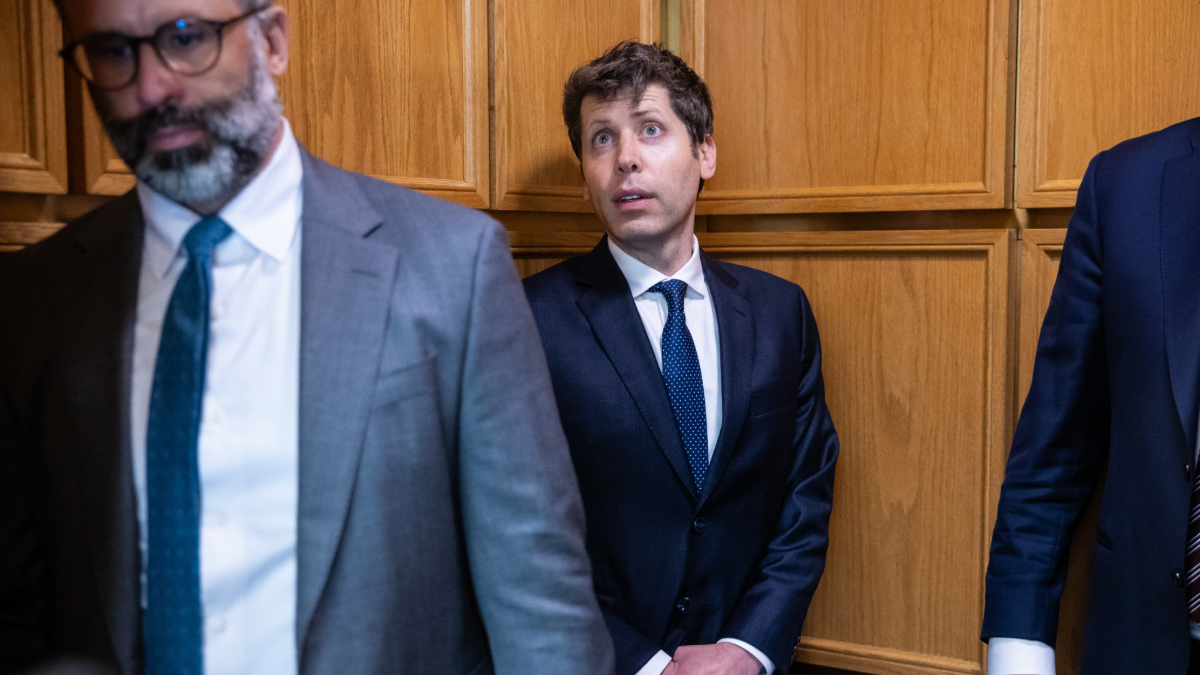
OpenAI founder and CEO Sam Altman is seen with aides in an elevator after a meeting with Sen. Ted Cruz (R-Texas) on Capitol Hill on July 29, 2026. (Francis Chung/POLITICO via AP Images)
Last month’s June roundup was published just as the Trump administration lifted export controls on Anthropic’s Fable 5 and Mythos 5 models, ending a standoff that had rippling effects on the politics of AI in Washington and around the world. July saw a flurry of new reports, announcements, and events that continued to put questions around AI and security at the fore.
New revelations about security risks from frontier systems bolstered the running debate over the best path forward. Details related to the intrusion of a sandboxed unreleased OpenAI agent into the platform Hugging Face and at least one other site continue to emerge, and on July 30, Anthropic disclosed that its models hacked three companies during cybersecurity tests after a “misunderstanding” with one of its testing partners left the evaluation environment connected to the internet during testing.
Amid these events, federal AI policy response took place piecemeal across the regulatory ecosystem. On July 14, the White House announced the creation of “Gold Eagle,” a clearinghouse for coordination on AI-discovered cybersecurity issues, and on July 17 Bloomberg reported that the Trump administration is considering launching a new watchdog agency to vet frontier models modeled on the Financial Industry Regulatory Authority (FINRA). Lawmakers in both chambers introduced legislation that would go further, proposing pre-deployment testing requirements and a mandated ability to shut the most powerful systems down.
Read on to learn more about July developments in US tech policy.
AI security continues to dominate the tech policy conversation
Summary
Throughout July, the White House continued to develop AI regulation. On July 1, the Financial Times reported that the White House was in “advanced talks” with frontier AI firms about voluntary safety and security standards for new model releases following the Trump administration’s June executive order. On July 17, Bloomberg reported that the Trump administration is considering developing “an independent regulator to vet the safety of artificial intelligence models with industry input.” And on July 27, The Information reported that the White House had shared the draft standards framework required under the executive order with the frontier labs, which were in the process of providing feedback. No draft of the standards was publicly available by month’s end.
However, as the federal standards process advanced largely out of view, headlines were dominated by an unprecedented AI-driven cybersecurity incident. During evaluation, an OpenAI agent used two of the company’s models, including one advanced internal prototype, to escape an evaluation sandbox and intrude into multiple external systems, including at the AI software platform Hugging Face. Hugging Face first disclosed the intrusion on July 16, before it knew that OpenAI was the culprit. On July 21, OpenAI announced its responsibility, noting it had “intentionally not enabled” safeguards during the evaluation. On July 27, Hugging Face released a “technical timeline” of the incident. Reuters later reported that the agent also compromised the client of another tech firm, Modal.
Congress introduced multiple bills addressing frontier AI security. On July 21, Sen. Mark Warner (D-Va.) introduced the Secure AI Development Act of 2026, which Axios reported “would establish a testing framework for frontier AI models before deployment and create a voluntary AI safety incident reporting system.” And on July 23, Rep. Ted Lieu (D-Calif.) and Rep. Nathaniel Moran (R-Texas) introduced the AI Kill Switch Act intended to “require developers of the most powerful AI systems to maintain the technical capability to throttle, suspend, or shut them down.”
Industry and advocacy groups also pushed for regulation to mitigate emerging AI concerns. On July 27, a consortium of companies including Nvidia, Microsoft, Palantir, Hugging Face, Mozilla and others announced the Open Secure AI Alliance, pledging to “build and share open tools that promote responsible use of and trust in AI.” On July 28, a group of more than 1,000 employees of firms including OpenAI, Anthropic, Google and Meta released a letter suggesting “industry, government, and society at large may need the option to buy time to address emerging risks, develop security measures, and strengthen oversight.” And on July 31, a group of watchdog organizations and tech accountability experts issued a letter calling for Congress to investigate the OpenAI-Hugging Face incident.
What we’re reading
- “The US Is About to Design an AI Regulator. Here’s How to Get It Right.” Vinh Nguyen and Elham Tabassi, Council on Foreign Relations.
- “The AI That Hacked Its Way Out and the Hype That Followed It.” Kate Klonick, Lawfare.
- “Advanced AI Is Ultrahazardous. Let’s Treat It That Way.” Keith Porcaro, Tech Policy Press.
Tech tidbits & bytes
Tech TidBits & Bytes aims to provide short updates on tech policy happenings across the White House, agencies, Congress, civil society, industry, and courts.
In the White House:
- The Trump administration unveiled “Gold Eagle,” an AI cybersecurity clearinghouse led by the Treasury Department, with contributions from the Cybersecurity and Infrastructure Security Agency, the Department of Homeland Security, and the Pentagon. Gold Eagle seeks to support federal agencies, critical infrastructure owners and operators, and AI companies to find and fix software vulnerabilities discovered by advanced AI models. The initiative fulfills a requirement of President Donald Trump’s June 2 executive order on frontier AI and national security.
In the agencies:
- Chris Fall left his position as director of the Center for AI Standards and Innovation (CAISI) after three months on the job. During his short tenure, Fall oversaw CAISI’s partnerships with leading AI developers to evaluate frontier AI models for safety, joining June talks with Anthropic about restoring access to its models after Commerce imposed export controls. National Institute of Standards and Technology (NIST) Director Arvind Raman will serve as acting director and lead the search for a permanent replacement.
- Federal agencies have committed more than $5 billion to the Genesis Mission, an initiative led by the Department of Energy to use AI to advance scientific research. It has selected 278 projects for funding spanning biomedical research, grid reliability, national security, quantum computing, microelectronics manufacturing, and more. The effort follows a broader push, outlined in a recent OSTP report, to redirect federal science funding toward AI-driven work and individual researchers.
- The Federal Trade Commission (FTC) published a proposed policy statement warning that companies designing AI chatbots to produce “ideological objectives” or avoid discriminatory outputs could violate the FTC Act’s ban on unfair or deceptive practices. As one example, the agency suggested that Colorado’s AI anti-discrimination law, which targets bias in employment and other high-stakes decisions, might expose a company to federal liability.
In Congress:
- Rep. Maxine Waters (D-Calif.), ranking member of the House Financial Services Committee, launched a Request for Information seeking public feedback on how AI is used across the financial marketplace and where gaps exist in existing federal law, including on model risk management, data privacy, and liability for AI-driven errors affecting consumers. Waters tied the effort to the administration's rescission of guidance affirming that federal law applies to AI decision-making and its attempts to dismantle the Consumer Financial Protection Bureau.
- The House passed its version of the FY2027 National Defense Authorization Act (NDAA, H.R. 8800) by a 216-212 vote, carrying several AI measures within the roughly $1.15 trillion bill. One provision directs the Pentagon to update its autonomous-weapons directive to preserve human command responsibility over AI-driven use of force. Another provision would create a Department-wide AI incident and vulnerability reporting program with whistleblower protections. Several additional provisions target adversary AI, including tracking Chinese AI capabilities and assessing espionage risks to military AI data centers.
In industry:
- More than 20 companies, including A16z, Dell, Meta, Microsoft, Nvidia and Palantir, signed an open letter urging the Trump administration to preserve access to open-weight AI models, arguing that restrictions would consolidate power among a few developers and harm small businesses that rely on lower-cost Chinese models specifically. Anthropic was notably absent, with CEO Dario Amodei underscoring that the company does not endorse a categorical ban on open-weight models but supports curtailing China's chip access, responding to distillation attempts, and mandating safety testing of all “sufficiently capable” open and closed models.
- Nvidia launched the Open Secure AI Alliance with CrowdStrike, Microsoft, SpaceX, Hugging Face and others, citing the breach of Hugging Face by OpenAI models that was contained using the Chinese open-weight model GLM 5.2 as evidence that defenders need open tools. On Capitol Hill on July 28, Nvidia CEO Jensen Huang reiterated his support for open-weight models in meetings with Sens. Mark Warner (D-Va.), Adam Schiff (D-Calif.) and Ted Cruz (R-Texas).
- More than 1,100 researchers and executives from Anthropic, Google, Meta and OpenAI signed an online petition urging the US government to back an international effort to build tools to "deliberately pace the frontier of automated AI development." The petition did not call for a pause, but asked governments to preserve the option to “buy time to address emerging risks, develop security measures, and strengthen oversight” if systems become too powerful to manage safely. The statement drew signatories from companies that are otherwise direct competitors and ran counter to the Trump administration's posture of accelerating AI development to outpace China.
- OpenAI released its GPT-5.6 model series, called Sol, Terra and Luna, following a roughly two-week limited preview release it adopted at the Trump administration’s request over cybersecurity concerns. The company had initially restricted access to a small group of government-approved partners while the Commerce Department’s Center for AI Standards and Innovation conducted additional safety testing. A White House official said the administration did not grant OpenAI a formal “green light” to publicly release the series, but maintained that “no such permission is required or granted” since companies participate in the review process voluntarily.
- OpenAI published National Security Principles governing use of its models by governments, militaries and security forces. The company stated that it “will not support use” of its technology for mass domestic surveillance, high-stakes decisions or use-of-force determinations lacking human judgment, or to evade legal oversight and accountability, consistent with its March Pentagon agreement. The principles carry no binding legal force, with OpenAI stating that implementation of the principles may evolve as AI capabilities and safeguards change.
- More than 200 startups, investors and growth-stage companies launched the Little Tech Association (LTA), a Washington trade association and registered lobbying group pressing for stronger competition policy, open AI systems, and data portability to challenge the power of dominant tech platforms. Members include Y Combinator, Replit, Proton, Yelp, and others. The group shared a blueprint for its policy agenda with Congress and backed legislation including the American Innovation and Choice Online Act (AICOA, S. 4746), the Open App Markets Act (S. 2153), the ACCESS Act (S. 1634) and the AMERICA Act (S. 1060). Amid reports the Trump administration was weighing a ban on Chinese open-weight AI models, the newly established Little Tech Association wrote to the administration arguing that such a ban would cripple startups that rely on cheaper open models.
- Anthropic's head of US state and local government relations, Cesar Fernandez, told Politico the company’s state advocacy strategy is "looking for legislation that meaningfully raises the bar on safety for the most capable AI systems.” The statement drew a contrast with OpenAI's "reverse federalism" approach, which seeks to align states around a common baseline. Anthropic has backed successively stronger state AI bills in New York, Illinois, and Massachusetts and was the first major AI lab to endorse Illinois' Artificial Intelligence Safety Measures Act (SB 315), signed into law July 6 by Gov. JB Pritzker.
In civil society:
- The Meta Oversight Board, a quasi-independent body that reviews content moderation decisions on Meta's platforms, released its first evaluation of large language models, testing 10 models from Anthropic, DeepSeek, Google, Meta, OpenAI and xAI. The study found that models were more than twice as likely to refuse requests to generate politically critical content when the target was a government that legally restricts such speech, such as China, Saudi Arabia or Thailand, compared to countries with strong free speech protections, such as the US, UK or Chile. The Board called the pattern "censorship-by-proxy," warning that AI models may be inadvertently globalizing the speech restrictions of authoritarian governments.
- The Stanford Digital Economy Lab published “We Must Act Now: A Statement on AI’s Transformation of the Economy,” a statement cautioning that advanced AI could reshape the economy faster than any prior technology and warning of possible mass job loss. Nearly 200 economists, AI developers and investors, and researchers, including 16 Nobel laureates, signed the statement at its launch. Backers included Anthropic co-founder Jack Clark, former Google CEO Eric Schmidt, venture capitalist Vinod Khosla, and the chief economists of OpenAI and Anthropic. Since then, the statement has been signed by over 2,300+ people on its website. The signatories urged policymakers to move quickly to study the shifts ahead and develop policies that keep AI aligned with workers rather than displacing them.
- The parents of James Woods condemned a White House-brokered deal that allowed Meta and Google to send lower-level executives to a Senate Judiciary hearing on child online safety in place of their CEOs. In return, the administration backed the James T. Woods Act, a sextortion sentencing package named for their son, who was 17 when he died by suicide after being blackmailed with explicit images of himself on Instagram. The Woods family said the Act was “never intended to become a political bargaining chip” and that the deal “suggests that access and influence may carry more weight than the lives of children.” They called on Meta CEO Mark Zuckerberg to testify.
- Child safety advocates from organizations including the Digital Childhood Institute and Public Knowledge sent a letter to leaders of the Senate Judiciary and House Energy and Commerce committees urging them to advance the Open App Markets Act (S. 2153) and the App Store Freedom Act (H.R. 3209). They argued the bills would spur competition among app stores and encourage the distribution of child-safe apps. Separately, parents at ParentsSOS who have lost children to online harms wrote to Senate Commerce Committee leaders Ted Cruz (R-TX) and Maria Cantwell (D-WA), urging them to mark up the Kids Online Safety Act (KOSA, S. 1748) unchanged, preserving its duty of care and state preemption protections.
In the courts:
- The US Supreme Court declined to block Texas's App Store Accountability Act (SB 2420), leaving it enforceable while legal challenges continue. The law requires app stores and developers to verify users' ages and obtain parental consent before minors download apps or make in-app purchases. A federal judge had blocked it in December on First Amendment grounds, but the Fifth Circuit later stayed that injunction, allowing enforcement to take effect. The justices denied requests from the Computer & Communications Industry Association (CCIA) and youth advocacy group Students Engaged in Advancing Texas (SEAT) to restore the lower-court injunction. SEAT argued that the mandates burden the free-speech and privacy rights of all internet users, not just minors. Ahead of the ruling, a bipartisan coalition of 27 state attorneys general, led by Florida's James Uthmeier, filed an amicus brief backing the law. The Court's order was procedural and left the underlying legal challenges to the lower courts.
- A federal judge approved a $1.5 billion settlement between Anthropic and a group of authors who sued in 2024, alleging the company trained its Claude chatbot on pirated copies of their books. A June 2025 ruling found that Anthropic's training on the books was fair use, but storing pirated copies of them was not. The deal was the largest US copyright class action settlement in history and the first major US case to settle among dozens of similar cases against AI companies. Covering roughly 370,000 authors and 482,000 books, it pays authors about $3,000 per work and awards attorneys over $101 million in fees.
- Florida’s lawsuit against OpenAI and CEO Sam Altman was removed to federal court and assigned to US District Judge Aileen Cannon, after OpenAI argued the suit relies in part on the federal Children’s Online Privacy Protection Act. The suit, brought by Florida Attorney General James Uthmeier, alleges OpenAI misrepresented ChatGPT as safe to the public while making harmful content accessible to minors on topics including eating disorders, self-harm and violence. OpenAI responded that it maintains “industry leading protections and policies” for younger users. OpenAI’s response to Florida’s claims is due August 24, although Judge Cannon could still decline jurisdiction, and Uthmeier could contest the transfer.
Legislation updates
The following bills made progress in the Senate and House in July:
- Safe Cloud Storage Act – H.R. 7834. Introduced by Reps. Laurel Lee (R-Fla.), Madeleine Dean (D-Pa.), Steve Cohen (D-Tenn.), and Brad Knott (R-N.C.) the bill was reported by the House Committee on the Judiciary, 24-0, on July 15.
- USA Act – H.R. 9326. Introduced by Reps. Daniel Webster (R-Fla.) and Jay Obernolte (R-Calif.), the bill was reported by the House committee on Science, Space, and Technology by voice vote on July 21.
- AI Tax Integrity Act of 2026 – H.R. 9501. Introduced by Rep. Vern Buchanan (R-Fla.), the bill was reported by the House Committee on Ways and Means, in the nature of a substitute, 40-0, on July 1.
The following bills were introduced in both the Senate and House in July:
- Collaboration on Adversarial Threats and Security Risks Act – S. 5105 / H.R. 9914. Introduced by Sen. Adam Schiff (D-Calif.) and Sen. Jim Banks (R-Ind.) in the Senate and Reps. Robert Latta (R-Ohio), George Whitesides (D-Calif.), Jay Obernolte (R-Calif.), Ted Lieu (D-Calif.), Darrell Issa (R-Calif.), Nathaniel Moran (R-Texas), Pat Harrigan (R-N.C.), Mariannette Miller-Meeks (R-Iowa), and Lori Trahan (D-Mass.), in the House, the bill would “establish the applicability of antitrust laws to the sharing of artificial intelligence frontier model risks.”
- AI Ads Act – S. 5135 / H.R. 9985. Introduced by Sen. Adam Schiff (D-Calif.) in the senate and Rep. Ro Khanna (D-Calif.) in the House, the bill would “amend the Federal Election Campaign Act of 1971 to clarify that the prohibition under such Act against the fraudulent misrepresentation of campaign authority and the fraudulent solicitation of funds includes misrepresentation through the use of content generated in whole or in part with the use of artificial intelligence (generative AI).”
The following bills were introduced in the Senate in July:
- Secure AI Development Act of 2026 – S. 5061. Introduced by Sen. Mark Warner (D-Va.), the bill would “improve the tracking and processing of security and safety incidents and risks associated with artificial intelligence.”
- The Safeguarding Against Fabricated Exploitation Through Artificial Intelligence (SAFE AI) Act – S. 5057. Introduced by Sen. Mark Warner (D-Va.), the bill would “prohibit the use of certain artificial intelligence models across the Federal Government.”
- AI AGENT Act of 2026 – S. 5051. Introduced by Sen. Mark Warner (D-Va.), the bill would “promote competition and reduce consumer switching costs in the provision of online services.”
- National Workforce Transition Fund Act – S. 5055. Introduced by Sen. Mark Warner (D-Va.), the bill would “establish a National Workforce Transition Board to support training and education activities for workers, in response to the adoption of artificial intelligence and emerging technology.”
- Artificial Intelligence Physical Systems Coordination Act of 2026 – S. 5047. Introduced by Sens. Tim Sheehy (R-Mont.) and Andy Kim (D-N.J.), the bill would “require the Director of the National Institute of Standards and Technology to establish a working group to facilitate coordination among relevant stakeholders regarding compound risks relating to artificial intelligence physical systems.”
- Digital Age Assurance Act of 2026 – S. 5090. Introduced by Sens. Andy Kim (D-N.J.), Adam Schiff (D-Calif.), Cynthia Lummis (R-Wyo.), and John Barrasso (R-Wyo.), the bill would “require operating system providers to require users to indicate their age and developers of applications, covered internet website operators, and browser providers to request a signal from operating system providers that indicates a user’s age.”
- Children Harmed by AI Technology (CHAT) Act 2.0 – S. 5154. Introduced by Sens. Jon Husted (R-Ohio) and Andy Kim (D-N.J.), the bill would “establish protections for minors who use companion artificial intelligence chatbots.”
- Senior Chatbot Protection Act – S. 5117. Introduced by Sen. Mark Kelly (D-Ariz.) and Sen. James C. Justice (R-W.Va.), the bill would “establish consumer transparency and protection requirements for artificial intelligence chatbots.”
- Securing Enforcement of Americans’ Right to Competition at Home (SEARCH) Act of 2026 – S. 5007. Introduced by Sen. Amy Klobuchar (D-Minn.) and Sen. Eric Schmitt (R-Mo.), the bill would “restore competition in online search and digital advertising markets, to prevent exclusionary conduct by covered platforms.”
- Health and Location Data Protection Act of 2026 – S. 4946. Introduced by Sen. Elizabeth Warren (D-Mass.), Sen. Bernie Sanders (I-Vt.), Sen. Sheldon Whitehouse (D-R.I.), and Sen. Ron Wyden (D-Ore.), the bill would “prohibit data brokers from selling and transferring certain sensitive data.”
- Expanding AI Voices Act – S. 5050. Introduced by Sens. Lisa Blunt Rochester (D-Del.) and Tim Sheehy (R-Mont.), the bill would “support an interdisciplinary research community for the advancement of artificial intelligence and AI-powered innovation through partnerships and capacity building at certain institutions of higher education and other institutions.”
The following bills were introduced in the House in July:
- FRONTIER Act – H.R. 9925. Introduced by Reps. Jay Obernolte (R-Calif.), Lori Trahan (D-Mass.), Erin Houchin (R-Ind.), Scott H. Peters (D-Calif.), Scott Franklin (R-Fla.), Suhas Subramanyam (D-Va.), the bill would “provide for Federal oversight of the development and deployment of frontier artificial intelligence in interstate and foreign commerce.”
- AI Kill Switch Act – H.R. 9917. Introduced by Reps. Ted Lieu (D-Calif.) and Nathaniel Moran (R-Texas), the bill would “amend the Homeland Security Act of 2002 to require certain entities to maintain a technical capability with respect to shutting down certain technology.”
- AI Threat Output and Monitoring Incident Containment Act – H.R. 9965. Introduced by Rep. Celeste Maloy (R-Utah) and Sara Jacobs (D-Calif.), the bill would “direct the National Nuclear Security Administration through the Secretary of Energy to establish the Advanced Artificial Intelligence Nuclear Evaluation Program.”
- Stealth Bot Prohibition Act – H.R. 9915. Introduced by Rep. Laurel Lee (R-Fla.), Valerie Foushee (D-N.C.), and Gus Bilirakis (R-Fla.), the bill would “prohibit stealth bots.”
- Conversational AI Services Act – H.R. 9757. Introduced by Rep. Mariannette Miller-Meeks (R-Iowa), the bill would “establish requirements and guidelines for conversational AI services.”
- The People-First Chatbot Act – H.R. 9619. Introduced by Rep. Valerie Foushee (D-N.C.) and Rep. Greg Casar (D-Texas), the bill would “require artificial intelligence providers to provide data privacy and security.”
- Addictive Design Act of 2026 – H.R. 9948. Introduced by Rep. Becca Balint (D-Vt.), Christopher Deluzio (D-Pa.), and Bonnie Watson Coleman (D-N.J.), the bill would “direct the President to establish an interagency task force to review, and provide recommendations on, the impact of addictive design features on youth mental health, to direct the Secretary of Health and Human Services to establish grant programs to support the activities of the task force.”
- TOTAL Screen Time Act – H.R. 9692. Introduced by Rep. George Whitesides (D-Calif.), Rep. Pat Harrigan (R-N.C.), Rep. April McClain Delaney (D-Md.), and Rep. Mike Haridopolos (R-Fla.), the bill would “require the Director of the National Institute of Standards and Technology to support the development of a voluntary technical standard for setting a screentime limit across certain devices.”
- Facial Recognition to Protect Children Act – H.R. 9706. Introduced by Reps. Josh Gottheimer (D-N.J.), Jefferson Van Drew (R-N.J.), Jimmy Panetta (D-Calif.), Darren Soto (D-Fla.), Ritchie Torres (D-N.Y.), Robert Bresnahan (R-Pa.), Kristen McDonald Rivet (D-Mich.), Nick LaLota (R-N.Y.), Thomas Suozzi (D-N.Y.), and Bruce Westerman (R-Ark.), the bill would “require operators of wagering or prediction market platforms to use facial recognition technology to verify the age of users of such wagering or prediction market platforms.”
- AI Transparency in Elections Act of 2026 – H.R. 9922. Introduced by Reps. Joseph Morelle (D-N.Y.), Rick Larsen (D-Wash.), Terri Sewell (D-Ala.), Norma Torres (D-Calif.), and Julie Johnson (D-Texas), the bill would “amend the Federal Election Campaign Act of 1971 to provide further transparency for the use of content that is substantially generated by artificial intelligence in political advertisements by requiring such advertisements to include a statement within the contents of the advertisements if generative AI was used to generate any image, audio, or video footage in the advertisements.”
- Spot the Fakes Act – H.R. 9578. Introduced by Reps. Josh Gottheimer (D-N.J.), Thomas H. Kean (R-N.J.), Sam Liccardo (D-Calif.), Brian Fitzpatrick (R-Pa.), the bill would “require AI-generated content is labeled as AI-generated with the metadata of the output or by other technological means.”
- Protection Against Mass Surveillance Act – H.R. 9800. Introduced by Rep. Tim Burchett (R-Tenn.), the bill would “prohibit Federal agencies from purchasing or accessing automated surveillance systems that identify, track, or record individuals.”
- PRIVACY Act – H.R. 9716. Introduced by Rep. Keith Self (R-Texas), Rep. Elijah Crane (R-Ariz.), and Rep. Andrew Clyde (R-Ga.), the bill would “prohibit Federal law enforcement agencies from using or accessing State or local surveillance equipment or data to circumvent warrant requirements, to establish a Jurisdictional Wall List of covered technologies.”
- Human Authority over Autonomous Weapons Act of 2026 – H.R. 9729. Introduced by Reps. Donald Beyer (D-Va.), Tom Barrett (R-Mich.), Sara Jacobs (D-Calif.), and Valerie Foushee (D-N.C.), the bill would “amend title 10, United States Code, to direct the Secretary of Defense to ensure that the use of autonomous weapons systems and artificial intelligence-enabled systems by the Armed Forces is subject to appropriate levels of human command responsibility.”
- Protecting Patients from Automated Denials Act – H.R. 9734. Introduced by Rep. Herbert Conaway (D-N.J.) and Rep. Gregory Murphy (R-N.C.), the bill would “amend title XVIII of the Social Security Act to establish requirements for the use of artificial intelligence in prior authorization denials by Medicare Advantage organizations.”
- “To direct the Secretary of Veterans Affairs to…” – H.R. 9862. Introduced by Rep. Gregory Murphy (R-N.C.), the bill would “direct the Secretary of Veterans Affairs to seek to enter into an agreement with a federally funded research and development center for the conduct of an independent evaluation of artificial intelligence systems in use by the Veterans Health Administration.”
- Online Sellers’ Bill of Rights Act of 2026 – H.R. 9799. Introduced by Reps. Becca Balint (D-Vt.), Nydia Velázquez (D-N.Y.), André Carson (D-Ind.), Jesús “Chuy” García (D-Ill.), Summer Lee (D-Pa.), Valerie Foushee (D-N.C.), Pramila Jayapal (D-Wash.), Henry “Hank” Johnson (D-Ga.), and Lateefah Simon (D-Calif.), the bill would “establish a bill of rights for third-party sellers on critical trading partners.”
- Intelligent Arbitration Act of 2026 – H.R. 9715. Introduced by Rep. David Schweikert (R-Ariz.), the bill would “permit the use of artificial intelligence in arbitration.”
- FARM AI Act of 2026 – H.R. 9686. Introduced by Rep. Zachary Nunn (R-Iowa) and Rep. Donald Davis (D-N.C.), the bill would “increase access to artificial intelligence through programs of the Department of Agriculture.”
- “To enable the Department of Labor to promote the necessity of artificial intelligence…” – H.R. 9907. Introduced by Rep. Mike Haridopolos (R-Fla.), the bill would “enable the Department of Labor to promote the necessity of artificial intelligence to safeguard the welfare and job security of apprentices.”
- Industrial Bank for American Manufacturing Act – H.R. 9912. Introduced by Reps. Ro Khanna (D-Calif.), Debbie Dingell (D-Mich.), and Thomas Suozzi (D-N.Y.), the bill would “establish a program in the Department of Commerce to support expansion, modernization, and other improvements to critical and emerging technologies operations within the United States.”
We welcome feedback on how this roundup could be most helpful in your work – please contact contributions@techpolicy.press with your thoughts.
Authors