June 2026 US Tech Policy Roundup
Rachel Lau, Shirley Frame, Ben Lennett / Jul 1, 2026Rachel Lau and Shirley Frame work with leading public interest foundations and nonprofits on technology policy issues at Freedman Consulting, LLC. Ben Lennett was managing editor of Tech Policy Press through June 2026.
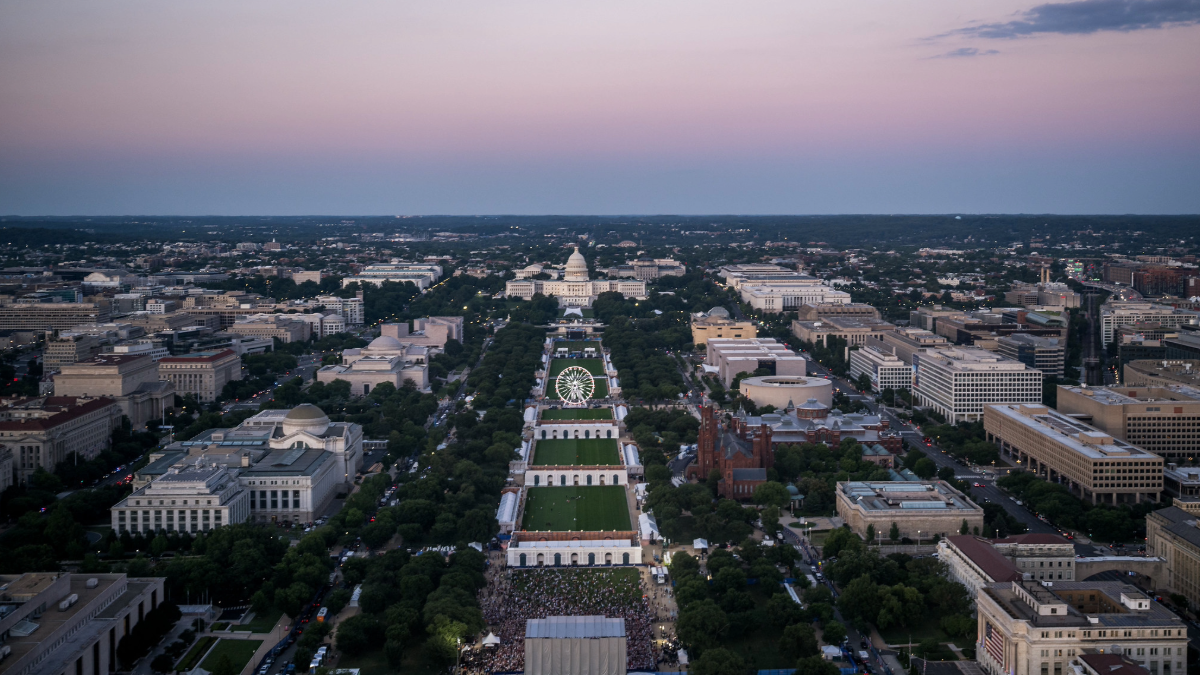
America 250 rally on the National Mall for the Great American State Fair. Wednesday June 24, 2026. (Official White House photo by Patrick B. Ruddy)
In June, US tech policy was marked by an unprecedented expansion of federal oversight over frontier AI, as the Trump administration signed an executive order calling on developers to submit advanced models for voluntary review, imposed export controls that forced Anthropic to remove public access to its Mythos 5 and Fable 5 models, and asked OpenAI to limit the rollout of its new GPT-5.6 family to vetted partners. The Anthropic export controls drew sharp pushback from a bipartisan group of congressional lawmakers demanding answers on the decision's legal basis, a federal lawsuit from legal technology firm Legion LegalTech, and civil society and AI policy experts who warned that ad hoc executive action could undermine US AI leadership. At the end of the month, the Department of Commerce fully rescinded the export controls but stated that it “reserves the right to reevaluate” in the future.
On the Hill, Reps. Jay Obernolte (R-CA) and Lori Trahan (D-MA) released a 269-page discussion draft of the Great American Artificial Intelligence Act. The bill would require the largest frontier developers to publish safety frameworks, undergo twice-yearly third-party audits, and report critical incidents to federal regulators, with penalties of up to $1 million per day for noncompliance. The draft bill also includes a three-year preemption of state AI laws specifically regulating AI model development, drawing criticism from civil society, AI safety advocates, and labor groups.
Separately this month, President Donald Trump signed National Security Presidential Memorandum 11 (NSPM-11), replacing a Biden-era directive centered on civil rights and privacy safeguards. The memo directs military and intelligence agencies to accelerate AI adoption and orders the Pentagon to update its primary policy on autonomous and semi-autonomous weapons within 90 days.
Meanwhile, on government surveillance, Section 702 of the Foreign Intelligence Surveillance Act (FISA) lapsed on June 12 after Congress deadlocked repeatedly over its reauthorization, though intelligence agencies are expected to continue surveillance under existing certifications through March 2027. The Supreme Court also ruled 6-3 in Chatrie v. United States that law enforcement's use of a "geofence warrant" to compel Google to turn over location data for cellphones near a crime scene constituted a search under the Fourth Amendment, a decision Justice Alito's dissent warned would "send seismic waves through our Fourth Amendment doctrine."
Read on to learn more about June developments in US tech policy.
Executive and legislative branches explore levers for federal oversight of frontier AI models
Summary
In early June, President Trump signed an AI executive order asking frontier AI developers to voluntarily submit their models to the federal government for review up to 30 days before releasing them to “trusted partners.” The order directed the Treasury Secretary, the Secretary of Defense, through the Director of National Security Agency (NSA), and the Secretary of Homeland Security, through the Director of the Cybersecurity and Infrastructure Security Agency (CISA), to develop a classified benchmarking process to identify and assess covered frontier AI models in consultation with the White House and other agencies. It also directed the agencies to establish an AI cybersecurity clearinghouse in voluntary collaboration with the AI industry and critical infrastructure operators. While formally voluntary, the order exceeded any prior federal intervention in the AI industry.
In a blog post responding to the executive order, Anthropic CEO Dario Amodei went further, proposing a mandatory third-party testing regime that would allow governments to block high-risk deployments across cybersecurity, biological weapons, loss of AI control, and autonomous self-improvement.
About two weeks later, the Trump administration imposed export controls on Anthropic's Fable 5 and Mythos 5 models after Amazon CEO Andy Jassy reportedly flagged a jailbreak in Fable 5 to Treasury Secretary Scott Bessent, who had taken the lead on the administration's response to Mythos. Anthropic CEO Dario Amodei refused senior officials' request to voluntarily withdraw the models, arguing that a "narrow potential jailbreak" falling short of a universal bypass did not justify pulling access broadly. When the administration imposed the controls anyway, Anthropic removed public access to both models globally, stating it had no way to selectively block foreign users or foreign national employees in real time. The company acknowledged governments should be able to block unsafe deployments but argued any such process must be "transparent, fair, clear, and grounded in technical facts."
The export controls drew widespread pushback. Legal technology firm Legion LegalTech sued the federal government, arguing the restrictions caused "immediate, irreparable, and existential" harm to its Canada-based developers. Brad Carson, president and co-founder of Americans for Responsible Innovation (ARI), warned that, "When ad hoc executive actions replace clear standards, America risks surrendering its lead in AI and allowing genuinely dangerous technology to be deployed." Dean Ball, the primary author of the Trump administration's July 2025 AI Action Plan and incoming head of Strategic Futures at OpenAI, said the government's approval requirements "change constantly and are always a secret, even to the administration itself."
On the Hill, a bipartisan group of four House members sent a letter to Commerce Secretary Howard Lutnick demanding answers on the export controls’ legal basis and the timeline for restoring access. A number of legislators said the ban could be an opening for legislation reclaiming congressional authority over AI regulation broadly. Rep. Lori Trahan (D-MA) argued the imposition of export controls underscored the need for durable federal congressional standards, stating: “the Trump administration is deciding company by company who gets access to the newest AI model. No law. No process. No oversight. Just appointees in Washington deciding who's in and who's out.'"
Earlier in the month, Trahan and Rep. Jay Obernolte (R-CA) had released a 269-page discussion draft, the Great American Artificial Intelligence Act (GAAIA), to require top frontier AI developers including OpenAI, Anthropic, Google, and Meta to publish safety frameworks, submit to twice-yearly independent audits, and report critical incidents to federal regulators, with penalties of up to $1 million per violation per day. The draft includes a three-year preemption of state laws specifically regulating AI model development, covering frontier safety laws in California, New York, and Illinois. However, it preserves state authority over AI deployment and use, as well as laws of general applicability like privacy, civil rights, and consumer protection statutes.
White House officials initially told WIRED they would only allow the models to be re-released if Anthropic guaranteed its guardrails could not be circumvented across all its frontier models — a bar security experts said may be impossible to meet. But after two weeks of negotiation, the Department of Commerce partially restored Mythos 5 on June 26 to roughly 100 vetted US companies, federal agencies, and national labs, and fully rescinded the export controls on June 30. In a letter to Anthropic, Commerce Secretary Howard Lutnick warned the department "reserves the right to reevaluate" if the company fails to meet its commitments. Anthropic said it has implemented a safeguard blocking the jailbreak that prompted the restriction and is developing shared jailbreak-severity standards with Amazon, Microsoft, and Google.
Near the end of the month, the Trump administration limited the release of OpenAI’s new GPT-5.6 family of models, which will now reach only a small set of US companies and organizations vetted by the White House. OpenAI had not planned to restrict the models but reversed course at the White House’s request, in consultation with the Office of Science and Technology Policy (OSTP) and the Office of the National Cyber Director (ONCD). In a leaked memo, CEO Sam Altman called the controlled release a departure from the company’s “preferred” method and said OpenAI hoped to develop a more “sustainable” approach with the government for future launches.
What we’re reading
- Merve Hickok, “Transparency and Accountability Gaps in Trump's New AI Executive Order,” Tech Policy Press.
- Justin Hendrix, “Anthropic's Mythos Recall and the White House's Missing AI Safety Playbook,” Tech Policy Press.
- Justin Hendrix, “Unpacking the Great American Artificial Intelligence Act of 2026,” Tech Policy Press.
- Alan Z. Rozenshtein, “A Kill Switch for Frontier AI,” Lawfare.
Tech tidbits & bytes
Tech TidBits & Bytes aims to provide short updates on tech policy happenings across the White House, agencies, Congress, civil society, industry, and courts.
In the White House:
- President Trump signed National Security Presidential Memorandum 11 (NSPM-11), directing military and intelligence operations to accelerate AI adoption and replacing the Biden administration's NSM-25, which had centered on civil rights and privacy in national security AI deployments. The memo requires agencies to terminate contracts with vendors that repeatedly limit lawful government use of their tools, which was widely read as targeting Anthropic's Pentagon dispute. However, the National Security Agency (NSA) reportedly retains access to Claude Mythos under an existing limited waiver. NSPM-11 also directs the Secretary of Defense to issue an updated version of the Pentagon's primary policy governing autonomous and semi-autonomous weapons (DOD Directive 3000.09), including requirements for human judgment before lethal force, within 90 days, with subsequent annual reviews. Civil society groups including the Electronic Privacy Information Center argued the memo's rhetorical civil liberties commitments are contradicted by the substance of its provisions. Meanwhile, two former senior national security officials writing for the Council on Foreign Relations urged Congress to codify the revised weapons autonomy rules, assurance and accountability mechanisms, and prohibition on unlawful domestic surveillance into the next defense and intelligence authorizations.
In the agencies:
- The Cybersecurity and Infrastructure Security Agency (CISA) issued a binding directive carrying out the Trump administration's June 2 executive order on AI cybersecurity. The new risk-based framework sorts software flaws by severity and gives federal civilian agencies 72 hours to patch the most dangerous ones, while less urgent vulnerabilities can be deferred. A flaw qualifies for the 72-hour track only when four conditions are met at once: it is reachable from the open internet, attackers are already exploiting it, those exploits can be automated, and a successful attack would give an outsider control of the affected system. CISA tied the shift to AI tools that are shortening the time between when a flaw is found and when attackers exploit it — Anthropic's Claude Mythos Preview, for example, identified more than 10,000 critical open-source flaws in a single month.
- According to Reuters, the Trump administration has delayed publishing additions to the Commerce Department’s Entity List, a trade blacklist restricting exports of US goods and technology, since October, the longest gap in more than a decade. More than 100 companies that were approved for listing by an interagency committee remain unpublished. Companies that remain unlisted despite these approvals include DeepSeek, the Chinese AI startup identified by Anthropic as having attempted to illicitly extract capabilities from Claude; Chinese firms that supplied drone components to Russia; and others accused of illegally acquiring restricted Nvidia chips. Commerce Under Secretary Jeffrey Kessler has reportedly delayed list updates to avoid escalating tensions with China.
- CIA Director John Ratcliffe announced that a broad overhaul of the agency's technology acquisition process, including a streamlined procurement framework and a new Office of Corporate Partnerships, has cut the time to field new technology from nearly three years to about six months, enabling nearly 400 acquisitions since its implementation. Citing recent operations in Iran and Venezuela, he said fielding frontier AI is critical and described its emerging capabilities as "akin to digital nuclear weapons."
In Congress:
- Section 702 of the Foreign Intelligence Surveillance Act (FISA) lapsed on June 12 after Congress failed to take action before the end of a 45-day extension passed in April. Senate negotiators were reportedly close to finalizing a three-year extension with modest reforms before President Trump's appointment of Federal Housing Finance Agency Director Bill Pulte as acting Director of National Intelligence (DNI) sparked Democratic opposition over Pulte's lack of intelligence experience and concerns he would weaponize FISA information against Trump's political opponents. Another short-term extension was stymied when the Senate blocked an extension on a 47-52 vote on June 5, and the House rejected a three-week extension 218-198 on June 11. Trump then nominated US Attorney Jay Clayton as permanent DNI but canceled his confirmation hearing days later. He also conditioned his signature of FISA-related legislation on the attachment of the SAVE America Act, a voter ID bill that is widely seen as a nonstarter in the Senate. Despite the lapse, intelligence agencies are expected to continue surveillance through March 2027 under existing certifications.
- Sen. Ron Wyden (D-OR) and 13 bipartisan legislators sent a letter to the Department of Defense (DOD) urging action to prevent adversaries from exploiting commercially available location data to track US military personnel. The letter cited an April US Central Command document confirming instances of such exploitation in active war zones. Lawmakers called on the DOD to disable unique advertising identifiers on military-issued devices, turn off location sharing in the field and shift personnel away from Google Chrome toward more secure browsers. The Pentagon said it would respond directly to the legislators.
In industry:
- OpenAI founder and Chief Executive Officer Sam Altman visited the White House to meet with lawmakers and officials about a possible government equity stake in the company. Under the proposed framework, OpenAI could donate equity to the federal government to seed a “Public Wealth Fund” that would allow citizens to share in the returns from AI growth. No official terms have been decided. Trump said he is meeting with AI companies in the near future to discuss arrangements where “the American public essentially becomes a partner with the companies.” Sen. Bernie Sanders (I-VT) also plans to introduce legislation to redistribute earnings from AI growth. His American AI Sovereign Wealth Fund Act seeks to impose a one-time 50 percent tax on top AI companies paid in stock, giving the federal government voting shares and board representation in the companies.
- OpenAI published a threat report identifying two clusters of ChatGPT accounts “likely originating from China” that generated content targeting US debates over AI data centers and tariffs. One operation, traced to an unnamed Chinese tech firm with provincial government contracts, amplified claims that data centers were raising household electricity costs. Another campaign criticized President Trump's trade policies. OpenAI said that neither campaign gained meaningful public engagement and stopped short of attributing the operations to the Chinese government. The report landed days after House Energy and Commerce Republicans urged the administration to initiate a federal probe of alleged Chinese influence behind US data-center opposition.
In civil society:
- Democratic organizers Shaunna Thomas and Leah Hunt-Hendrix launched the Guardrails Alliance, a new super PAC positioning itself as a populist counterweight to Leading the Future, an industry-backed super PAC that advocates for lighter-touch AI regulation. So far, Guardrails and its affiliated nonprofit have raised at least $5 million toward a $15 million goal, and spent $250,000 backing New York Assemblymember Alex Bores, who lost his congressional primary to fellow Assemblymember Micah Lasher.
- Retirement advocacy groups including the Alliance for Retired Americans, the American Postal Workers Union Retirees, and the American Federation of Teachers sent a letter to House Homeland Security Committee Chair Andrew Garbarino (R-NY) and ranking member Bennie Thompson (D-MS) urging them to investigate Meta over fraudulent ads targeting seniors in Medicare scams. The demand followed a May report from the Center for Countering Digital Hate, which estimated that Medicare scam ads from 30 of the most active accounts drew 215 million views on Facebook over the past year, most from users over 65, and earned Meta an estimated $14.3 million overall. Meta said it works with law enforcement to the best of its ability to aggressively remove scam ads.
In the courts:
- The Supreme Court ruled 6-3 in Trump v. Slaughter that the Federal Trade Commission’s (FTC) statutory protection against at-will removal of commissioners violates the separation of powers, overturning 90 years of precedent. Writing for the majority, Chief Justice John Roberts held that the FTC "unquestionably exercises executive power" and must answer to the president. The ruling upheld Trump's March 2025 firing of Commissioner Rebecca Slaughter and ended the FTC's statutory bipartisan structure. The decision carried outsized stakes for tech policy: the FTC oversees antitrust cases against Meta and Amazon and enforces the Children's Online Privacy Protection Rule (COPPA) and AI-related consumer-protection rules, and its leadership can now shift abruptly each term. The ruling also potentially jeopardized the EU-U.S. Data Privacy Framework, which relies on FTC independence to certify transatlantic data transfers, with privacy groups calling on the European Commission to withdraw the framework.
- The Supreme Court ruled 6-3 in Chatrie v. United States that law enforcement’s use of a “geofence warrant” to direct Google to supply location data for cellphones near a 2019 Virginia bank robbery constituted a search under the Fourth Amendment. The Court vacated the ruling and remanded the case to the Fourth Circuit to determine whether the search was reasonable. Writing for the majority, Justice Elena Kagan held that police intrude on a constitutionally protected privacy interest when they compel a tech company to turn over location data tied to someone’s phone, regardless of how narrow or brief the request. Justice Samuel Alito wrote a dissenting opinion joined in part by Justices Clarence Thomas and Amy Coney Barrett, warning the ruling would “send seismic waves through our Fourth Amendment doctrine.”
- In a suit brought by the League of Women Voters, the Electronic Privacy Information Center (EPIC) and others, US District Judge Sparkle Sooknanan blocked the Trump administration's attempts to overhaul a federal database by adding Social Security records and citizenship data and enabling bulk searches by state and local governments. Sooknanan found that the administration knew the data to be unreliable and that the database had violated privacy protections Congress enacted to prevent the creation of such a clearinghouse. While active, states had used the database to cancel the registrations of voters erroneously flagged as noncitizens.
- US District Judge Rita Lin declined to dismiss most claims that Workday’s AI-powered screening tools discriminated against job applicants. Lin allowed the case to proceed under California’s Fair Employment and Housing Act (FEHA), the federal Age Discrimination in Employment Act (ADEA), and the Americans with Disabilities Act (ADA), rejecting Workday’s argument that FEHA cannot reach out-of-state applicants because the company designed, operates, and controls the screening tools from its California headquarters. Lin dismissed a newly added race-based disparate-impact claim brought on behalf of Asian American applicants on procedural grounds. Workday called the claims false, saying its technology assesses only job qualifications and that customers retain control of hiring decisions.
- Florida Attorney General James Uthmeier filed a lawsuit against OpenAI, making Florida the first state to take legal action against the company over child safety concerns. The suit alleged OpenAI misrepresented ChatGPT as safe to the public while making harmful content accessible to minors on topics including eating disorders, self-harm and violence. Uthmeier argued these practices are unfair and deceptive under Florida consumer protection law. The suit followed a criminal investigation Uthmeier launched in April over ChatGPT's alleged role in a 2025 mass shooting at Florida State University. OpenAI and CEO Sam Altman could face billions in damages or penalties.
Legislation updates
The following bills made progress in the Senate and House in June:
- NO FAKES Act – S. 4591. Introduced by Sens. Chris Coons (D-DE) and Marsha Blackburn (R-TN), the bill advanced out of the Senate Judiciary Committee by unanimous voice vote on June 18.
- Digital Asset Market Clarity Act – H.R. 3633. Introduced by Rep. French Hill (R-AR), the bill was reported by the Senate Committee on Banking, Housing, and Urban Affairs, with an amendment in the nature of a substitute, on June 1.
- KIDS Act - H.R. 7757. Introduced by Reps. Brett Buthrie (R-KY) and Frank Pallone (D-NJ), the bill passed the House 267-117 on June 29.
- Romance Scam Prevention Act – H.R. 2481. Introduced by Rep. David Valadao (R-CA), the bill passed the House by voice vote on June 17.
- SBA Artificial Intelligence Utilization Act of 2026 – H.R. 8881. Introduced by Rep. Brad Finstad (R-MN), the bill passed the House by voice vote under suspension of the rules on June 23.
- Small Business Technological Advancement Act – H.R. 915. Introduced by Rep. Mark Alford (R-MO), the bill passed the House, as amended, 414-4 with one member voting present, under suspension of the rules on June 24.
- The House Committee on Science, Space, and Technology advanced ten AI-related bills at a June 25 full committee markup:
- AI Flaw Reporting and Security Enhancement Act – H.R. 9333. Introduced by Rep. Deborah Ross (D-NC), the bill would direct NIST, in consultation with CISA, to establish a voluntary program for reporting and tracking AI vulnerabilities and flaws.
- AI-Ready Federal Data Guidelines Act – H.R. 9341. Introduced by Rep. Brian Babin (R-TX), the bill would direct NIST to develop voluntary guidelines to help federal agencies prepare data, including open government data, for use in training AI models.
- AI Security and Innovation Act – H.R. 9363. Introduced by Rep. Jay Obernolte (R-CA), the bill would strengthen the federal government’s approach to securing AI systems and improve coordination across government and industry on AI risks.
- CREATE AI Act of 2025 – H.R. 2385. Introduced by Rep. Jay Obernolte (R-CA), the bill would establish a National Artificial Intelligence Research Resource to expand access to computing power and datasets for AI research.
- Data Infrastructure Energy Measurement and Standards Act – H.R. 9372. Introduced by Rep. Suhas Subramanyam (D-VA), the bill would direct NIST, in consultation with the Department of Energy (DOE), to improve how data center energy and water use are measured and reported.
- LIFT AI Act – H.R. 5584. Introduced by Rep. Thomas Kean Jr. (R-NJ), the bill would authorize the National Science Foundation to support AI literacy programs for K-12 students and educators.
- NSF AI Education Act of 2025 – H.R. 5351. Introduced by Rep. Vince Fong (R-CA), the bill would expand AI education and workforce training programs at the National Science Foundation (NSF), including scholarships, fellowships, and professional development.
- Protecting Consumers from Deceptive AI Act – H.R. 8893. Introduced by Rep. Valerie Foushee (D-NC), the bill would direct NIST to support research and standards for detecting, authenticating, and disclosing the origin of AI-generated content.
- READ AI Models Act – H.R. 6461. Introduced by Rep. Sarah McBride (D-DE), the bill would direct NIST to establish a pilot program developing voluntary resources, including standardized templates and technical guidance, for documenting AI models.
- Workforce for AI Trust Act – H.R. 9334. Introduced by Rep. Zoe Lofgren (D-CA), the bill would direct NSF to support AI fellowships and training and direct NIST to expand its AI workforce activities.
The following bills were introduced in both the Senate and House in June:
- Artificial Intelligence Environmental Impacts Act of 2026 – S. 4727 / H.R. 9183. Introduced by Sen. Edward Markey (D-MA) and Rep. Donald Beyer (D-VA), the bill would “require the Administrator of the Environmental Protection Agency to carry out a study on the environmental impacts of artificial intelligence data centers and associated energy infrastructure, to require the Director of the National Institute of Standards and Technology to convene a consortium on such environmental impacts, and to require the Administrator to develop a reporting system for the reporting of the environmental impacts of artificial intelligence, and for other purposes.”
- CONSENT Act – S. 4695 / H.R. 9155. Introduced by Sen. Brian Schatz (D-HI) and Rep. Jennifer McClellan (D-VA), the bill would “establish a private right of action against a person who transmits unsolicited intimate visual depictions.”
- Stop Spying Bosses Act – S. 4831 / H.R. 9402. Introduced by Sen. Edward Markey (D-MA) and Rep. Chris Deluzio (D-PA), the bill would “prohibit, or require disclosure of, the surveillance, monitoring, and collection of certain worker data by employers, and for other purposes.”
- Web of Biological Data Act of 2026 – S. 4770 / H.R.9307. Introduced by Sen. Todd Young (R-IN) and Rep. Matt Van Epps (R-TN), the bill would “require the Secretary of Energy to establish a centralized resource for access to data to facilitate biological research through enabling advanced computational methods such as artificial intelligence, and for other purposes.”
The following bills were introduced in the Senate in June:
- Secure and Accountable Military AI Act of 2026 – S. 4656. Introduced by Sen. Kirsten Gillibrand (D-NY), the bill would “provide for secure and accountable use of artificial intelligence by the Department of Defense, and for other purposes.”
- Human Authority in Lethal Operations (HALO) Act – S. 4697. Introduced by Sen. Adam Schiff (D-CA), the bill would “provide for design and safety requirements for autonomous and semi-autonomous weapon systems, and for other purposes.”
- SAFE KIDS Act – S. 4855. Introduced by Sens. John Curtis (R-UT) and Adam Schiff (D-CA), the bill would “require providers of certain artificial intelligence systems to implement child safety by design, parental settings, and independent audits, to prohibit child targeted advertising and the sale or sharing of children’s personal information, and for other purposes.”
- Fraudulent Artificial Intelligence Regulations (FAIR) Elections Act of 2026 – S. 4774. Introduced by Sen. Jeff Merkley (D-OR), the bill would “prohibit the distribution of false AI-generated election media, to amend the National Voter Registration Act of 1993 to prohibit the removal of names from voting rolls using unverified voter challenge databases, and for other purposes.”
- Generative AI Terrorism Risk Assessment Act – S. 4762. Introduced by Sen. Rick Scott (R-FL), the bill would “require the Secretary of Homeland Security to conduct annual assessments on threats to the United States posed by the use of generative artificial intelligence for terrorism, and for other purposes.”
- Justice Against Weaponized Bureaucratic Overreach to Networked Expression (JAWBONE) Act – S. 4749. Introduced by Sen. Ted Cruz (R-TX), the bill would “amend the Communications Act of 1934 to create a Federal cause of action to address jawboning, and for other purposes.”
- AI Bubble Transparency Act – S. 4743. Introduced by Sen. Elizabeth Warren (D-MA), the bill would “require the Office of Financial Research to compel data relating to the financing of artificial intelligence development, provide that data to Congress, and issue recommendations to financial regulatory agencies and Congress to mitigate financial stability risk, and for other purposes.”
- AI DATA Act – S. 4742. Introduced by Sen. Mark Kelly (D-AZ), the bill would “authorize certain labor market data collection activities and to improve Federal measurement of the workforce impacts of artificial intelligence, and for other purposes.”
- Combat Emerging Threats to Critical Infrastructure Act of 2026 – S. 4728. Introduced by Sen. Mark Warner (D-VA), the bill would “require the Director of the Cybersecurity and Infrastructure Security Agency to work with Sector Risk Management Agencies to update sector-specific plans, and for other purposes.”
- Responsible Artificial Intelligence Defense Act of 2026 – S. 4707. Introduced by Sen. Chris Coons (D-DE), the bill would “amend title 10, United States Code, to establish policy for the Department of Defense on maximizing autonomy and artificial intelligence systems, to establish requirements relating to Department review and verification of autonomous weapon systems and artificial intelligence capabilities, and for other purposes.”
- WARP Act of 2026 – S. 4683. Introduced by Sen. Mark Kelly (D-AZ), the bill would “require the Secretary of Defense to assess the effects of artificial intelligence integration on warfighter effectiveness, skill retention, and operational readiness, and for other purposes.”
- Ultimate Human Responsibility in Defense Systems Act of 2026 – S. 4682. Introduced by Sen. Mark Kelly (D-AZ), the bill would “establish requirements for human judgment in the use of force by autonomous weapon systems used by the Department of Defense, and for other purposes.”
- American Innovation and Choice Online Act – S. 4746. Introduced by Sen. Chuck Grassley (R-IA), the bill would “provide that certain discriminatory conduct by covered platforms shall be unlawful, and for other purposes.”
- Email Privacy Act – S. 4649. Introduced by Sen. Mike Lee (R-UT), the bill would “amend title 18, United States Code, to update the privacy protections for electronic communications information that is stored by third-party service providers in order to protect consumer privacy interests while meeting law enforcement needs, and for other purposes.”
- A bill to address the effects of artificial intelligence-enabled systems… – S. 4916. Introduced by Sen. Mark Kelly (D-AZ), the bill would “address the effects of artificial intelligence-enabled systems, including artificial intelligence chatbots, on older adults, and for other purposes.”
The following bills were introduced in the House in June:
- AI Tax Integrity Act of 2026 – H.R. 9501. Introduced by Rep. Vern Buchanan (R-FL), the bill would "require the Comptroller General to submit a report to the appropriate committees of Congress on the potential of artificial intelligence to assist the Internal Revenue Service in detecting tax fraud."
- AI Incident Reporting Act – H.R. 9477. Introduced by Rep. Nathaniel Moran (R-TX), the bill would “require certain artificial intelligence model developers to submit reports to the Secretary of Commerce, and for other purposes.”
- AWARE Act – H.R. 9381. Introduced by Rep. Tim Walberg (R-MI), the bill would “direct the Bureau of Labor Statistics to report on the usage of artificial intelligence in the workplace.”
- Artificial Intelligence Data Center Moratorium Act – H.R. 9442. Introduced by Rep. Alexandria Ocasio-Cortez (D-NY), the bill would “impose a moratorium on the construction of new data centers until legislation is enacted that safeguards the public from the dangers of artificial intelligence.”
- Voluntary Consumer AI Disclosure Pilot Act – H.R. 9439. Introduced by Rep. Zoe Lofgren (D-CA), the bill would “amend the National Institute of Standards and Technology Act to direct the Director of the National Institute of Standards and Technology to establish a pilot program and develop voluntary disclosure standards relating to the use of artificial intelligence systems by private sector entities, and for other purposes.”
- AI Workforce Impact Study Act of 2026 – H.R. 9427. Introduced by Rep. Valerie Foushee (D-NC), the bill would “direct the Comptroller General of the United States to conduct a study on the impacts of artificial intelligence on the workforce in the United States, and for other purposes.”
- AI-Related Job Impacts Clarity Act – H.R. 9352. Introduced by Reps. Steven Horsford (D-NV), Sara Jacobs (D-CA) and James Moylan (R-GU), the bill would “require reports regarding artificial intelligence-related job impacts, and for other purposes.”
- Department of Advanced Technology and Artificial Intelligence Act – H.R. 9323. Introduced by Rep. Luz Rivas (D-CA), the bill would “establish the Department of Advanced Technology and Artificial Intelligence, and for other purposes.”
- DHS Surveillance Technology Moratorium Act of 2026 – H.R. 9314. Introduced by Rep. Daniel Goldman (D-NY), the bill would “enact a moratorium on certain Department of Homeland Security contracts relating to the use and implementation of surveillance and data analytics technologies pending public audits and reporting requirements, and for other purposes.”
- Preventing AI Censorship Act – H.R. 9279. Introduced by Rep. Harriet Hageman (R-WY), the bill would “provide for a right of action against Federal employees for violations of First Amendment rights relating to the use or development of artificial intelligence.”
- Sectoral AI Governance Act of 2026 – H.R. 9125. Introduced by Rep. Sara Jacobs (D-CA), the bill would “authorize the head of agencies to issue rules related to the uses of algorithmic decision-making systems that are likely to materially contribute to violations of Federal laws that the agency is authorized to enforce, and for other purposes.”
- SLASH Prices Act – H.R. 9371. Introduced by Rep. Suhas Subramanyam (D-VA), the bill would “require disclosure when personalized algorithmic pricing is used, and for other purposes.”
- Protecting Student Privacy Act – H.R. 9134. Introduced by Rep. Emily Randall (D-WA), the bill would “amend the Higher Education Act of 1965 to ensure that personally identifiable information provided in the Free Application for Federal Student Aid is not used for immigration enforcement, and for other purposes.”
- Supporting Knowledge Through Industry-Led Learning (SKILL) Act – H.R. #. Introduced by Rep. Sam Liccardo (D-CA), joined by Rep. Jimmy Panetta (D-CA), the bill would use tax credits to spur private-sector investment in community college and public university programs that train students and dislocated workers for an AI-driven economy.
- A bill to establish a pilot program for use by US Customs and Border Protection… – H.R. 9566. Introduced by Rep. David Schweikert (R-AZ), the bill would "establish a pilot program for use by U.S. Customs and Border Protection at land ports of entry along the Arizona border to assess the use of artificial intelligence through an anomaly detection algorithm, and for other purposes."
We welcome feedback on how this roundup could be most helpful in your work—please contact contributions@techpolicy.press with your thoughts.
Authors