Iran’s Case Should Put an End to Illusions About Digital Sovereignty
Azadeh Akbari / Jan 15, 2026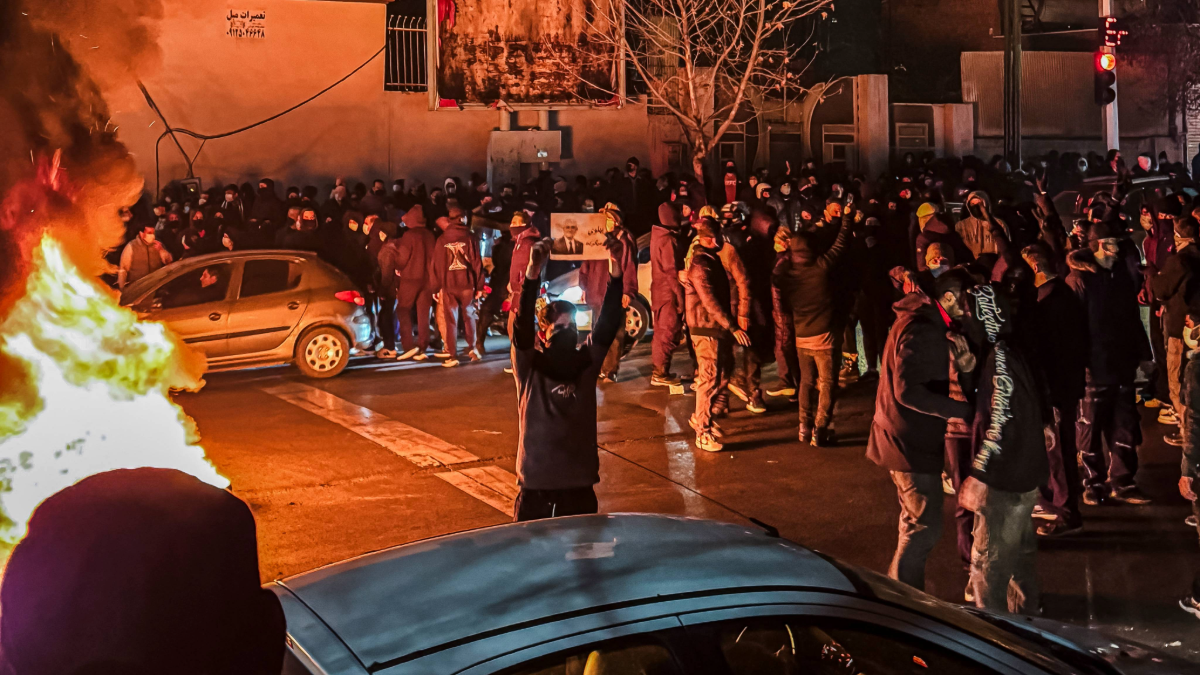
Iranians gather while blocking a street during a protest in Tehran, Iran on January 9. The nationwide protests started in Tehran's Grand Bazaar against the failing economic policies in late December, which spread to universities and other cities, and included economic slogans, to political and anti-government ones. (Photo by MAHSA / Middle East Images / AFP via Getty Images)
As I write this piece, the comprehensive shutdown of the Internet in Iran has entered its seventh day. With most other channels shut down — mobile networks, landlines, and messaging apps — communication has been reduced to what the state can tolerate and monitor. Since 13 January, Iranians have once again been able to call foreign numbers directly from inside the country. But these calls are prohibitively expensive in an already broken economy, and few assume the lines are private. Conversations are short, coldly vague, and hardly informative.
In an unprecedented escalation, the regime has been using military-grade electronic warfare to disrupt Starlink traffic across wide swaths of the country, while also physically identifying and confiscating Starlink dishes. Iran has given the word blackout a new meaning.
A group of Iranian digital rights and Internet freedom activists has written an open letter to the International Telecommunication Union (ITU) and the international Internet community. One might wonder what executive teeth these international organizations have, but our goal was not an appeal for help. We intentionally aimed to remind the international community how misleading and dangerous it is to give up on the idea of a free global internet and instead increasingly promote a concept of national digital sovereignty.
The ideas of digital sovereignty, internet sovereignty, technological sovereignty, and now AI sovereignty build on notions of sovereignty that underlie national ownership of technological firms and local innovation. The most well-known case of conceptualizing digital territory on a par with physical territory and pushing against the multistakeholder model of international governance systems was put forward and advocated by China. With the rapid growth of Big Tech in the United States, platform corporations’ current close involvement in US politics, and their massive pushback against regulation, digital sovereignty has gained new traction, especially in the European Union and BRICS countries.
The concept has also gained momentum amongst Indigenous and marginalized communities. In this conception of digital sovereignty, less emphasis is placed on the nation-state, while the concept’s emancipatory dimensions are foregrounded, emphasizing autonomy and independence. As much as such efforts were ignored, silenced, or co-opted, the current wave pushing digital sovereignty as the key to ending dependency on American and Chinese technology is negligent of its Eurocentric bias. Despite democratic and people-centred language, such initiatives basically imply one message: our nationalism is better than yours!
Our letter and our bitter experience of witnessing a massacre of protestors in Iran during the internet shutdown are a loud cry that the threat of market domination by the US and China should not convince us to give up the idea of a free global internet and a decentralized system of digital governance and infrastructure. The ITU, as the United Nations’ specialized agency for digital technologies, is mandated to facilitate and safeguard international connectivity. This mandate will not be achieved by a nationalist and nationally centralized system of internet governance. As we have written: A network designed to be global, open, and resilient is being reframed as something states can fragment, weaponize, and shut down at will. In the context of internet shutdowns, the debate over digital sovereignty has reached its limits: when states sever connectivity and kill with impunity, the priority can no longer be sovereignty but ensuring that people can remain connected and in control of their communications.
Over the past several years, the Iranian regime has built an increasingly sophisticated surveillance architecture that goes far beyond traditional internet censorship. At its core is the National Information Network, which effectively splits Iran’s digital space into two parallel realms: a domestic network and the global internet. To ordinary users, the two appear almost indistinguishable unless they try to access blocked websites and platforms. The domestic network, on which essential public services run and which banks and businesses are compelled to adopt, is aggressively promoted by the state. It is cheaper, faster, and more reliable, but also far more vulnerable to government monitoring and surveillance. By contrast, access to the global internet is at the state’s discretion and can be severed at any time, including during a political uprising.
This system has been steadily refined since the brutal suppression of the 2019 uprising. More alarmingly, these monitoring capabilities are now being reinforced through the rollout of mandatory digital identity cards. Required for routine activities such as obtaining healthcare or purchasing train and airline tickets, the cards are linked to biometric databases that can be cross-referenced with Iran’s extensive CCTV system. Together, they allow security forces to identify participants in protests almost instantly. It is therefore unsurprising that, in recent years and during the current wave of protests, protesters have routinely destroyed surveillance cameras in public spaces and covered their faces.
Add to this intertwined system of control and surveillance, the absolute power over centralized telecommunication systems. During the Women, Life, Freedom movement, it was revealed that mobile phone regulators have direct access to systems that allow them to track users’ locations in real time, monitor metadata, and interfere with mobile connectivity. Rather than relying solely on blunt internet shutdowns, the state can selectively slow data speeds, block specific users, or disrupt services in targeted areas, making repression less visible while remaining highly effective. Because SIM cards and devices are tightly linked to national identity information and unique device identifiers, switching SIM cards or phones offers little protection. Authorities can map social networks, identify protest organizers, and trace individuals’ movements before, during, and after demonstrations, turning ordinary telecommunications infrastructure into a powerful surveillance weapon.
These are some chilling examples from a country that has sent its researchers and digital policy experts to major international conferences to speak about localization, self-determination, sovereignty, and local law. Iran should be a conclusive case why digital sovereignty is not a solution to a rising trend of internet shutdowns in non-democratic or semi-democratic regimes, or a worrisome increase of private actors’ dominance over digital infrastructure, such as cloud computing services or satellite connectivity.
In both cases, we shy away from international responsibility for monitoring adherence to principles of human rights and democratic governance. Internet connection is a human right, and it should not be left in the hands of irresponsible governments or private actors. No nationalism is better than others and the danger of democratic backsliding is always present, even in the US and the EU.
Authors