Human Rights Should Still Matter When Countries Buy Tech That Kills
Petra Molnar / Oct 5, 2026Petra Molnar is a fellow at Tech Policy Press.
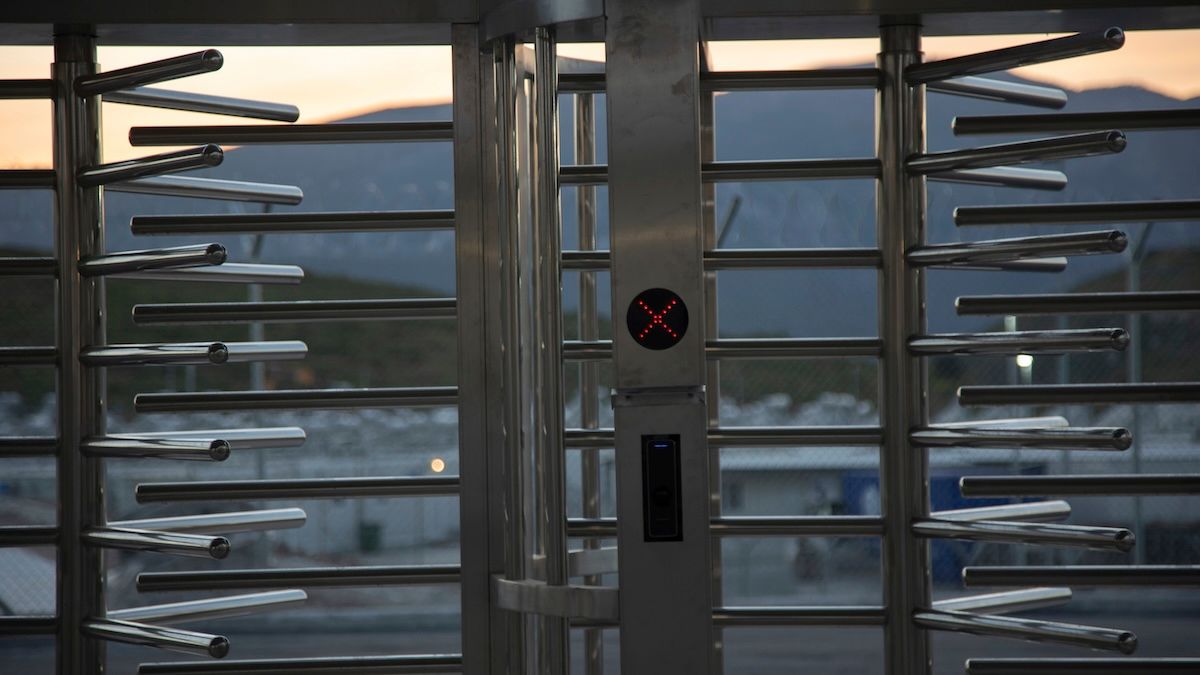
Biometric fingerprints and police screening are required upon exit and entry to the refugee camp on Samos Island in Greece. Photo from September 21, 2021 (Nicolas Economou/NurPhoto)
A sprawling refugee camp on the Greek island of Samos is carved into a sun-baked hillside, far enough from the main port town of Vathy that reaching a lawyer or a doctor’s office can take most of a day. Officially opened in 2021, it is ringed by barbed wire, heavy police presence and airport-style security checks. Despite its rustic appearance, this camp — as many others — is the site of high-tech systems to surveil and control residents. To enter or exit, people press a finger to a scanner and wait at a turnstile. Residents interviewed by the Greek nonprofit Homo Digitalis told of waiting more than an hour to pass, with one person saying that the biometric checks discourage them from leaving at all. There are cameras above the housing containers in the camp, though many residents were never told they would be filmed nor why.
The system watching the camp on Samos is called Centaur, and it feeds CCTV and drone footage through motion analysis software to a control room at the Ministry of Migration and Asylum in Athens. Two of the suppliers behind Centaur are Israeli companies: Viisights, whose behavior recognition watermark was visible on footage from the camp, and Octopus, which makes command-and-control software for CCTV networks. Both are substantially owned or funded by AWZ Ventures, and both have supplied Israel’s ministries of defense and public security.
At the end of August, Greece signed a $3.5 billion agreement with Israel for an integrated air defense architecture called Achilles Shield, the largest defense agreement in its history. Greece’s announcement contained a detail that connects to this hillside. The munitions and missiles — David's Sling, Rafael's Spyder and Barak MX — made the headlines, but what Greece also bought from Israel is a new architecture of surveillance: multi-mission radars and an AI-enabled command center. Israel Aerospace Industries, which will supply Greece's Barak MX batteries, also builds the Maritime Heron drones that the European Border and Coast Guard Agency, Frontex, flies over the Mediterranean to watch for people crossing.
Greece's deal comes at a time of regional conflict, which is part of the rationale for Greece’s purchase of air defense systems. However, the deal is eyed with apprehension by states opposed to Israel's war on Gaza — and perhaps (were they to be consulted) also by its own population which, according to a Pew Research survey from June, is largely distrustful of Israel’s prime minister, Benjamin Netanyahu. The core governance question is, should there be limits on an EU state's entitlement to buy weapons and surveillance systems from a government that a UN Human Rights Council Commission has found guilty of genocide? Currently, there are none.
European human rights conditionality scrutinizes what weapons member states sell to others, but falls silent about purchases. The EU AI Act places military and national security systems entirely outside its scope, despite how much AI technology is on the line. In other words, the Israel-Greece contract is constrained by neither.
The rights of people held captive and under surveillance at Europe's borders are also determined in this same regulatory gap.
As journalist Antony Loewenstein documents in The Palestine Laboratory, Israel’s export success is tied to its track record of using tech on a population under occupation. I have traced elsewhere how that logic travels from the checkpoints of the West Bank to the watchtowers of the Aegean and the Sonoran desert. Greece’s surveillance systems are pointed at people as well as aircraft.
In 2024, the Hellenic Data Protection Authority fined the Greek Ministry of Migration and Asylum €175,000 over Centaur and its biometric companion Hyperion. It was the largest penalty ever imposed on a Greek public body for failures including an inadequate impact assessment and inadequate information to people being monitored. The fine was trivial against a system reportedly worth €55 million in EU funds, and it changed little on the ground. However, for the people held in the Samos camp, the finding represented a route through which their rights could at least be represented in principle.
Greece’s data protection authorities could fine Centaur because it processes the personal data of people living in a camp. Meanwhile, EU authorities exclude defense and national security from their scope in Article 2(2) of the GDPR and in Article 2(3) of the EU AI Act. The border-industrial complex operates in this regulatory gap. Europe's most ambitious rights framework for AI would regulate a hiring algorithm in Athens, yet has nothing to say about a national system fusing sensor data and automated threat analysis, built by the architects of the technology of occupation.
The vocabulary European institutions have built around AI, with its language of proportionality, impact assessments and human oversight, stops precisely where the state's coercive capacity begins — which is where it was always needed most.
Since 2023, Spain, Italy, the Netherlands, Slovenia, Canada and others have suspended or banned arms transfers to Israel. The European Commission proposed suspending trade concessions created under an EU-Israel Association Agreement from 2000, a measure that as of April 2026, still lacked unanimous support, despite UN experts describing suspension as a minimum requirement under international law, and the UN Human Rights Council Commission having concluded in September 2025 that Israel was committing genocide in Gaza.
Every one of these instruments regulates what Europe sells and almost none regulate what Europe buys. It shows just how thoroughly the legal frameworks place the moral duty on the seller. In other words, whether it relates to Greece or any other EU country, human rights conditionality in European arms policy attaches to export licenses and not to procurement decisions.
In fact, Israeli defense exports reached $19.2 billion in 2025, with Europe purchasing 36 percent of the total. Sales of observation and optronics systems used for surveillance rose from 6 percent of Israeli defense exports in 2024 to 22 percent in 2025. Europe remains the largest regional buyer of the whole portfolio.
As a bare minimum, European states should apply human rights due diligence to defense and dual-use purchasing with the rigor they already apply to export licensing.
The two assessments ask different questions, which is why the criteria need adapting rather than copying across. Export licensing asks what a buyer will do with a weapon. Procurement due diligence asks what a purchase does for a seller, and in the case of Greece the answer is concrete: $3.5 billion flows to an industry whose systems are marketed on their performance in Gaza and Lebanon, at a moment when UN experts are urging states to confront their own inaction on the obligation to refrain from rendering aid or assistance in maintaining an unlawful occupation. European governments already demand this type of scrutiny of private companies under the UN Guiding Principles on Business and Human Rights, which treat a purchasing relationship as a channel through which a buyer contributes to harm.
With a crate of ammunition, you could argue that a seller has no influence on who is harmed after the sale. With high-tech weapons, this argument falls apart entirely. Achilles Shield will be delivered to Greece in stages over 35 months and will depend on Israeli firms for spares, training, software updates and the tuning of whatever counts as a threat. Greece has essentially bought a relationship of decades with these companies. That is also why the software, data-handling and update terms of these contracts, currently protected as commercial confidences, should be published. A state that cannot tell its people what its command systems do, or who else can see what they see, has outsourced more than procurement.
In Europe, the AI Act’s military exclusion should go. There is no principled reason why the systems with the greatest capacity to kill are the ones the EU has agreed in advance not to regulate. Any case for the carve-out collapses the moment military AI quite literally generates kill lists and tracks people to their homes. These are AI systems that help facilitate genocide in Gaza. Reopening the AI Act is politically unlikely, so what is needed is a separate binding legal instrument covering military and national security AI — written with the enforcement teeth that Article 2(3) currently withholds.The greater a system's capacity to kill, the stronger the case for regulating it. On Tech Policy Press, Afsaneh Rigot has written that violent technologies cannot be improved by better design for the people at the margins, and that such tech can only be bettered by abolition.
The people held behind biometric turnstiles on Samos; the Palestinians targeted by these systems in Gaza, and anyone else who may one day be targeted by the new Greek-Israeli defense tech are all at mercy of an apparatus that sorts people into ‘the watched’ and ‘the expendable’ in the border necrotechnics of life and death. The question that should be facing every country is not how to buy this surveillance and military architecture more responsibly, but whether to enter into these arrangements at all — especially with a government whose policies the International Court of Justice has found to breach the prohibition on racial segregation and apartheid, and which Amnesty International has documented as maintaining a system of apartheid against Palestinians. There is no version of European technology policy worth defending that is selective about whose human rights are worth defending within its borders — and beyond.
Authors