How the 'Censorship-Industrial Complex' Narrative Went From Fringe to Trump Policy
Justin Hendrix / Aug 23, 2026Audio of this conversation is available via your favorite podcast service.
This month, in partnership with Type Investigations, MIT Technology Review published a feature titled “How ideas of a vast censorship network moved from the online fringe to Trump policy.” It considers the emergence and impact of the narrative that revolves around the idea of the “censorship industrial complex,” and how a network of aligned right wing actors collaborate to build that narrative. It also details the impact on civil society groups and independent technology researchers who have been targeted with lawsuits, investigations, visa restrictions, and various forms of harassment for their work.
This week, I spoke to two of the authors of the piece about what they learned reporting it, and where the story might go next: Eileen Guo, MIT Technology Review senior reporter for features and investigations, and open source investigative reporter Gisela Perez de Acha.
What follows is a lightly edited transcript of the discussion.
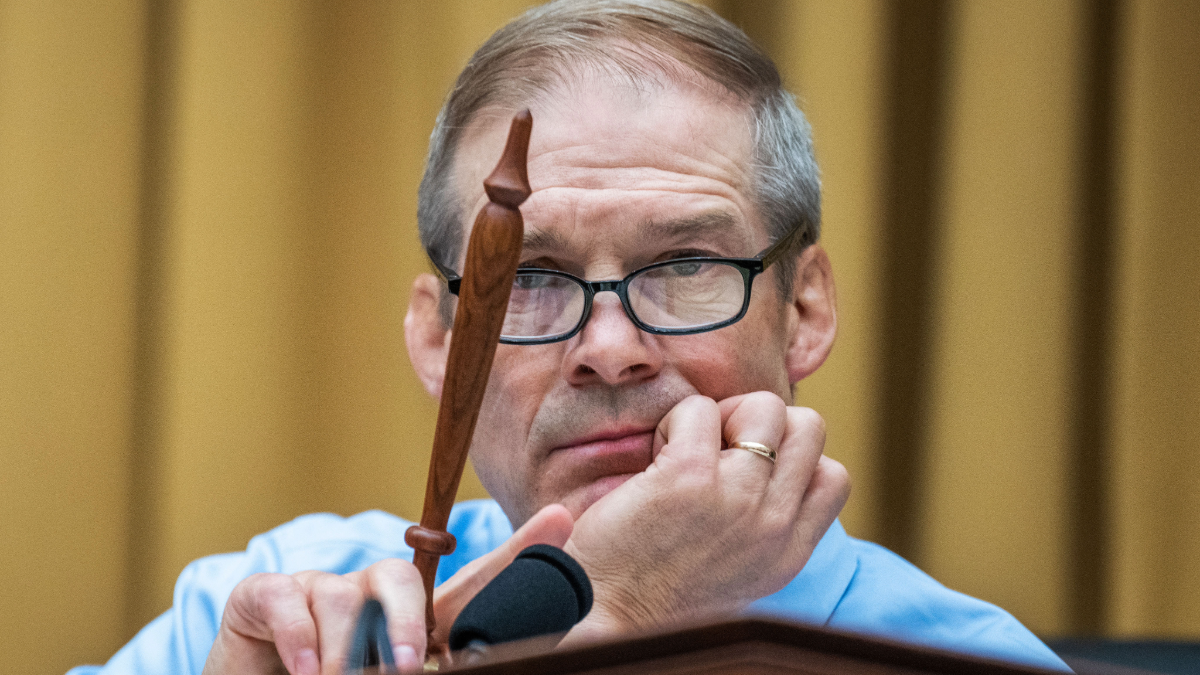
House Judiciary Committee Chairman Jim Jordan, R-Ohio, conducts the Select Subcommittee on the Weaponization of the Federal Government in the Rayburn Building on Thursday, July 20, 2023.
Eileen Guo:
Eileen Guo, MIT Technology Review, where I am a senior reporter for features and investigations.
Gisela Pérez de Acha:
I'm Gisela Pérez de Acha. I'm an OSINT investigative reporter.
Justin Hendrix:
I want to thank the two of you for joining me today to talk through this feature that you produced on the censorship-industrial complex. We're going to talk through some of the details of the piece and some questions that I have, after both reading it and following this issue for a few years.
But let me just ask to start… nine months of reporting, more than 100,000 social posts scraped, hundreds of thousands of pages of records. Give listeners just a shape of the scope of the undertaking.
What were you looking at? What made you decide that it warranted this effort in this moment?
Eileen Guo:
Maybe I'll just start with how this story came to be. It really came about, actually, even before those nine months that we've been investigating this.
Last April, I got a tip that this small office at the State Department that focused on monitoring and countering foreign disinformation was going to be shut down the next day. And that that office had long been accused of working at the center of this so-called censorship-industrial complex.
And I'm not a disinformation beat reporter, so I was really coming at it from my limited perspective. Important office is being shut down in the midst of all of these other DoD shutdowns. What's going on?
And the mention of this idea of the censorship-industrial complex, and the fact that it was being announced in an interview with a person that most people haven't heard of, including me at the time, named Mike Benz, really made me want to understand what's actually behind this.
How did it come to this moment that we're at? And just again, in the midst of everything else that's been happening since January 2025, where could this be going?
Justin Hendrix:
I want to get a little more into the implications, the effect that state and other parts of the government, for instance, but I want to stick a little bit just with the genesis.
I mean, I think one thing that's special here, you try to go back to the ideological origins as well as the events that led to what we can now think of as this meme around the censorship-industrial complex.
Walk me through that genesis. You trace language like ‘censorship industry’ on Twitter back to more than 15 years ago, and then you bring us up to date, the 2022, 2023 timeframe. What's the through line from 2011 to 2023 to today?
Gisela Pérez de Acha:
I'll let Eileen walk us through the through line, but I think it's really important to say that a lot of these conspiracy theories have been enacted as policy in the Trump administration, and it was important for us to figure out where this came from.
It was a massive effort. And one of the biggest challenges that we faced was actually that after Elon Musk bought Twitter, he ended all the free access to Twitter's API and making it prohibitively expensive for many researchers, us included, to really gain a full picture of what's happening in the platform.
A few years ago, I would just go to the platform and scrape and just get all of the censorship tweets. And now we just had to go around it and find creative ways and work with what we had, given all the roadblocks that Elon Musk had put for us.
Eileen Guo:
Yeah. And so we ended up looking at, I think, around 100,000 tweets, but had we had full access, we could have looked at a lot more.
And to tie that back to your question, I think we could have started this story also at so many different points because this narrative of censorship has been going on for a lot longer.
In our story, we really were focusing on three main historical events that led to the sense that maybe there was censorship in quotes going on. And I actually think that it's really important to talk about this idea of censorship and what is and is not censorship.
Because the way that we use it colloquially is just, it's not very precise and it's very different from the legal definitions of censorship, which are also not really defined in US law.
But the closest is the First Amendment protections of speech, which is specifically talking about the way that the government might be quote unquote "censoring" again, people.
So that's really important because a lot of what people that have been claiming that there has been a censorship industry, or a censorship-industrial complex, or the other types of phrases that are used are really conflating these ideas of legal censorship versus what is often happening, which is content moderation.
And so the three historical events that we start out the story with, and we discuss this, we call it in our story, the origins of this discontent, are in 2016 when Russian influence operations were pretty widely recognized as having a really big influence in both the US presidential elections as well as the UK's Brexit vote.
Obviously, there are a lot of events that led up to this, so it wasn't just this but it was this really important point and transition from this earlier period where everyone thought that the internet was going to be great for democratization and both of voices.
Anyone can have a voice as well as just the democratization process around the world to, "Well, actually it's not all that rosy and we need to think about content moderation and safety on the internet maybe in a more proactive way than we've done in the past."
And then in 2020, there was obviously the pandemic, which led to a lot of rumors and misinformation and just again, this period where there was a lot of distrust, there was a lot of polarization and different ideas about what we should be doing and what we shouldn't be doing.
And in both of these time periods, we had these big tech platforms that were taking on a much more active role in moderating what was on their platforms and also talking to government and other experts because they were recognizing that they had first let Russian disinformation or Russian information operations proliferate for far longer than they should have, and that something needed to change.
And then finally, the other thing that we talk about is in 2021 with the J6, the insurrection, which was itself driven by false claims that the 2020 election had been stolen. The sense that platforms needed to do more led to President Trump being removed out of fears that he was going to be stoking more violence.
And so all of these things led to this sense that there are certain viewpoints that are being removed at greater levels.
Justin Hendrix:
I want to get into what you've found about that, the extent to which those claims hold up. But I actually want to ask you just to maybe steelman the censorship-industrial complex argument a little more.
Out of that origin that you just described, where is the core concern? Where do you locate it? You talk about the grain of truth.
I think there are a lot of folks out there that may not necessarily agree with any of the details of the proponents of the censorship-industrial complex narrative, and yet they're sympathetic to the idea that there are reasons to be concerned that government, or platforms, or maybe some cabal of academics are somehow coordinating on content moderation in a way that's affecting politics.
How do you think about the most charitable, the best version of the argument that those folks are making or buying into?
Eileen Guo:
That's a really great question. I mean, I think that's such a great point because there is this widespread concern that is not partisan, that big tech and social media platforms have a lot of power that is often not very well explained about the content or the accounts that they are either removing or algorithmically boosting or not.
So I think that is something that is shared and with AI is increasing in new ways. But the censorship-industrial complex, this argument I think is actually more specific.
It's the idea that academics, civil society organizations, and big tech have all been conspiring to specifically remove conservative or populous speech and really at the behest of the Biden administration.
And that they're hiding their real purposes by saying that they're fighting disinformation, but then the people that believe in this or that are promoting it are seeing that again, to them at least, it seems to be affecting speech that they agree with.
Gisela Pérez de Acha:
I think another way to look at this or another way to explain this is content moderation decisions that at the time might've seemed right, acceptable, necessary, what we call that grain of truth. Information about the Hunter Biden laptop, this laptop that had alleged corruption information on Joe Biden and Ukraine, that was taken down.
And Jack Dorsey from Twitter later admitted that was a mistake. Mark Zuckerberg also talks about that. And that's something that the right has really held onto as the basis for them to prove the censorship-industrial complex.
And what's really fascinating as we were reporting this is the best conspiracy theories have that grain of truth. They have that content that was taken down, whether we want to call it censorship or not, whether social media companies are actually able to censor a state or not, that content was taken down.
And that's where the spiraling of the conspiracy campaign and the propaganda campaign starts. From that one thing that gets spun out of proportion into a cabal of academics, government, and big tech conspiring against right-wing speech.
Eileen Guo:
I think that's right. It's this idea that when something happens, then it gets applied to everything else. And that's the problem that we go from the actual facts to this is the vibe and policy is being made on vibes.
Gisela Pérez de Acha:
And then I think the term itself, it's so catchy. It's like if this were a marketing campaign, it would've been a right-on term to pick.
Because it comes from the military industrial complex, which is something that both the left and the right use a lot, feel very comfortable with in describing these alliances, I guess, between academia and government, an industry that brings something forward.
So the censorship-industrial complex has such a great ring to it already that I think that also contributed to the virality and how easily it was adopted through the internet.
Justin Hendrix:
Well, since you've used the term marketing to talk about this, maybe I'll ask you a little bit about where we've got to in more recent years and the extent to which pushing this idea of the censorship-industrial complex has on some level become a business.
Has become something that is supported by big money and is making money for the people who are pushing it. What did you find when it came to those types of questions?
Eileen Guo:
We found that there was this really big network of media organizations, of grant-making organizations, and then individual influencers like Mike Benz, who was the one to interview Marco Rubio, which we talk about in the start of the story that kicked all of this off.
And it's millions of dollars that are supporting various organizations that are behind this. And so it has become a really big business, and I can go into the network of how that looks if that would be helpful as well.
Justin Hendrix:
Give us some of the basics. What does it look like? How would you sketch it out for a listener who's unfamiliar with this network?
Eileen Guo:
So after President Trump's first term in office, a number of his former administration officials started these media and advocacy groups.
And so I mentioned Mike Benz, he started a group called the Foundation for Freedom Online, and we found him to be really the key player that has been talking about censorship. Since before he was using his own name, he used to have a podcast called Frame Game Radio where he was anonymous, but he was talking about censorship as primarily a Jewish phenomenon.
He was talking, at the time, about the ‘diversity-industrial complex’ and how all of these networks really needed to be taken down in order for, at the time they were talking about the alt-right still, so in order for the alt-rights ideas to be popular.
So there was Benz who served in the Trump administration for a very short period of time. There was Stephen Miller who started a group that became a really key part of all of this, America First Legal, which they pop up in a lot of other places.
But in the free speech and censorship space, they got a lot of the documents from the government that was then used by Benz and the Foundation for Freedom Online to make the argument and to provide the citations.
And then there were the media organizations, and in particular, John Solomon's Informing America Foundation that was giving money out to right-wing podcasts, including Charlie Kirk's podcast, John Solomon's podcast, Steve Bannon's podcast. They're all supported by these same networks.
And so we just found that they were mutually reinforcing and putting forth this idea that there is massive amounts of censorship against the right. And from there, these ideas kept getting picked up and cited in more mainstream places and then moving into policy. And that's where it really became dangerous.
Gisela Pérez de Acha:
What I think is also particularly interesting is that when we first set out to map the origins of the censorship-industrial complex, we thought that we might find a bunch of bots amplifying certain messages.
And when we actually got into the data analysis, it didn't look like bots at all. It looks like what you would've called organic content, but by what Eileen just described as a really big apparatus that is used strategically to amplify each other.
And they use it not only against. In the piece we mentioned the example of Cat Park, this video game that was used to train younger folks on spotting disinformation. And you see this playbook work against Cat Park in a really clear way.
First, the game comes out, then Stephen Miller's AFL files FOIA requests to get documents on the game. Then once they publish those documents, Mike Benz takes those documents and posts them on his organization.
And then after that, this entire Informing America Foundation ecosystem amplifies whatever Benz and AFL have put out, and then there's a congressional hearing where you mentioned Cat Park.
And it also has to do with the fact that the House became majority Republican, and that also gave a lot of political power to pick up these sorts of topics like that.
Justin Hendrix:
Yeah, I mean, I think that's one thing that we followed closely at Tech Policy Press over the last couple of years, Rep. Jim Jordan's (R-Ohio) committee in particular and the weaponization effort that they've led there to try to dig into this.
And it does seem like it's that kind of a cycle of we will find some new set of documents or unearth some new thing that we can hold up to the light.
And you see that cycle begin where some citations created by one of the characters in this network, it ends up in front of the committee, and then there's another round of discourse and attention to it after it gets surfaced in the committee.
I have to say that the last couple of hearings have really felt like a recycled concern. It's been difficult to, I don't know, get the sense that there's a lot of new material. I don't know. Do you have that sense at all that they are recycling the greatest hits rather than being able to churn out much that's new?
Eileen Guo:
Yeah, absolutely. I mean, if you look at Mike Benz's Instagram page, which I follow still, he's still talking about USAID, which was dismantled. He's still talking about the same things that they have been talking about for years. So I think that's right.
Justin Hendrix:
I want to ask you just a little bit now about the wreckage, some of the implications. I mean, you've already mentioned the R/FIMI or R/FIMI. There's things like the Global Engagement Center, CISA, the effects on the FBI. You mentioned USAID. Some of these are very consequential in terms of what the effect has been.
I find it very ironic on some level that some of the cuts at USAID have cut actual anti-censorship efforts that the United States government was engaged in abroad, working in Asia, working in Latin America, elsewhere, efforts to support digital rights activists and others who are contending with real and true censorship by authoritarian regimes.
But what else would you point to as a particular, I don't know, forms of impact that this narrative and the political power that's come behind it have led to?
Gisela Pérez de Acha:
What was really striking is to see this playbook in action, for example, against the Disinformation Governance Board, which we talk about in the story.
The shutdown of other disinformation-focused organizations like the Stanford Internet Observatory, the Election Integrity Partnership, and later government agencies like R/FIMI as well.
So it's all just so well coordinated against these handpicked organizations. And Eileen, maybe you can talk a little bit about the policy part.
Eileen Guo:
Yeah, I mean, I think Justin and Gisela, you both have spoken to it. I just want to highlight, I guess, two parts additionally, which is it's really affected not just domestic policy, but also foreign policy and foreign policy towards people that we have traditionally considered our allies.
Censorship concerns in Europe are not the only reason that there is this readjustment of how the US is looking at Europe, but it is part of it. So there have been attacks on the Digital Services Act, which is the EU's flagship attempt to regulate technology.
There's Mike Benz and Jim Jordan and others claim that it is the flagship censorship law. So there's that. There's this new effort, freedom.gov, which is trying to show the posts that are being taken down under the DSA.
So there's really this reorientation of what speech and regulation the US will or will not support around the world. And I guess what I want to say about that also is the second part beyond policy, which is that really has the potential to just affect everyone's experience of the internet.
And I think a thing that we couldn't get as much into in this case, but I think it's really important when we talk about censorship and free speech is that we, and certainly the people that believe or promote the CIC, they really focus on the rights of the person that is speaking or posting on the internet.
But especially in the European context, there is also the rights of the public, the public good. And so I think that's another piece of this that's really getting affected. A lot of the organizations, the researchers, the individuals that are being targeted by a lot of these policies, they're really working on online safety.
They're working on content moderation and making the internet just a better place for especially marginalized communities, for women that face a lot more violence online. And so all of this will just affect the experience of the internet and who matters on the internet essentially.
Gisela Pérez de Acha:
And also it's fascinating that you mentioned that, Eileen, because I am not American, I'm Mexican, and I'm coming to this piece with a completely different cultural background in terms of what's free speech is.
In the US, it's very famously free speech. There's this very famous court resolution which makes free speech equal to the free marketplace of IBS.
So in the US, where the majority of big tech and Silicon Valley companies are actually the law that they're operating under, it's this idea of the market of free speech will regulate itself and the best speech will win.
And it's interesting to see how all of the conversations about content moderation, the censorship-industrial complex, the European aspect of it are really just putting in question that very core First Amendment understanding of free speech is a free market where the best speech will win.
Where, actually, it might not actually be like that after all the time that we have on the internet.
Justin Hendrix:
I want to bring up another thing too, which you get into a bit, this idea that some of the people targeted in the censorship-industrial complex campaign, many of whom, by the way, quite close to Tech Policy Press, and then we publish researchers who've worked on problems of disinformation. Renée DiResta is on the board of Tech Policy Press. Tech Policy Press itself has fallen into the targets of some of the individuals who you've looked at for this article.
But an argument that I hear and that I am naturally sympathetic to, but I'll ask you about, is that this research itself, this effort to look at how false claims spread on the internet, how conspiracy theories, how hate speech, how other types of phenomena operate on the internet. That itself is speech. And that efforts to contain and diminish and intimidate the individuals who are conducting that research is in itself a form of or an attempted censorship, especially when of course it becomes supported by the government or by government policy or results in investigation or other types of negative impacts brought by government authorities.
And I don't know, it seems like to me that that's something we're now seeing born out in the courts most recently in this case around the Coalition for Independent Technology Research versus Marco Rubio and the visa bans that has come through recently. It's not a complete victory or a final victory, but it's been interesting to see how that's played out.
But I suppose I might just ask you about that, about what your reporting tells you about that. About the impact on the folks doing the work of mis and disinformation research, looking at these questions in universities and in other types of agencies that concern themselves with these things.
Eileen Guo:
Yeah, we don't get into it quite as much in this story, but I did actually write another story covering the lawsuit, and I've written and interviewed the two co-CEOs of HateAid, which was one of the organizations that has been targeted as part of the censorship-industrial complex and were subject to the visa bans.
And I think you are right, and obviously the judge has decided that some of the arguments are right about all of this being examples of censorship. And censorship in the sense that it is actually the government chilling speech as opposed to what we talked about earlier where it's private companies making decisions about speech.
So I think that's a really, really good point and also comes to both one of your original questions of why did we write this story now and also the conclusion that we came to.
Which is that it seems to be by the way that the proponents of the censorship-industrial complex have idea, have been talking about it for years, is they seem to be building their own censorship-industrial complex that is targeting their enemies. And we end the story with this really great quote.
Two years ago, there was this Heritage Foundation, a conference, and Mike Benz, who's central to our story, talks about the censorship-industrial complex having its hand on this quote unquote, "God button," and how it controls discourse on every political issue.
And then he says, "Democracy is about the hearts and minds of the people. If you can simply shut off the ability to influence hearts and minds through censorship, you win by default."
And so when we're going back to your question, Justin, about misinformation and disinformation research as being speech, if they want to stop it, censorship is the way to do it.
Justin Hendrix:
That's one thing that comes through in your work here. James Ball, who's a fellow at Tech Policy Press now, before he was a fellow, wrote a long piece for The Verge. I feel like comes to a similar conclusion on this, the extent to which this has turned right around and become a tool that the government is using, the Trump administration in particular.
I mean, you quote David Kay talking about the idea that we are probably facing the most substantial moment of censorship in the US in 100 years under this particular administration. So there's a deep irony here, and it really something that these claims of censorship are now effectively the scaffolding for very real censorship that is ongoing.
Let me ask you, maybe taking this forward, where do you think this goes from here? We've got a couple years left of the Trump administration, at least we'll see what happens. There's possibility that Congress will change its orientation a little bit later this year in terms of who has subpoena power.
What do you see for the near-term future of the censorship-industrial complex narrative? Where is it headed? What will be the impact over the next year or so? Can you forecast at all?
Eileen Guo:
Oof, that is always a tough question for investigative reporters. Let me answer it this way and then I'm curious, Gisela, what you think. Two things in terms of policy and action, and then just a general vibes check because that is important.
As you mentioned, the conversations, the inquiries into the censorship-industrial complex, they are continuing. Jim Jordan is continuing to hold hearings on European nonprofits that he claims to be part of the censorship-industrial complex.
I don't see many signs that that is going to stop just by the trend and the pattern of actions. But on the other hand, there are these fights against the label that I think are. And so I'm talking about the CEDA case, I'm talking about the NewsGuard lawsuit against the FTC.
So there's these fights that are challenging it in the courts, and I think it'll be interesting to see where those go. And generally, they seem to be recognizing that the censorship that was alleged as part of the censorship-industrial complex narrative, the arguments are typically falling apart.
So I think there will be this continued battle between the two sides. But I think the bigger challenge is the overall vibe of just massive amounts of distrust.
That's both where this all started in terms of distrust of what big tech was doing, increasing distrust now from the Europeans towards the US government, as well as just distrust that I think most people feel that big tech really is going to have our interests in mind, or really distrust that they'll make the right decisions.
So it's just this overall really hard place to come back from. How do you rebuild that trust really is, I think, the key question that I don't have an answer to.
Gisela Pérez de Acha:
I agree with everything that Eileen said, but the fact that the House majority might change will take away a lot of that power to both subpoena, but also to just amplify Informing America Foundation and Mike Benz into what looks like official policy, even though it's just a subcommittee.
But coming from the House, it has this allure of officialness that gives a lot of punch to the theory of the censorship-industrial complex. So if the House majority would change, I think that would be a very first big thing.
The second thing to me is, like I said before, I really think that the US is going through a very deep cultural rethinking on what free speech means and who has the right to speak and who doesn't. There's a lot other, we say that in the piece and Eileen just articulated it very well.
There are certain things that are prohibited in Europe or Latin America that the US hasn't necessarily gone through that process yet. I recently read a German free speech scholar say that the US hadn't gone through an authoritarian process that would make them rethink hate speech and free speech in the way that you guys are doing that.
So that to me is the biggest cultural takeaway of it all. How are we going to define censorship in the US given that that will impact how censorship is defined in social media around the world?
And then I can't help but think about AI. Are any of these decisions going to be encoded from if the Trump administration's already doing policy, are any of these decisions about what censorship means or doesn't mean going to be encoded into AI mechanisms that might or might not be content moderation, but just even chatbots?
And how will that affect the general public and our general sense of safety on the internet?
Justin Hendrix:
Tech Policy Press listeners aren't your average audience. They're folks who are also working on these issues, thinking about these issues, in some cases researching or writing about these issues.
Let me ask each of you, if there's something you would point them towards. Maybe a question that you still feel is unanswered by your reporting or something that you think is worth picking up and going to next.
If you had one thing you want to leave the listener with that might encourage them to continue the exploration of this topic, what would it be?
Gisela Pérez de Acha:
This project of tracing the origins of conspiracy theories that have been enacted into policy could literally be applied to a lot of other things.
I think there's a lot of things in the Trump administration right now that have become policy. And I would be really interested to see a lot more research on where did these ideas start and how they came to be what they are right now.
Justin Hendrix:
So this idea of the mimetic wave and how that eventually became policy decisions and/or, I don't know, personnel decisions or particular actions that the administration's taking.
Gisela Pérez de Acha:
100%. And there are so many methodological challenges in this that I would love to see super smart people getting on to research this and open source their methods in how they did it.
It's like disinformation research 2.0. We're not researching what... Disinformation research in the first place was like Russian, Chinese, maybe Iranian interference. Right now, I think, disinformation research 2.0 would be where did these ideas start? Where was their origin and how did we come to where we are right now?
Eileen Guo:
I think that's great. I don't know that I have that much to add other than that I read Tech Policy Press and I love what you guys do. I think you focus on these issues in a lot more depth. So continue to do that because we draw from it all the time, certainly.
Something that I don't get a chance to look at as deeply as I would like is just what do all of these policies and what do all of the responses to the Trump administration, in particular, when it comes to tech policy and disinformation and content moderation and really tech regulation, what that looks like in other parts of the world.
I think that's an area that deserves really close tracking, which I think you guys are already doing. So look forward to continuing to read that.
Justin Hendrix:
Absolutely. And I mean, I guess I'll just say too, back to the grain of truth. I mean, there is a censorship complex in the world, mostly established by governments.
And if you look at some of the superstructure that's been put in place in places like India, for instance, to deal with take down requests, or certainly in more authoritarian places like China or Russia, you can see a real censorship complex and you can see how these things might operate. I think they look very different from what's being described by the proponents of the censorship-industrial complex here.
But again, back to grain of truth, there is some concern, I think, that once you start to develop the sorts of technologies necessary to deliver content moderation in authoritarian context, that can easily be turned over and put toward work in more democratic contexts as well and may have unintended consequences.
So, I don't know, this is such a complicated topic.
Gisela Pérez de Acha:
It's such a complicated topic, and it was very challenging also to figure out how to approach it and how to define it. I think it's like a battle of definitions.
In all the different free speech theories around the world, the free speech is marketplace, there's obviously the people who are pro-censoring certain types of hate speech or the idea that free speech needs a limitation, it needs limits.
And what's really interesting in all of these conversations is that at the very end, it's like, okay, fine, but who's going to decide what's a limit? Who's going to decide where the line is? Who's going to enact that?
Because if it's a government, then the question is, which government? For a really long time, the government of the US, it was pretty acceptable for the government of the US to be making these decisions, at least for certain people, I guess. For others, not so much.
But if you go to authoritarian governments making these decisions, or then all of a sudden all the big tech Silicon Valley companies pledging allegiance to the Trump administration, the big question for me is who gets to decide?
If free speech needs limits, if not everything is a free fall, if the idea of free speech, the free market is being contested, what are those limits? But most importantly, those are an international law. Who decides how to implement those limits?
And that's a question that I feel like we're going to grapple for the rest of our lives as long as we're online, because it's not an easy question and it shouldn't be. We're establishing these new forms of free speech governance and maybe just a new way of becoming a civilized society online, whatever that means.
Justin Hendrix:
I think you're right. I think that's one of the things that drew me to tech policy to begin with was I feel like it's one of the places, one of the spaces where we are trying to decide who gets to decide, where the rules are being made up as we go. That still feels very right. I think your exploration here gets to that, so I appreciate it very much.
I'll just say for my listeners, if you're looking for this piece, again, it'll be in the show notes, but it is called “How Ideas of a Vast Censorship Network Moved From The Online Fringe to Trump Policy.” And Eileen, Gisela, thank you so much for joining me.
Eileen Guo:
Thank you so much for having us and for covering these issues.
Gisela Pérez de Acha:
Thank you so much.
Authors