How African Governments Use Information Control to Shape Election Outcomes
Liz Orembo / Apr 30, 2026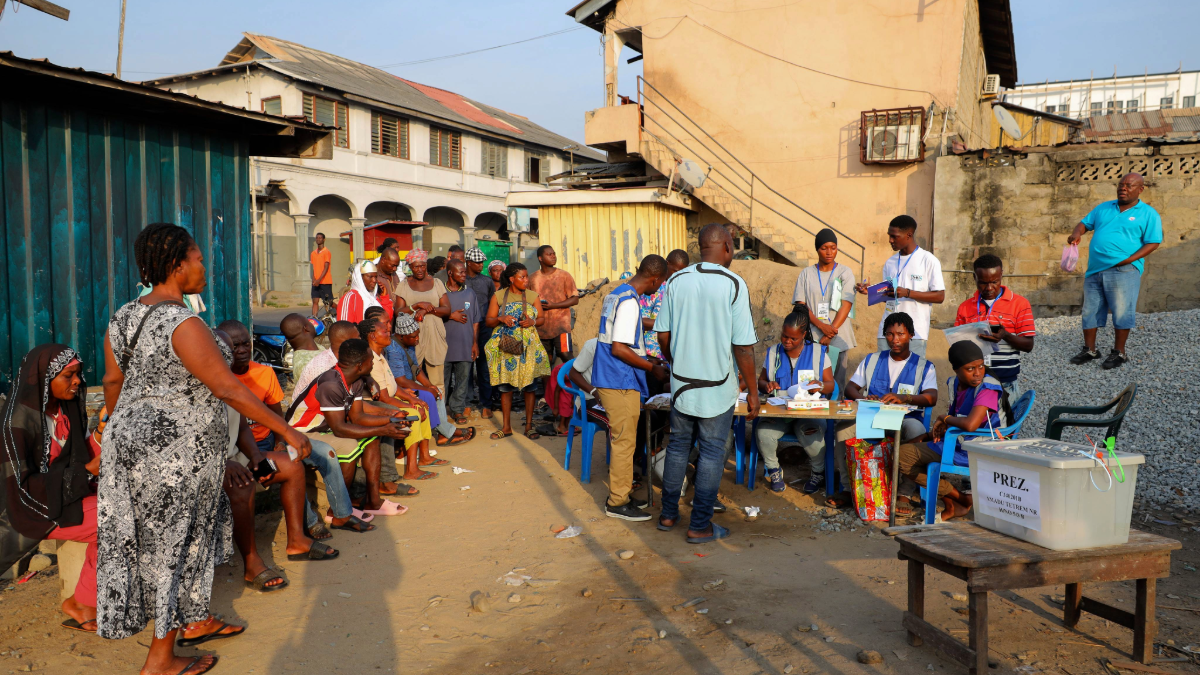
People line up before the opening of the polling stations to cast their ballot in the general elections in Accra, Ghana, Saturday, Dec. 7, 2024 (AP Photo/Misper Apawu)
Last month, the African Commission on Human and People’s Rights (ACHPR) issued a resolution expressing deep concern about widespread human rights violations in the context of elections. The commission called on African governments to cease all internet shutdowns, protect the independence of electoral bodies and counter disinformation through establishing robust monitoring systems and clear legal frameworks. Eleven more countries will hold elections in 2026 and this makes the resolution timely. However, the resolution and other related resolutions therein are insufficient because they address symptoms without naming the power structures and governance conditions that make those symptoms inevitable.
A number of African countries have power structures that worked to gain independence and take democracies through the first years post independence. These structures are now irrelevant 50 years later and in the era of the internet. The space for information is shrinking, not so much because information is scarce, but because governments undemocratically control information infrastructure. This power may be legitimate, as governments have a duty to ensure human rights and act in the public interest, but it doesn’t exempt them from accountability, especially when the line between governing and political interests begins to blur.
Two recent elections—in Ghana in December 2024 and Tanzania in October 2025—illustrate what that looks like in practice.
Ghana
Ghana's election was loud, messy, and polluted with false content at the two major parties—the New Patriotic Party (NPP) and the National Democratic Congress (NDC)—flooded social media with doctored images, fabricated claims, and attacks on the Electoral Commission's credibility. AI-generated content promoted candidates through fake endorsements. By any measure of content quality, the information environment was compromised while the digital environment remained open.
But the same conditions that allowed false claims to spread also allowed them to be contested. Both parties fact-checked each other relentlessly—not out of civic virtue, but because it was in their self-interest to do so. This didn't mean all misinformation was caught or debunked. The sheer volume of false content made comprehensive fact-checking impossible, so political players and independent fact-checkers alike prioritized the claims that mattered most, such as those with the potential to directly shift votes or damage reputations.
Stakeholder coalitions working on information integrity functioned in part because they relied on information flows that the state permitted to continue. Fact-checkers could access content, verify claims, and distribute corrections. Community radio could amplify accurate information in local languages. Detection platforms could flag problematic posts and route them to authorities. The work was imperfect, as fact-checks still travelled slower than the falsehoods that prompted them, but the environment was open enough for the work to be possible, and the distributed disinformation did not derail the election.
The lesson from Ghana is not that stakeholder coalitions solve everything, but that stakeholders can only function when the information environment remains open and information keeps moving. The free flow of information, even when that flow is polluted, creates conditions for the possibility of self-correction that closed environments cannot replicate. It also allows for higher levels of public participation during elections.
Tanzania
Tanzania had the same tools, the same frameworks, with the same dedication from stakeholder coalitions. Stakeholders trained over five hundred community fact-checkers across the country. Jamii Forums, the vibrant homegrown platform sometimes rivaling Facebook in local engagement, anchored a verification network rooted in community trust. Before its suspension, the platform demonstrated the same self-correcting dynamics visible in Ghana as politicians used it to counter each other's claims, leak damaging information about rivals, and to contest narratives they found threatening. Jamii forums had a network of fact-checkers distributed across the country, even in remote areas, for rapid fact-checking. It provided a platform that allowed open contributions and decentralized fact-checking, which could also evaluate claims by the government and politicians.
Which is precisely why it was suspended.
On October 29, 2025, the government imposed a total internet blackout lasting six days, covering the window when the results would be announced and disputes would emerge. Prior to the elections, stakeholders formed rapid response coalitions to tackle challenges on information integrity, and most of them, as in Ghana, ran through instant messaging channels like WhatsApp. However, due to the total internet shutdown, these coordination networks fell silent. Fact-checkers could not reach each other or their audiences. The African commission would later single out Tanzania in its March 2026 resolution expressing concerns on human rights violations.
Months before voting, the opposition candidate was jailed and denied the opportunity to campaign until it was nearly too late. On voting day, the news media could not report the low voter turnout due to some informal government directive. Journalists, even those trained and prepared, chose silence over the risk of prosecution and a climate of fear settled over the country.
Media houses, over ninety percent owned by politicians, amplified the ruling party's narrative, and the public watched an election where the outcome felt predetermined. When protests erupted, they were met with lethal force. Unarmed demonstrators were killed. Some tracked to their homes and shot. CNN reported a pregnant woman, fleeing plain-clothes police, was gunned down. The shutdown ensured that all this happened unseen, as none of this could be documented and shared in real time.
We often separate digital rights issues from offline governance structures, but the root cause enabling human rights abuse is a dominant and centralized power architecture.
Tanzania operates a dominant-party system where the presidency and the ruling party wield enormous constitutional power. Election results, once proclaimed by the electoral management body, cannot be contested in court. This is written into the constitution.
Fragile rule of law meets digital public infrastructure
Winner-takes-all systems in countries with high levels of social and economic inequalities produce these dynamics. When electoral victory means total control and defeat means total exclusion, the stakes become existential. Governments will use every tool available, including infrastructure control, to maintain power. Legal frameworks that might constrain such action do not exist, or exist only on paper.
Ghana's relative openness was not inevitable but reflected a political context with mature institutions that ensured some level of accountability in how the state controlled information flows. The contest remained within legal and democratic bounds, although media stations were partisan. Tanzania's shutdown reflected a system where the state could control information flows when threatened; the contest had exceeded those bounds, or where the bounds were wide enough to accommodate genuine competition.
The lessons from Ghana and Tanzania call on us to rethink democracy and open participatory governance amid the wave of new digital technologies. Without open and participatory governance, resilience strategies become survival tactics for civil society operating under authoritarian constraint, yet the current models that served most African countries when seeking independence have become the very threats to Africa’s growing democracy and prosperity. Fact-checking and media literacy matter, but they cannot compensate for structural closure.
The stakes are widening.
African governments are acquiring unprecedented visibility over their citizens through digital public infrastructure. DPIs: digital identity systems, centralized databases, and integrated payment platforms are being marketed as essential public infrastructure, akin to roads or electricity grids. Development partners and technology advocates push African countries to embrace DPIs in their tech stack, promising efficiency, inclusion, and modernization.
The promises are real. So are the dangers.
While no incidents of DPI data abuse have been reported in Ghana or Tanzania so far, the data held on government platforms continues to grow—and so does the obligation on tech companies to hand it over on demand. Already, there are patterns of state abuse of DPI and DPG data elsewhere in Africa. In Kenya, Safaricom's infrastructure was reportedly used to track activists during the Gen Z protests, and the surveillance mechanisms have often involved the data used while citizens purchase electricity tokens.
Tanzania, Kenya, Uganda: the pattern repeats. Governments are digitizing social and economic activities, centralized records are accumulating, and AI tools provide new lenses to analyze populations. This infrastructure of surveillance is expanding under the language of development and inclusion.
DPI can serve the public good. But it require democratic safeguards that most African countries do not yet have. Data protection commissions exist in some countries but lack independence or enforcement capacity. When authoritarian governance meets expanding data infrastructure, the combination is dangerous. States that can already shut down information flows during elections are acquiring detailed knowledge of their citizens, where they live, how they move, what they earn, and who they associate with. Visibility becomes one-directional. The state sees everything. Citizens see only what the state permits.
What can be done?
While the ACHPR resolution points in the right direction when calling on states to allow opposition parties to campaign freely, to protect electoral bodies from political interference and to cease all interruptions of internet access during election periods, the resolutions are directed at the same governments committing the violations, and they rely on voluntary compliance of these states that have already calculated that the stakes of non-compliance are low.
Building resilience matters. Stakeholders must continue with civic education, even and especially when political tensions are low, so that citizens understand their relationship to the state before a crisis hits, and what's at stake with the increasing datafication and digitization. Critical information should be pre-positioned through radio, print, and community networks that survive digital shutdowns. Long-term resilience-building strategies must also include building regional networks of support for regional accountability.
But resilience is not the end goal.
The end goal is democratic constraint on unaccountable state power over information. Democracies need constitutional frameworks that guarantee the right to access information, and that cannot be suspended by executive orders unless the suspension is proportionate, lawful, consistent with international human rights standards, and accompanied by clear democratic safeguards. African citizens must demand electoral systems in which outcomes can be contested through legal channels, creating opportunities for public interrogation of the election process. And they must fight for governance structures where power is distributed, not concentrated, and where no single actor can flip the switch.
This piece draws on research conducted by Research ICT Africa in partnership with International Media Support and local stakeholders in Ghana and Tanzania.
Authors