Google's AI Governance Plan Draws the Boundaries of What Counts as Harm
Gregory Gondwe / Aug 3, 2026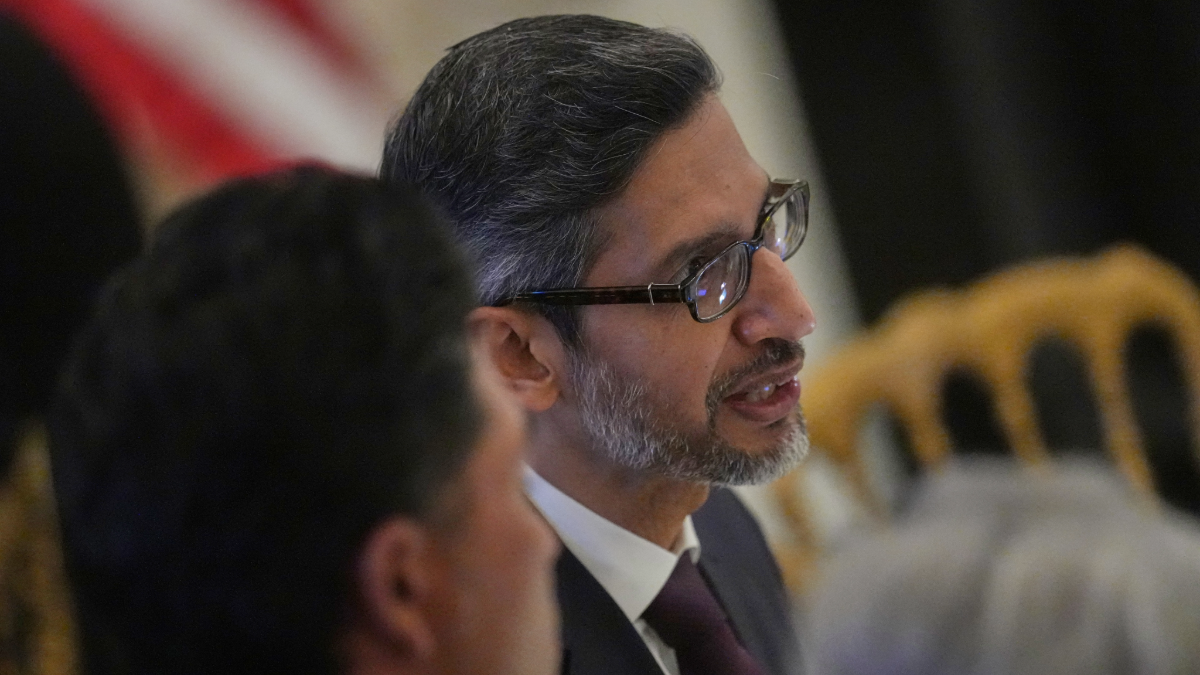
Google CEO Sundar Pichai talks before a dinner with President Donald Trump and Japan's Prime Minister Sanae Takaichi in the State Dining Room of the White House, Thursday, March 19, 2026, in Washington. (AP Photo/Julia Demaree Nikhinson)
In June 2026, Google published a new policy position intended to influence US debate over artificial intelligence regulation. In “A Pragmatic Approach to AI Governance in America,” the company rejects both overly restrictive rules and an unregulated "Wild West." It instead offers what it calls a practical middle path. Parts of the proposal are unsurprising. Google worries that powerful models may assist serious cyberattacks or dangerous biological research. The company believes government agencies need experts who can evaluate these systems. Children need protection from manipulative chatbots, the document says, while data-center growth raises questions about electricity, water, and public infrastructure.
But Google's most important move is easy to miss. The document divides AI harm into two categories. One category is treated as exceptional and therefore deserving of a new regulatory institution. The other is presented as familiar enough to remain largely within the legal and regulatory system that already exists. This division is intended to shape what lawmakers should focus on. It is an attempt to frame governance priorities by classification, or the power to shape regulation by deciding which harms deserve special attention and which appear familiar. Reading through the lines, it appears that Google is not only recommending rules; it is helping define what counts as an AI problem.
Why Google wants a special regulator for frontier AI
Google uses frontier AI to refer to the most advanced models—systems capable of creating serious national-security or public-safety risks. It proposes a Frontier AI Regulatory Organization, or FARO, funded by industry, supervised by a federal agency, and governed by independent and industry representatives. FARO would set safety standards, review company procedures, and oversee audits before frontier models are released. It would pay competitive salaries to attract technical specialists. Google presents this as a middle path between slow bureaucracy and unchecked corporate self-regulation, building partly on Google DeepMind's Frontier Safety Framework, which sets thresholds for identifying especially dangerous model capabilities.
The attraction here is clear, given that regulators cannot oversee technology they do not understand. Yet the regulated companies would help fund FARO, provide much of its knowledge base, and sit within its governing structure. This does not guarantee failure, but independence would need to be protected and not assumed. The concern is heightened when Google says FARO should balance safety with innovation and "speed to market in a global race." A regulator should be able to delay a system when evidence is incomplete. If speed is also a national priority, however, caution can be portrayed as a threat to US competitiveness. A company's release schedule can quietly become part of the national interest. Google also supports giving the federal government early access to models with advanced national-security capabilities, following the administration's executive order on advanced AI innovation and security. This may improve preparedness, but it also brings leading AI companies and national-security institutions into a closer relationship.
How AI harms become less visible
For common systems such as chatbots and automated decision tools, Google says the government generally does not need a new regulatory system. Existing consumer, employment, privacy, and copyright laws can be applied or updated when specific harms appear. That sounds practical if we assume that fraud and discrimination do not become legal because AI is involved. But the reality is that many forms of AI power do not appear as one clear violation. They develop gradually through dependency and repeated decisions.
The difficulty is that most existing laws are designed to identify a specific act, a clearly injured person, and a responsible institution. AI systems often complicate that sequence in that harm may be distributed across several companies, data sources, software tools, and human decisions, making it difficult to determine where responsibility begins or ends. A person may experience exclusion, reduced visibility, or economic loss without being able to point to one decision that clearly violated the law. By the time the pattern becomes visible, the technology may already be deeply embedded in the institution, and those affected may have little practical ability to challenge it
Consider a local newsroom. Search engines and chatbots may summarize its reporting, reduce visits to its website, and weaken advertising income without clearly copying one article. In a workplace, managers may use automated tools to rank applicants, assign shifts, monitor performance, and recommend dismissals. Each decision may seem small, but together they change who holds power and who can challenge it. This is why the distinction matters. Cyberattacks and biological threats are dramatic and easy to imagine. Routine systems are less spectacular, but they can still reshape education, employment, journalism, culture, and public knowledge. Familiarity can make their power harder to see.
Copyright: a choice that not everyone can exercise
Copyright is one of the clearest places where Google’s language of choice conceals unequal power. In principle, creators can decide whether their work should be used to train AI systems. In practice, however, exercising that choice requires knowledge, technical capacity, and bargaining leverage that many creators do not possess. The issue is therefore not simply whether an opt-out mechanism exists, but whether people can realistically discover that their work is being used, understand the available protections, and act before its value has already been absorbed into a commercial system.
Google argues that training AI on publicly available material can qualify as fair use. It also supports tools allowing website owners to restrict automated use. A document cited in the white paper explains its approach to creative content and AI training and points to licensing and other forms of "value exchange" with creators. These options have value, but not everyone can use them equally. A large media company may have lawyers, engineers, and bargaining power. A freelance journalist, community newspaper, local artist, or small African publisher may not know its work entered a training system, much less have resources to negotiate. In this regard, an opt-out system offers the same formal choice to parties with very different power. The stronger party collects by default; the weaker party must discover the practice and act to resist it. Google has discussed supporting the information ecosystem, but voluntary partnerships do not settle the larger question at hand: What enforceable rights should creators have when their work helps build profitable AI products?
When corporate infrastructure becomes a national project
Behind Google’s promises to improve the electricity grid and protect households from higher utility bills is a more difficult issue. A stronger and more reliable grid would clearly benefit the public, but the costs of expanding AI infrastructure will not be shared equally. Data centers require large amounts of electricity, water, land, and local infrastructure, and the pressure they create may be felt most strongly in the communities where they are built. As Google presents the infrastructure needed for its AI business as a national priority, it becomes harder to separate what serves the public from what mainly serves the company. The key question is not only whether the United States needs a better grid, but also who decides what counts as a public benefit, who measures the local costs, and who makes sure that companies keep their promises.
Google calls for a major expansion of the electricity grid, comparing it to the Eisenhower-era interstate highway system. This presents AI infrastructure as a shared national investment and not simply a business need. Indeed, the US does need a more reliable grid. Google cites research on electricity prices and data center growth suggesting that large customers could sometimes spread fixed costs across more users. It supports the Trump administration’s Ratepayer Protection Pledge and its own Capacity Commitment Framework, which are both intended to prevent data center costs from shifting to households.
These commitments matter, but Google is not a neutral observer. Its AI business needs data centers, electricity, cooling, water, land, and faster approvals. The public may benefit, but costs and benefits will fall on particular towns, utility customers, workers, and water systems.
Corporate expansion can serve the public. The key questions are who defines the benefit, measures local costs, and enforces promises. Those decisions should not rest mainly with the companies that need the infrastructure.
The global consequences of a US standard
Rules created in the United States often travel far beyond its borders, especially when they are built into technologies used around the world. This means that a US regulatory system for AI would not remain only a domestic matter. If other governments begin relying on American approvals, then the assumptions, priorities, and blind spots of that system could shape how AI is governed in countries that had little role in designing it. The issue is therefore not only whether a U.S. standard is efficient, but also whose risks it recognizes, whose values it reflects, and whose concerns may be pushed aside.
Google suggests that other countries could recognize models approved by FARO without repeating the entire evaluation process. In policy language, this is called regulatory reciprocity. It could save money and help countries that lack large teams of AI specialists. But it could also turn a US system, shaped partly by American companies, into the standard other countries are expected to accept. That possibility matters especially for countries in Africa, Latin America, Asia, and other regions that are often underrepresented when global technology rules are written. Their concerns may include local-language failures, dependence on foreign cloud services, the use of cultural knowledge without compensation, weak worker protections, and AI systems introduced into already unequal public institutions. A US regulator focused mainly on frontier security may not give these issues the same priority.
International cooperation is necessary, but cooperation should not mean that some countries write the standards while others merely adopt them. Governments should remain free to evaluate AI systems against their own laws, languages, social conditions, and public values. They should also have a meaningful role in developing international standards from the beginning, rather than being consulted only after the rules have already been written. Without such participation, regulatory reciprocity could easily become another form of technological dependence.
What more democratic AI governance would require
A more democratic approach to AI governance would begin from a simple principle that technical expertise is necessary, but expertise alone should not determine public policy. The people who build AI systems understand their capabilities and risks, yet the consequences of those systems extend far beyond the companies that develop them. Workers, journalists, creators, consumers, local communities, and governments all experience those consequences differently. A credible regulatory system must therefore draw on industry knowledge without allowing the industry to control the institutions, standards, and definitions of harm that are supposed to hold it accountable.
Google's proposal should not be dismissed simply because it comes from Google. The company has substantial expertise, and several of its recommendations address real weaknesses in the current system. The stronger response is to take the proposal seriously while asking what protections would prevent industry knowledge and influence from becoming industry control. A credible FARO would need a public-interest majority on its board, not merely a mixture of corporate and independent members. Its funding should be required by law and administered independently. Audit findings should be summarized for the public, with narrow exceptions for genuine security risks and trade secrets. Rules should also limit the movement of officials between the regulator and the companies it oversees.
Regulation of everyday AI must also look beyond obviously harmful outputs. It should examine who controls the data, who can appeal automated decisions, how AI changes competition, whether creators can bargain collectively, and who pays for the electricity, water, and public infrastructure that AI requires. Google's plan is important because it does more than recommend particular policies. It offers lawmakers a map of AI harm. On that map, frontier threats sit at the center, structural harms remain at the edges, and the infrastructure needed for corporate growth is presented as a national priority. Policymakers should debate Google's recommendations. But before following the map, they should ask who drew its boundaries—and whose experiences may have been left outside them.
Authors