Five Things 2025 Taught Us About AI Deception and Detection
Zuzanna Wojciak, shirin anlen / Dec 16, 2025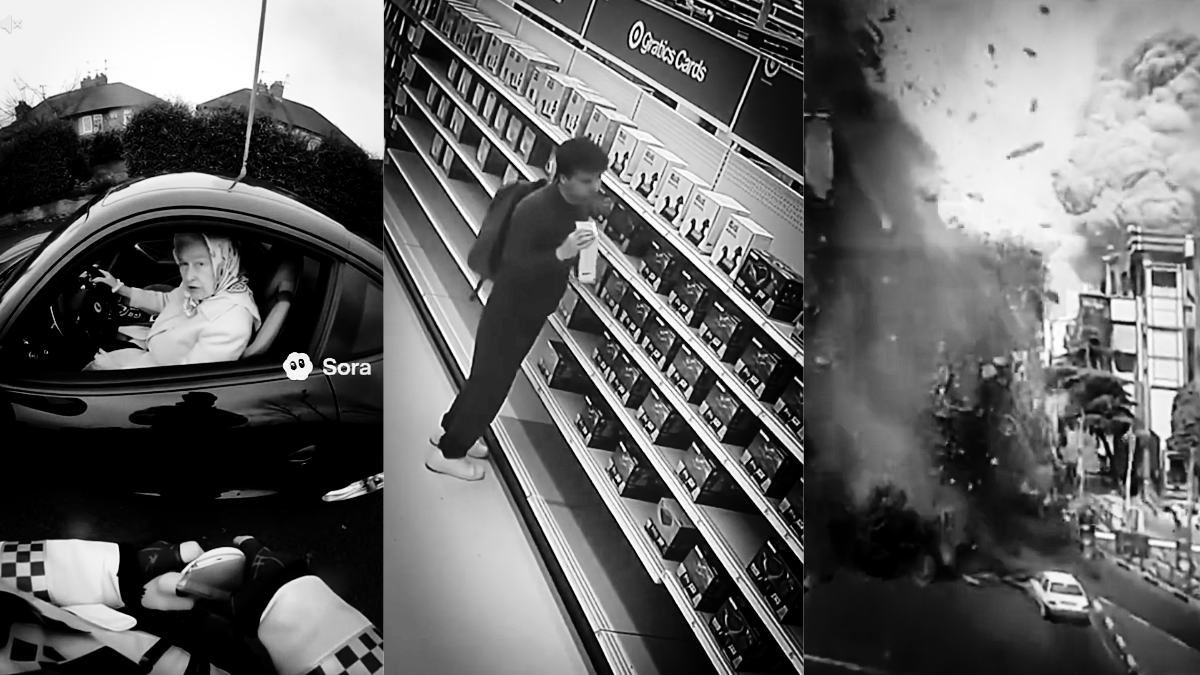
Screenshots from fake videos referenced by the authors.
2025 was the year synthetic media crossed another threshold. The new generation of video models unleashed an unprecedented flood of AI-generated content, with deepfakes of public figures (dead or alive) blending seamlessly into social media feeds: Queen Elizabeth being pulled over, OpenAI CEO Sam Altman shoplifting, ’leaked conversations’ from Bolivian and Iraqi elections, and a wave of deceptive media circulating during the 2025 Iran-Israel war.
AI-driven media never left the headlines, and with rapid improvements in realism, synchronization, and long-form generation, its ability to deceive is accelerating.
Yet our capacity to detect and respond to these deceptions continues to lag. Through the Deepfakes Rapid Response Force, a WITNESS-led initiative linking frontline journalists, fact-checkers, human rights defenders, and media forensics experts, 2025 revealed not only the persistence of old detection challenges but also a new layer of complexity introduced by emerging multimodal models. Here are five lessons from this year’s cases that show where AI deception is headed and what detection must confront next.
1. Hyper-realistic long-form videos and complex pipelines are outpacing detection
This year saw a sharp rise in suspected AI videos, especially after the release of Google’s Veo 3 and OpenAI’s Sora 2. These models generate longer, more coherent scenes with synchronized motion, speech, and environmental details. A recent case concerning an AI video of a news anchor discussing Ecuador’s referendum illustrated how model improvements blur reality: intricate camera movements, consistent lighting, and believable anchor gestures produced one of the most convincing AI news videos DRRF has seen to date.
But the longstanding detection bottlenecks persist and worsen as content circulates: low-resolution, high-compression reuploads across platforms continue to confuse the detectors. In a suspected AI video of Russian politician Vladimir Medinsky making an obscene gesture during peace negotiations between Ukraine and Russia, the low resolution of the video prevented the DRRF’s detection models from providing conclusive results.
In other instances, suspected AI content reaches analysts as re-recordings of the original footage, adding yet another layer of degradation. In June 2025, DRRF was asked to analyze a clip of Israeli strikes on Borhan Street in Tehran that was itself a recording of CCTV footage played on an external monitor. Each step removed the video further from its source, stripping metadata and obscuring the digital artifacts that detectors rely on. A parallel dynamic surfaced in a montage circulated online as four alleged CCTV clips purportedly showing Israeli strikes on Iranian military sites. Across versions, the format and recirculation introduced additional distortion, while the content itself showed indicators consistent with AI-generated and/or manipulated imagery. A similar challenge occurred in an audio case involving an alleged WhatsApp conversation with former Bolivian president Evo Morales planning to disrupt the elections: the file submitted for analysis was not the leaked audio itself, but a recording of it played on another device.
The Borhan street example, together with the video of the bombing of the Evin prison, highlight a deeper structural blind spot: many detectors are built to analyze faces, making them ineffective for footage of explosions, fires, nighttime operations, or other non-human scenes—exactly the kind of content most common in conflict, climate disasters, and crisis contexts, where this limitation becomes significant.
Lesson: Detection, and the broader verification ecosystem, must move beyond face-centric, artifact-dependent approaches and adapt to a world of scalable deception, where Sora/Veo-style models make “camera-real” synthetic video the default and highly convincing long-form content is routinely “laundered” through multimodal, multi-step manipulation pipelines.
2. Editing, inpainting, and “minor” manipulations create major confusion
Manipulation of authentic content poses significant challenges. In one case from Georgia, a video presented as evidence in a legal proceeding against protesters, when analyzed by the DRRF’s experts, was flagged as AI because it included blurred sections and a red circle annotating a key area. The experts clarified that these were standard editing overlays, not deception. It points to how overlay graphics and minor editing effects can trigger false positives and the need for human experts to contextualize the findings.
Images, though fewer this year, revealed another worrying trend: surgical inpainting, where only small regions are replaced. Two cases–one involving Nigerian officials at the Tokyo International Conference on African Development and another showing Ukrainian children holding Azov-related signs, a Ukrainian military unit accused of far-right and neo-Nazi affiliations–showed how subtle modifications are exceptionally difficult to detect.
Lesson: As attention shifts toward video and complex AI manipulation, image manipulation is becoming quieter, more precise, and harder to detect. Detection models must address the increasingly surgical image modifications.
3. Audio remains the weakest link in detection systems
Audio manipulation is the most prevalent and yet the most challenging type of AI manipulation, with each case highlighting the complexities of audio detection. The low quality, combined with background noise and cross-talking consistently reduced AI detection confidence. Across regions, leaked conversations remained a powerful political weapon: suspected fake calls involving various political figures in Bolivia, including the former president, former ministers, or an influential businessman; alleged recordings of Iraqi politician Nofal Abu Raghif; and numerous voice messages circulated during election periods.
In such cases, reliance on voice comparison techniques becomes key—not only to find evidence of manipulation but also to confirm the identity of the speaker. In a case involving a leaked audio call in which Georgian Archimandrite Dorote Yurashvili retracted his support for the protests, fact-checkers asked not only to assert whether a piece of audio was AI-generated but also if the audio was authentic and whether it was actually the Archimandrite speaking. While some detection tools look specifically for patterns indicating AI use, the lack of such evidence does not exclude other types of deception (e.g., impersonation).
Voice comparison techniques can provide greater clarity and insights by comparing the audio in question with authentic samples of the speaker. In one case, allegedly featuring Bolivian businessman Marcelo Claure discussing his influence over Bolivian media, one team of experts went as far as reverse engineering Claure’s voice by generating an AI audio of him and comparing it to the submitted recording. Such a method, while incredibly insightful, requires access to advanced technical expertise as well as samples of authentic speech, which may be challenging to obtain for lower-profile public figures who have less of a digital footprint.
Detectors continue to underperform with languages missing from training data. In cases featuring Khmer, Bolivian Spanish, and Libyan Arabic dialects, experts pointed out that the lack of these languages in the training datasets limited the accuracy of the detection tools. Audio detection appears to be moving towards language-agnostic models that perform equally well across languages. Despite this positive development, familiarity with specific languages and local dialects is still needed when human experts review the results. DRRF’s experts highlighted several times that a lack of knowledge of the local language and context was a limitation in their analysis. In these cases, they had to rely solely on the tools' results and were therefore unable to spot potential false positives or negatives.
Lesson: Audio detection must become more noise-tolerant and language-inclusive, and advanced techniques like voice comparison need to be made broadly accessible, not restricted to well-resourced contexts.
4. Public doubt about authentic content is surging
As hyper-realistic AI-generated videos become widely accessible, baseline skepticism toward authentic footage is rising sharply. Plausible deniability is increasingly used to dismiss real evidence, simply by claiming “it's an AI”, especially when the content is politically sensitive or uncomfortable. The latest video models have dramatically raised the threshold of what people consider believable, creating an environment where doubt is the default. Combined with limited media literacy and a lack of understanding of how these technologies work, this makes it increasingly difficult to counter false claims, particularly around polarizing topics.
In such an environment, evidence-based communication is critical. Fact-checkers increasingly request detailed, evidence-based explanations to educate audiences and counter reflexive doubt. In a recent case involving a suspected deepfake of Burkina Faso leader Ibrahim Traore, despite the video’s clear signs of manipulation, fact-checkers still requested an in-depth analysis to support this claim and educate their readers about the use of generative AI and the detection techniques.
Evidence-based analyses are particularly important in cases where authentic evidence is claimed to be AI to deny its credibility. Past DRRF cases have proven that building a positive case for authenticity, however, is far harder. Proving something is not AI requires deeper technical analysis, multimodal verification, and knowledge of local context.
Lesson: Transparent, detailed, and evidence-based detection results are now a core component of harm mitigation, not an optional add-on.
5. Human expertise is not optional, it’s the backbone
AI detection tools are indispensable, but they cannot operate on their own. Human experts are essential to interpret ambiguous or low-confidence detections; resolve false positives caused by overlays, edits, and re-recordings; bring linguistic and cultural knowledge that models lack; assess alternative explanations (e.g., impersonators); and communicate nuance to journalists and the public. In one Indonesian case involving an audio recording allegedly featuring a minister berating his staff, experts were able to confirm the tool’s results despite poor audio quality thanks to their deep understanding of AI audio capabilities. In the case of the Georgian protesters, the detection tool flagged evidence of AI manipulation. However, the experts clarified that the additions were editing factors intended to point to elements relevant to the legal case, rather than to deceive. In another case, a native Spanish linguist identified speech rhythms and grammatical features, helping confirm that a supposed recording of Evo Morales was authentic.
Human verification must complement the analysis provided by the AI tools. However, it’s important to consider cases where human oversight is neither possible nor advisable. A human rights group submitted extremely graphic footage for analysis, where, due to the nature of the video, some experts chose not to watch it, relying solely on tool outputs. Fortunately, multiple tools produced consistent results, but the situation underscored a critical question: who should we trust when human oversight is not possible?
Lesson: Detection workflows should default to human expertise, but also plan for contexts where human review is limited, unsafe, or unethical.
Bottom line: what 2026 requires
What 2025 has made unmistakable is that the sprint toward “camera-real” generative video is outpacing the guardrails: detection is increasingly easy to evade, provenance remains far from widely (or consistently) adopted, platform safeguards are uneven, and likeness theft is becoming routine. The result is a direct threat to truth at scale, and a narrowing window to reinforce it. Meeting that challenge demands a sociotechnical approach: strong infrastructures and effective tools paired with human expertise, contextual verification, and communication that is transparent, actionable, and appropriately uncertain.
For detection, that means building systems that work on the media people actually share—compressed reuploads, screen recordings, and degraded audio—not just pristine source files. It also means prioritizing methods that can handle the hardest (and most common) real-world scenarios: non-face and dynamic conflict footage, noisy multilingual audio, and subtle “surgical” edits. And it means treating explanation as part of the intervention, not only whether something is AI-generated, but what the evidence is and how confident we can be.
AI manipulation is increasing, but mislabeling authentic content as AI-generated is rising even faster. Detection tools remain constrained by quality limitations, diversity gaps, and rapidly evolving techniques. In that reality, human judgment, contextual verification, and clear communication aren’t optional; they’re essential parts of any reliable analysis workflow.
WITNESS’s work on a global, effective AI detection benchmark reflects the same principle: detection isn’t a single score or model. It’s an ecosystem. One that must be evaluated, stress-tested, and communicated responsibly so that people on the front lines can act quickly, credibly, and safely. Anything less risks amplifying the very harms we’re trying to mitigate.
Authors