EU's New Budget Will Test its Commitment to Digital Democracy
Mark Scott / May 4, 2026Mark Scott is a contributing editor at Tech Policy Press.
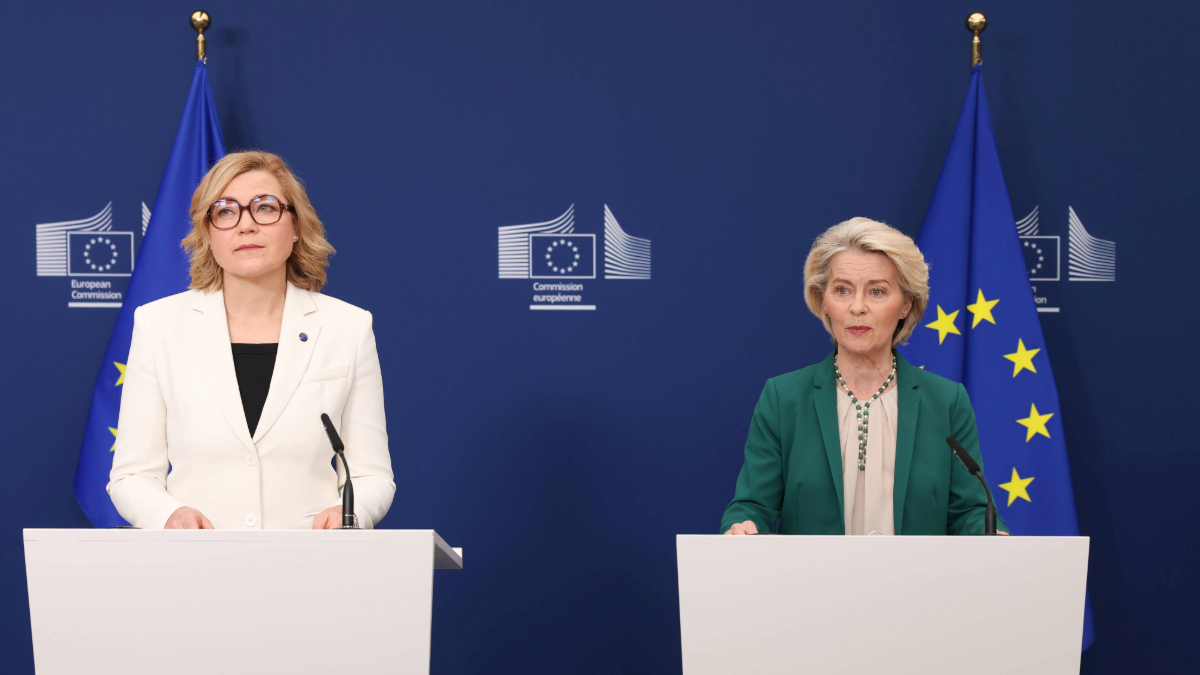
European Commission President Ursula von der Leyen, right, and European Commissioner for Tech Sovereignty, Security and Democracy Henna Virkkunen speak during a media conference at EU headquarters in Brussels, Wednesday, Apr. 15, 2026. (AP Photo/Omar Havana)
The European Union faces a ‘stick or twist’ moment for its commitment to digital oversight.
The 27-country bloc is currently negotiating its next 7-year budget, or an estimated €2.1 trillion cash pile between 2028 and 2038 that will fund everything from national agricultural subsidies and military support for Ukraine to student exchange programs and academic-led research and development.
Among the funding priorities that still need to be ironed out is Europe’s stated ambitions of supporting projects that foster democratic resilience from Portugal to Poland at a time when trust in governments and democratic norms is at a 50 year-low across most Western countries.
At the top of the list are the EU’s stated policy objectives of making its online environment as safe as possible for citizens — either via the bloc’s digital rulebook or the wider promotion of Europe’s democratic values online.
Among the current proposed €2.1 trillion EU budget, billions of euros are up for grabs to support such work via the likes of AgoraEU and the European Competitiveness Fund funding proposals. It has led to heated horse-trading between EU lawmakers, civil society groups and industry ahead of a final agreement on the EU’s next seven-year budget that is expected by the summer of 2027.
Ursula von der Leyen, the European Commission president, has made it clear that democratic resilience — particularly when confronting online threats and upholding the bloc’s existing digital regulatory rulebook — remains one of her top priorities.
EU agencies are already implementing the likes of the Digital Services Act and Digital Markets Act just as the United States has made its opposition to such rules increasingly vocal. Civil society groups across the 27-country bloc also provide critical evidence to regulatory investigations at a time when existing funding sources, particularly from philanthropic organizations, are drying up.
“In a world where information is increasingly weaponized to undermine our democracies, we are taking action,” the German politician told EU national leaders in February. “We will level up our collective capacity to counter foreign information manipulation and disinformation.”
Yet such public statements have yet to be matched with firm funding commitments as part of the EU’s next budget. If anything, European policymakers are failing to grasp the seriousness of the threat they are facing — and how best to meet these challenges under the bloc’s next EU budget, known as the Multiannual Financial Framework.
Threats against the bloc’s democratic institutions and norms are now driven by digital threats in the form of cyber and so-called hybrid attacks. Foreign interference campaigns are now regularly amplified by AI-enabled online trickery. Structural changes in how the internet operates, based on democratic norms, are threatened by authoritarian countries like China increasingly taking the lead. The underlying technical infrastructure to enable civil society groups to support the EU’s policy objectives remains shaky, at best.
Europe’s existing funding of democratic resilience projects, particularly within the digital realm, is not fit for purpose. The bloc relies too heavily on highly bureaucratic tenders. Its complex administrative procedures make it hard for smaller expert groups to apply for funding. Brittle policymaking priorities — often set years in advance — are not agile enough to meet fast-evolving digital threats.
That is the conclusion of a series of national convenings that I held across multiple EU member countries over the last six months, as well as a separate analysis of how the bloc currently funds projects related to upholding values associated with democratic resilience. That includes existing work related to digital rights, fact-checking, independent media, disinformation and other policymaking areas linked to the EU’s democratic resilience agenda, both home and abroad.
As part of the Chatham House Rule workshops, national ministries, local philanthropy and domestic civil society groups and academia discussed each country’s EU budget priorities, as well as how digital-focused organizations could best support those national policymaking agendas. It represented the first time these groups had gathered in capitals across the bloc to address a critical gap in the EU’s next long-term budget.
The goal was not to subordinate academia and civil society’s own ambitions to the policymaking needs of national governments. Instead, the workshops highlighted how much EU member country ministries and regulators now rely on these outside groups to meet the bloc's wider digital agenda around democratic resilience.
The similarities between all national workshops only compounded the need to shore up financial support for organizations now central to the EU’s digital policymaking agenda.
In workshop after workshop, officials acknowledged how non-government groups provided a significant share of evidence for regulatory enforcement; promoted EU fundamental rights in the digital world; and represented a critical early-warning system for direct threats to both national and EU-wide democratic norms and institutions.
Yet the crucial — and long-term — role that such groups play within the 27-country bloc is not reflected in how Europe supports these organizations, based on a review of the current EU budget and these separate national workshops.
Between 2021 and 2027, the EU has earmarked more than €600 million for projects linked to democratic resilience via existing funding programs like Horizon Europe, the Citizens, Equality, Rights and Values (CERV), Creative Europe and Multimedia Actions from DG CNECT.
That is a sizable pot of cash. But less than half of those funds, or €243 million, is accessible to the types of civil society groups and academic institutions now central to the EU’s ambitions in defending democratic norms online. The remainder is primarily focused on supporting traditional media across the bloc — an important, but incomplete, part of how Europe protects society from internal and external threats.
Yet even the €243 million figure does not tell the full story. Roughly 80 percent of that funding is doled out through EU grants that last between 1 and 3 years, based on publicly available data.
Such short-term support for the likes of online interference detection and social media algorithm auditing does not provide sufficient long-term stability for organizations to meet the policymaking demands now asked of them from national and EU officials. These groups can’t hire staff, build internal capacities and maintain regulatory and policymaking networks because they don’t know if they will secure a new round of funding to support these activities.
In contrast, the EU’s own funding, based on publicly available data, for regulatory compliance infrastructure — everything from building databases for domestic agencies to share data to financing technical tools for regulatory enforcement — is built within permanent institutional funding mechanisms that don’t ebb and flow on a yearly basis.
That allows the bloc’s digital enforcers, many of which remain reliant on civil society organizations whose own funding sources are precarious, to plan long-term investigations and develop institutional capacity in ways that are just not available to these external groups.
This dichotomy — in which digital civil society organizations live and die by a short-term funding cycle, while traditional media and EU regulators have access to long-term support not depending on changes in the bloc’s budget — needs a fundamental revamp as part of Europe’s next budget.
If that doesn’t happen over the next year of budgetary negotiations between EU officials, the bloc’s vaunted commitment to leading the Western world in promoting democratic resilience in the digital age will unfortunately ring hollow.
Authors