Europe Fined X, But It's Still Avoiding the Real Threat to Democracy
Alexandra Geese / Dec 6, 2025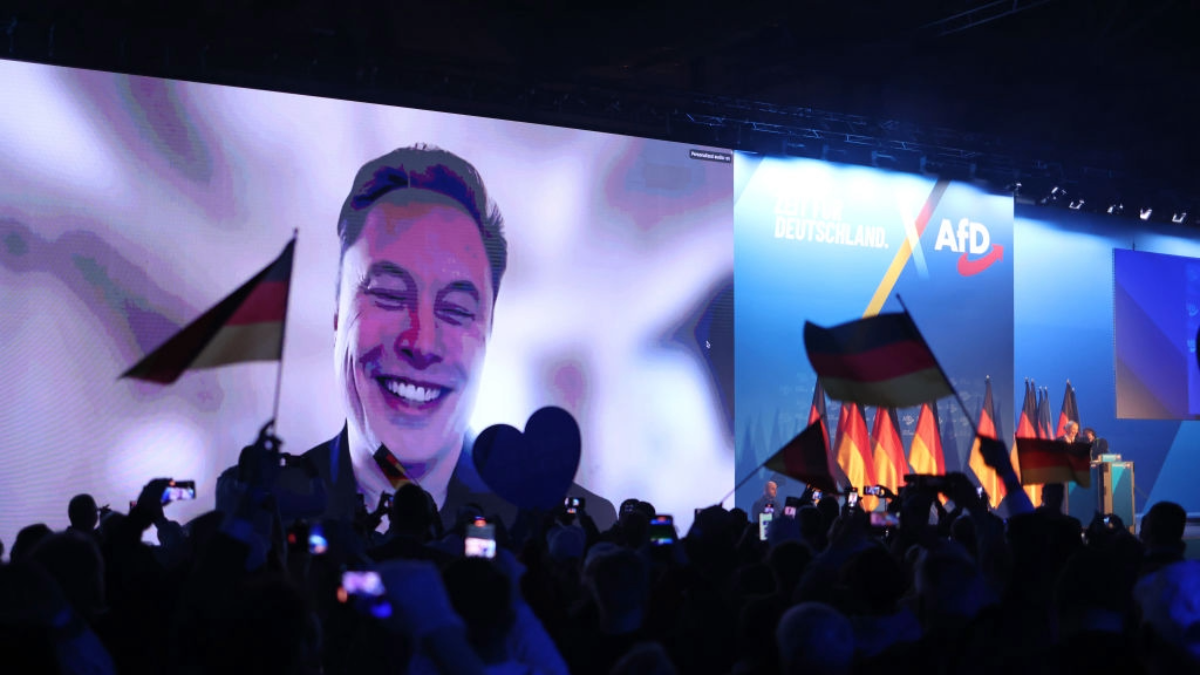
Tech billionaire Elon Musk speaks live via a video transmission during a speech by Alice Weidel, chancellor candidate of the far-right Alternative for Germany (AfD) political party, at the AfD election campaign launch rally on January 25, 2025 in Halle, Germany. (Photo by Sean Gallup/Getty Images)
The European Commission on Friday issued its first-ever non-compliance decision under the Digital Services Act against X (formerly Twitter) and imposed a €120 million fine. It confirmed serious violations: deceptive use of the verification checkmark, major failures in advertising transparency, and the systematic obstruction of researchers’ access to platform data.
This is a necessary first step in enforcing European digital regulation against a platform that is one of the worst offenders. But ultimately, it is not sufficient to address the systemic risks posed by X, which must be considered in the broader context of a United States foreign policy bent on pushing Europe to the right.
Systemic risks remain unaddressed
Earlier in January, the Commission opened additional investigations into X’s recommendation systems, including demands for internal documentation and technical access. The core suspicion is clear: the systematic amplification of certain political content and the systematic suppression of others. To this day, no decision has been taken.
As long as the Commission avoids a binding decision on X’s algorithms, the central instrument of political manipulation remains untouched. A platform that systematically relies on deception, manipulation, and opacity must not be allowed to treat EU enforcement as a predictable cost of doing business.
This is the real failure. The Commission is sidestepping the central power question: who regulates the platforms that determine political reach in Europe? Is it the European Commission, or the US government and allied tech oligarchs? As a result, the systemic risks to elections and democratic discourse under Article 34 DSA remain unaddressed, despite mounting evidence from elections in Germany, Poland, and the United Kingdom showing algorithmic distortion of political visibility on X — consistently favoring far-right and pro-Putin actors.
The geopolitical context is key
This regulatory hesitation comes at a moment of a rapidly hardening geopolitical backdrop.
Public attacks by senior US officials on EU platform law, coordinated lobbying campaigns by US tech corporations against DSA enforcement, and repeated trade threats linked directly to digital regulation form a consistent pattern rather than a series of isolated incidents. Over the past months, European antitrust and platform investigations have been openly politicized in Washington, export controls and tariff tools have been rhetorically tied to regulatory disputes, and diplomatic pressure has been exerted in multiple capitals to weaken enforcement. Taken together, these actions amount to a sustained pressure campaign on Europe’s digital sovereignty.
Only hours ago, the White House released its new National Security Strategy. Its message to Europe is openly confrontational. Europe is portrayed as a continent on the brink of “civilizational erasure.” The US declares its intention to actively support so-called “patriotic” parties across Europe to counter migration, weaken liberal democratic majorities, and reshape political power inside EU member states. Europe is no longer viewed as a democratic partner to be strengthened, but as a political space whose current course is to be actively countered.
Translated into political reality, this means direct backing for far-right nationalist parties such as the AfD in Germany or Reform UK in Britain — forces that oppose migration, attack democratic institutions, and openly undermine the European project. The document frames the European Union itself as an enemy of “liberty,” accuses it of suppressing political opposition and free speech, and calls on the US to help Europe “correct its current trajectory” over the coming decades.
This is nothing less than a declaration of intent to intervene structurally in the political systems of allied democracies. And this framing does not stand in isolation. The US State Department recently made it explicit in a publication calling for “civilizational allies in Europe.” Trump and his allies have been consistent and determined in pursuing these objectives. A goal that is congruent with these objectives is to shift political majorities inside the EU until European platform regulation can no longer be enforced.
At the same time, the US strategy echoes narratives long promoted by the Russian regime. It questions the legitimacy of NATO’s expansion, criticizes European governments over their Ukraine policies, and adopts language closely aligned with Kremlin talking points. This will inevitably fuel concerns over Washington’s positioning toward Moscow and embolden pro-Putin forces inside Europe. Instead of addressing the deep domestic legitimacy crisis reflected in the exceptionally low approval ratings of its own president, the US administration appears increasingly focused on exporting political destabilization abroad.
Platform power is core to US strategy
Social media platforms are central to this strategy. Through the algorithmic amplification of far-right and pro-Putin actors and the systematic suppression of progressive voices, they directly shape public opinion and electoral outcomes. This is not a side effect of digital markets. It is a core geopolitical lever.
It formalizes what has long been observable in practice: the Trump administration prefers there to be no obstacles to political influence operations conducted through US-controlled digital infrastructures.
When US platforms systematically favor far-right and pro-Russian actors through their algorithms, this is not a coincidence. It aligns precisely with the strategic logic now openly articulated in US security doctrine. What is written today is what has been executed for years. At this point, this is no longer a discussion about free speech. It is about algorithmic power as a geopolitical instrument for targeted election interference and systematic political manipulation in Europe.
This is exactly the systemic risk under Article 34 DSA that the Commission continues to avoid confronting.
Editor's note: Just before the above perspective was published, Elon Musk advocated that the European Union "should be abolished" in a post on X.
Authors