Disinformation Conference in Europe Caught Up in Transatlantic Politics
Ramsha Jahangir, Giovana Fleck / Oct 7, 2026Update (October 7): Shortly after this article was published, The Guardian reported that the Trump administration urged several countries to drop their sponsorship of the #Disinfo2026 conference, with Canada, Lithuania and the EU’s diplomatic service subsequently withdrawing their support.
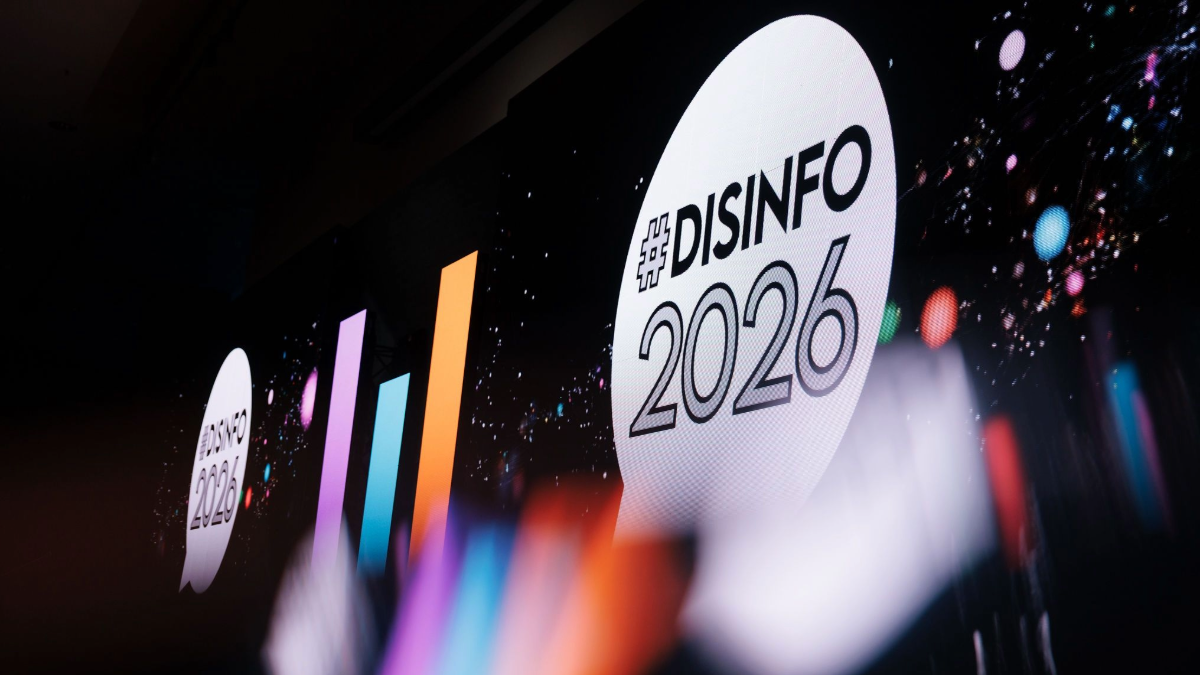
Source: EU DisinfoLab
Europe’s premier gathering of disinformation researchers, the #Disinfo2026 conference, opened Wednesday, October 7, with some of its biggest government backers pulling their names from the sponsor list at the last minute.
The conference in Vilnius, organized by non-profit EU DisinfoLab, brings together researchers, NGOs, think tanks, public authorities and technology companies working on disinformation, and more specifically on foreign information manipulation and interference (FIMI). The organization works through collective action, fostering a community of practitioners who share knowledge and information, mostly publicly through a series of reports, activities and webinars.
But just before the event, the logos of three government sponsors — the European External Action Service (EEAS), Canada and Lithuania — were covered with tape on conference banners and printed materials.
The withdrawals came as organizers and participants faced questions over the conference’s programming, including discussions about whether the United States itself has become a source of foreign information manipulation in Europe — a politically sensitive question at a time when the Trump administration has increasingly challenged European approaches to disinformation and online speech.
It was not immediately clear whether the governments had withdrawn their financial support, or were simply distancing themselves publicly from the event. The EEAS remained involved in the program, with representatives presenting its research at the conference.
The EEAS told Tech Policy Press it asked for its logo to be removed because of the content of the program.
“We have decided to have the EEAS logo removed from the material associated with the conference in view of the content of the program,” a representative for the service said. The organizers, they added, had framed some discussions in ways that “do not align with the official positions held by the EU.”
At the same time, the EEAS stressed that supporting “free and open discussion” at civil-society events working on foreign information manipulation and interference remains an important part of its work.
In a similar statement to Tech Policy Press, a spokesperson for the Canadian government said Global Affairs Canada (GAC) officials continue to participate in the conference and look forward to engaging with partners and stakeholders on efforts to counter disinformation.
However, “following changes to the framing of several panel discussions, GAC decided to revise its participation in those sessions at the EU DisinfoLab 2026 conference.”
“States, and state-affiliated agencies, shouldn’t have control over the program; it's part of the problem that governments have been acting so cowardly [to tackle disinformation],” said Nina Jankowicz, a disinformation researcher and former Biden administration official who is co-founder and CEO of The American Sunlight Project, a nonprofit that works on information integrity issues.
The dispute comes as the EU is expanding its efforts to counter foreign interference and disinformation, which it regards as a “growing threat to European democracies.”
The European Commission’s Democracy Shield initiative includes measures aimed at strengthening democratic resilience, supporting civil society and independent fact-checking, and countering foreign information manipulation. Since its launch, several researchers and civil society organizations have contributed knowledge and experience to make the Shield a mechanism that fully helps healthier information spaces — including the EU Disinfo Lab.
Washington’s shadow
The anxiety hanging over Disinfo 2026 is not only coming from Europe. It is also shaped by a broader backlash against the disinformation research field in the US. The Trump administration has made attacks on the European approach to disinformation and tech regulation more generally a recurring part of its broader criticism of European efforts to tackle online harms and foreign interference.
For years, conservative politicians and activists have accused researchers studying misinformation, disinformation, and content moderation of participating in censorship, particularly through alleged coordination with technology platforms and the government. That campaign has included congressional investigations, lawsuits, and efforts to discredit researchers and the field itself.
Since President Donald Trump returned to office, some of those attacks have moved from political rhetoric into government policy. The administration has dismantled or cut programs related to information integrity and democracy, while researchers and civil society organizations have faced funding losses and new scrutiny. The State Department has also used visa restrictions against foreign individuals it accuses of participating in censorship, including people working in disinformation research and content moderation.
That history matters for #Disinfo2026 because one of the conference's most politically sensitive questions was whether the US itself could be considered a source of foreign information manipulation and interference in Europe. That topic was addressed in one of #Disinfo2026’s first panels, the description for which called it “one of the most uncomfortable questions in the counter-disinformation field today.”
For Adam Fivenson, non-resident fellow at the Center for Security, Innovation, and New Technology (CSINT) at American University and one of the speakers on the panel, having those discussions publicly is one of the remedies for information spaces.
“To me, this conference is an island of civil society sanity,” said Fivenson. “In the United States, we are in a horrible spot where there are no opportunities domestically to work in the space of helping people get access to high-quality information.”
The outreach came amid what some participants described as a broader pressure around the conference.
Fivenson stressed that these community spaces are under attack, and that he sees the US articulation as silencing European efforts to mitigate disinformation. “To me, it also shows vulnerability [from the Trump administration]. If they were confident in what they are doing, why would they care about this conference?” he said. “Personally, that’s encouraging to my work.”
But European governments have not responded uniformly. France — the conference’s only remaining government sponsor — publicly reaffirmed its support for the conference and for the role of civil society in countering foreign information manipulation.
“France is one of the countries most heavily targeted by foreign information manipulation campaigns and remains firmly committed to countering any actions that undermine its fundamental interests,” a spokesperson for the French Ministry for Europe and Foreign Affairs told Tech Policy Press. The ministry added that the success of such efforts “relies to a large extent on the work and engagement of civil society” and said it regularly supports initiatives including the #Disinfo conference.
In September, Politico reported that Washington had excluded French applicants from funding for “Developing Civilizational Bonds, Democratic Resilience, and Rule of Law in Europe” until after the 2027 French elections to avoid the appearance of US interference.
In a statement to Tech Policy Press, a spokesperson from the US state department said: “While we are unable to comment on the details of diplomatic conversations, it should not be a surprise that countries would disaffiliate from this conference upon learning that it labeled the US a ‘FIMI threat’. Labeling the United States a ‘FIMI threat’ – a term normally reserved for describing influence operations of adversaries – undermines shared goals and should alarm those involved.”
The response also raises a broader question about whether governments, in Europe and elsewhere, will continue to publicly support this work, or whether growing political pressure will push them to distance themselves from the researchers and civil society groups they once backed.
“It’s really important that no speakers withdrew from participating. I think it shows the resilience of this community in the face of increased threats,” said Ben Schultz, lead researcher at The American Sunlight Project. “I’ve heard two panels here about how the White House sanctioned researchers in this space, and to see people showing up is really nice. These are scary times.”
EU DisinfoLab did not provide comment. A comment from the US State Department was added after publication.
Authors