Democrats Have A Mandate. They Can’t Repeat Congress’s Tech Governance Failures.
Janet Haven / Nov 23, 2026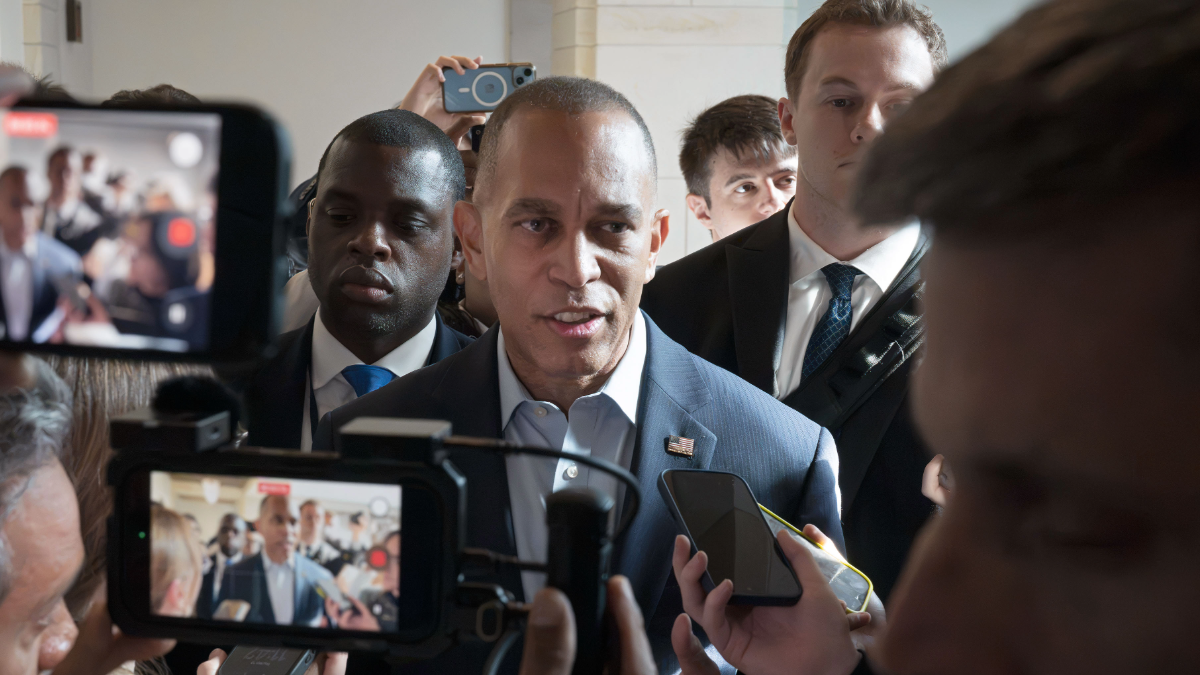
House Minority Leader Hakeem Jeffries, D-N.Y., discusses his agenda with reporters at the Capitol in Washington, Thursday, Nov. 12, 2026. (AP Photo/J. Scott Applewhite)
This month's blue tsunami showed us clearly how voters feel about AI. A majority of voters took a stand against the tech industry and its oligarchs, against data centers, and against monopoly power. And Americans voted for candidates promising controls over AI and the people behind it. Now we have a clear and unprecedented opportunity in front of us: not only to govern, but to articulate and move forward the elements of a public interest, people-first vision for AI in society that centers public science and protections for people.
This is lighting a fire under the Democrats. Legislative wishlists are being drawn up, hearings are being planned, and Americans are expecting to see their new, Democratic Congress take big swings, given their powerful mandate.
There’s one problem: we’ve been here before. A major threat to governing AI and the AI industry is the long-standing tendency of Congress — both Republicans and Democrats — to cave to the tech industry. Legislators have a history of being swayed by the industry’s money and access, and by its threats that regulation and accountability will stagnate the economy, weaken national security, and shut down innovation. Although the close ties between the tech industry and an increasingly authoritarian Republican administration has damaged the industry’s relationship with Democrats, politics is likely to prevail. Now frantically pivoting as newly empowered Democrats storm back into Washington, the industry will presumably deploy its vast resources to draw Democrats back into the fold, and attempt to persuade them to embrace friendly, self-regulatory positions.
But the main reason the United States is facing down an obscenely powerful AI industry intent on externalizing risk and harm onto everyday Americans is because both parties in Congress have failed, again and again, to respond to calls from the public for action. The new Democrats coming into Congress must learn from this history, take a sharply different approach, and commit to action that will inevitably put them at odds with the tech industry and the powerful AI labs.
Remember the Cambridge Analytica scandal? In 2018, the world learned that Facebook had allowed the firm to harvest personal data of up to 87 million users, leading to charges of online political manipulation and malfeasance. Congress held high-profile hearings, Mark Zuckerberg and other CEOs testified, the country waited. And waited. The US still does not have a federal data privacy law that responds to the clear harms and violations that took place under Zuckerberg’s watch.
Remember when ChatGPT launched and the idea of existential risk from AI entered mainstream political discourse? In a panic, in 2023 bipartisan Congressional leadership launched the AI Insight Forums, bringing AI lab CEOs and computer scientists, researchers and policy actors together to provide direction in the Senate’s response to governing AI. I participated in the Forum on “Risk, Alignment, and Guarding Against Doomsday Scenarios,” and argued that Congress should act to govern AI’s current harms, thus building the muscle to guard against the potential for catastrophic loss-of-control scenarios.
Surely such a public commitment from Congress to define their responsibilities to the public vis-a-vis AI would have led to legislation? But no. In 2024, Senator Chuck Schumer, D-N.Y., released the anodyne “Driving US Innovation in Artificial Intelligence: A Roadmap for Artificial Intelligence Policy in the United States Senate,” which essentially advised a range of committees to consider various concerns about AI. It was, decidedly, not legislation. And it did not trouble the tech industry or indicate that it should anticipate public oversight and accountability.
When outsized power and money sits with the tech industry and its lobbyists, Congress’s attempts at “balance” have amounted to inaction, and have led to a spiraling set of harms to the public. The American people cannot afford for such inaction to continue, and their votes in this election speak loudly. The incentives to block governance have not changed: national security is still a concern, perhaps even more front and center following Nvidia CEO Jensen Huang’s shocking conflicts of interest with chip export to China. And AI labs and tech companies alike still have enormous amounts of money to throw at lobbyists who are skilled in presenting weak, industry-friendly rules as reasonable compromise.
But there are hopeful signs that this time is different: the midterms revealed that the range and scale of the opposition to the tech industry’s overreach is unlike anything we have seen before. The incoming Congressional cohort of Democrats has received a clear message from their constituents, and has a pivotal opportunity in front of them. On the most basic level, this means passing holistic governance of AI that protects safety and rights, and securing Americans’ future — social, economic, and existential. It means ensuring the US participates, in good faith, in international standards-setting for how AI is developed and deployed around the world. And it means taking steps to prevent catastrophic risk. All of that is a floor for the work that Congress must undertake now, not a ceiling.
The truth is that industry actors will never willingly agree to governance that interferes with their interest in wielding power and growing their wealth. Recognizing this, our representatives must get to work reclaiming the public oversight and agency that Americans are clamoring for. Through legislation, public spending, and new authorities, Congress must direct a path for AI that centers the clear demands of the American people, rather than the priorities of companies who have fought hard against democratic accountability.
Authors