A New Agenda for Tech Regulation Beyond AI
Alice Marwick / Nov 9, 2026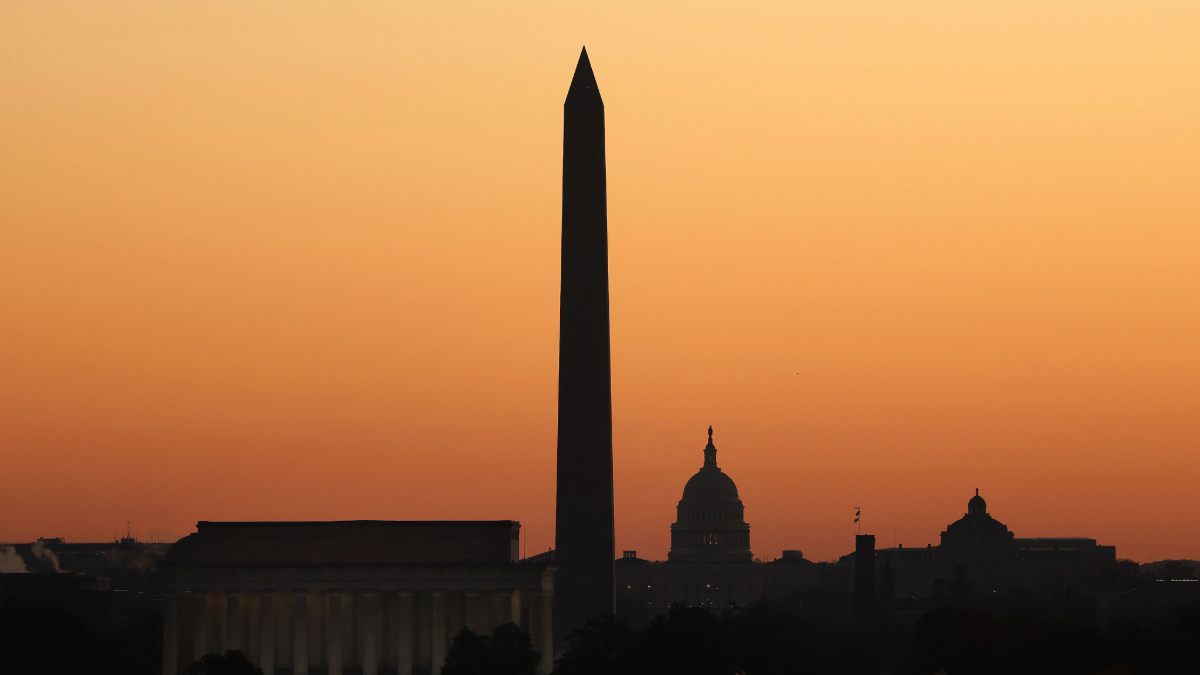
The sun rises over the US Capitol and the Washington Monument on the National Mall the day after election day on November 04, 2026 in Washington, DC. (Photo by Kevin Dietsch/Getty Images)
The massive Democratic sweep of congressional and state races across the United States was a referendum on many things: the increased cost of living, President Donald Trump’s unpopularity and corruption in his administration, the rollback of reproductive and LGBTQ+ rights, the damage caused by tariffs, and the war on Iran. But curbing the power of the tech oligarchy was high on voters’ minds.
Across the country, winning candidates campaigned against Big Tech. Texas governor-elect Gina Hinojosa and South Carolina Senator-elect Annie Andrews, who won in what were among the night’s biggest upsets, both ran on a data center moratorium. Michigan senator-elect Abdul El Sayed campaigned on a public “AI dividend” and called for a federal agency to regulate frontier models. Manny Rutinel, who co-sponsored the first comprehensive state-level AI regulation law back in 2024, successfully flipped a House seat in Colorado with AI accountability as part of his platform. And around the country, ballot initiatives to curb data centers overwhelmingly passed.
Data centers are the Achilles heel of the tech industry: they’re a visible place where people can focus their efforts to curb the power of big social media platforms and AI companies. But regulating data centers, or even AI, is by no means the only form of technology regulation that we need. Given this overwhelming voter mandate to enact tech regulation, I asked some of the top scholars and policy folks in this space one question: what’s on your wishlist to regulate technology, at either the state or the federal level?
The answers were big and small, more and less realistic, but all concrete. And while Trump has promised to veto Democratic legislation, many of these ideas are viable at the state level given new slates of enthusiastic Democratic leaders around the country.
Affordability
Affordability is at the top of the populist agenda; witness El Sayed’s often-repeated refrain “Money out of politics, money in your pocket, Medicare for all.”
While gas and grocery prices aren’t tech related, Big Tech’s enthusiasm for subscription models, algorithmic pricing, and consumer surveillance has contributed to the soaring costs of consumer goods and services. There are forms of tech regulation that can combat this.
For example, New York City mayor Zohran Mamdani implemented a “Click to Cancel” law that requires businesses to make it just as easy to cancel a subscription as it was to sign up. This is a quick and easy win for any state, as it’s tremendously popular, has immediate benefits, and combats dark patterns and “enshittification” — which consumers loathe. Robyn Caplan, assistant professor of public policy at Duke, explained, “This is a major issue around tech and affordability; it seems minor but rent setting [the use of algorithms to determine pricing in rental housing markets] and subscription traps are terrible for consumers and are a visible marker of the tech industry’s unregulated power.”
Privacy
The US has no comprehensive privacy law. But Big Tech enables data collection on an enormous scale. From Palantir to Flock, tech companies are taking advantage of the lack of regulations to gather an unprecedented amount of data about Americans. Strong privacy laws are needed to curtail ICE surveillance of immigrants through social media data and facial recognition, the explosion of companies built on the collection and monetization of personal and behavioral data, federal scrutiny of legal anti-ICE protests, and the widespread use of automated license plate readers by local and federal law enforcement.
What we do have is the 1974 Privacy Act, which regulates what the federal government is allowed to do with Americans’ personal data. When Elon Musk’s DOGE team took a hatchet to the federal government, it removed long-standing silos between data collected for one purpose and use for another. In 2025, for example, the Social Security Administration, IRS, and HHS began sharing immigrants’ personal data with immigration enforcement agencies, reversing longstanding policy and facilitating deportation efforts. Nathalie Maréchal, the managing policy director at the Institute for Information, the Internet, and Democracy at Northeastern University, thinks that any reform effort needs to start with accountability. Oversight hearings on privacy that cover DOGE, ICE, and Palantir — which racked up billions in federal contracts in the last two years — could be a first step.
Legislatively, Hannah Bloch-Wehba, a law professor at Texas A&M, has very specific ideas about how the 1974 Privacy Act could be revised. In simple terms, the law needs to be amended to stop agencies from freely sharing people’s data with each other and from circumventing the law by buying data from private companies. She wants an independent watchdog to keep an eye on how the government uses personal information, along with a broader privacy law that limits what companies can collect in the first place.
Federal privacy legislation governing both federal and private collection and use of data would replace an increasingly confusing state-level landscape– twenty-four states have now enacted comprehensive privacy laws, meaning that some Americans have more privacy rights than others. Many of the experts I spoke to believe that comprehensive privacy legislation is a necessary cornerstone of tech regulation, and should be a top priority for lawmakers.
Advertising market transparency
There’s a creeping suspicion among many Americans that much of the activity on social media isn’t people at all, but bots — the “dead internet theory.” Bots can be used for spam and fraud, but they can also be used to manufacture consensus and manipulate public opinion. Social platforms are often slow to take down bots because they inflate user numbers and engagement; if there are no bots on Facebook, it’s unlikely that the platform retains a daily active user number of 2 billion. Caplan says, “We’re not going to stop the dead internet, but we should at least know how much of the internet is dead.” More pragmatically, while the FTC prohibits fake social media influence, it doesn’t require disclosure. Thus, advertisers, many of whom are small businesses, are getting charged for bot clicks even when they’re told they’re not.
To combat this, the FTC could require large social media companies to measure and disclose how much of their traffic is “manufactured activity”: bots, engagement farms, AI agents, and paid humans. Independent third-parties would audit these reports and disclosures. The goal would be transparency: platforms wouldn’t be penalized for having high volumes of bots, but for failing to disclose this. It’s unclear exactly what impact bots are having on social media discourse, but it would be good to know the extent of it.
Scams
AI-driven scams are a bipartisan issue: they affect virtually everyone, from teenagers to seniors, and they’re rapidly decreasing trust in platforms, phone calls, text messages, and e-commerce sites. Scams are a hard problem to solve simply because the ecosystem is global, but there is low-hanging fruit that can be tackled immediately.
- Ban crypto ATMs. The crypto lobby is rich and powerful, but they aren’t invulnerable: they lost $60 million trying to defeat Sherrod Brown. Crypto ATMS are overwhelmingly used for scams, because once money is transferred via crypto, it’s basically gone forever. The AARP, which has strongly advocated for regulation on crypto ATMS, reports that they were responsible for more than $300 million in scam losses in 2025 (almost certainly a low given that scams are underreported) and that 76% of losses were from people 60 and over. Recently, Coinme was forced to shut down all of its crypto ATMS as part of a settlement against money laundering; this is another quick win that would signal to voters that policymakers are taking scams seriously.
- Liability for scam advertising on social platforms. 30% of scams in the US originate on a Meta platform, and Meta reportedly makes billions of dollars every year from scam ads. Since self-regulation clearly isn’t working, we have two suggestions. First, make Meta liable for consumer losses due to fraud originating from a Meta ad. Second, require social platforms to implement Know-Your-Customer laws to prevent scam advertisers from creating endless numbers of accounts. This model legislation from the Consumer Federation and Consumer Reports outlines these possibilities.
Data access
A recent study found that nearly ⅓ of computational papers on social media topics published in top journals had links to Meta and other Big Tech companies. The tech companies know a lot more than anyone else about how people use their products — and they’ve vociferously guarded access to their data. Meta’s data access programs for researchers were quietly shut down years ago. In Europe, the Digital Services Act (DSA) requires social platforms to open their platform data vaults to researchers, but in the US, the Computer Fraud and Abuse Act presents challenges to researchers who download (or “scrape”) public website data without permission, and platforms often weaponize their terms of service against researchers, shutting down academic projects and issuing cease and desist letters to people conducting public-serving empirical research.
This state of affairs needs to change. Rebekah Tromble, a professor of political science and computer science at Northeastern, said her first priority is enabling “access to company data that allows independent, public-interest researchers to understand the impacts these technologies have on users and society.” Deen Freelon, a professor at the Annenberg School for Communication at the University of Pennsylvania, emphasized the need for data access mandates for very large online platforms, similar to those in the DSA. Ryan Calo, a professor at the University of Washington, added that the US badly needs a way to “protect third-party researchers and whistleblowers.”
Alissa Cooper, the executive director of the Knight-Georgetown Institute, called for restoring funding to the National Science Foundation, the National Endowment for the Arts, and the National Institutes of Health. The Trump administration’s cuts have wiped out entire programs. As Tromble put it, “We need to fund the social scientific and humanistic research necessary to understand societal impacts of these technologies.” That independent scholars can be captured by Big Tech only strengthens the case for public funding of sociotechnical work.
Expanding regulatory capacity
The big picture is that the federal government has operated on austerity budgets, well below capacity, for years — making any big regulatory moves very difficult. This has accelerated during the second Trump administration, which understaffed and under-resourced regulatory bodies by design. Addressing this needs to be a top priority for a Democratic congress.
As Olivier Sylvain, a professor of law at Fordham University noted, lawmakers should “insist on filling vacant positions at administrative agencies with competent subject-matter specialists, particularly at those who've been severely understaffed or brazenly beholden to the White House. The Department of Justice has been debased and demoralized. The Federal Trade Commission currently only has two of five seats filled. The Consumer Financial Protection Bureau has been gutted.” Sylvain served as senior advisor to the chair of the Federal Trade Commission in the Biden Administration.
Similarly, Anna Lenhart, a former senior advisor to the White House Office of Science and Technology Policy and currently a PhD candidate at the University of Maryland, wrote, “Congress needs to reform and expand expert committee staff, who are the staff that lead investigations and write well researched bill text.” Any evidence-based policy reform under a future Democratic president will require a stronger legislative branch, which is hampered by lack of headcount. Lenhart explained, “Committees are currently staffed at 1980 levels, Republicans gutted staff during the red wave in the 90s and we never remedied the situation. Really great, underpaid staff often end up working 16 hour days on end during investigations (including myself).”
A surprising number of people I spoke with mentioned the importance of resurrecting the Office of Technology Assessment, a federal agency that was dedicated to empirical research on the impact of science and technology (view its archives here). Founded in the 1970s, the OTA was dismantled by then-House Speaker Newt Gingrich during the “Contract With America” anti-government fervor of the mid-90s, just as the information superhighway was getting off the ground. There is bipartisan support for the OTA, which lawmakers have been pushing to revive since 2019. The estimated price tag of $30 million seems like a small price to pay for nonpartisan technical research on climate change, social platforms, and artificial intelligence.
This could be paid for by a tax on tech companies. danah boyd, a professor of communication at Cornell, explained, “More than anything it’s about tax law not product. Direct financial implications will prompt more changes.” I know I said I wouldn’t mention AI, but it’s worth noting that Anthropic’s IPO filing shows the company has paid almost no federal corporate income tax, offsetting its income with billions in loss carryforwards; OpenAI remains private and discloses nothing. Asad Ramzanali, the director of AI policy at the Vanderbilt AI Policy Accelerator, outlined 34 different taxes that could be leveraged on AI, including taxes on automation, energy use, and capital gains. Sarah Jackson, associate professor at the University of Pennsylvania's Annenberg School for Communication summed it up: “I just want tech bros to pay their fair share of taxes.”
– – –
As civil society organizations, thinktanks, and policy shops scramble to readjust their policy priorities in the wake of this week’s election, it is important to think beyond AI. Expanding regulatory capacity, passing comprehensive privacy legislation, and mandating data access for researchers may not be flashy, but these policies will have real-world implications for technology companies and, potentially, enormous benefits for the average American.
Authors