Canadian Hydronyms, Builders, and Other Adventures in Middle Power Tech Policy
Chris Russill, Patrick McCurdy / Sep 10, 2026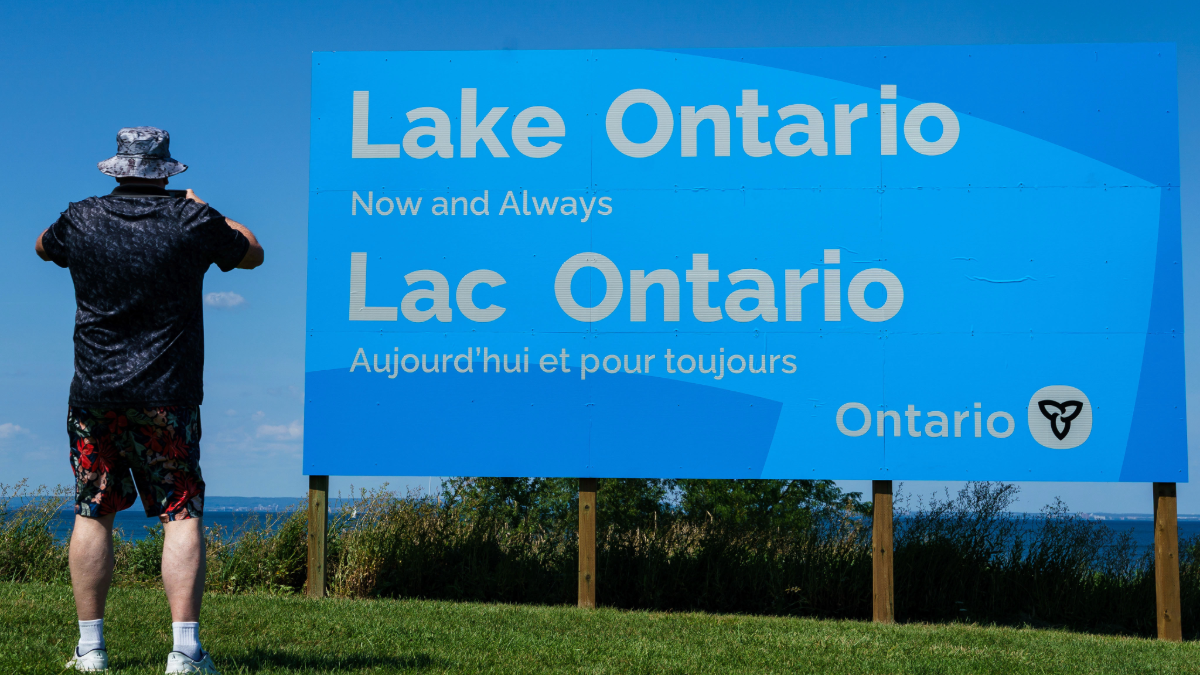
A person takes a picture of the newly unveiled sign for Lake Ontario at Fifty Point Conservation Area in Grimsby, Ontario, on Saturday, Aug. 29, 2026. (Keito Newman/The Canadian Press via AP)
If you look at the Great Lakes on Google or Apple Maps from the United States, you might notice that Lake Ontario is now labeled “Lake America.” Named long ago and commonly traced to the Wendat word Ontari’io, the change follows an executive order from President Donald Trump directing the US government to rename the body of water. The order was issued amid a trade war, part of Trump’s strategy to leverage US economic integration with its northern neighbor to erode Canadian sovereignty.
Google Maps quickly followed the directive for US-based users. But users geo-located in Canada, Google says, will find the lake labeled with its usual name, and those outside both countries will see both names. Shortly after the change, however, some Canadian government and financial institutions displayed Lake Ontario as Lake America. The change likely resulted from their reliance on data accessed from Google’s API to display maps on their sites. The incident illustrates a larger problem: as tech and state power have merged under the Trump administration, Canada has struggled to ensure autonomy for institutions and people reliant on US tech—which is most institutions and people in Canada.
The Carney government is widely celebrated for its middle power rebuke to the tech-fueled ambitions of US empire. Memes, slogans, and speeches evoking desires to build circulate widely in Canada. There is ‘build, baby, build,’ an election night meme, and ‘build, partner, buy,’ an industrial strategy for defense and AI (also a meme). The middle power approach, however, is an international overture to other state actors. How it informs policy for addressing tech companies tied in with the US state (and that follow its directives) is less obvious.
The Canadian tech policy landscape is more kludge than doctrine. It includes largely rhetorical ambitions to build, well-meaning gestures toward digital sovereignty, and a generally accelerationist AI posture (AI for All). Industry’s fingerprints are apparent, including on Minister of Canadian Identity and Culture Marc Miller’s proposed bills on social media, in trade deals, alliances, swanky conferences, quantum computing investment pitches, and in public consultations and data center promises bloated with industry talking points. Miller’s bills, in particular, address public concerns, including social media safety for children and teens (Bill C-34, the Safe Social Media Act) and the role of AI in the Tumbler Ridge tragedy. The consultations were rushed, however, and the government failed to adequately distribute agency into public and civic sectors with the AI transparency (ISED) and data center consultations (Government of Ontario). Despite the duty of care model incorporated into C-34, these legislative interventions are not organized around a comprehensive taxonomy of vulnerabilities, risks, or harms that can handle the collision of tech and state power shaping the AI moment.
Part of the problem is that Carney’s ‘builder’ mindset is associated with industry deployment, not government regulation. This dichotomy limits how Canadians understand building and emboldens the political ambitions of tech actors that create systematic vulnerabilities in Canada’s tech and AI policy.
Let’s unpack this.
A middle power approach to tech accepts an inability to compel platform and AI companies to align with Canadian values, principles, and laws. In fact, the diminished role of regulatory power is framed as a principle of partnership for building technologies with companies. It is an intentionally distinct posture from the previous liberal government, and powerful actors are pursuing its implications in different ways.
On the one hand, there is the example of Cohere. The company actively grounds itself in middle-power desires for digital sovereignty that dependencies on US tech companies have created. Whether it is foreign acquisitions, calls to commercialize government centers to attract AI capital, or deployment of LLMs on enterprise infrastructure so politicians cannot meddle with national hydronyms or restrict access to a systemically important AI provider, Cohere executives use middle-power sovereignty rhetoric to organize their approach to technology and politics. AI is treated as a technical stack, an enterprise technology, and a geopolitical supply chain issue for democracies. AGI, X-risk, effective altruism, related Thiel-speak and other tech founder intoxicants are left to Canada’s neighbors down south. When Trump restricted access to an Anthropic model, for instance, Cohere reported a “huge number of inbounds” from businesses and governments interested in reducing their vulnerability to US politics. Carney and Cohere use these moments to chart a middle power alternative that grounds ideas of building and sovereignty in partnership.
On the other hand, there is Shopify CEO Tobi Lütke, his executives, and those they organized in the wake of Carney’s election in 2025. They are, let us say, less enamored of democratic alternatives to the US example. Lütke, for instance, apparently approves of the idea that voting should be restricted to productive citizens with the wealthiest having up to five times more voting power in Canadian elections. In the “Go!” memo published by Build Canada, the political advocacy arm that grew out of efforts by Lütke and Shopify executives, sovereignty requires unleashing state capacity to de-democratize political action. The crisis facing Canada is framed as less about Trump’s leveraging of economic integration as a weapon than about economic productivity or stagnation. In their view, the future belongs to builders cleared of government obstacles to operate at “crisis speed”. Inuring oneself to the complaints of the stagnated (workers, voters, non-millionnaires) is part of being a builder worthy of 5X voting power.
Build Canada has been discussed as a DOGE for Canada, and its aims are a topic of considerable interest in Canada as discussed here, here, and here. There is no question its organizers were emboldened by Carney’s call to build and have influenced government discourse. It is also clear that Build Canada formalizes the political ambitions of wealthy Canadians involved in the tech industry, some of whom are openly attracted to anti-democratic positions on the reactionary right, a radicalized set of fringe ideas about the relationship of technology and politics. It is a beta test for Canadian politics, not a finished product.
It is worth pausing a moment to reflect not on the organization’s parallels to DOGE, or in bringing tech and state power more closely together, but to simply ask: What has this class actually built in Canada?
Lütke, for instance, is an entrepreneur, tech founder, and billionaire. Like many rich people in Silicon Valley, Lütke is a software person. He founded a company on top of digital infrastructure, supply chains, energy systems, and material networks built by others. This approach to tech manages systems. It ships software, extracts rent, and sometimes tweets into the discourse. Call it software ‘engineering,’ if you like, but it is not nation-building. This kind of tech founder has little experience in building hardware. Or energy transmission. Or geopolitical supply chains. Or holding a federalist union together.
Consider, for example, “Builder MP,” the AI member of parliament created by Build Canada. Builder MP is, of course, not an actual MP. Nor an actual builder. It is an application built on an OpenAI chatbot. It reports on how pro-builder politicians should vote on bills and engage with questions before the government. Illustrating how AI can be harnessed to Canadian democracy by offloading representation and voting decisions to a US LLM is many things. It is not what building means in the AI era.
Carney has ignored Builder MP. But he is openly proud that Canada is among the few places to originate a large language model from scratch (one not distilling or built on a US model). He might pause with the memes a moment and explain, as he did with Lake Ontario, how this came to be.
An answer would likely include the fact that Cohere founders are part of the Gregory Hinton / University of Toronto / Google tree. Hinton has been called the Godfather of AI, and is among the most cited and famous scholars in the world. But an honest answer would certainly include the series of exchanges facilitated by universities, which receive public funding, immigration policies, state investment, and, yes, US tech firms—and the opportunity to exit those tech firms when alternatives are created through regulation and policy. Perhaps most important for this moment, an honest answer would illustrate how regulation and policy are a harness. As Hinton himself has argued, regulation is a steering wheel to harness tech power, not a brake or an obstacle.
These are illustrative and incomplete examples. They are hardly the only approaches to understanding technology and power in Canada, a place with a long history, nor the only actors involved in thinking about such questions. Nor is the current US approach to state and tech power without international context, including concerns about how technology is organized in China.
But these examples do shape Canada’s current approach to tech and AI. Labels matter, whether it is for hydronyms or industrial policies, and it is the time to forego jingoistic ideas of nation, builder, and tech in building a middle power alternative.
Authors