AI, Gig Work, and the Future of Nursing
Chris Mills Rodrigo, Justin Hendrix / May 3, 2026Audio of this conversation is available via your favorite podcast service.
In this episode, Tech Policy Press fellow Chris Mills Rodrigo speaks with Katie Wells, a senior fellow at the AI Now Institute and the author of two reports on the 'gig-ification' of nursing, to dig into how AI is reshaping the profession from the inside out.
Rodrigo and Wells examine what's actually being deployed in hospitals: scheduling algorithms, productivity tools, and a fast-growing app-based contingent workforce that is turning bedside care into something closer to gig work. Wells reports that these trends prefigure the broader adoption of AI in healthcare, raising questions not only about the stability of the profession and the quality of patient care, but also about how the degradation of healthcare work affects communities.
What follows is a lightly edited transcript of the discussion.
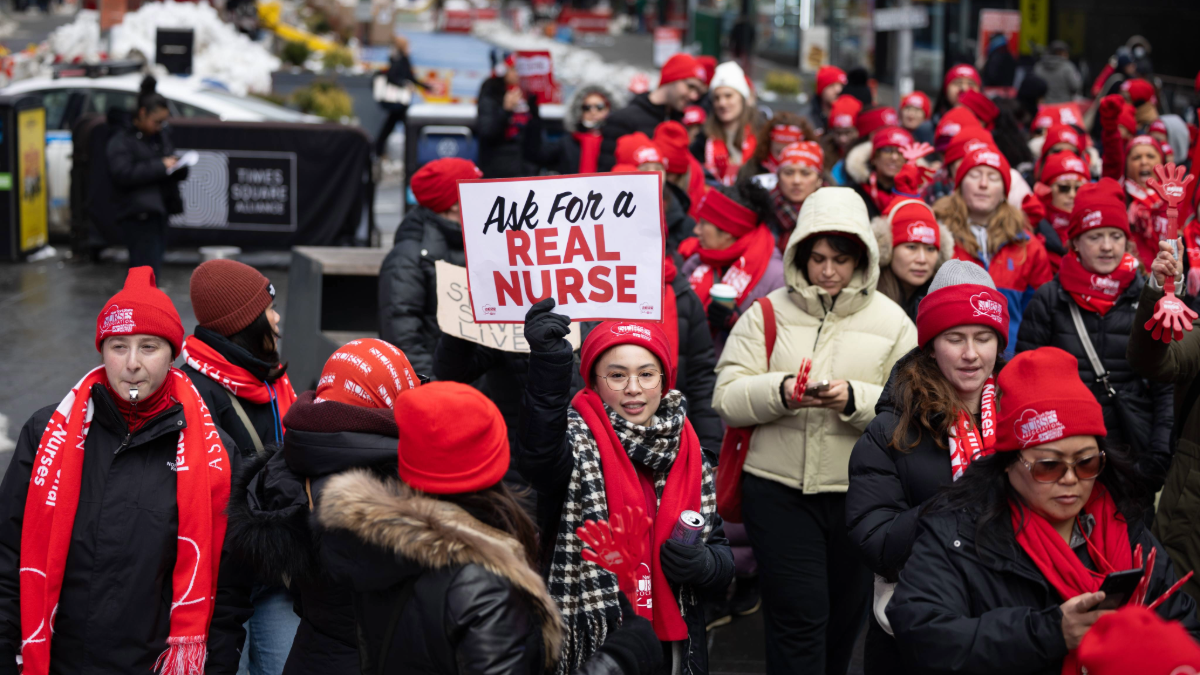
Hundreds of nurses and supporters of the New York City nurses strike hold a rally in Times Square and march through midtown Manhattan on Day 26 of the New York State Nurses Association (NYSNA) strike. (Photo by Melissa Bender/NurPhoto via AP)
Media montage:
It's the age of AI and some nurses are pushing back saying they're fighting for their jobs and their patients.
Nurses chanting to be heard, worried about the impacts of AI, especially with patient care.
AI, it's just like a tunnel vision. It limits the nurses' ability to do their job effectively.
Nurses fighting back against artificial intelligence in their place of work. Today, nurses took to the streets to protest. You see the nurses here with signs that read, "Our patients, our union, our rights." Today, they told us the use of AI limits the nurse's ability to do their job effectively.
We're not able to spend the time that we should be spending.
Justin Hendrix:
That was a montage of local news reporting from Florida, New York, and California, where in recent months, nurses have taken the streets to demonstrate concerns over the ways technology is changing their work and their relationship to their employers.
Tech Policy Press fellow Chris Mills Rodrigo has been looking at how AI is impacting labor, including nursing. For this episode of the podcast, Chris spoke to one expert conducting research in the tech and healthcare who says that the rise of gig nursing platforms pre-figures the broader adoption of AI in healthcare, raising questions not only about the stability of the profession and the quality of patient care, but also about how the degradation of healthcare work affects communities. Here's Chris.
Chris Mills Rodrigo:
The rapid advances in artificial intelligence systems over the last few years have been accompanied by broad proclamations about how the technology will transform work. When speaking in broad strokes about AI, it's easy to end up thinking in extremes, believing it will either be the end of work as we know it or make our labor hyper-efficient. The truth is much easier to tease out by taking a fine tooth comb to actual cases of AI deployment into workplaces.
Over the last few months as a fellow at Tech Policy Press, I've been looking into how specific sectors are responding to practical applications of AI. Last month, I sat down with Cathy Kennedy, president of National Nurses United, for a discussion on why nurses have broken ranks with others in the labor movement to more firmly reject deployments of AI in their workplaces. Nursing has been early testing ground for AI.
Not only have tools been deployed to schedule nurses employed by hospitals, but they've also brought in nurses that are essentially gig workers. Today for this podcast, I'm joined by Katie Wells, the author of two reports on the phenomena of the gig economy-ification of nursing. Katie is currently a senior fellow at the AI Now Institute where she leads research into tech and healthcare. Welcome, Katie.
Katie Wells:
Thanks, Chris.
Chris Mills Rodrigo:
And thank you for being here. Your research on this topic is split into two reports, which gives us a really natural way to structure this conversation about how elements and strategies derived from the gig economy have worked their way into nursing. Let's start at a simple place though. Can you walk us through how on demand nursing platforms work for both prospective nurses and medical facilities?
Katie Wells:
These apps, these gig nursing apps, or we can call them platforms, they work by creating a magical match. It's a match between understaffed facilities on one hand, and these facilities might be hospitals, long-term care facilities, rehab facilities, dental offices, correctional facilities, and in two states, ICE holding centers. So they make a magical match between facilities in one hand and nearby nurses or nursing assistants looking for work in the other. And what the app does, which is really the heart of the app, is algorithmic management software. What it does is create these matches between the two.
Chris Mills Rodrigo:
So for one of these nurses that's interested in using one of these platforms, how do they apply and how do they get matched with a medical facility?
Katie Wells:
So these apps do not, for the most part, require any human action. They do not require any interviews on the part of a nurse. So a nurse can download an app, upload the requisite documents, which often are her nurse's license, driver's license, COVID vaccine documentation, other kinds of drug test screening results. And then once she gets approval, she will be able to express her interest in nearby shifts. Sometimes that means just saying, "Hey, I'm interested in that shift at that rate." Other times, and this is a gross part, other times it means participating in something we'd call wage auctions, where a nurse will actually bid on a shift and indicate the lowest rate for which she'd be willing to work.
Chris Mills Rodrigo:
When did these platforms start popping up and how prevalent are they today? Also, if you want to talk about here a little bit about what the big players are in the space, would also be curious to hear about that.
Katie Wells:
Yeah, those are great questions. We think that these really started showing up around 2016. And I'm going to use the phrase we think because I'm an empiricist and it really bothers me that we do not have more data about exactly when they arrived and how prevalent they are. How big are they? How many workers are using them? How many facilities are using them?
Are the majority of the shifts RNs? Are the majority of shifts CNAs? We don't know. And that's very irritating for us dogged researchers or perhaps for you as a journalist to not have access to data about those questions. So what I can say is we think there are about a dozen main players. We know that of the top 10 players, that at least two of them are considered unicorns by Silicon Valley standards. So there's huge amounts of private equity and venture capital money that is propelling the largest of this bunch.
And where are they? We think they're in all 50 states. We think they are clustered in particular areas. We think, and I keep using that think, because I want evidence to show me. We think that they are most prevalent in areas that are under-resourced. These are areas that do not have university hospital systems as in this, you can think rural facilities, you can think poorer facilities, and you can especially think private equity owned or corporate facilities.
And so one of the interesting things about this project when we were talking to unions is that unionized facilities are not often seeing these gig nursing platforms.
Chris Mills Rodrigo:
Just on that note of these often rural, often poor facilities, what's in it for them? What's the benefit to using these platforms? Or at least how is it pitched to them?
Katie Wells:
Yeah, I think it's pitched as a real lifesaver. I think for facilities that are under-resourced, that don't feel as if they have enough money or finances to support the kind of staff they want to get, this is a great short-term bandaid. Then you're only really paying for the nurse the one time your other nurse calls out. It can be attractive. It's also attractive, not just for money reasons, but also because it can potentially lower the human resources or staffing labor, scheduling labor that goes into a facility because these things do these... I mean, it automatically sort of integrates with hiring and firing, to that end too. Push a button, DNR, do not return these nurses.
Chris Mills Rodrigo:
My instinct there is that it also might be pretty helpful if you have staff that are perhaps interested in unionizing if you can just call in replacements whenever.
Katie Wells:
That's my thought exactly. And I think it's also one of the things we're seeing in a lot of debates about these, is that very, very worry.
Chris Mills Rodrigo:
In your first report on these platforms, which was in 2024 for the Roosevelt Institute, you actually spoke to, I believe it was 29 people using these platforms. What were the takeaways from these conversations and what were the issues or even the benefits from using these platforms that people were getting?
Katie Wells:
Yeah, that's great. I'll speak to the benefits first. For a lot of the workers with whom we spoke, and again, we don't know if it's representative of all nurses who use these platforms, but what we kept hearing over and over was that these nurses were attracted to this work for one of two reasons.
One, they were attracted to it because it provided extra income if their other full-time jobs were not providing them with enough means. And for a second, they were attracted to this because even though they understood the risks, their schedules were so difficult in traditional nursing jobs that they felt like this was an okay gamble, that for many of them, they have to take their dad to dialysis or get their kid to his IEP meeting. And their childcare responsibilities or elder care responsibilities were so great that at least in this job, they didn't feel as if they were letting folks down by needing to ask for days off or calling out sick.
And so it allowed them to have a little semblance of control, or I should say, it allowed them to have the possibility of control. For many of them, it wasn't much control in the end. And there were many downsides to this work, which they experienced firsthand. Part of it is that these are caregivers and they want to do this work because they like nursing, but they don't like nursing work when it is treated as a gig job.
And that was hard to hear. One of the questions I asked all of these workers is, "If you or a loved one were ill, would you take them to any of the facilities in which you worked as a gig nurse?" And almost always the answer was no. And that just sort of highlights, I think, the extent that these gig nursing apps are really this bandaid solution for a lot of facilities that are already struggling with significant structural issues.
Chris Mills Rodrigo:
I was struck in these portions of your report about the sort of underlying labor conditions for nurses. They're already quite difficult. And you have these statistics about how many registered nurses there are that just choose not to work, which is leading some experts, some commentators to describe it as a nursing shortage. It seems like these platforms have almost been able to exploit those labor issues in a way where they're offering a way out, which sounds quite a lot like what Uber did in the early 2010s, taking advantage of existing societal issues, lack of policymaking in transportation spaces, and then using those gaps to kind of assert themselves. You think that those parallels exist and maybe you might want to talk a little bit about that?
Katie Wells:
I definitely think those parallels exist. I think that's a really compelling description. And I think I'd also say, I'm not sure we should even describe it as taking advantage of as much as... I wouldn't say the gig nursing apps are not so much taking advantage of a problem. They're exploiting, as you say, but the reality is there is real purchase in the complaints of nurses who say, "My existing options aren't so great. Of course, I'll turn to gig nursing."
And I think we can see the parallels where chauffeurs and taxi drivers were frustrated with the existing system, and so maybe Uber offered a leg up. I very much worry about gig nursing providing a crappy solution to a real problem, which is, there is this terrible mismatch between the available jobs for healthcare workers and our trained healthcare workers who are saying, "No, these no longer meet my standards.
This is no longer an acceptable way for me to work and that I need to have more control in the workplace." And they deserve to.
Chris Mills Rodrigo:
Yeah, that's a very helpful way to reframe that point. I was curious, another thing that kind of struck me from your two reports is how common third-party nursing staffing agencies are already. Can you tell me a little bit about what role those function in the hospital ecosystem and also how these new platforms are different?
Katie Wells:
Yeah, that's a great question. So one thing to keep in mind, one thing that perhaps you'd be interested in and listeners might be, which is, I learned in the course of doing this work that nurses historically in the early 20th century were not employees of any hospitals, that they instead were their own third-party staffing agency, something called a private duty registry.
And really until the 1950s, nurses were always sort of bargaining with hospitals and facilities about what hours they would work and what rates.
And so the idea of third-party staffing isn't new at all. In the 1950s, 1960s, these nurses began working primarily for hospitals in house. And so then it wasn't really till the 1970s that we saw the travel nursing agencies that we're most familiar with, especially during the pandemic when these travelers, as they were called, would make serious bank by going to different COVID-filled facilities.
But that travel nursing model is more than 50 years old, the current iteration. But in that version, travel nurses are given long-term contracts. It might be for four weeks, it might be for four months at a single facility where they have the same role every day, and they're also provided employee benefits. They have protections against discrimination, unemployment insurance access, workers' comp, all these things that gig nurses don't.
And so the biggest distinction between these two really is a kind of contract and the length of time, for a gig worker, a gig nurse, it can be a four-hour shift or a 12-hour shift. It's not going to be a six-week contract. And also the difference is when you work for a travel agency, you have someone to call when things go wrong. And so when one nurse said to us, and I just remember this, she said, quote, "I just feel like I'm on an island by myself a lot." And I think that's a really good way to think about gig nursing, which it is a very sped up version of travel nursing, but a lot of the protections have been dropped.
And so one thing that gig nursing companies are doing is they are constantly trying to magnify this difference. They're always saying, Chris, they're like, "Oh, we're not a healthcare staffing agency. We're not travel nursing. We're not those people." And they're doing that so that these gig nurses are carved out of even more protections that they've already been carved out of.
Chris Mills Rodrigo:
Just before we get into that discussion of how these platforms are presenting themselves, I wanted to ask, because we spoke a little bit about the potential drawbacks for nurses that are using these platforms. What are the issues you encountered on the hospital side? I think just kind of listening to you talk about these four hour shifts where one person's coming into a hospital and was just being dropped in. Are there issues as well in terms of having to train up these people or to integrate them into existing systems?
Katie Wells:
That's a great question. We are seeing some emerging research that confirms, or shouldn't say confirms, that echoes a lot of what my coauthors and I found, which is that bringing in gig nurses often creates tremendous strain on a workforce where employed staff have more responsibility because they have to train up the peers, or they are resentful because of the different pay structures, or the patient care suffers because there is very little continuity in care.
And so there is some great research that has come out in the last few years that has really helped us understand what are the risks of this arrangement, not necessarily for the gig nurse, but rather for those around her.
Chris Mills Rodrigo:
To move into your most recent report from earlier this month with AI Now Institute, you dive into how these on demand nursing platforms are pushing policymakers to treat them like a new business model, different from the travel nurses that we talked about earlier. How are they making this pitch and what are the benefits to them for carving out this new niche?
Katie Wells:
I am so worried about this, Chris, and I think especially for someone like you that followed the Uber story so closely, the parallels are freaky. I think what these gig nursing companies have done in the last four years alone is at a greater speed with greater success than what Uber did in its first four years.
But what we found, and I was not expecting to find this, is that since 2022, 17 states have had bills introduced to carve gig nursing apps out of existing rules about how healthcare staffing should work. This is super worrying. And what it means is that the idea that gig nursing apps are AI-powered, that becomes a rationale for exempting them from all these set rules about how workers should have workers' comp or unemployment insurance or medical malpractice insurance.
And so one of the ways that these gig platform companies are advancing their arguments is they often say, "Hey, we're just a bulletin board. We're not a healthcare staffing agency. We're a tech company. We're a bulletin board. We just provide the matches. We don't have anything to do with any of the actual management of worker operations of healthcare."
And I find that to be false, but I think it's a really compelling argument. And again, it's like we've seen this movie before when Uber got its go, it made headway in now 34 states by arguing that it's not a chauffeur service, and so it should not be subject to taxi rules. Fast-forward a decade, gig nursing companies are saying, "We're not a healthcare staffing agency, we are a tech company, and so we should not be subject to existing rules about healthcare staffing."
Chris Mills Rodrigo:
It's really incredible how few lessons were learned from how Uber and Lyft took over, unfortunately.
Katie Wells:
No, Chris, we are going to learn this lesson. I'm convinced of it. I am heartened by watching and listening to the hearings and seeing the testimony that I think more and more legislators and the public are going to understand the risks of unregulated healthcare.
Chris Mills Rodrigo:
I am cautiously optimistic. Can you give us a bit more of a look into this lobbying campaign that gig nursing platforms have waged? What is the scope of it and what kind of laws are they focused on pushing through?
Katie Wells:
Yeah, it's a great question. So the laws are often aimed at carving gig nursing apps out of either state workers' comp, for instance, and/or enshrining gig nursing apps as a new category. There's this new, it's kind of, we could call it definitional arbitrage, but it's this very determined effort to get gig nursing apps recognized by a new definition. Hello, I am not a healthcare staffing agency, I am something magically new called a healthcare worker platform or a healthcare technology platform.
And so we see this phrase pop up in state after state in more than two dozen bills, and part of the effort of getting... And there was even one federal bill, but part of the effort is to recognize these gig nursing platforms as entities that have not employees, but independent contractors. So it is a very old, familiar battle over the rights of workers, but it is now being waged in the healthcare space, which we had not seen previously.
Chris Mills Rodrigo:
One point you made earlier as well was that they're often pitching themselves as AI companies, which for a lot of policymakers, they hear AI and they go like, "Oh, great. This is a exciting new technology." What does it mean for these platforms to be AI powered?
Katie Wells:
Yeah. So these companies use a lot of automated decision-making systems or AI systems to set rates of pay, we believe, to assign shifts, to allocate shifts, and to communicate between the worker and the facility.
There's a lot of questions about how these systems work, but they have very little human oversight from what we can tell. And so they fall into a category of automated decision making. For these platform companies, they're not shy about this. In fact, they sell themselves as having "smart rates and AI-powered rates and AI-powered human resources." And I think one of the best ways that when I explain it to students or friends, I say, "Well, it's almost as if AI has eaten the manager."
Chris Mills Rodrigo:
That is very evocative language, but that does make sense. One sort of, I guess, bright spot from your report was talking about New York State, which in 2025 passed a law explicitly saying that gig nursing platforms should have to comply with the state's healthcare staffing agency rules. I'm curious whether you see this as a model for other states to adopt and what the political constituency behind this legislation was.
Katie Wells:
Yeah, this is a super bright spot, I think, Chris, and it's a really interesting one. It's a very quiet move and all New York did is they simply said, "Hey, you over there, you with a technology hat. Just so you know, we know whether you have the hat or not, you are a healthcare staffing agency and you need to abide by these rules."
And that was a really exciting move because what it does is it recognizes these apps as having to play the fair game, that they don't get to exempt themselves from all the rules and regulations that we as a society have over decades written and enforced and tried to establish as norms.
And I'm very much worried about what's happening in other states where these gig nursing platforms have either successfully or are on the verge of upending the norms of how we set rules for healthcare staff.
Chris Mills Rodrigo:
I'm just curious, this might be outside the scope of your research, but what does one of these platforms look like in a scenario where they are complying with existing regulations? Have we learned anything from New York about how these platforms are continuing to operate? Is it affecting them?
Katie Wells:
One thing that was great to hear about in the course of this research, and it was really a reminder for me that I needed to hear it again, that there's actually nothing inherently wrong with a scheduling app.
There's nothing inherently wrong with helping to make matches between schedules and workers and things like that. And there are some hospital systems that have developed in house scheduling apps that allow internal float pools, workers who have been oriented and hired and interviewed to choose their shifts or trade with other workers.
The problem is the power imbalance in this existing gig nursing platform version and the vast amounts of data that's being collected on workers and workers don't know how it's being used to inform their future pay. There's a real fear about algorithmic wage discrimination or surveillance wages in these apps, especially those that allow wage bidding and auctions.
Chris Mills Rodrigo:
Yeah. I guess to close this out, I'm curious what nursing looks like in a scenario where instead of the New York state route, you follow the route of these gig platforms being exceptionalized, not having laws applied to them. What does that look like for the average person going to a hospital?
Katie Wells:
Yeah, it's a great question. And Chris, I'm deeply worried about it because we did find facilities where every week they have more than a hundred gig nurses working within the building. I'm deeply worried about this. I'm deeply worried also about what it means for public contracts.
Many of these apps have contracts with public agencies. The Department of Veteran Affairs in Kentucky has a million dollar a year contract with ShiftKey, for instance, one of these gig nursing apps, but the risks are not just to the public of us supporting a potentially predatory worker model, and it's not just for the worker. It's also going to be for communities. If nursing is still the most upwardly... Can you say it for me?
Chris Mills Rodrigo:
Upwardly mobile? Is that-
Katie Wells:
Yes. If nursing is still a sure fire ticket to the middle class, and nursing was, I believe, the only growing profession in the US in 2025, I'm deeply worried about what this means for communities. Nurses, especially those that are women, are often breadwinners in their families. And so the economic impacts for communities could be huge of dissolving this profession.
So when facilities primarily only use gig nursing workers, I'm worried about how that will lower wages, but also how it will affect families, how it will affect our public offers in terms of will there be still money for schools and things like that. And so this... I'm deeply worried about Silicon Valley's infusion of its gig model into healthcare and what it will mean not just for workers, but for all of us. I'm super worried. Oh my God, Chris, I'm in the midst of these off the record focus groups with nurses about the other AI technologies coming. It's like...
Chris Mills Rodrigo:
Yeah. Awesome. Well, thank you so much, Katie.
Katie Wells:
Chris, also thanks for your reporting on the nurses issue.
Authors