AI and the Future of Artistic Labor
James Paisley / Mar 5, 2026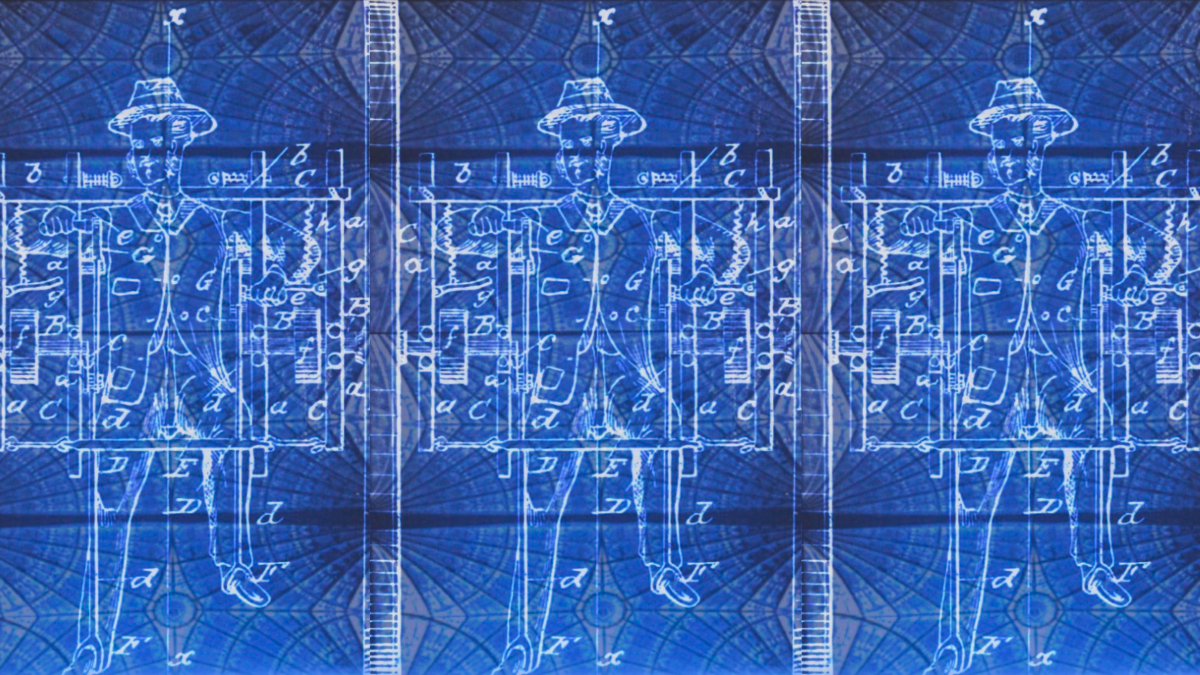
Detail from Puppeteering Virtual Reality by Hanna Barakat & Cambridge Diversity Fund / Better Images of AI / CC by 4.0
When I left my job with DHS Cyber Policy, I went home to Kansas City to hang lights in the theater my parents founded. This was the job I spent my youth doing, climbing ladders, hanging and focusing lights, running cable to and from the dimmer rack. It is tactile, physical work that requires human judgment at every step.
My work in cyber and emerging technology policy brought me close to the issues surrounding AI deployment, governance, and ethics. I knew about the rush to train workforces and the sheer speed of adoption. I knew that major tech firms were pausing junior programmer hires; I knew Duolingo was rolling out AI in place of human linguists; I knew the administration had discussed using AI to slash the federal and contractor workforce. AI impacts on the workforce were and are rippling across the labor market one by one.
Theater is not immune to this impact. Artists are already exploring what hybrid performance looks like, both with AI as a supplement or a central performative component. As I worked twenty feet in the air with these lights, I started thinking about how these very technological AI developments could impact the very human work of the performing arts. AI could eliminate some theater jobs entirely, but what happens to the artists who remain and what kind of art they'll be forced to create, is yet to be determined.
The conversation we're not having
Generally, when discussing AI & the labor force, we primarily fixate on a single question: Will algorithms replace workers? For the arts, that’s an incomplete consideration. We cannot be so focused on whether AI will replace artists that we ignore how it will transform the labor conditions of artists who remain.
To the outside observer, the industry looks better off than it is. Last year, the National Endowment for the Arts reported that arts and cultural industries grew at twice the rate of the US economy, adding $1.2 trillion to GDP, with Broadway concluding its highest-grossing season on record with $1.89 billion in profits.
But these numbers mask a crisis: Broadway's record was driven by 4% higher ticket price averages since 2019, even as attendance remained 5% below pre-pandemic levels. As Broadway League president Jason Laks warned, “We can't be satisfied with 2019's definition of success anymore. With rising costs hitting every facet of production, it is becoming harder and harder to bring live theatre to the stage.” Beyond Times Square, regional and nonprofit theaters are reporting budget deficits and programming fewer shows as independent artists, writers, and performers saw their value decline from 2022 to 2023, reversing recent gains back to pre-pandemic levels. The Theatre Communications Group's most recent report has also reported the largest decline in unrestricted net assets since 2009.
The data reveals a stark divergence: while performing arts companies increased their output by 20% between 2022 and 2023, independent artists, writers, and performers – the labor in question - saw their total compensation drop 13.5%, even as the number of employed artists increased by 7%. More artists are working, but each is earning less. This is labor devaluation in real time.
The industry is experiencing a K-shaped recovery: Broadway consolidates around expensive, star-driven productions - where average tickets for shows like Denzel Washington & Jake Gyllenhaal’s “Othello,” George Clooney’s “Good Night,” and Good Luck sit around $300 - while the ecosystem that trains and sustains most working artists contracts. This paradox creates the perfect conditions for the adoption of AI. When a sector is flush with aggregate capital but plagued by rising production costs, the pressure to replace the most expensive variable, typically labor, becomes irresistible. The $1.2 trillion figure isn't a safety net; it's the capital that will fund replacement.
The Arts is a multibillion-dollar industry still recovering from pandemic losses. It is vulnerable to disruption precisely when it can least afford it. While performing arts companies showed strong nominal growth between 2022 and 2023, they remain below pre-pandemic levels. Independent artists, writers, and performers - the backbone of the theatrical labor force - saw their economic contribution decline in 2023, reversing gains from the previous year.
The real threat isn't sudden replacement, but an underappreciated erosion of labor standards, safety, and creative agency that is invisible to those outside the theater community. Three specific dangers are already taking shape.
First threat: The creative hollowing
Perhaps the least understood consequence for theatrical labor isn't that the jobs will disappear, but that something essential in the work itself will be lost, even when humans remain employed.
Consider the role of the playwright. Generative AI works by predicting the most likely next token; by definition, it is an engine of averages. The danger isn't that AI will write bad plays, but that it will write competently average ones.
The AI generates the statistically most likely response to grief, the average structure of a redemption arc, and the median pacing of a revelation scene. And here's the trap: that play will be easier to produce and cheaper to stage than the weird, difficult, human script with all its contradictory multitudes.
In this future, actors may still find work, but they will be hired to enact hollow, derivative content. They become gig workers delivering lines generated by a probability model, their creative agency limited by a script pantomiming a perfect average of human emotion without ever touching the specific reality of it. The labor market will not just shrink as AI determines the minimum necessary number of actors, but become artistically impoverished. The work remains, but the agency disappears and what's left is a form of alienated labor where artists become executors of algorithmic output rather than collaborators in creation.
This raises an ontological question we're not asking carefully enough: even if AI serves purely as a tool, generating lighting cues a human designer refines, or drafting dialogue a playwright reshapes, does something essential leak out? Theater is not just spectacle, it's communion. The audience knows when they are witnessing the realness of human vulnerability versus the execution of algorithmic instructions imitating life. I am uncertain if AI-assisted art can preserve that essence, but it’s being deployed at scale before we have seriously grappled with the question.
Second threat: The training pipeline collapse
To be clear, I am not a Luddite. There's a lot of good AI could do in theater. The rise of plain-language design tools could function as a powerful tool to help lower barriers to entry, design, and accessibility. You can simply tell an AI the mood you're going for, and it will generate a lighting scene and color palette to build from. Audio-visual AI tools can now create complex soundscapes from descriptions of "a forest where the wind is breezy and birds trill in a minor key" and bypass the need for expensive, pre-designed libraries. AI could help audiences with near-simultaneous subtitles or translation into other languages.
For some theaters, these are transformative tools that allow them to punch above their weight and create technically impressive productions on a shoestring budget.
But, this efficiency creates the conditions for a long-term structural collapse. The same tools that lower the barriers to entry also lower the ceiling for professional sustainability. If a producer can use an algorithm to generate a "competent" sound design for free, the entry-level jobs that historically trained the next generation of designers vanish. We run the risk of the tool not just democratizing the arts but inadvertently devaluing the professional rate.
The promise is seductive: for a nominal fee or license, AI will let a theater create technically impressive sound design on a shoestring budget. But this framing obscures the commodification of expertise. The theater gets a good-enough production, but the next generation of designers lose valuable experience. More importantly, we lose something human in the design. The technical execution may be flawless, but the creative soul suffers.
The risk is creating a "barbell" industry where there are a few superstars at the top, and a mass of AI-assisted amateurs at the bottom, with the middle-class professional artists hollowed out. Entry-level jobs aren't just economic steppingstones, but training grounds. When you eliminate the entry-level sound design job, you don't just lose one position; you lose the person who would have become the next great sound designer in fifteen years.
Third threat: Digital replacement
The most speculative threat to theatrical labor hasn't fully materialized yet, but has made inroads in adjacent industries. Film and television have already woken up to the danger of “synthetic performers”, which SAG-AFTRA condemned in the aftermath of the AI-generated "actress" Tilly Norwood and the threat it presents to artists. To further address industry concerns and the growing use of deepfakes, New York and California passed laws requiring estates' consent before using dead performers' likenesses to create AI replicas. In the United Kingdom, the union Equity is currently balloting members on industrial action regarding the right to refuse intrusive digital scanning that could turn their bodies into training data.
Film and television are building guardrails against synthetic performers, but the American stage remains a blind spot. Imagine a near-future Fringe Festival production of “Hamlet” or “Waiting for Godot.” The audience wears lightweight augmented reality (AR) glasses. On stage, a recent drama school graduate performs the role in real-time. However, the audience does not see them. Through the lenses, they see the photorealistic likeness of a deceased Hollywood legend overlaid perfectly onto the living body.
These technologies already exist in separation and are iteratively improving. Motion capture suits transmit movements to a computer, tools like Deep-Live-Cam can do real-time face-swapping and deepfake overlay, digital avatars are leveraging real-time information, and wearable AR continues to improve, away from bulky headsets to lightweight glasses. The integration of these technologies is a matter of time and engineering, not invention. When these converge, the living actor will cease to be an artist interpreting a role, but become a biological armature. They are reduced to a meat puppet whose only job is to provide the kinetic data necessary to drive a digital skin.
This creates a terrifying labor dynamic. A producer could pay a living actor minimum wage to serve as a motion-capture rig, while paying a premium to a dead star’s estate for the "face" of the performance. The living actor is erased from the experience entirely: physically present, but digitally invisible. The audience’s applause is directed at a ghost, while the human sweating under the lights is at best an extension of the technical crew or, at worst, merely infrastructure.
Questioning the optimists
The counterargument is predictable: AI will democratize theater, enabling a Cambrian explosion of new productions and experimental performances. If 1,000 theaters can now produce shows they couldn't before, it will create more total opportunities, even if individual rates drop. Thus, more theater will mean more demand for human actors, directors, and designers.
This argument misunderstands what makes theater valuable. Yes, AI might enable 1,000 theaters to produce more shows. But if that work is algorithmically average, performed by enacting hollow scripts and produced by leveraging AI to bypass labor, have we actually expanded the arts or just industrialized mediocrity?
Optimists assume that quantity of productions translates to quality of labor, but we already know from journalism, music, and visual arts that flooding the market with cheap, algorithm-assisted content doesn't raise all boats; it crashes the floor. When "good enough" content is free and instantaneous, it pushes professional-grade work out because AI-generated scripts and designs don't compete on quality; they compete on price. Flooding the zone with good-enough creates noise, not a Renaissance.
Technology optimists also ignore the pipeline problem we've already discussed. If we exploit current workers through biometric demands and hollow out creative roles through algorithmic content, who develops the expertise for tomorrow? More theater is only good if the labor conditions are humane and the work is meaningful. A world with 10,000 AI-assisted productions staffed by exploited, creatively hollow workers is not a victory for the arts. It's a dystopia with better production values.
Defending the human workflow
The integration of AI into the performing arts is inevitable, but theaters and artists must decide if they want AI to be a tool that amplifies human intent or a mechanism that exploits human labor. The solution requires a defense of the human contribution, with specific and actionable guardrails:
Physical Autonomy and Identity Rights: Unions must strictly distinguish between "acting" and "live motion capture" on stage. If a producer uses a human actor solely as an infrastructure to drive a digital avatar, that is a fundamentally different job than acting with a distinctly different physical strain. The actor is no longer moving to express emotion; they are moving to maintain algorithmic alignment with a digital overlay. Contracts will need to mandate "Identity Transparency” and disclose whether a living human is performing the movement to the audience. Furthermore, actors must have the right to refuse "digital masking." The performing arts are an industry where labor trades on their physicality, capacity for emotion, and interhuman connectivity. An actor's movement signature is as unique as their face and both deserve protection from non-consensual cloning or erasure. The actor's body is not an infinite data source and their physical presence should not be treated as a blank canvas for a digital ghost.
Creative Credit Transparency: At DHS, CISA has been working on a Software Bill of Materials (SBOM) policy to help consumers know what is inside their purchases. Any production using AI-generated content must disclose the percentage of algorithmic contribution - an AI-BOM of sorts. If a script is 60% AI-generated, say so. If lighting or sound design was AI-generated and refined by a human designer, disclose both contributions. This transparency informs the audience experience and prevents AI from being the sole creator of any element eligible for professional credit. There must always be a human artist making final creative decisions.
Training Set Compensation: If an artist’s performance data trains a model, they get residuals when that model is licensed. Collective bargaining must extend to the data generated by a performance, not just the performance itself. This requires new infrastructure: data trusts or collective licensing agreements where artists benefit when their work trains a model, rather than tech companies extracting value from creative labor without compensation. When a theater company's production library becomes training data for a generative AI, those artists deserve a share of the revenue that the model generates.
For artists, it means recognizing that value lies not just in the final product, but in the process. When I hung those lights in Kansas City, I was interpreting the space, feeling the heat of the lamp, making choices based on the way the light hits dust in the air. That agency is what makes the work valuable and so essentially human for the audience.
What's at stake
In five years, a theater director might be able to generate a full production – script, lights, sound – with a single prompt. The question isn't whether this is technically possible, but rather what happens to the actor who performs that script 8 shows a week, embodying emotions predicted by an algorithm that has never felt anything? What happens when "the show must go on" means your body must generate data until you break?
If we allow AI to displace the creative professional without defending the labor conditions of those who remain, we don't just lose jobs. We lose the architects of our culture, replacing them with caretakers of a machine that knows how to speak, but has nothing to say.
Authors