A Congressional Commission on AI Risk is Overdue
Zoë Baird / Oct 23, 2026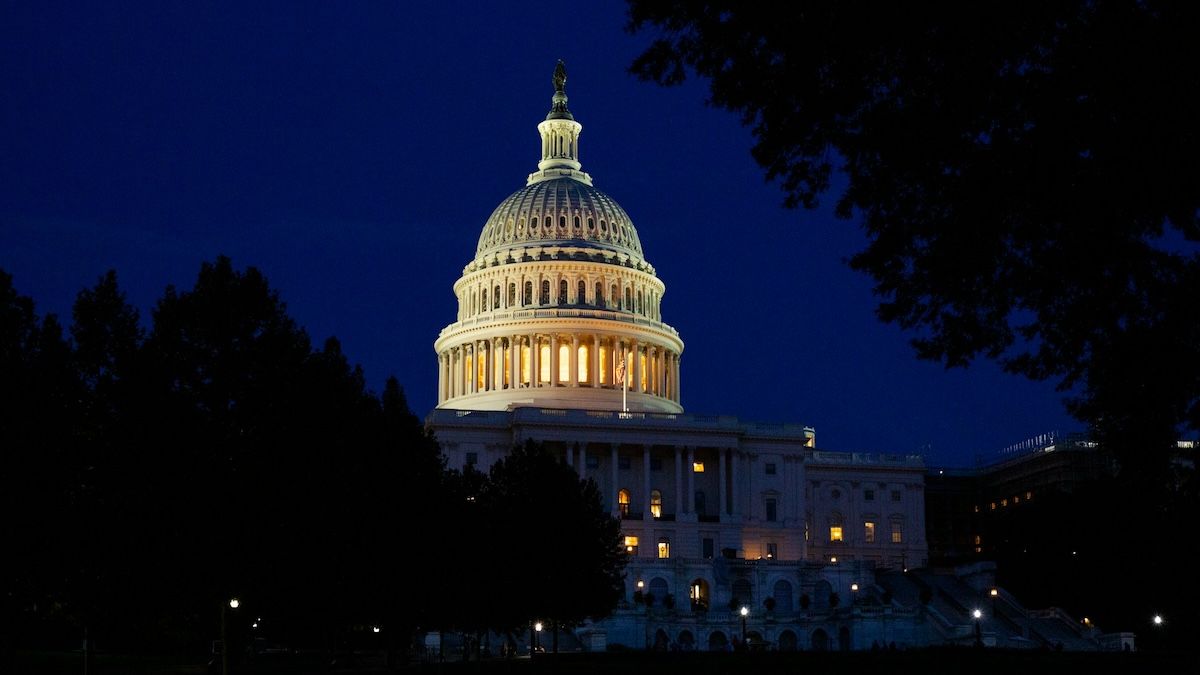
The United States Capitol dome by night, Washington DC, 2019. Photo by Darren Halstead on Unsplash.
The leaders of the major frontier AI developers are sounding the alarm at the speed at which AI is creating potential catastrophic risk, calling for a slowdown and government regulation. But Congress and the president are far from consensus on government’s role. Congress is unprepared and needs to devote serious attention to legislative options. As it does, it should quickly establish a bipartisan public-private AI Commission to define solutions for responding to public alarm and industry warnings.
There is precedent for using a Commission to build rapid consensus in response to a radical change in the threats at hand. The end of the Cold War was one such moment. The terrorist attack of September 11 was another. In each case, the existing machinery of the US government had been built for a world that no longer existed. The moment required a clear-eyed rethinking of government's role itself, at a speed government rarely manages.
We are in such a moment now. The people building artificial intelligence — the engineers, researchers, and executives who understand the technology best — are the ones sounding the loudest alarms. That is not normal. Industries do not typically lobby for their own regulation or warn that their products could cause catastrophic harm. When this happens, the debate about whether government needs to act should be over. What remains are the hard questions: what should government's role be, and how does it organize itself to protect the AI future while maintaining America’s lead in AI development?
Certain steps should be taken right away, like requiring embedded independent reviewers and government safety review, but for Congress to frame regulation it should establish an AI Commission and give it six months to make its initial report. This will provide a thoughtful space where points of view can be explored deeply and participants can learn from each other. Its membership should include congressional leaders of committees for technology, commerce, and national security; former government officials; public interest and private sector representatives, including but not limited to AI developers; and independent domain experts. There are four questions Congress should ask:
First, what is the federal government's role, and what capabilities does it already have or urgently need to build? The US government started to create the ability to evaluate AI risks in the Commerce Department with the AI Safety Institute (now the Center for AI Standards and Innovation) at the National Institute of Standards and Technology (NIST); however, NIST is not a regulatory entity but rather a place that builds consensus standards. The Commission should say plainly what that capacity should look like and how fast it can be built. And in the meantime, what emergency action can the government take?
Second, what are the responsibilities of AI developers and of those who deploy AI systems, and what enforcement mechanisms should attach to each? Congress should define government oversight and audit mechanisms to hold private sector actors accountable.
Third, what information-sharing architecture is needed — between developers and government, between government agencies, and between the US and its allies — to give regulators visibility into risks before they metastasize into harms?
Fourth, what global alliances are most urgent to establish? As we regulate the AI America unleashes in the world, we need to strike agreements with China as the other leading AI developer with its own reasons for avoiding unconstrained AI and the loss of human control.
Fortunately, we are not without precedent for how to do this well. When the Berlin Wall fell, a serious argument emerged in Congress that the CIA, an institution built for a bipolar Cold War world, had lost its reason for being. Instead of recommending the agency be abolished, a Congressional Commission proposed reorienting the intelligence community's mission toward emerging threats such as international terrorism years before most Americans understood how serious that threat would become.
After the terrorist attacks of September 11, in April 2002, in the absence of a government commission, the Markle Foundation — where I previously served as CEO — convened a task force on National Security in the Information Age which gave a jump start to the later congressional 9/11 Commission. In the first six months, Markle detailed a blueprint for how the intelligence community should transform from a “need to know” to a “need to share” information environment to prevent terrorism while still protecting traditional civil liberties. Agencies across the government began implementing its recommendations, even as they were absorbed over the next 20 months into the findings of the 9/11 Commission and became law in the new Congress.
Congress needs to get this work started so by spring, a new Congress will be ready to address the calls for regulation of AI.
The people closest to this technology are telling us, in plain language, that the stakes are high and the window for shaping outcomes is narrow. We have faced comparably disorienting moments and found a way to think clearly and act quickly when it mattered: after the Cold War ended, and after 9/11. It is time to do it again.
Authors