Trump and GOP Lawmakers Push for New National AI Legislation
Ben Lennett / Mar 20, 2026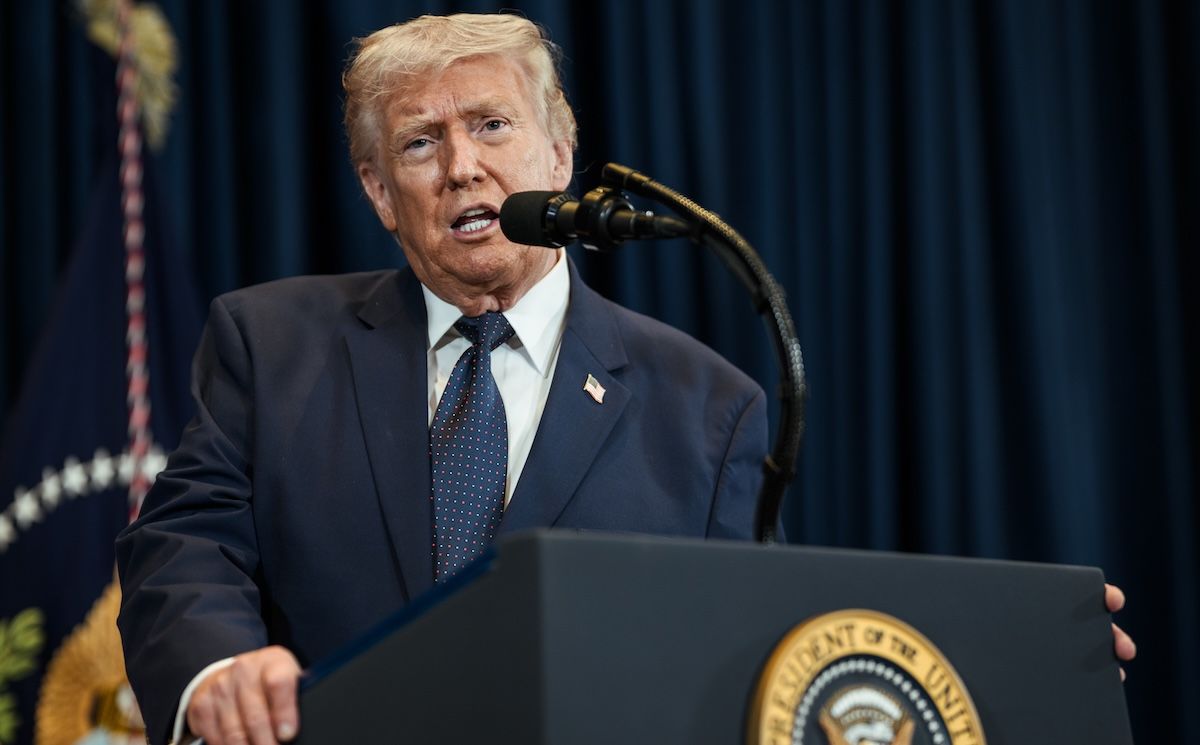
President Donald J. Trump delivers remarks at a press conference, March 9, 2026. (Official White House Photo by Daniel Torok)
The Trump administration unveiled a new National AI Legislative Framework today, outlining its preferred approach to establish a unified federal standard for artificial intelligence governance. The framework calls for new protections spanning children, intellectual property and energy costs, while also enacting a sweeping federal preemption of state AI laws.
The announcement comes as the White House and Republicans in Congress are also moving to translate this framework into legislation.
One new proposal led by Sen. Marsha Blackburn (R-Tenn.), dubbed the “TRUMP AMERICA AI Act,” attempts to overcome prior congressional resistance, including from Republicans, by weaving together protections for children, intellectual property and conservative speech alongside its state preemption measures. The act is being framed as a solution to protect the “‘4 Cs’” previously coined by influential conservative operative Mike Davis, “children, creators, conservatives, and communities,” while ensuring “American AI companies can innovate without cumbersome regulation.”
This renewed push follows the unsuccessful effort, led by Sen. Ted Cruz (R-Texas) last year, to pass a 10-year moratorium on states enforcing their own AI laws. After the measure passed the House in July, the Senate voted 99-1 to drop a version of the moratorium that was inserted into a budget reconciliation bill.
Following that legislative defeat, President Donald Trump signed an executive order in December to target state AI regulations.
The order charged the Department of Justice with developing a task force to challenge state AI laws and directed the Commerce Department to build a target list of "onerous" state regulations that hamper innovation, among other measures. And it tasked Congress with passing a “minimally burdensome national standard” that would “forbid” conflicting state AI laws. GOP congressional leadership and Blackburn are among those now seeking to codify the White House’s wishes into legislative text, hoping it can make it through Congress.
What’s in the framework?
The White House framework sets out the administration’s priorities for advancing US leadership in artificial intelligence by establishing a federal approach to AI governance. Key elements described in the framework include protections for children and better tools for parents to manage use and access, consumer protections against energy cost and scams, measures to enable individuals to prevent the unauthorized use of AI-generated digital replicas of their voice or likeness, and prohibitions on the government “coercing technology providers” to alter AI-generated content.
In addition, it calls for a series of proposals to limit regulation and support the development of AI, such as “regulatory sandboxes” and establishing federal datasets as a resource for AI model training. It explicitly opposes Congressional efforts to create a new federal rulemaking body to regulate AI broadly, and instead supports the “development and deployment of sector-specific AI applications through existing regulatory bodies” and “through industry-led standards.” It also said the administration would defer to the courts on the intellectual property questions concerning the use of copyrighted material for training.
Finally, it calls on Congress to preempt state AI laws that “impose undue burdens” and that it “must ensure that State laws do not govern areas better suited to the Federal Government or act contrary to the United States’ national strategy to achieve global AI dominance.” It does, however, acknowledge that preemption should not remove the ability of states to enforce laws of “general applicability,” including protecting children and consumers, state zoning laws (including to determine the placement of AI infrastructure), or rules governing a state’s own use of AI.
What’s in the legislation?
The TRUMP AMERICA AI Act spans numerous titles and targets several areas of AI policy, including protecting children, addressing creators' concerns, policing “woke” AI and supporting AI research. The legislation incorporates the Kids Online Safety Act (KOSA) and introduces new guardrails tailored to artificial intelligence. It places a specific duty of care on the developers of AI chatbots to prevent reasonably foreseeable harms to users. Furthermore, it includes the GUARD Act, which mandates a reasonable age verification process for AI chatbots and explicitly prohibits minors from accessing "AI companions."
It also incorporates the NO FAKES Act, which Blackburn has championed. This would establish a federal property right for individuals over their voice and visual likeness, making it illegal to produce or distribute unauthorized digital replicas (deepfakes), among other protections for copyrighted material.
Picking up on a recurring grievance for the Trump administration and many on the right, it also includes measures to address the alleged censorship and bias of AI models toward conservatives. It mandates independent, third-party audits for "high-risk" AI systems specifically to detect "viewpoint discrimination or discrimination based on political affiliation." It further outlines "unbiased artificial intelligence principles" for federal procurement, explicitly forbidding the use of large language models that feature "ideological dogma, such as diversity, equity, and inclusion" or that manipulate outputs to favor specific political judgments.
The draft legislation also, perhaps surprisingly, includes a provision to repeal Section 230, the internet’s foundational liability shield. The inclusion of such a measure comes on the heels of a Senate hearing on Wednesday, where both Democratic and Republican senators appeared hesitant to completely roll back or sunset the law.
Moreover, in an effort to mollify state and other lawmakers' concerns on AI safety, which could be overruled given the proposals’ preemption language, it proposes federal mechanisms to monitor advanced AI. This includes establishing an Advanced Artificial Intelligence Evaluation Program housed within the Department of Energy, tasked with testing advanced AI systems for severe risks.
What’s next?
The emergence of the framework and the proposed legislation is the result of a contentious and protracted debate over who should control the future of AI regulation.
The push for a federal standard is not new, but previous efforts, particularly those involving preempting state laws, have faced fierce, bipartisan opposition. The failure of Cruz's 2025 moratorium push could be partly attributed to Blackburn herself, who argued at the time that Congress could not block states from protecting their citizens until lawmakers passed federal legislation like KOSA. In July 2024, the Senate passed a package of kid-focused bills that included KOSA and the Children and Teens’ Online Privacy Protection Act, only for it to die in the House amid opposition from House GOP leadership.
Now, the White House, Republican House leadership and Blackburn are putting forth and developing legislation in a bid to align on a framework.
By fusing AI regulation with online child safety, they also aim to build broader support, given the pushback from lawmakers on the issue. Trump’s executive order contained a specific carve-out preserving state child safety laws, a clear nod to the political reality that protecting children was a non-negotiable priority for key lawmakers.
The inclusion of child-safety laws also seems intended to build on recent momentum in the House. Last month, the GOP-led House Energy and Commerce Committee advanced a package of kids' online safety bills on largely partisan lines. However, House Republicans also significantly altered aspects of the legislation, expanding federal preemption language and stripping out the "duty of care" provision, a key part of the Senate's KOSA legislation. The maneuvers have sparked opposition from both Senate Democrats and Republicans such as Blackburn, dimming its chances of passage barring an agreement between lawmakers in both chambers.
The new effort may also have to contend with opposition from Republican lawmakers at the state level. Earlier this month, more than 50 Republican state lawmakers sent a letter to Trump expressing that they are "deeply concerned" by the administration's efforts to interfere with state AI legislation, warning that federal preemption strips states of their sovereignty and leaves them unable to respond to emerging local harms. The letter came after the Trump administration sent a letter in February to the Republican leader of the Utah Senate opposing a state bill that would require AI developers to publish public safety and child protection plans.
Last year’s pushback to Cruz’s federal AI moratorium also included Republican governors, such as Arkansas Gov. Sarah Huckabee Sanders, who led a group opposing the effort. As a result, the bill’s trajectory may depend as much on navigating these state-federal tensions among Republican lawmakers as on building consensus in Congress.
Authors