When Nigeria’s Election Technology Cannot Recognize the Voter
Habeeb Adisa / Sep 18, 2026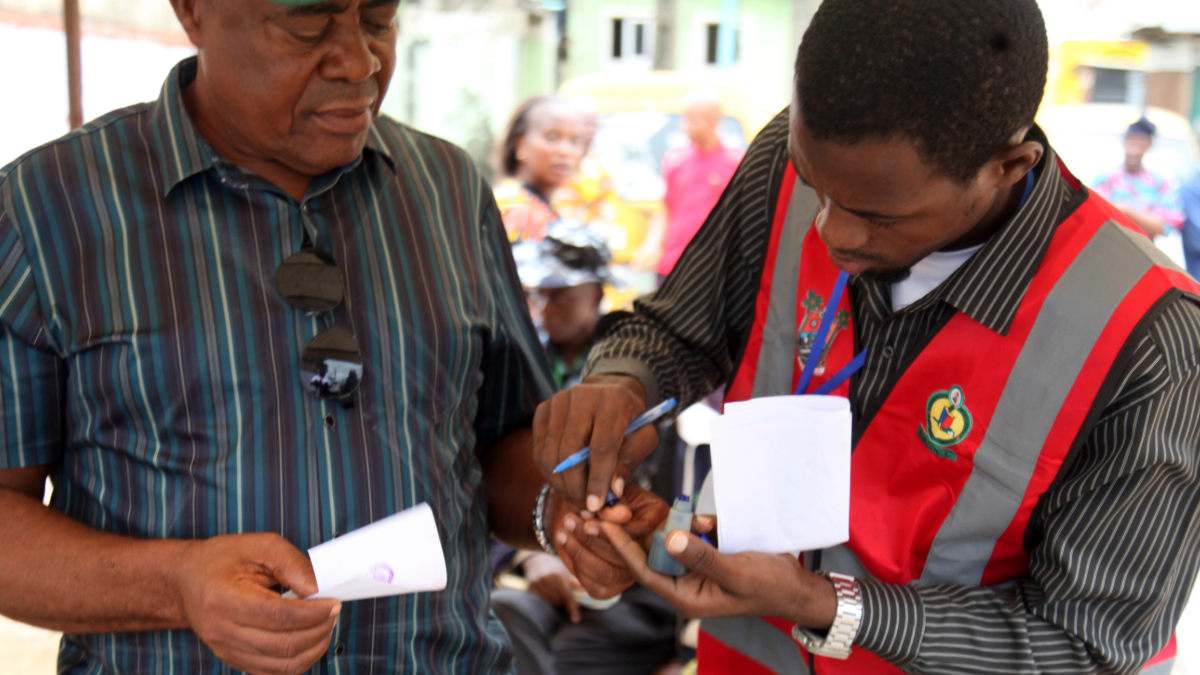
An official of the Lagos State Independent Electoral Commission (LASIEC) marks a voter's finger with ink in Lagos, Nigeria, on July 12, 2025. (Photo by Adekunle Ajayi/NurPhoto via AP)
A 90-year-old woman arrived at a polling station in Nigeria's Ekiti State on June 20 to vote in a governorship election. She had a voter registration card and was physically present at the polling unit. But the machine required to verify her identity could not recognize her.
The Bimodal Voter Accreditation System, known as BVAS, uses fingerprints and facial recognition to verify voters before they can cast a ballot. The device failed to capture either biometric identifier for the woman at Polling Unit 007 in Ado 'J' Okesa. Officials at other polling units also reported repeatedly retrying elderly voters whom the system would not recognize.
Nigeria's Electoral Act 2026 sets out procedures for some failures of election technology. If an accreditation device fails, Section 47(3) provides for its replacement and, if the failure cannot be remedied under the specified conditions, for the election at the affected polling unit to be canceled and rerun. It is less clear what happens when the device is functioning but cannot authenticate an otherwise eligible voter.
That gap matters as Nigeria prepares for its next national election on Jan. 16, 2027. A biometric system can be highly reliable overall and still exclude individual voters. Nigeria's new law is explicit about some kinds of election-technology failure. Section 47(2) requires voters to be accredited through BVAS or another technological device prescribed by the Independent National Electoral Commission (INEC). Section 47(3) provides a recovery path when that device fails, while Section 60(3) preserves the signed paper result when communications make electronic transmission impossible. Structured observation shows the pattern.
Nigeria Civil Society Situation Room deployed observers across all 16 local government areas of Ekiti State; its partner networks deployed more than 200 accredited observers. Its final statement found that where BVAS malfunctioned, facial authentication especially affected elderly voters.
Yiaga Africa, using a statistical sample of 250 polling units, reported that in 10 percent of sampled units, some voters were denied accreditation because BVAS failed to verify Permanent Voter Cards (PVCs) or authenticate fingerprints or facial biometrics. At the same time, the EU-SDGN Election Observation Hub reported 96 percent BVAS performance across 246 observed polling units. High overall functionality and individual exclusion are not contradictory findings. They are precisely why the failures that remain need to be counted.
A box to tick
INEC has already shown how an election bureaucracy can handle failed biometric recognition. Under the 2022 guidelines, three failed biometric attempts resulted in a formal 'Failed Accreditation' (FA) record in the voter register. There was no fallback, but there was a box to tick. The procedure's outcome was exclusion.
Those rules have since been replaced. INEC has issued 2026 Regulations and Guidelines under the new Act, and its current public explanation keeps the decisive outcome: when the biometrics do not match, BVAS locks the voter out. Public reporting from Ekiti and Osun does not disclose how those individual failed matches were classified or aggregated after voters were turned away. That is the live accountability gap before January. Whatever internal code INEC now uses, the accountability standard is straightforward. INEC should be able to show how many registered voters reached the biometric gate, exhausted the available checks, and left without voting because the system could not match them. A system that makes machine recognition a legal condition of voting should not make failed recognition disappear into an unreported residual.
Disability at the gate
The disability problem is already written into the Act. Section 9 requires the voter register to include disability status disaggregated by type, while Section 54 requires reasonable steps to assist persons with disabilities, people with special needs and other vulnerable voters, including Braille, large embossed print, electronic devices, sign-language interpretation and, in appropriate cases, off-site voting.
Section 54 is still headed "visually impaired and incapacitated voters," archaic language in a statute governing a digital election. But the larger contradiction sits between those provisions. The law recognizes disability when the register is built and promises assistance once a voter reaches the ballot. Between those protections sits biometric accreditation. A registered voter can reach that threshold, fail to match, and find no equivalent individual remedy in the Act. Recognition exists before the gate. Assistance exists after it. At the gate itself, exclusion can be final.
Article 29 of the UN Convention on the Rights of Persons with Disabilities requires equal political participation and accessible voting procedures. The same governance problem also goes beyond elections. A ten-country African Digital Rights Network study published with the Institute of Development Studies documents biometric identity systems increasingly gaining access to voting, social protection, banking, mobile services, education and health. Nigeria's election is a particularly visible test of a broader rule: when machine recognition becomes mandatory, redress for failed recognition becomes part of the system, not an optional add-on.
From system reliability to individual redress
After Ekiti, civil-society observers urged INEC to provide an alternative verification route for eligible elderly voters whom BVAS could not recognize. Two months later, similar problems appeared in Osun. In Ikirun, 55-year-old Sharafa Lasisi said he was sent away after facial verification failed, returned, and failed again.
Before the January 16, 2027 national election, the accountability test is not another assurance that BVAS will usually work. INEC needs to say what the 2026 rules require after an individual failed to match, publish how many such failures occurred in Ekiti and Osun; however, those cases are now classified, and explain what changed after those elections. If the Commission concludes that the Act leaves no lawful room for a secure individual exception, the question moves to the National Assembly: whether the statute should provide one.
On a national scale, even a small failure rate can represent many people. But the principle does not depend on a large number. The 90-year-old woman at Ado 'J' Okesa was physically present at her polling unit. The machine still could not read her.
The test for 2027 is whether Nigeria can measure, explain and remedy the cases in which it does not work for the right person. A system with recovery paths for broken machines and broken networks, but no clear route for the citizens its machine cannot recognize, has not eliminated technological uncertainty. It has decided who must absorb it.
Authors