What to Do About the Coming Glut of AI Data Centers
Mark MacCarthy / Oct 27, 2026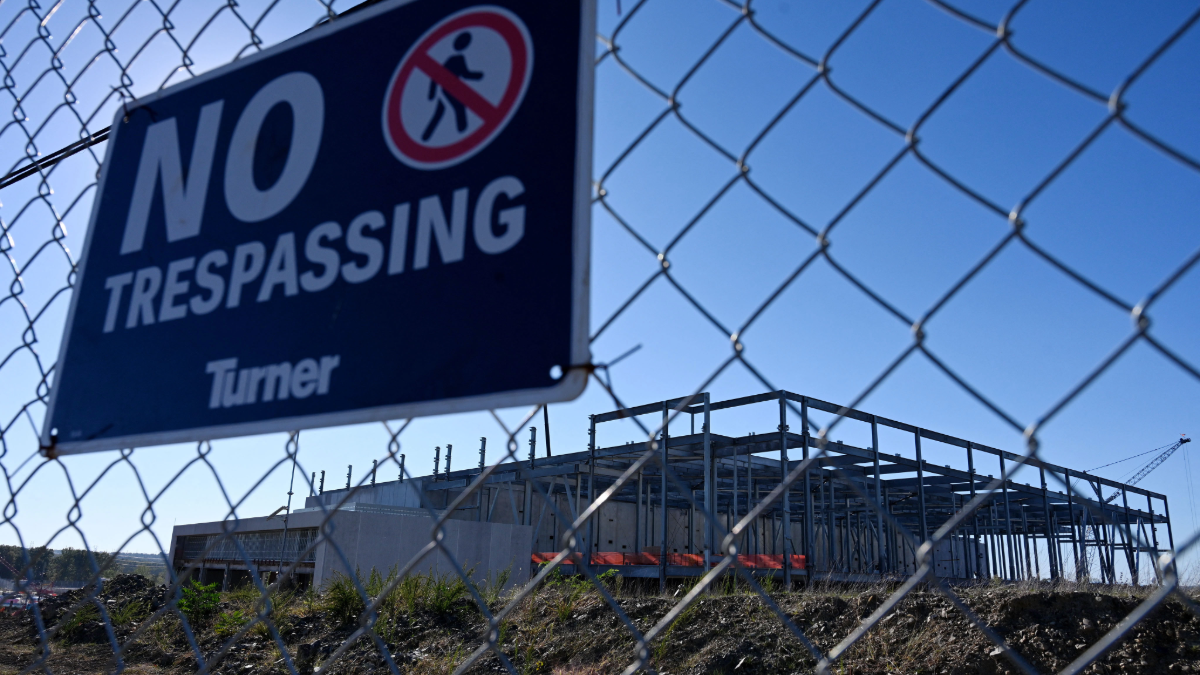
A data center is under construction in Loudoun County, Virginia on October 7, 2026. The region houses the world's largest concentration of data centers, making Virginia the nation's digital capital. (Photo by Olivier Douliery/Sipa via AP Images)
There is a current shortage of AI data centers, but that shortage is temporary. More AI data centers will be built than will be needed to satisfy future AI compute demand. The industry is in the throes of a familiar bubble, where more investment flows into constructing facilities for a new technology than can be supported by customer demand. This has happened before with railroads and internet communications facilities and is happening again now with AI data centers.
An oversupply is usually followed by a contraction — prices and supply collapse until an equilibrium is restored. But in this case the overexpansion of AI data centers is so large that the contraction is likely to have substantial macroeconomic consequences, a rapid decline in stock values and economic activity across the economy. This sequence of a recession following an overexpansion is also a familiar pattern established by the earlier overexpansion of railroads and internet facilities.
Regulation can serve several purposes other than preventing the coming AI data center crash. Policymakers generally know how to protect electricity ratepayers from paying the costs of providing service to AI data centers and picking up the bill for stranded transmission and distribution facilities no longer needed to supply AI data centers. Policymakers are moving toward AI safety regulation needed to protect against dangerous AI experiments by AI developers. Congress should begin a series of hearings on the liability of AI developers and deployers for damages caused by AI models and agents, and a system of insurance needed to make sure victims of these mishaps can be compensated. Policymakers must also begin to address inaccuracies and unreliability of AI models, especially in consequential areas such as providing health information to the public. Along with collaborators, I will be addressing these issues in upcoming commentaries.
Unfortunately, the system of governance in the US does not provide policy tools to prevent the coming oversupply-contraction cycle in AI data centers. Generally speaking investors are free to put their money where they feel they can earn the largest return, even if the collective result is an economic crash. Policymakers should be aware, however, of the industry dynamics that are leading to this outcome, even if there is little they can do to stop it.
AI data centers today and tomorrow
Chips are the key physical elements in an AI data center. Strung together in elaborate layouts of ever-increasing density within enormous physical structures, they are the devices that AI companies use to train and operate their AI models. There are shortages of chips, especially memory chips, and prices for these scarce items are soaring. But the major cloud computing companies, Amazon, Google, and Microsoft have been able to secure a steady supply of chips from providers like Nvidia and have begun to develop chips of their own.
In addition to chips, data centers costs include land, design and engineering expenses, construction of physical structures, power, cooling facilities, and networking expenses. Together with Meta, the three major cloud companies are expected to devote roughly $750 billion to capital expenditures this year alone, almost all of it focused on these AI infrastructure expenses.
Often independent developers build and operate data centers specifically designed to handle AI workloads and lease them to cloud computing tenants or directly to AI developers. One of these “neocloud” providers, CoreWeave, for example, has Microsoft, OpenAI and Meta as leading customers.
The leading AI companies, including Anthropic and OpenAI, have been scrambling to secure adequate compute through contracts with companies operating data centers and providing chips. Anthropic said it expects to spend at least $518 billion over the coming decade building AI infrastructure with six partners including the big three cloud computing companies, Google, Microsoft and Amazon, according to a confidential IPO prospectus. Including chip deals with companies like Broadcom means that Anthropic’s future AI infrastructure costs top $600 billion, according to its draft S1 prospectus, a figure confirmed by the formal release of its prospectus on October 26.
There is a widely recognized shortfall in current data center capacity. As Wall Street Journal reporter Asa Fitch noted, “A data-center crunch is coming.” According to a recent Morgan Stanley analysis, estimated global demand for data center capacity will be “about 56 gigawatts next year, with just 51 gigawatts of new facilities being energized.” In 2028, estimated demand climbs to 86 gigawatts, but “only 68 gigawatts of computing power come online.”
Protests against data centers have the potential to slow data center expansion to meet this unmet demand. Texas and New York have halted the construction of new AI data centers and Pennsylvania and Oregon have imposed new limits. Heatmap reports the “cancellation” of $260 billion worth of data center projects in 2026.
Some of this is a healthy shakeout. Utilities have known for some time about “phantom” data centers, where companies operating data centers ask utilities for power they might not need, sometimes because they file the same energy requests with several utilities at the same time. But new requirements on potential data center customers have begun to purge utility wait lists of phantom data centers.
Despite protests and moratoria, data center expansion still seems to be on track. The industry analysis firm, Semianalysis, estimates that data center capacity will double in 2027 compared with 2026.
The ultimate driver of this demand for AI data centers is increasing usage of AI services, mostly by enterprises, but also by individual users. By one estimate consumer AI spending has reached $40 billion this year, more than triple what it was a year ago. Anthropic’s AI revenue from AI services jumped to $16.3 billion in the six months ended June 30, up from $1.1 billion in the year-earlier period.
Token usage — the unit of input and output by which AI processing is measured — is also exploding. Right now, global throughput of tokens is estimated to be roughly 438.6 trillion tokens per day and it has been increasing dramatically over the last few years. In May 2024, Google was processing 9.7 trillion tokens across all its services; that figure surged to over 3.2 quadrillion tokens by May 2026. The developer routing platform for large language models OpenRouter grew its annual run rate from 10 trillion tokens to more than 100 trillion tokens in mid-2025.
The growth in token usage is fueled by the rise of agentic AI, reasoning models and the increasing need to re-read old material to generate new answers and actions. Goldman Sachs thinks token demand might increase by another 24x to 70x by 2030, pushing monthly global consumption to a massive 120 quadrillion.
The overexpansion of data centers
With demand for AI services growing at such a rapid rate, data center capacity clearly needs to increase beyond today’s levels. But it is also true that a speculative bubble is forming and that more AI data centers will be built than is needed to meet future AI demand.
A Brookings report from September provides a sense of the size of the AI investment boom. It projects that AI investment will total an enormous $10.3 trillion from 2025 to 2032, or an average of 3.63% of U.S. gross domestic product per year. This projected buildout “would be larger relative to the economy than the major US canal, railroad, electrification, highway, and telecommunications investment booms.” The report notes that systemic financial risk from this investment is hidden from public view in “opaque off-balance sheet financing through joint ventures, private credit, securitization, special-purpose vehicles, lease commitments, loan guarantees, and other structures.”
But even from the outside, the dangers can be seen. Gartner recently forecast that $3.5 trillion in AI infrastructure investment could be exposed to impairment by 2030. While the industry will spend $7 trillion on infrastructure through 2030, according to Gartner, they will generate no more than $3.6 trillion in related revenue over that same period. Moreover, the report said that 80% of the neocloud companies — the data centers that specialize in AI workloads — would cease independent operations. The ultimate reason for these failures, the report argues, is the insufficiency of AI demand as “enterprise and consumer AI revenue will be insufficient to support profitable returns on all planned AI capital expenditures during this period.”
As investor Ray Dalio said in explaining why he thinks the market is “almost certainly” in an AI bubble, “I think all of Corporate America is looking at their bills from Anthropic and OpenAI and going, ‘Okay, we need to think about how to make sure we’re getting productivity out of this.’”
Torsten Slok, chief economist with the asset management firm Apollo, is even more negative. With profit margins flat for the S&P 500 minus tech and no sign of AI productivity gains, he writes, “mainstream corporate America is pulling back and starting to view token spending not as a source of growth but as a cost center that weighs on margins.”
As if on cue, the markets immediately punished the neoclouds and the vehicles used to finance data center projects. CoreWeave’s stock fell 17% during the week, in line with declines from other neoclouds including Nebius and Iren. Bonds issued by CoreWeave sank to distress levels below 80 cents on the dollar, and bonds issued to fund data center buildout projects declined markedly, indicating investors were no longer confident that they would receive their payout.
There is clearly too much debt chasing too few dollars in the data center market. But the underlying driver of data center risk is not from shaky financing on the part of the intermediaries seeking to join the data center bandwagon. It is the discrepancy between the compute AI developers say they need and what they will ultimately use.
A classic race dynamic has developed where no company can abandon its quest for more compute because its competitors will press on even if it stops. Abandoning the race means its rivals will gain more customers, revenue and market share until they have an insuperable lead. Each company keeps ordering up more data center capacity until it has enough to service the entire market all by itself. As venture capitalist Paul Kedrosky says, this prisoner’s dilemma dynamic means that an oversupply will be inevitable, just as it was in the case of railroads, where rival companies built competing lines running alongside each other.
The way forward
AI investment at its current scale is fraught with problems, even without the risk of a collapse. It is inflationary and generates less employment than comparable investments in typical industries. Moreover, an outsized proportion of US investment and almost all the growth in investment is focused on one kind of AI, large language models. But going all-in on large language models is likely crowding out other needed investments in traditional manufacturing and construction to say nothing of investments in other important new technologies such as embodied AI and robotics, electric vehicles, clean energy such as wind and solar, quantum technology, biotechnology, aerospace and advanced telecommunications.
Still, US policymakers have few policy tools that can save investors from their own foolishness and redirect investment toward more productive ends. Perhaps it would be better if the US had such policy instruments, but the nation does not and cannot invent new ones in time to respond to this crisis.
“If something cannot go on forever, it will stop,” economist Herb Stein famously said. And so policymakers might feel comfortable doing nothing about the coming glut of AI data centers, since such an unsustainable thing will naturally come to a halt on its own, even if the consequences for the nation are severe.
But complacency about the fate of irresponsible speculators and a dearth of government policy instruments to affect the amount and direction of US investment should not lead policymakers to ignore the steps they can take.
Protecting electricity ratepayers, establishing effective safety regulation, exploring liability and insurance requirements, and limiting the harmful effects of AI misinformation should all be on the policy agenda. The next Congress can and should take action in these areas.
Authors