What the Bond Market Disruption Means for Rebuilding American Tech Policy
Cole Donovan / Aug 24, 2026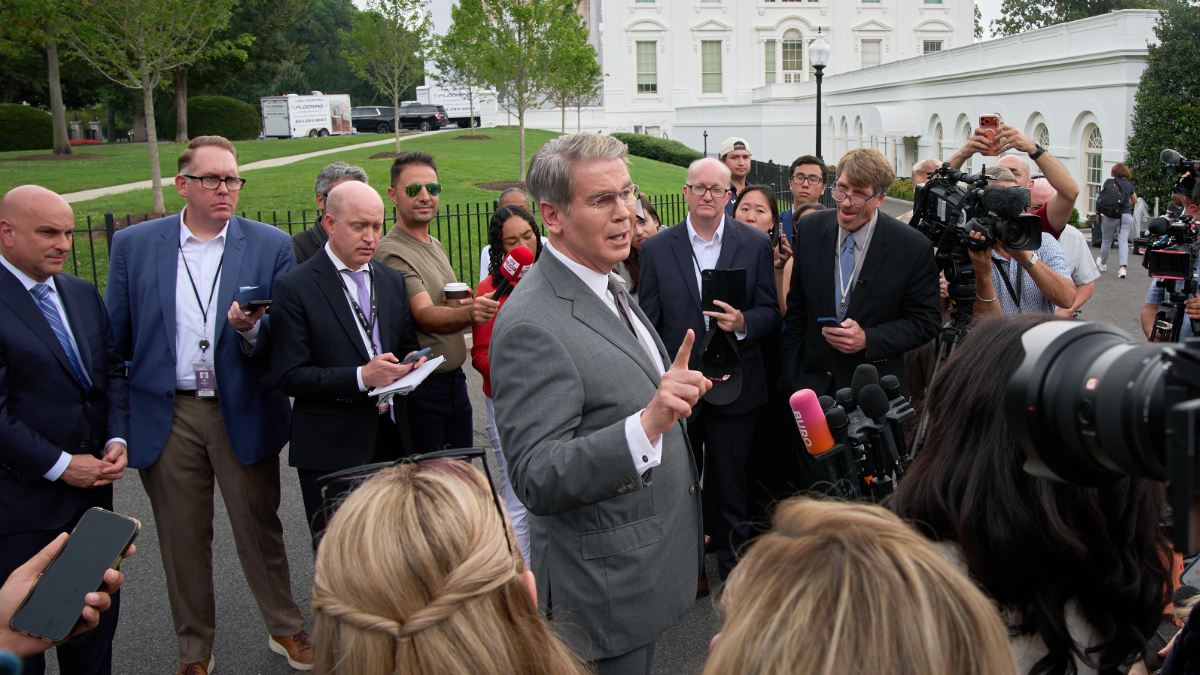
United States Treasury Secretary Scott Bessent speaks to members of the media outside the White House in Washington, Thursday, Aug. 20, 2026. (AP Photo/Jacquelyn Martin)
If you pay attention to financial news and markets, you’ve likely seen headlines about weakness in the United States bond market. This includes the fact that the first round of policy interventions attempted by Treasury Secretary Scott Bessent haven’t worked. Accompanying headlines include the fact that the US national debt has surpassed $40 trillion and that similar interventions into Japanese currency have also failed.
The story is actually much bigger than bonds for US policy. Bonds, as a safe haven asset, are financial instruments that you purchase when you want to invest in the long term and are worried about the stability of literally everything else. This means that if you’re buying a 10 or 30 year bond, you’re confident in the fiscal soundness of the US in that timeline (as well as the country’s commitment to pay when the bill comes due). So when the bond market weakens, that signals increased concern about the US fiscal situation. Bessent has suggested that fiscal consolidation is coming. That’s where tech policy experts need to pay attention.
None of this is much of a surprise. In 2016, I recall speaking to former White House science advisors about large scale science projects scheduled to come online in the early 2030s. One of them commented that projects with major expenditures in that period would be placed under extreme budget pressure due to our worsening fiscal situation. Thanks to the massive fiscal interventions required during COVID-19, successive waves of tax cuts, and eye-popping increases in defense and immigration enforcement spending, it’s safe to say the timeline has advanced substantially.
Contextualizing US public spending
The first thing to understand is the relative breakdown of the federal budget. Under President Donald Trump, defense spending is now the single largest expenditure at $1.6 trillion. The next two largest expenditures are medicare ($1.4 trillion), Social Security ($1.3 trillion), followed by interest servicing the federal debt ($1.1 trillion). That last number is key–interest servicing the debt now exceeds that of all other non-defense discretionary spending, which only accounts for about 14 percent of the total budget. According to the Center for Budget and Policy Priorities, the total expenditure of the US in non-defense discretionary expenditures is at historic lows, at least as far back as data are available.
Non-defense discretionary spending is where most of tech policy lives (except for matters related to the military). Military research and development (R&D), which is overwhelmingly spent on new platform development, stands at about $100 billion, which is roughly the same amount that’s spent on science and technology everywhere else. R&D spending covers everything from grants issued to universities by the National Science Foundation (less than $10 billion) to all of the infrastructure supporting weather forecasts (about $1.5 billion).
All of this spending is investment in the non-military activities of the country, from the stuff that supports commercial agriculture to healthcare research and the things that make food safe to eat. It includes the development of new energy technology, safety standards, and measurements that support international trade. It also includes spending for things like education, which is a country’s ultimate investment in its own future.
Why this matters now, and what it means for the future
Even without the current bond situation, a future administration could be expected to face considerable pressure to engage in fiscal consolidation. Consolidation comes in two forms: increasing revenues and reducing spending. Even if the US wipes out all of the investments that it makes into the architecture that supports science and tech policy in this country (as well as the IRS, which is needed to collect the revenues needed to pay our bills), it would still not be enough to balance the budget. This doesn’t mean that pain is not coming, but it helps to know all of this before having a serious conversation about what the US must do to get its fiscal house in order.
This administration has already committed itself to radical, undirected, and ineffective budget cuts while arguing for significant increases in spending for defense programs. Expect most of the administration’s position to be focused on locking in its proposed non-defense budget cuts for 2027 and beyond, and then for a future administration to be faced with proposals for things like binding deficit commissions.
If you’re someone who supports the US government’s role in science and technology, that means thinking now about the justifications for future investments in science, technology, and education. An honest conversation is going to have to admit that taxes have to go up, especially if you want to maintain investments in science and technology and embark on a massive rebuilding exercise that’s focused on reestablishing the science and technology ecosystem.
The bond situation is a leading indicator in other people’s confidence in the stability of the US government. When the country is engaged in highly disruptive wars, like the one in Iran, or making trade enemies with its neighbors, people start treating the US as a less dependable force for global good. While US dependability has always been a bit of a myth (especially in science policy), the fact that it was considered a generally stabilizing force meant that people in the rest of the world were willing to continue making bets on it.
What the bond crisis reflects is ultimately a loss of influence and trust in the position of the US. It’s an indicator of the fact that the toolbox that US policymakers had to affect global affairs based on trust and reliability are weakening. The US is becoming a normal country, and that’s going to have major impacts on the amount of rope that countries are willing to grant American negotiators when negotiating everything from standards treaties to tech regulations. People pulling out of the US bond market should be treated as equivalent to actions taken by foreign governments to reduce their exposure to US technology and a re-alignment toward new technology alliances where the US is absent.
And then there’s US competition with China
The impacts of the current moment are particularly acute when thinking about US-China technology competition. The ability of the US to successfully engage in a competition depends on two factors—overwhelming technological supremacy and the ability to serve as a credible deterrent to PRC expansion, especially with respect to Taiwan. Previous administrations have recognized the global economic risk extending from the concentration of the semiconductor industry in Taiwan and Korea–something we got to preview with technology shortages during the COVID-19.
The debt situation—paired with the depletion of precision weapons with Iran in a remarkably short period of time, despite a $1.6 trillion dollar defense budget—makes this all much more precarious. Reinvestment in infrastructure, technology, and even defense support are all imperiled if the US cannot finance the competition effectively, and certainly not without having significant deleterious effects on the rest of the economy. When paired with the fact that the US was already on the ropes with respect to its national laboratories and doesn’t even know how much they cost to run and maintain, the prospects of the country being able to effectuate a technology competition look about as bad as its ability to control the Strait of Hormuz. The geopolitical situation forces US policymakers to reckon with the fact that the US has limited resources, authorities, and weakening alliances. Overconfident assertions of Pax Americana are unlikely to work.
Impact on future rebuilding efforts
Multiple groups are working on pulling together plans to rebuild the country in the aftermath of the current presidency. As I noted before, those efforts can only succeed if there is a nuts and bolts approach to decision-making and the core functions of government. All of this is imperiled by the current situation. If the administration uses this moment to cut core technology functions and eliminate government control of spaceflight safety systems, things could get much, much worse.
Future support for technology programs is far from guaranteed. Recall that billions of dollars in CHIPS and Science funding failed to materialize in the wake of 2023 budget caps deals after Republicans took the House. Without a theory of political influence that balances the multitude of competing factors in technology—from the state of the electric grid, the damage to weather forecasting, and the gutting of research programs, a future administration will also fall short. This will require honest assessments of what can be done, the tools necessary to do it, and what it will cost. The old adage “show me your budget and I’ll show you your strategy” certainly applies.
The US has come out of dire fiscal situations before, though not without sacrifice. At the start of World War II, President Franklin Delano Roosevelt made the case to the nation for higher taxes and resource rationing in his “Call for Sacrifice” speech. President John F. Kennedy, Jr. made similar arguments when he asked Americans to pay for the Apollo space program, as did Ronald Reagan in an Easter and Passover address when he asked Congress to increase funding for fundamental research. American citizens need to know what is being asked of them, what it will cost, and the consequences of inaction. The blowback against data centers should serve as a warning of what will happen if policymakers impose financial and physical costs on society without earning the public’s trust.
Yet the benefits of rebuilding far outweigh the costs of the long-term struggle. Science and technology offer the world more than new knowledge and flashier devices. From cancer to the climate crisis, they are the source of solutions for some of our most vexing problems. We need to give ourselves, our children, and successive generations the best shot at a better future that we can muster. “After all, the tradition of hope is one we can’t afford to forget.”
Authors