UN's Global Digital Compact Review Could Sideline the Global South
Emrys Schoemaker / Sep 19, 2026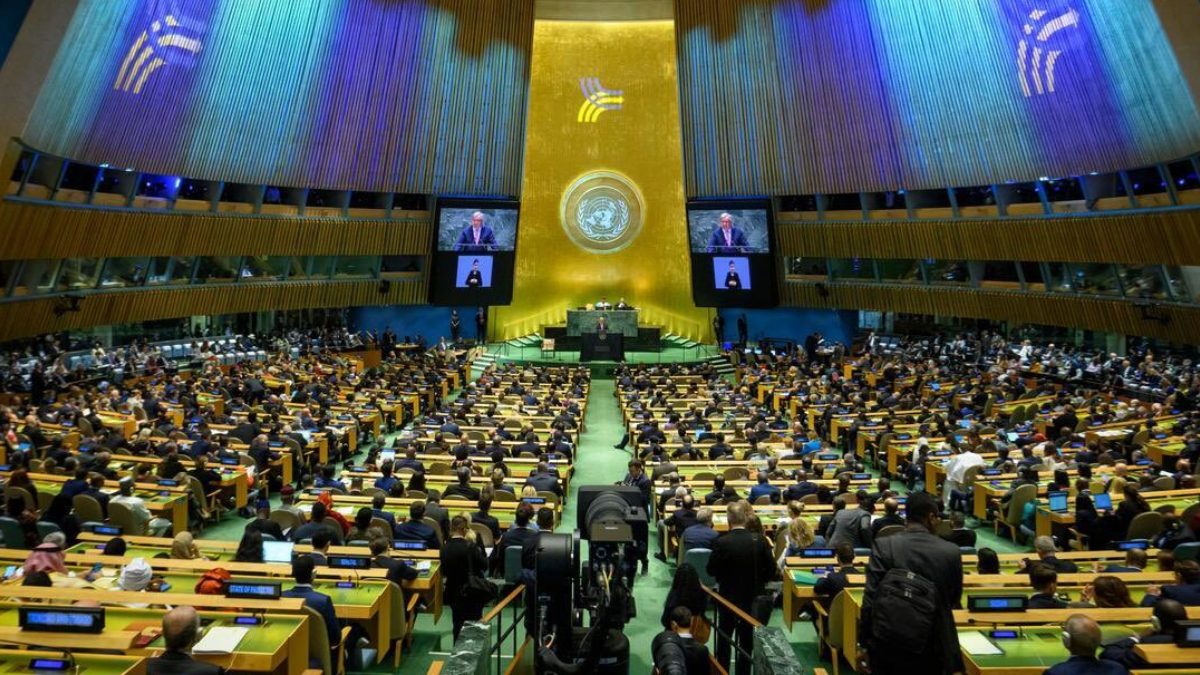
The Global Digital Compact was adopted at the UN General Assembly in New York City on September 23rd, 2024. Source
As the policymakers and the public fret over how to govern artificial intelligence, what role the United Nations should play is a subject of debate. But when a new UN Secretary-General takes office on January 1, 2027, one of the most consequential decisions facing the organization about the role it will play in governing the future of technology may already have been decided. The answer could hinge not on a landmark vote, but on a procedural decision about the scope of a review that almost nobody is watching. At stake is more than the UN’s relevance. It is whether countries that may never get a fair chance to build the digital future have any hand in shaping it.
The Global Digital Compact, a UN Framework for international cooperation on digital governance, adopted by consensus in 2024, is due for review in 2027. How that review is scoped will impact issues ranging from connectivity to data use, digital public infrastructure, cyber security and AI. The stakes are not procedural: standards encode the assumptions of whoever writes them, while the cost of adapting falls on those that did not. Early advantages compound, and the path that consolidates need not be the best one, only the one that arrived first.
While the Global Digital Compact gives the UN an important convening role, the organization has to navigate the contested geopolitics of AI and an increasingly fragmented global patchwork of digital governance arrangements. Some countries and regions regulate; others coordinate without regulating. The World AI Cooperation Organization, for instance, founded in Shanghai in July with 29 members led by China, is a cooperation body, not a rule-making one. Some work by other means entirely, as the US-led effort on the AI supply chain Pax Silica does, by coordinating the resources and raw materials necessary for compute. Others are voluntary or technical, and are already doing quiet work: the OECD principles, the G7 Hiroshima code, the AI safety institutes network, ASEAN arrangements, a new mechanism on state conduct in cyberspace and a controversial cybercrime convention heading for its own conference of parties.
Each is coherent and legitimate on its own terms, and each decides its own membership, which means none offer standing to anyone outside it. For States with something to trade, that is workable. For those without, these are not governance mechanisms but queues, and the price of admission is often the thing joining was meant to protect: compute and standards arrive on terms the recipient cannot set. That is dependency with better access. Speaking for the Group of 77 and China in July, a representative from Uruguay put it plainly: the next divide "will increasingly be about access to the capacity to shape technology". It is telling that the States with the least leverage are the ones defending the universal venue most strongly.
The Compact commits to a review "with the input and meaningful participation of all stakeholders", a process that is left to co-facilitators appointed by the President of the General Assembly. Scoped widely, the review is the one place where these arrangements can be assessed against a single set of expectations by everyone they affect. Scoped narrowly, it simply takes stock of the Compact's own paragraphs: accurate, uncontested and irrelevant to the architecture around it.
The breadth of the review will therefore help determine who has a voice in shaping the digital future. Here are five things the UN can do to ensure that future is more inclusive.
- Agree what the portfolio is for. The incoming Secretary-General inherits an independent scientific panel that has delivered its first report, a capacity-building network with centers nominated in more than twenty countries, a proposed three billion dollar Global Fund for AI, and an Internet Governance Forum made permanent last December. Instruments spanning AI, data, connectivity and infrastructure share a secretariat, but little else. Naming a common purpose is the first act of governance, and the review is the occasion for it.
- Close the gap that stops States using the representation they already have. There should be support for delegations without the expertise to follow a technical process, ministries without the capacity to form a position, and governments without a budget to send anyone to join negotiations. The instruments to deliver this exist, but thinly — UN implementing agencies, the capacity network, the proposed fund as well as the United Nations University network from Macau to the new institute on big data and AI in Bologna. The consultation will decide what participation is permitted, while the level of capacity will determine what is actually possible. It is critical to fund the capacity and open the modalities together, or neither works.
- Govern the inputs. Data quality, provenance and interoperability sit upstream of every model and every digital service, and there is little insight into the state of them. Three initiatives circle the question separately: the CSTD working group, the Beijing data organization and the cyber mechanism. Producing the assessment that does not exist is work the UN is placed to lead. The next instance is already arriving: post-quantum cryptography will force a re-standardization of every identity system, payment rail and registry in the world, on a timetable set by vendors and donors, and no forum owns it.
- Build confidence through peer review. Mutual evaluation has changed state behavior without binding authority before — the Universal Periodic Review, IMF Article IV surveillance, the Open Government Partnership's reporting mechanism. These are well tested approaches, are proportionate to what the UN can do, and absent from formal digital governance frameworks or regulation.
- Work on interoperability rather than architecture. The co-chairs' summary of the Global Dialogue in July put interoperability among its central themes, and rightly so. The goal should not be a new institution to bridge the others — this is not something anyone is asking for. Instead, the UN should play to its convening strengths to support arrangements built separately to work together, which is in the interest of Washington, Beijing, Brussels and tech companies alike. Much of that effort can run through machinery that already exists, in standards bodies and cybersecurity cooperation. But what really has no home — including issues such as loss of control over AI models and agents, and the energy demands of AI — is a shorter list than it looks, and can be named, and managed.
The choice is not between governing these technologies and leaving them alone. It is about the form that governance takes and who shapes it. No coalition can give every country a seat. The UN can — and is uniquely placed to build a broad consensus about what comes next.
Authors