Unless Flock is Reined In, Mass Video Surveillance Will Grow Even More Pervasive
Jake Laperruque / Aug 18, 2026Jake Laperruque is a fellow at Tech Policy Press.
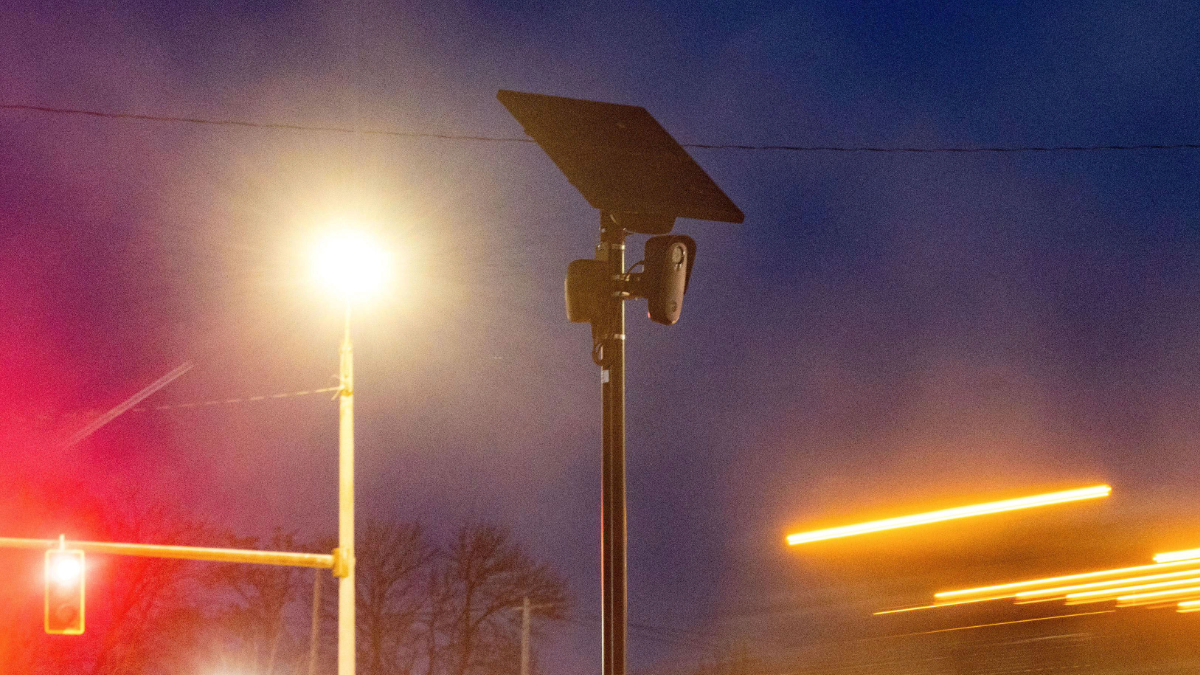
Flock Safety camera on Haverhill Drive near Phillips Avenue in Toledo, Ohio. (Photo by Stephen Zenner / SOPA Images/Sipa USA)(Sipa via AP Images)
Automated license plate reader (ALPR) systems in general, and the high-profile vendor Flock in particular, are facing a moment of public reckoning in the United States. This surveillance technology is provoking major backlash across the country, and becoming a prominent campaign issue. Dozens of cities have cancelled their Flock contracts, and Congress is considering cutting funding. There is even a growing trend of vigilantes destroying ALPR cameras.
An effort to push back against this pushback is underway. Over the past two weeks there’s been a flurry of pieces from voices on the right— including in the The Free Press, a Manhattan Institute senior fellow writing in The Atlantic, and alt-right figure Richard Hanania (who has previously argued that the only way to "solve" crime would be "more policing, incarceration, and surveillance of black people.") — that shrug off privacy concerns and praise Flock as a vital crimefighting tool. These claims may offer a messaging boost for Flock, but they’re paper thin as a substantive defense: There is simply no real evidence ALPRs are causing major drops in crime. In fact, as Jason Pye of the Due Process Institute details, there’s good countervailing evidence that ALPRs are merely hitching a free ride on the general post-pandemic crime drop that’s occurring across places both with and without the surveillance tool.
Adding to this PR push, on August 13, Flock announced a new set of policies aimed at responding to criticism, particularly a scathing report finding that dozens of officers have abused its tech to stalk romantic partners and other personal acquaintances. But while this update includes some meaningful changes — in particular it cuts standard data retention to one week — it mostly landed with a thud, with privacy experts flagging limits and exceptions to the new policy and highlighting that it still relies on self-policing to guard against misconduct.
And ultimately, only addressing the risks of ALPRs currently in the spotlight — stalking, abuse, and false positives leading to dangerous encounters — will leave a larger problem uncured: The current privacy risks from ALPRs are just the tip of the iceberg, and will dramatically expand in coming years. Unless they are seriously reined in, ALPR systems such as Flock will become a far more pervasive mass surveillance tool than they are today.
A warning sign of where ALPRs are headed can be seen in the AI driving analytics system being built up by the federal Customs and Border Protection agency (CBP). Under this system, all driving data from ALPRs is scanned and analyzed by AI software, then AI provides automated designations of driving patterns it deems “suspicious” and flags cars to be pulled over. According to the AP investigative report that unmasked this system, “The predictive intelligence program has resulted in people being stopped, searched and in some cases arrested.” Notably, Flock’s new one-week retention policy would have no impact on this emerging use of ALPRs. And contrary to the ‘nothing to hide, nothing to fear’ posture of Flock’s defenders, innocent behavior behind the wheel such as taking a back road, driving at odd hours, or going somewhere unusual could become an AI-generated basis for pulling you over.
The vendors pushing automated license plate readers also want their video surveillance networks to effortlessly track and catalog more than just license plates. There is a growing arsenal of automated video analytics tools that can allow the government to sift through footage to pull up types of vehicles, objects, movement paths, and people. As 404 Media recently reported, Flock is leaning into this creeping expansion of ALPRs into an all-purpose video scanner, with its “FreeForm” search function regularly used to scan the network’s stockpile of video footage for people. It’s not a stretch to envision this tool being used to track individuals based on demographic traits or political expression; there are already documented cases of officers running Flock FreeForm searches targeting people with Trump flags and bumper stickers.
Automated video analytics will also enable dragnet facial recognition. In the US, police typically use facial recognition by scanning a designated face from a crime scene photo. But efforts are already underway to create dragnet systems (sometimes referred to as “real-time facial recognition”) where instead of trying to ID a specific person, the AI scans every face that appears on a video feed and checks them against watchlists. This dragnet facial recognition has long been a key pillar of China’s Big Brother-esque surveillance apparatus, is being deployed increasingly across the United Kingdom, and last year made its first known US appearance in New Orleans. Fortunately, the New Orleans program was shut down in response to major public backlash. But we should expect more efforts to push this pervasive surveillance technology. And the networks of ALPR cameras increasingly blanketing America’s cities — combined with growing use of AI video analytics tools — offer a clear infrastructure that dragnet facial recognition could be grafted onto.
As video analytics technology continues to grow more powerful, and vendors continue to build out their camera networks to record more and more, we will likely see ALPRs mutate into an all-seeing eye that can be searched for any type of vehicle, object, or person just as easily as we now search for words in a text file. That is not a future a free and democratic society should allow. Stopping it will require far stronger measures than the type of agency protocols and administrative self-policing Flock and its proponents are offering. We need to curtail the proliferation of video surveillance networks across the country, and place strict limits — centered on independent, judicial review — on ALPR and other automated video analytics technologies.
Authors