UN Scientific Panel Warns of AI Concentration, But UN’s Vision Entrenches It
Bradley McNeil / Jul 21, 2026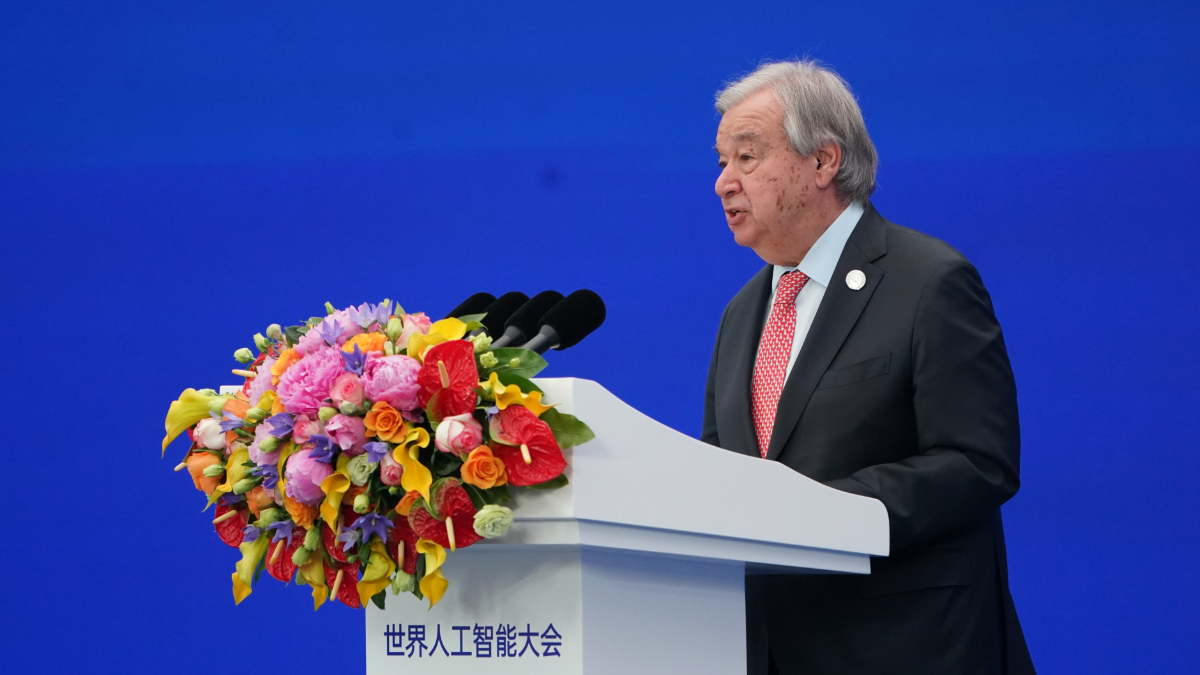
United Nations Secretary-General António Guterres addresses the opening ceremony of the 2026 World AI Conference and High-Level Meeting on Global AI Governance on July 17, 2026 in Shanghai, China. Themed "AI Partnership for a Brighter Future," the event included more than 140 forums, bringing together 1,400 guests from home and abroad. (Photo by VCG/VCG via AP)
The United Nations Independent International Scientific Panel on AI (IISPAI) is the latest in a growing series of UN initiatives aimed at shaping global AI governance, following efforts such as the 2023 High-Level Advisory Body on Artificial Intelligence and the negotiations leading to the 2024 Global Digital Compact (GDC) which outlined the UN’s commitment to “enhance international governance of AI for the benefit of humanity.”
The IISPAI’s preliminary report, released just ahead of the Global Dialogue on AI in Geneva earlier this month, reveals a tension at the heart of the UN’s wider global AI governance work. While the report recognizes the growing concentration of AI power in the hands of a few private corporations and countries, it simultaneously advocates for the rapid global diffusion of AI to unlock benefits in sectors such as health, education, food security while also promoting economic productivity, especially in Global South contexts. Achieving this vision depends on significant investments and contributions from the private sector to develop AI infrastructure globally, to support nations’ compute capacities, provide technical expertise, and cultivate enabling regulatory frameworks. In doing so, the UN risks reinforcing the very market structures and infrastructural dependencies on Global North Big Tech corporations that have led to current concentrations of power.
UN Secretary-General António Guterres introduced the IISPAI, which operates under a "strictly scientific, non-political mandate” as the “first global, fully independent scientific body dedicated to helping close the AI knowledge gap.” Yet the issues it addresses are not purely scientific; the questions it tackles in its pursuit of closing AI knowledge gaps, including those about how states should build AI capacity/compute, attract private investment, develop talent, and govern AI systems are fundamentally political. The IISPAI’s commitment to “balanced analysis of the risks and opportunities of AI”—defined as evaluating empirical evidence “without undue bias towards optimism or pessimism”—does not remove these political dimensions. Decisions about what constitutes an AI opportunity, what counts as a risk, and which governance pathways should be prioritized inevitably reflect underlying political assumptions about the role that AI systems should play in global society. Despite the IISPAI’s claims to independence, which require further substantiation, the Panel’s assumptions about the benefits and risks of global AI adoption are consistent with a broader trajectory in UN AI governance over the past several years.
As I argue in a recent study, which traces the UN’s AI governance discourse since 2019, the UN has consistently advanced an economic development approach to AI governance that frames AI adoption as a prerequisite for development and digital inclusion, while privileging private sector investment, cross-border data flows, and AI capacity building and diffusion in Global South emerging markets. These arrangements threaten to reinforce global reliance on Global North digital infrastructure. The primary concern driving the UN’s AI governance efforts has not been whether AI should be adopted. The UN treats the global spread of AI as inevitable and necessary. Instead, the UN is focused on determining how more countries can participate in the global AI economy while managing the risks of AI along the way.
If data was the fuel of the digital economy, compute—the computational infrastructure needed to develop and deploy advanced AI systems—is the defining resource of the AI economy. While the report points to evidence about AI systems and the inputs they rely on—such as computing power, data, and engineering talent—being concentrated in “a handful of firms in a handful of countries,” the report simultaneously promotes local infrastructure development which involves attracting private investment. However, private investment, even when undertaken by domestic corporations, does not necessarily translate into AI sovereignty. A country may build domestic data centers through domestic firms that still rely on NVIDIA chips, Microsoft and Amazon cloud services, and OpenAI models. Such infrastructural entanglements increase local AI capacity without necessarily increasing state’s domestic control over AI.
The IISPAI rightly observes that “Countries that rely on foreign models, cloud infrastructure and data pipelines may gain access to AI while losing practical control over its standards, safeguards and local fit.” It also acknowledges that developing advanced AI capabilities is increasingly beyond the reach of individual states, requiring “coalitions of countries or major stakeholders” to pool resources such as data, capital, compute, energy, and talent. Yet the Panel's proposed response—a UN-facilitated Global AI Fund—does not fully resolve this reliance on foreign infrastructure. To the extent that the fund depends on financial or in-kind contributions from dominant technology firms, including compute access, technical expertise, AI models, and training resources, it risks reinforcing the very dependencies it intends to overcome. The Global AI Fund may grant countries greater access to AI while remaining reliant on the tech corporations that control digital infrastructures on which those capabilities depend.
The UN’s global AI governance discourse appears to simultaneously throttle the gas and brakes on AI, promoting global AI adoption while it warns about the serious risks it poses to society. The UN must, at some point, acknowledge that the global diffusion of AI technologies and challenging AI market concentration are fundamentally different governance objectives. Rapid global AI adoption necessarily involves more global users, more investments in private infrastructure, and more global participation in an AI economy currently dominated by Big Tech corporations.
The IISPAI does deserve credit for confronting the political economy of AI more directly than previous UN AI governance documents. Yet even as it identifies dependency and concentration as central challenges, it treats nations' exclusion from the global AI economy as the problem. The IISPAI can identify private concentrations of compute, data, talent, and frontier AI development as challenges for global governance, but it fails to recommend reforms that would directly redistribute control over those resources.
In this respect, the IISPAI report reflects a broader pattern within UN AI governance which has become increasingly willing to critique the political economy of AI development and the global power relations it produces, yet remains reluctant to advocate for structural reforms that would challenge existing distributions of technological and economic power. Earlier reports, including 2023 “Governing AI for Humanity,” similarly warned about the concentration of AI capabilities among a small number of private corporations. Yet these concerns were largely absent from the adopted text of the Global Digital Compact. Of course, the UN is institutionally incapable of enacting binding resolutions that might redistribute control over the development of AI systems. But it could, at minimum, confront the contradiction of condemning AI market concentrations while advancing a model of global AI development that reinforces the very corporations and digital infrastructures at the center of those concentrations.
Questions of global AI governance are not merely technical questions answered by ‘politically neutral’ empirical evidence; they are political questions about whose interests are served by particular governance arrangements. Decisions about which risks deserve attention, which opportunities should be pursued, and which governance pathways are considered feasible inevitably reflect assumptions about AI development, innovation, and power. The question facing the UN is therefore not simply how to ensure that more countries can benefit from AI adoption, but whether it is willing to imagine forms of governance that redistribute control over the infrastructures on which AI depends. As AI governance shifts from debates over ethics to debates over infrastructure, international organizations like the UN, will increasingly have to decide whether their role is simply to expand participation in existing AI markets or to reshape the distribution of power that underpins them.
The harder question, therefore, is not whether the UN can diagnose concentration, but whether it is prepared to act upon what its own analysis reveals. Until then, the UN’s AI agenda may remain caught in a cycle of critiquing concentrated power over AI systems while simultaneously reproducing the conditions that sustain it.
Authors