To Mitigate Anti-Tech Violence, Strengthen Democracy
Jordyn Abrams / Jun 22, 2026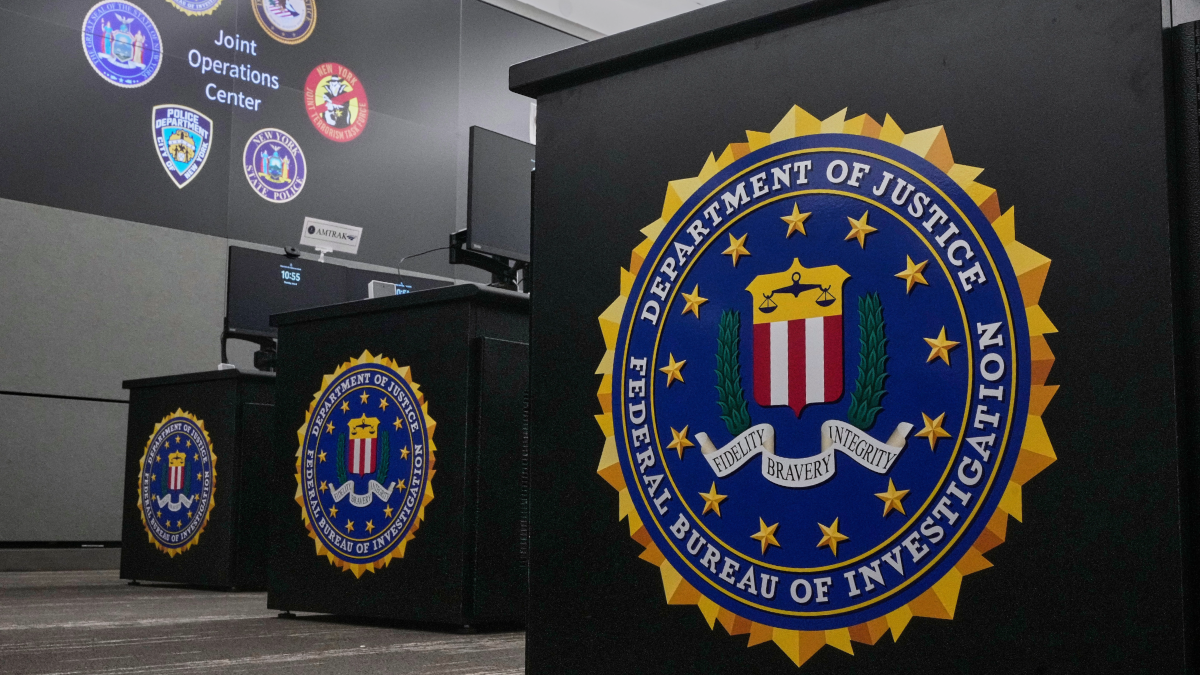
Federal Bureau of Investigation insignias adorn desks in the agency's Joint Operations Center in New York, Thursday, June 4, 2026, ahead of the World Cup soccer tournament. (AP Photo/Richard Drew)
Early in the morning on April 6, a man fired 13 shots at the house of Indianapolis Councilman Ron Gibson. Fortunately, neither the councilman nor his son were harmed. The only immediate indicator of the shooter’s motive was a note left on their doorstep, reading “NO DATA CENTERS.” Gibson had recently backed a controversial data center project. While many of his constituents were vocal in their opposition, only one took violent action.
Less than a week later, a man named Daniel Moreno-Gama allegedly threw a Molotov cocktail at OpenAI CEO Sam Altman’s house and was later arrested attempting to break into OpenAI headquarters. Moreno-Gama was found with a “manifesto” that included a kill list of AI leaders and a description of AI’s threat to humanity.
Most recently, as President Donald Trump planned to have a UFC fight in front of the White House, the FBI announced it had disrupted a plot to use drones with explosives to attack the event. One of the criminal affidavits alleges that one the suspects had recently been in contact with an "ultra-religious and anti-government” group which, among other grievances, was concerned about “data centers taking up all the water in communities.”

This photo provided by Sara Hindi, chief communications officer for the Indianapolis City-County Council shows damage at the front door of Councilman Ron Gibson's Indianapolis home on Monday, April 6, 2026. (Communications office for the Indianapolis City-County Council via AP)
This trend toward anti-tech extremist violence is accelerating. Its growth is driven by opposition to AI infrastructure on the ground, by the increasingly blurry line between tech and government elites, and by fear of AI’s social consequences. But the US is on a dangerous path: instead of taking public concerns seriously, recent reporting shows that law enforcement has begun monitoring local opposition to data centers as a potential national security threat. Further, the Department of Justice argued that xAI, part of Elon Musk’s empire, is “vital” to national security efforts. This may well be true, as AI is now integrated into government activities from military operations to cybersecurity to potentially expediting background checks for security clearances.
A purely national-security-focused approach is the wrong way to tackle this challenge. Instead, policymakers must recognize and respond to legitimate public concerns about the development of AI and the increasing US lapse into techno-oligarchy. This, combined with a narrow focus on indicators of violent intent, is the most appropriate response.
The anti-technology extremism surge
Mauro Lubrano, author of “Stop the Machines,” writes that “anti-technology extremism emerges as a cross-cutting ideological current found in different ideological milieus.” History bears this out: while the most famous example may be Ted Kaczynski—dubbed the Unabomber, whose politics were notoriously difficult to describe in contemporary partisan terms—anti-technology sentiments are flexible enough to appear across the political spectrum. Among the far right, ecofascism has been a popular justification for attacks including the Christchurch shooting in 2019, as well as Christchurch-inspired attacks, including the May shooting at the San Diego Islamic Center.
On the far left, environmentalist causes may justify attacks—historically through organizations like the Animal Liberation Front (ALF) and Earth Liberation Front (ELF). These have more modern equivalents like Vulkangruppe (Volcano Group) in Germany, which sabotaged a Tesla factory out of opposition to Elon Musk, whom they called a “techno-fascist.”
This moment is different: AI is driving the emergence of anti-tech extremism not as an appendage to another ideology but as a distinct worldview capable of contributing to violence on its own. Yannick Veilleux-Lepage, a scholar of political violence, has created a framework in which three AI-driven grievance domains—the shifting economic order, changes to state and institutional power, and tears in social and personal fabrics—create a foundation for political violence.
Further, the framework identifies an “accountability gap” in assigning responsibility for AI harms, as well as a “tempo problem” stemming from technological development which has drastically outpaced regulation or redress. These are force multipliers which amplify the risk of political violence.
Blurred lines and trust issues
The blurring of the line between government and tech elites represents a combination of the Veilleux-Lepage framework’s force multipliers. From tech elites influencing policy and government institutions—or the perception that they are–to the government awarding millions to tech companies, where government ends and industry begins is no longer clear to the public. As a result, tech companies are innovating at a breakneck pace while neither industry nor government are responsive to public demands for regulation.
The political marriage between tech elites and the Trump administration had an immediate impact on federal policy. On the first day of president Trump’s second term, he revoked Biden-era regulations on AI, switching the US government’s footing to pursue innovation through deregulation and AI supremacy over its rivals in Beijing. In July 2025, the Trump administration released their AI Action Plan, focused on three pillars: accelerate AI innovation, build American AI infrastructure, and lead in international AI diplomacy and security. Ahead of the 2026 midterms, some of the largest tech companies “spent a combined $50 million on federal lobbying” over nine months and spent even more money through super PACs (Political Action Committees) to play a part in the electoral process. These same companies have nearly doubled their spending on lobbying since 2020.
Perhaps the most obvious example of the blurred line between Silicon Valley and the Beltway was the creation of the Department of Government Efficiency (DOGE), led by Elon Musk, the CEO of Tesla and SpaceX. The executive order establishing DOGE was vague in its stated purpose: “to implement the president’s DOGE Agenda, by modernizing federal technology and software to maximize governmental efficiency and productivity.” In practice, this meant aggressively purging the federal bureaucracy and upending institutions.
Though Musk and Trump’s relationship quickly soured, Musk remains inside the tent on AI issues: he joined the president on his highly anticipated trip to China in May 2026 alongside Apple CEO Tim Cook, Nvidia CEO Jensen Huang, Meta President and Vice Chairman Dina Powell McCormick, and others. The addition of a tech-elite entourage was meant to create opportunities for American businesses to join the world’s second most populous market.
Trump retains strong relationships with other tech leaders, including OpenAI CEO Sam Altman and Meta CEO Mark Zuckerberg, who joined the president to discuss the United States’ AI dominance. More recently, the president said that he is planning to meet with the leaders of major AI companies to discuss US government investment in their firms.
Promoting American business is ordinary for any administration, but the widespread perception that Big Tech is calling the shots in Washington has damaged Americans' trust in the government's ability to regulate technology for public benefit. Trust in the government to do what is right has been declining for decades, but in 2025, only 17 percent say they trusted the US government to do what is right “just about always” or “most of the time.” Trust in government is the foundation of the social contract that guides democratic processes; when it breaks down, negative trends like polarization, decreased confidence in election processes, reduced effectiveness in government institutions, and the erosion of social trust accelerate. Recent polls also reveal that the US public is among the least likely in the world to say it trusts its own government to regulate AI responsibly, at 31 percent.
Simultaneously, the public has lost trust in the tech sector’s ability to self-regulate and mitigate social harm from its products and services. The results from the first Anthropic Public Record survey series, which released results in June 2026, found that, “Only 15% of Americans said they trust AI companies to make decisions about how AI is developed and used.” Further, local opposition to data center development—a rare area of bipartisan agreement among voters—is also skyrocketing.
Democracy as an alternative to violence
However, if government leaders and authorities do not respond to the citizenry in regulating technology, what does the citizenry do? When there is loss in trust of the system of government, for some, violence can seem like the only answer.
The increasingly apocalyptic rhetoric about AI does little to quell concerns about the technology’s continued, unregulated development. Tech leaders themselves have claimed that AI poses an existential risk, for example when Altman testified at a Senate Judiciary subcommittee meeting that “if this technology goes wrong, it can go quite wrong.” These unnerving claims may create an urgency for action, including potentially violence, as a way of bringing attention to the issue, disrupting the infrastructure behind these systems, or even harming individuals connected to the AI industry.
Exacerbating the urgency is the fact that the democratic process is slow. Without immediate safeguards from the government preventing the perceived existential risk, individuals may feel the need to take matters into their own hands.
To avert future violence, policymakers must meet their constituents where they are on AI. Fourteen states are considering moratoriums on the development of AI data centers while they study their effects on local communities. Such measures, if implemented, may release some of the pressure driving anti-tech violence. Likewise, the Trump administration’s turn toward AI regulation through a recent executive order and a new bipartisan bill on AI regulations in the House of Representatives suggest that a constructive government response to public anger is possible.
While these are important first steps, they are reactive. In the long term, government must disentangle itself from the tech elite. A poll from January 2026 found that by “a two-to-one margin, voters believe the Trump Administration is too close to Big Tech.” Until this perceived coziness changes, citizens will continue to distrust the motivations and representativeness of their institutions.
In the meantime, anti-AI sentiments are growing. While only a small subset of individuals with these views will turn to extremist violence, responding to that risk requires addressing legitimate public grievances. It is vital to separate those committed to nonviolence from the small—but potentially dangerous—minority who are not. Intelligence collection efforts should focus on true indicators of violent intent and mobilization, while law enforcement should apply the law equally across partisan lines and avoid the impulse toward expanded surveillance—which would, after all, risk further validating anti-tech sentiments. Elsewise, the threat of anti-tech extremist violence will become a midwife to increased political repression.
Authors