Three Justifications—and the AI Accelerant—of India’s Digital Censorship Infrastructure
Apar Gupta / May 5, 2026Apar Gupta is a fellow at Tech Policy Press.
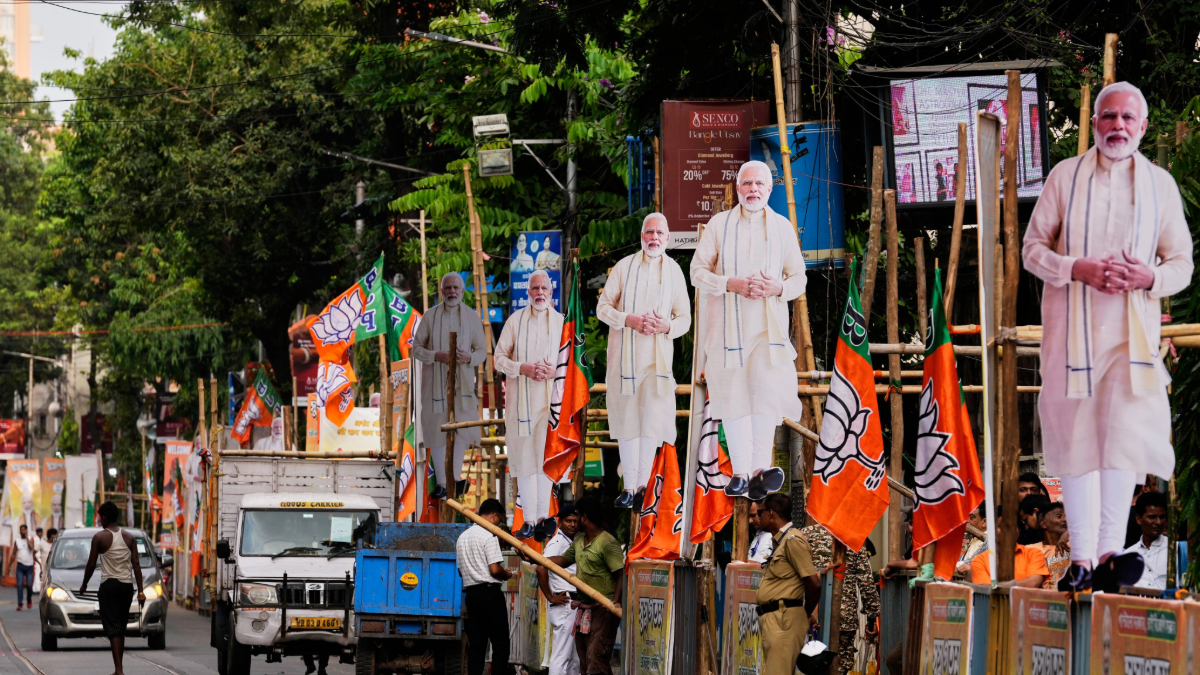
Cut-out boards of Prime Minister Narendra Modi are put up along a street prior to a road show during a campaign rally ahead of the West Bengal state Legislative Assembly elections, in Kolkata, India, Sunday, April 26, 2026. (AP Photo/Bikas Das)
The spectacle of the India AI Impact Summit in February 2026 may feel distant, but its memory lingers. Overcrowding, mismanagement and a sidelined civil society were repackaged as the democratic diffusion of AI among enthusiastic young Indians. But what happens when students are bussed in to fill the frame for a prime ministerial address and one of them makes a sardonic reel about it? The answer reveals quite a lot about the state of free expression in the country.
On March 30, a college student's Instagram reel about Prime Minister Narendra Modi's March 28 inauguration of the Noida International Airport at Jewar was withheld in India under a blocking order issued by the Ministry of Electronics and Information Technology (MeitY). The student said she had been herded to a government event, offered "free attendance" against missed classes, trapped in traffic and heat, and handed some Parle-G biscuits. The takedown, issued under Section 69A of the Information Technology Act, shows how India's censorship infrastructure now reaches not only organized dissent, but mere Gen Z sarcasm directed at the State.
The political imperative for a permanent spike in takedowns and blockings
The scale of this censorship is now visible in the numbers. On April 17, the Indian Express reported that MeitY had more than doubled its online content blocking orders in the past year, rising from an average of about 6,000 orders annually between January 2018 and October 2023 to roughly 12,600 in 2024. The number doubled again to 24,300 in 2025. These figures cover only the direct orders issued by MeitY. In addition to these numbers, another report stated in its first full year of operation (October 2024 to October 2025), the Sahyog censorship portal was used by State Police authorities to issue and additional 2,312 blocking orders to 19 online platforms. Each blocking order is treated as a state secret — often not provided to the impacted parties despite request, frustrating their right to legal remedy — and each one routinely contains several URLs linking to multiple different social media accounts. When blocking orders have been disclosed due to court directions or leaks, it has been found that a single blocking or takedown order is directed against tens of accounts and posts, in some instances even hundreds.
Beneath the minutiae, two questions of political economy demand attention on what Amber Sinha terms as “India’s Decentralized System of Internet Censorship.”
First, what are the power incentives driving the growth of internet censorship in India? With more than twelve years in office, Modi is now India's second longest-serving Prime Minister by consecutive tenure, behind only Jawaharlal Nehru. Yet longevity has not produced confidence. Modi's third term began on June 9, 2024 in a coalition setting after the Bharatiya Janata Party (BJP) won 240 seats, short of a Lok Sabha majority despite the electoral slogan “Abki baar, 400 paar” ("this time, beyond 400" in an assembly of 543 seats). This makes platform virality, parody and meme videos, and youth disaffection more politically costly than in 2014 or 2019. The decline in popularity is no longer confined to Indians ideologically opposed to the BJP for it now extends to votaries of Hindutva themselves, several of them who act as volunteers to spread party propaganda. The reasons for disaffection are complex and diverse, ranging from disenchantment with civic infrastructure, hazardous levels of pollution, anger against the bureaucracy and police services, and assertions of caste pride. There is substantial evidence of Modi supporters venting on social media, regardless of whether this influences their voting behavior. It is viewed as a threat by BJP, which has pioneered digital campaigning at least since 2009, drawing on a cadre of techies, including some among the diaspora. With an authoritarian logic it has projected India, and by extension the Prime Minister, as a Vishvaguru (world teacher/leader), and thus ridicule and derision must be taken seriously.
Second, and more important, what are the popular narratives that make digital repression administratively routine? Three visible wedges of state justification can be traced that are propped up with urgency due to the mass rollout of LLM, image and video generation models.
Three wedges of political censorship
The first wedge for a conservative society like India is the moral panic around OTT content, YouTube commentary, and the policing of "Indian values." While the Broadcasting Services (Regulation) Bill, 2023 was framed as regulatory modernisation was instead driven by social and political objections to streaming shows such as Tandav and Sacred Games. Its target also was the commentary of independent YouTubers such as Dhruv Rathee, Ravish Kumar, Akash Banerjee, Ajit Anjum, Punya Prasun Bajpai, Abhisar Sharma who had emerged as a meaningful electoral variable prior to the 2024 general elections. Withdrawn after a leak, the Broadcasting Bill's substance has reappeared, in pieces, through the IT Rules.
The same wedge re-opened in 2025. India's Got Latent a comedy show on YouTube aired a February 8, 2025 episode in which one of India’s most popular online influencers Ranveer Allahbadia ("BeerBiceps") cracked a dated incest joke. Mr. Allahbadia, who had been awarded Indian Creator of the Year by the Prime Minister despite using Adolf Hitler as a case study for “career hacks,” was the target of swift moral outrage. Criminal cases for obscenity and even hate speech followed that forced Allahbadia to move the Supreme Court, where on February 18, 2025 the bench observed a "vacuum in law" on digital content. The Ministry of Information and Broadcasting issued an advisory on February 19, 2025 reiterating the IT Rules Code of Ethics. The Standing Committee on Communications and IT directed MeitY to assess the sufficiency of existing regulations. Within three weeks, a YouTube joke had produced a Supreme Court direction, a ministerial advisory, and a parliamentary push for fresh amendments to the IT Rules.
The second wedge is national security. On April 22, 2025, a terrorist attack in Pahalgam killed twenty-six Indian civilians, the deadliest assault on tourists in Jammu, Kashmir and Ladakh since 2008. India launched an armed response on neighboring Pakistan called Operation Sindoor on the night of May 7, 2025. What followed was a digital crackdown that swept far beyond Pakistani propaganda. On April 28, 2025, YouTube made the Hindi news channel 4PM News unavailable in India on grounds of national security. On May 8, 2025, X disclosed that it had received executive orders to block over 8,000 accounts in India, often without any specific post or evidence cited. Among those withheld were Maktoob Media, The Kashmiriyat, Free Press Kashmir, the Indian Express deputy editor Muzamil Jaleel, the Kashmir Times executive editor Anuradha Bhasin, the Instagram pages of Greater Kashmir, Rising Kashmir and Kashmir Life, and even the global Reuters handle for a period. The Wire found its English site blocked by MeitY after carrying a story based on a CNN report on the Rafale, and was unblocked only after public outcry and threatened litigation. The Ministry of Information and Broadcasting issued a vague advisory on May 8, 2025 telling OTT platforms to take down content with Pakistani origin or affiliation. On July 8, 2025, MeitY directed agencies to monitor "anti-national" online content.
The third wedge is cybercrime, which has been rising rapidly with the digitisation of financial services and a corresponding lack of policing expertise and capacity. Sahyog originated as a COVID-era inter-agency coordination tool under the Indian Cyber Crime Coordination Center at the Ministry of Home Affairs. Today it provides a technical flow in which law enforcement officers can use pre-filled form fields to generate legal notices and send them to social media companies that have also been onboarded onto the platform. A MeitY Office Memorandum of October 31, 2023 reinterpreted the safe harbor clause exempting intermediary liability to create an independent takedown authority. The portal became operational in October 2024. Its public justifications have been cybercrime, financial fraud, child sexual abuse material, and women's online safety. Yet the 2,312 orders issued through Sahyog in its first year reached parody handles, journalists, and opposition figures.
Deepfakes as an accelerant for political censorship
All three wedges have acquired kinetic force through the moral panic around deepfakes. On November 7, 2023, MeitY directed significant social media intermediaries to remove flagged misinformation and deepfakes within 36 hours, warning of safe harbor loss. The advisory followed days after the viral deepfake of the actor Rashmika Mandanna. On November 17, 2023, at the BJP's Diwali Milan, the Prime Minister flagged deepfakes as among the biggest threats facing Indians online. The 2024 election produced a fresh justification, alongside the unauthorised use of the attributes of celebrities, including Bollywood actors and cricketers, in investment scams and personality-rights suits in the Delhi High Court. All of these fears came to bear in January, 2026 when X’s deployment of Grok Image capabilities resulted in thousands of women and children being sexualized in India.
Each of these incidents is a real harm but none of them, on their own, would justify the regulatory architecture that has been built around them rather than bundling them under a safe harbor framework that has been mutilated into a censorship infrastructure. Here, deepfakes have functioned as the connective tissue between the three wedges as it lets the State frame moral-panic regulation as user protection, national security blocking as defence against synthetic disinformation, and cybercrime takedowns as protection against impersonation fraud. On February 10, 2026, MeitY brought "synthetically generated information" within the IT Rules, with effect from February 20. Platforms must now label AI-generated content, prevent label removal, warn users, and respond to certain takedown directions within three hours rather than thirty-six. This compresses judgment into the default for compliance, leaving no room for context, appeal, proportionality, journalistic verification, or resistance. The rhetoric was supplied by the IndiaAI Impact Summit, where Prime Minister Modi said that, "deepfakes and fabricated content are destabilizing open societies" and called for authenticity labels, watermarking, and source standards. This formulation was polished for an international audience but the takedown mechanism around it was domestic and coercive.
The draft amendments issued on March 30 and April 21 to the IT Rules, 2021 take this further. They convert MeitY's written "clarifications, advisories and directions" into enforceable compliance risk for platforms including Meta, Google, and X, potentially outlawing platform features such as community notes under threat of liability. They extend Part III oversight to intermediary-hosted news, including individual creators, thereby rekindling the powers of the withdrawn Broadcasting Bill. And they require continuous, always-on labelling for the full duration of AI-generated visual content.
The targets of censorship demonstrate the gap between official justification and censorship. Takedowns have most often been criticism or parody of the Prime Minister, or of the Hindutva ideology of the BJP. The Wire's satirical animation of the Prime Minister; the cartoonist Satish Acharya; Ananda Vikatan, restored only after the Madras High Court intervened; Pulkit Mani's mimicry; Maktoob Media's explainer on Kunan Poshpora; 4PM News after the Pahalgam terror attack; the Instagram pages of Greater Kashmir, Rising Kashmir, and Kashmir Life; the parody handles @DrNimoYadav and @Nehr_who; the Congress leader Saral Patel and the AAP handles in Gujarat before the even of municipal polls; the Hotmail co-founder Sabeer Bhatia.
Each expansion of state power is preceded, justified, or accompanied by a public anxiety. Often the anxiety is real due to the deployment of digital technologies at scale without any consideration or restraint despite obvious social harms. Children have been exposed to obscene content. Women have been targeted by non-consensual deepfake imagery. Senior citizens have been defrauded through synthetic impersonation. Soldiers and civilians have been killed in cross-border terrorism. The dishonesty lies in what follows. Powers justified for these harms are written broadly, implemented opaquely, and then deployed across the full range of political speech, satire, journalism, and dissent. The anxiety beneath this censorship infrastructure is not only deepfakes, financial fraud, or terrorism, but the possibility that the BJP's carefully staged politics and the cinematic production of the Prime Minister as a strong man may be punctured by a teenager’s joke.
(Disclosure: Apar Gupta is a litigator in several constitutional challenges to the IT Rules, 2021, and in the cases concerning Ananda Vikatan, Maktoob Media, @Nehr_who, and Saral Patel. The substantive comments made here concern the policy and political economy of digital censorship in India, not any determined and/or pending court litigation.)
Authors