The Racial Necrotechnics That Lead to Death By Design at Automated Borders
Petra Molnar / Aug 17, 2026Petra Molnar is a fellow at Tech Policy Press.
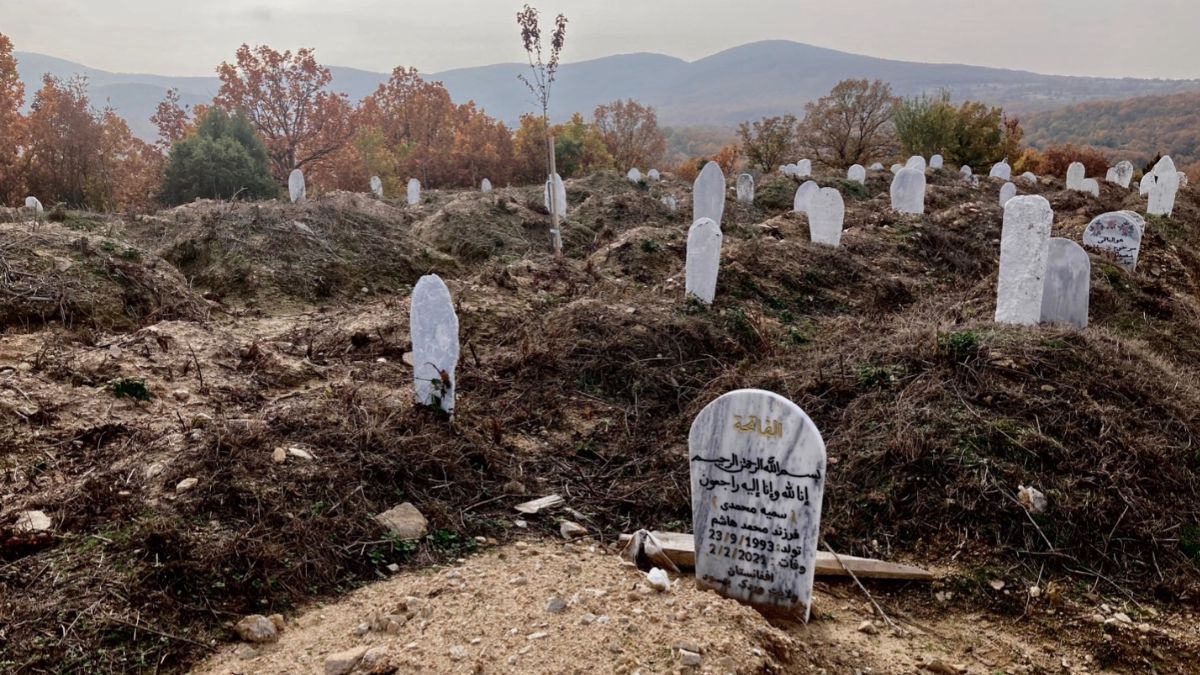
Cemetery for people on the move in Soufli, Evros, Greece. Photo by Petra Molnar.
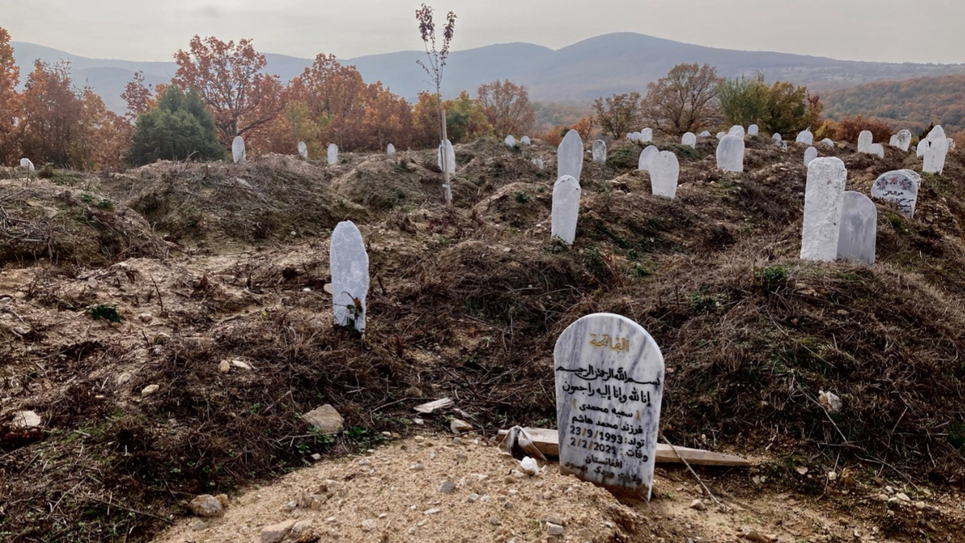
Outside a small village in the Greek border region of Evros lies a cemetery full of mostly unmarked graves, the final resting place of people who died crossing into Europe from neighboring Turkey. Last time I visited, decaying yellow roses laid on one relatively fresh grave, perhaps an act of recognition or care from the local villagers. The grave belonged to Sumaya Mohammadi, a young woman from Afghanistan who was buried there only weeks before my visit. She was 28 years old.
Sumaya was not shot at the border, nor did she drown in a shipwreck of the kind that occasionally breaks into the global news cycle. Instead, she died the way many people seeking asylum now die at the edges of the western world: pushed by infrared cameras, drones, and sensor networks into dangerous terrains where the environment itself does the killing, where each death can be filed away as an accident of geography rather than a direct outcome of policy.
I have spent the past eight years documenting these systems of life and death in the Sonoran desert in Arizona, in the so-called Greek asylum hotspots, and in Occupied Palestinian Territories. In my new book, Border Necrotechnics: Automation, Surveillance, and the Racial Politics of Migration Control, explicitly published in open-access so that the communities it documents can read it, I argue that we need precise language that makes visible this type of infrastructure that decides who lives and who dies. Border necrotechnics names the assemblage of automated systems, databases, and surveillance architectures through which states and corporations decide which lives are rendered killable, deportable, or indefinitely surveilled at and beyond the border. Unfortunately, tech policy conversations in Washington and Brussels continually shy away from directly confronting the reality of the deaths at the sharp end of these systems, preferring instead to focus on risk assessments, proportionality, safeguards, and bias audits, if anything at all.
Border Necrotechnics: Automation, Surveillance, and the Racial Politics of Migration Control is published open access and is available for free download.
Further, the importation of more and more border technologies explicitly render political decisions as neutral and a question of technology or computation, laundering the responsibility of states (and private actors) and dispersing accountability. The deaths that this system produces are not malfunctions or byproducts, but rather the system actually working as designed.
Necrotechnics is racial by design
Border necrotechnics inherits a centuries-old project. Modern migration control descends directly from colonial governance, from the biometric registration of colonized populations to the surveillance of communities deemed suspect and the collective restriction of their movement. Contemporary borders function as mechanisms for reinscribing and preserving global racial hierarchy, systematically constraining the mobility of people racialized as African, Arab, Muslim, or otherwise non-Western while movement in the other direction remains largely frictionless.
Digital border technologies contribute to this lineage by expanding the scale of operations and giving an appearance of objectivity to complex decision-making that shields racialized decision-making from scrutiny. Risk-scoring tools sort people-on-the-move by perceived danger, biometric infrastructures map racialized bodies into permanent suspect categories, and predictive analytics evaluate people not for anything they have done but for what they might do, a form of punishment without crime that runs continuously and pre-emptively. Digital technologies also lend a veneer of scientific objectivity to opaque and complex decision-making that converts political choices about who is welcomed and who is feared into technical decisions, further obfuscating responsibility. What modern digitized borders do is not a new type of racism but rather a re
inscription of the old racial order made normalized and more difficult to contest. The racial logic at the center of modern borders is not some unfortunate byproduct but rather the key organizing principle of the digital border itself.
How necrotechnics distributes life and death
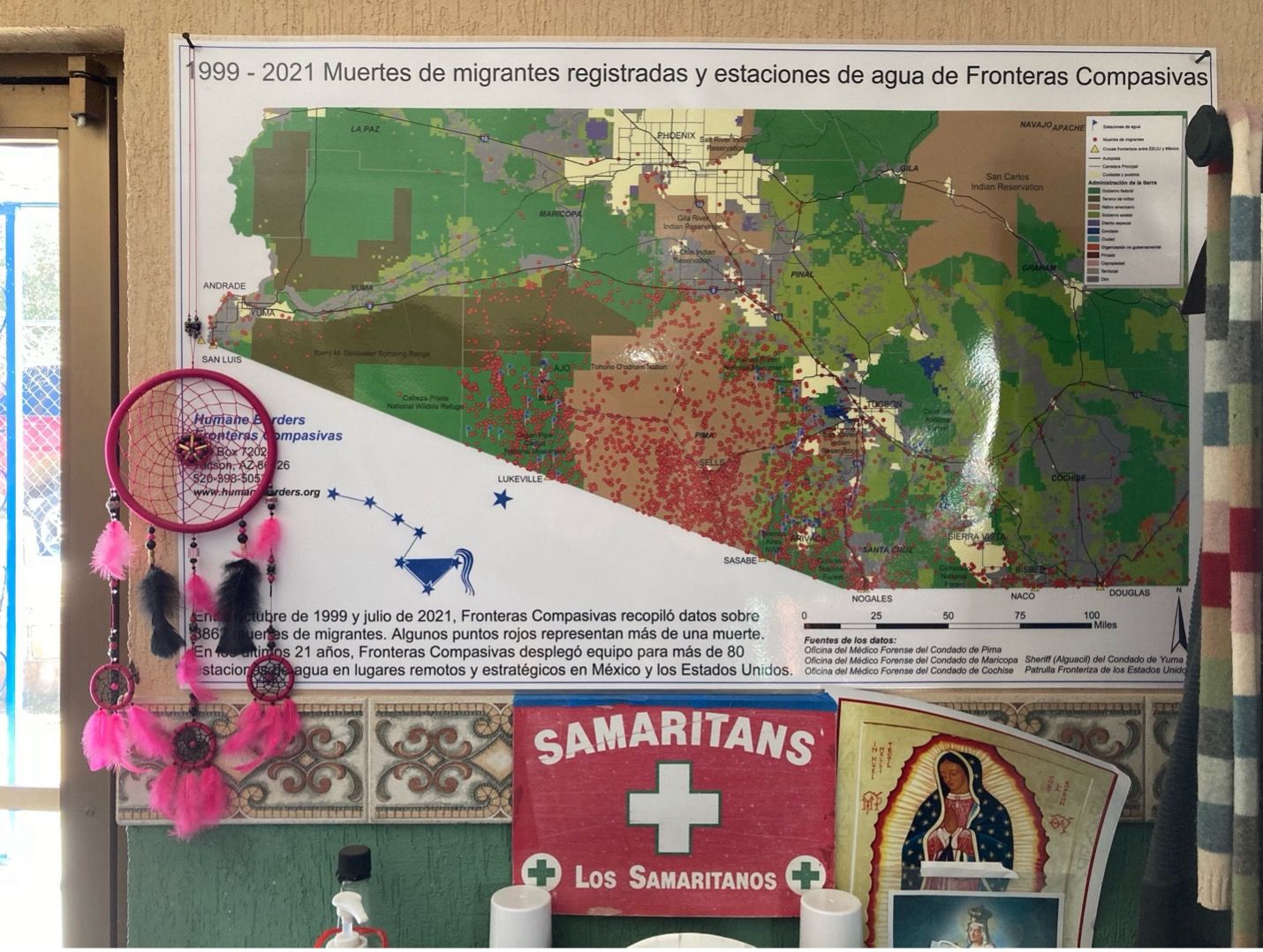
Each red dot represents the death of a person in the Sonoran Desert trying to reach the United States, Sasabe Mexico. Photo by Petra Molnar.
The concept of border necrotechnics is indebted to a longer intellectual genealogy: it builds most directly on Achille Mbembe's theorization of necropolitics, the sovereign power to expose certain populations to death and to consign them to death-worlds, which itself extends Frantz Fanon's account of the colonized as those relegated to a zone of nonbeing where violence is ordinary and life is rendered disposable. Border necrotechnics also draws on scholars like E. Tendayi Achiume, Simone Browne, and Ruha Benjamin who have traced how racial hierarchy is encoded into law, surveillance, and technology.
Where sovereign violence once required a visible decision, border necrotechnics now disperses that decision across databases that flag bodies as risky, sensors that redirect journeys into hostile terrain, and administrative platforms that render immigration detention routine and indefinite. In these environments, exposure to harm becomes infrastructural, cumulative, and diffused across many actors, interfaces, and design choices that violence becomes diffuse and disaggregated from one single act or decision, making it more difficult to contest and challenge.
But the violence is very real. Researchers such as geographers Samuel Chambers, Geoffrey Boyce, and Sarah Lanius have long documented that deaths in the Arizona desert rose sharply after the introduction of smart border surveillance towers, as crossings shifted into ever more remote and lethal terrain. The same funnel effect operates in the Aegean and in the Sahara. And more recently, in the last days of July, tens of thousands of people swam around the breakwaters of Ceuta in Spain, one of the most heavily surveilled and fortified borders on earth, and at least 88 of them died in waters watched by cameras, patrol boats, and sensors. Within days, twenty-two EU member states had responded not by asking why people die at smart borders but by calling for the strengthening of external borders, which in practice means more of the very infrastructure that killed them.
Events like Ceuta collapse whatever distinction there may be between the spectacular and the cumulative: the deaths that were televised and termed a ‘surge’ were acute enough to summon leaders to emergency summits, yet they were produced by the same steady accumulation of fences, cameras, and surveillance apparatuses that had been narrowing the corridors of movement for years. Rob Nixon calls this slow violence, harm that is incremental, attritional, and not attributable to one singular event, which is precisely why it escapes the accountability that a single act of violence would provoke. No single official kills anyone, because the system itself reshapes the geography of survival.
This is also why the reform vocabulary in tech policy conversations keeps failing. A growing body of analysis has documented how the European Union's AI Act, the most comprehensive attempt to date to regulate these technologies, classifies border systems as high-risk on paper while carving out the law enforcement, national security, and migration control applications where the stakes are highest, leaving oversight to self-assessment and internal compliance mechanisms with little prospect of meaningful redress. These carve-outs are political compromises: as civil society coalitions such as Protect Not Surveil have argued, the Act's treatment of migration reflects a broader European trajectory away from rights protections for people-on-the-move and toward offshoring, deportation, and carceral containment, and its first years of implementation have collided with precisely this hardening political reality. Harms that are structural, from people denied entry without explanation to people seeking asylum misclassified by opaque risk scores, are thereby reframed as implementation challenges awaiting more robust regulation, while the bordering systems themselves are never in question.
Migration as reparation: Futures beyond border necrotechnics

Water barrel in the Sonoran desert, placed by search and rescue groups. Photo by Petra Molnar.
To directly name the mechanisms of border necrotechnics as a real-world practice is my intervention to make visible how these systems distribute life and death. However, border necrotechnics do not just distribute death at random. In the name of preserving apartheid regimes, white supremacy, and western neocolonial extractivism, the broader project of modern bordering preserves a racial distribution of wealth and mobility that was built through centuries of imperialism and colonialism, through extraction, enslavement, and the drawing of the very borders that people now die crossing.
But what if instead of defaulting to migration from the Majority World being seen as a ‘crisis,’ a ‘surge’, or even simply a humanitarian claim upon the conscience of wealthy states, it instead becomes in and of itself a form of decolonization? Tendayi Achiume is one of the scholars who has advanced the insight that the colonial project never really ended but rather changed form. Today, the Global North and the Majority World remain bound together by structures of trade, debt, resource extraction, and military intervention through which wealthy states continue to benefit from and exercise power over the societies they once formally ruled. However, once this ongoing interconnection is enumerated, then perhaps it also means that the people of formerly colonized countries are not strangers petitioning for entry into unrelated political communities. Instead, they are in fact already co-sovereigns of an international system built out of their dispossession. As such, their migration is an assertion of the political membership that empire created but never honoured, claiming a share of wealth, safety, and security that was accumulated through their own societies’ subordination.
The reparative lens can extend further still. Global north countries that industrialized through colonial extraction are the same countries whose emissions now render whole regions uninhabitable, displacing the people least responsible for the crisis, and the same countries that export weapons and fund the conflicts from which people flee. Displacement is not misfortune that happens elsewhere and washes up in Ceuta by accident. It is manufactured by the very states that then deploy drones and risk algorithms against the people displaced. But repositioning migration as reparations removes seeing freedom of movement as a charity and admission as some act of benevolence or generosity. Rather, human movement from the Majority World becomes a partial repayment of centuries old debt, a form of reparation that costs receiving states far less than any formal reckoning with the colonial ledger ever would.
What does this reframe mean for technology policy? If there is even a little bit of space to recognize the reparative nature of migration, border necrotechnics then clearly becomes the enforcement arm of a bordering system that refuses to acknowledge the very real debt owed to the Majority World from centuries of colonialism and imperialism. However, as limited as they may appear, there may still be at least some pathways to change at the policy level. For example, ending the trade secret protections that allow private vendors to hide error rates from the people harmed by them, demanding procurement transparency for a border-industrial complex in which firms like Elbit Systems market technologies battle-tested in Palestine for deployment in Arizona, and committing to a moratorium on border technologies that are in contravention to established human rights principles is just the start. However, it is becoming increasingly clear that any reformist approaches will ultimately fail unless we engage with the central logics that underpin our border systems in the first place.
To explicitly name border necrotechnics is to reassemble harms deliberately dispersed across databases, sensors, and contracts into a single legible structure of responsibility, insisting that lonely deaths like Sumaya Mhammadi’s in Evros are not accidents of geography but rather direct outcomes of design.
But what has been designed can also be refused.
Border Necrotechnics is open access, free to read, download, contest, and share.
Authors