The Like Button Helped Social Media Put Profit Over People. We Can’t Let AI Do the Same.
Justin Rosenstein / Sep 16, 2026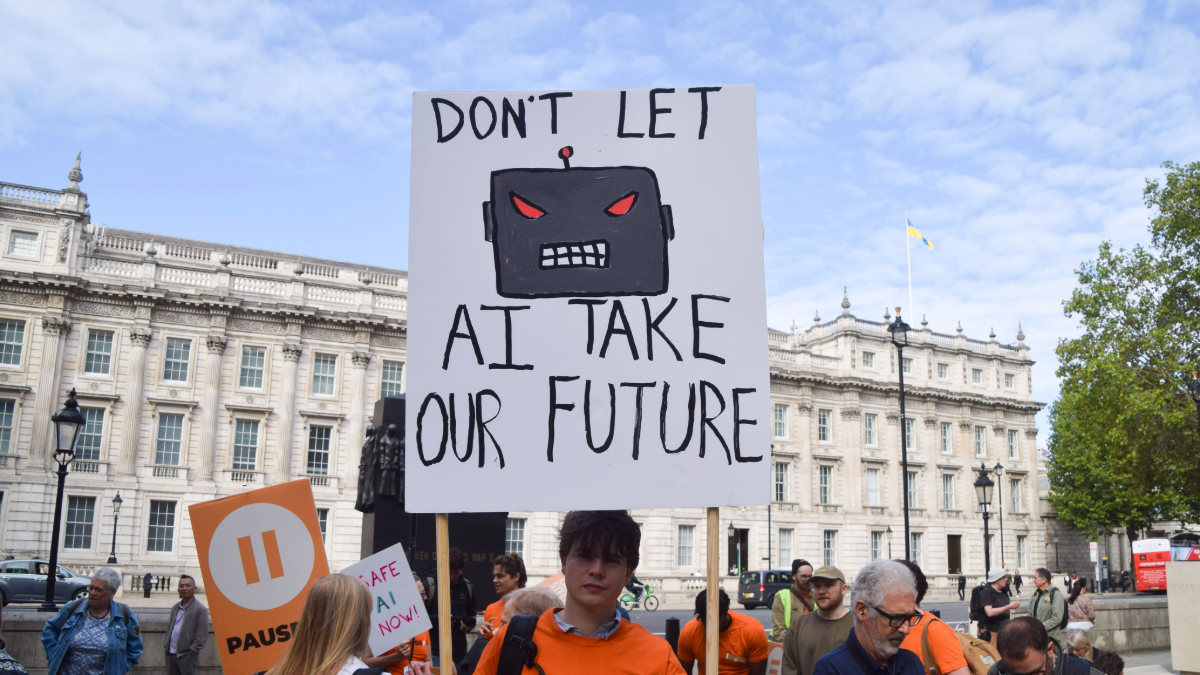
A protester holds a 'Don't let AI take our future' placard during the demonstration by the group Pause AI outside Downing Street. (Photo by Vuk Valcic / SOPA Images via AP)
When Meta agreed to a $17 billion settlement in its historic social media addiction trial last month, I was excited to see one particular detail in its concession: Facebook and Instagram will stop showing minors their number of “likes.” Why do I care about the “like” button? Because I helped create it.
As a young, optimistic engineer at Facebook, I hoped likes would be a way to connect with friends. But there’s a reason this well-intentioned feature went so wrong that it became a central piece of evidence in a child safety trial: economic misalignment. Addiction is more profitable than connection, so the button became a tool to capture our attention, drive unhealthy comparisons, and keep us obsessively refreshing our feeds for tiny hits of dopamine.
Since those early days, my colleagues and I have warned of the damage profit-maximizing social media platforms cause. Now, I see a misaligned technology that’s becoming an even greater threat: AI.
When people in my field discuss AI alignment, they generally focus on technical alignment: the disconnect between what we want, what we ask for, and what we actually get. Imagine asking for a clean house and getting a home flooded to the rafters with bleach.
Technical alignment is critical. But even if AI does what we ask, what will we ask it to do? Whatever the economy rewards. AI will supercharge the economy it’s in, and we know where ours has gotten us up until now.
Since the Gilded Age, corporations have been “reward hacking,” optimizing revenue at the expense of what communities want and need. Because clicks generate ad revenue, we create “social” sites that encourage endless scrolling over real conversations. Because healthcare treatments are profitable and prevention isn’t, in the United States we spend 30 times as much on managing disease as on keeping people healthy, and hundreds of thousands of Americans die unnecessarily. Because sugar and chemicals make food more profitable, families can find candy bars on every corner, while entire neighborhoods have nowhere to get fruit.
You get what you pay for, and no one is getting rich off clean air or easy access to the things that keep us healthy.
From the affordability crisis to the opioid epidemic to sensationalist media, most of the world’s big problems trace back to our misaligned economy. What happens when we let AI loose in this system? It will magnify the worst aspects of society. Already over-used resources will be exhausted. Technology will become hyper-addictive. Livelihoods will be destroyed. Struggling communities will be sacrificed in the name of marginal gains.
Just like social media, AI must be regulated. But restrictions only protect us so much. For hundreds of years, corporations have found ways to optimize their profit objective at all costs, skirting regulations, exploiting loopholes, and buying politicians who write the rules. AI will enable them to do this at previously impossible levels. We got a preview of AI’s ability to break out of constraints when AI agents hacked into the company Hugging Face — just to cheat on a test.
So how do we ensure this technology is aligned with human interests? We have to align the economy in which it’s embedded, rewarding the things we want and disincentivizing the things we don’t. We already do this in miniature, like taxing cigarette companies and paying for public education. Imagine that principle applied across the whole economy, in service of our biggest shared goals. That’s economic alignment.
And who should decide what outcomes we want? The public.
It’s already starting. In Boston, MA, a participatory budgeting initiative allows residents to decide how some of the city’s funds are spent. They’re investing in fresh food, housing stability, and workforce training. In Fort Collins, CO, a civic assembly decided the future of the Hughes Stadium, which will become a multi-use space with a conservancy, land for Indigenous ceremonies, and a bike park. Costa Rica has more than doubled its tropical rainforests, helped by taxing fossil fuels and then using the revenue to fund conservation.
Together, we call these approaches “economic democracy” — a way for “we, the people” to choose how resources are allocated, rather than politicians or values-blind markets.
Like many, I was for a time skeptical that more democracy is the answer. Across the country and around the world, people are losing faith in elected officials who are so often corrupted by donor influence. But true democracy, where everyday people have the power to decide what happens in the places they live, results in policies that benefit communities, while inspiring more civic engagement and voter turnout.
One Project, the non-profit I started to make economic democracy possible everywhere, found that this is already working in over 11,000 communities. Participatory budgeting initiatives have invested over $400 million across more than 40 US cities. Community land trusts in 46 states allow residents to govern their land and set rules to ensure affordability. Public banks like North Dakota's lend for their communities' benefit instead of shareholders’. And more than 10 million Americans work at companies they co-own, where maximizing shareholder value means supporting the people who do the work.
AI itself can help economic democracy scale from city budgets to whole economies, enabling millions of people to deliberate, find common ground, decide together, and track what’s working.
This movement isn’t about ending wealth. It’s about ensuring wealth flows to those who add real value to our society rather than extract it for individual gain. And in a time of anger across the political spectrum, it’s not a right or left issue. It’s a human issue.
In a world where we fund what matters, technology improves your life instead of stealing your time. Healthcare prevents disease instead of profiting from sickness. Neighborhoods get better without pricing people out. Companies compete to restore the planet. The media reports truth, not clickbait. Teachers, nurses, and artists get paid what they deserve. People’s basic needs are met, insulin is cheap, oceans are clean, and our children inherit a better world.
In my career in technology, I’ve seen that no matter how good intentions are, you get what you incentivize. That’s always been true, but AI makes it urgent that we reward what supports human well-being.
Economic alignment can give us the future we want, and economic democracy makes it possible. AI will supercharge whatever economy we put it in, so let’s put it in one governed by and for the people.
Authors