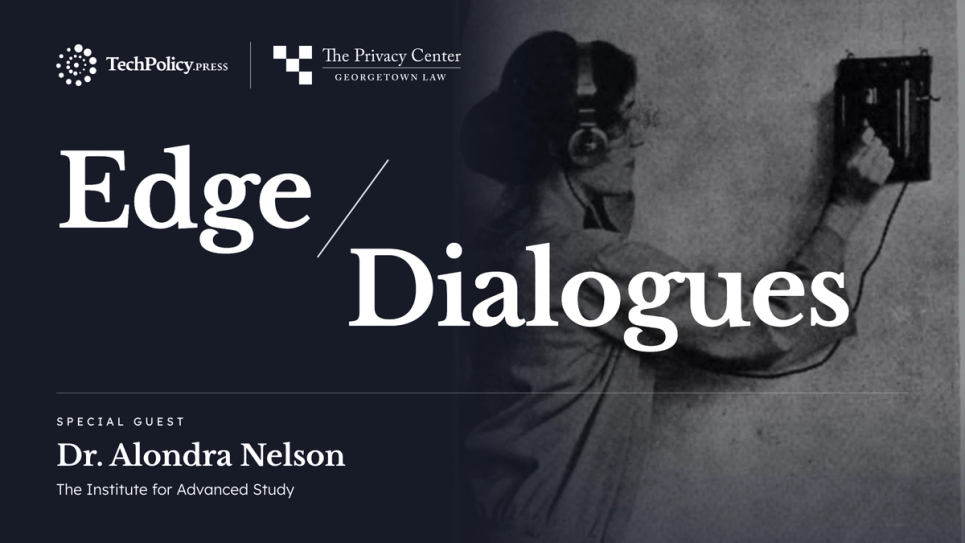
The Edge Dialogues with Dr. Alondra Nelson
Justin Hendrix, Emily Tucker / Oct 25, 2026Audio of this conversation is available via your favorite podcast service.
On October 22, Tech Policy Press teamed up with the Privacy Center at Georgetown Law to kick off a bimonthly series of events dubbed The Edge Dialogues. What follows is a lightly edited transcript of the discussion, which featured Dr. Alondra Nelson, the Harold F. Linder Professor of Social Science and founding director of the Science, Technology, and Social Values Lab at the Institute for Advanced Study.
What follows is a lightly edited transcript of the discussion.
Justin Hendrix:
I want to welcome all of you here. Very grateful to everyone who's taken the time to join today. My name's Justin Hendrix. I'm CEO and editor of Tech Policy Press, and this is the first installment of something we call the Edge Dialogues.
This is a series that is designed to bring together thought leaders and practitioners to explore fundamental policy questions we're often told we don't have the right to ask, and to help us try to understand why so many years of conversations about problems around tech haven't led to the kinds of laws and policies that actually keep tech companies in check and deliver us to a better future.
We're hoping not to just talk though about specific policy matters, not just specific questions around legislation or this policy consideration or that, but to talk about the ideas and issues that are upstream of those questions. We want to talk about power, labor, war, justice, privacy, art, community, all sorts of issues that inform the opportunity space around policy, the ideas that shape that space.
And that's what I think that we're going to get into today. This is very much aligned with what we're trying to do at Tech Policy Press generally with our mission, which is to provoke debate and discussion on issues and ideas at the intersection of tech and democracy.
And for this series, we are paired with, equally partnered with the Privacy Center at Georgetown Law. And I want to introduce Emily Tucker, who is the director of the Privacy Center. And Emily, perhaps you can say a word about it and its mission.
Emily Tucker:
Hi everyone. I'm Emily. I run the Privacy Center at Georgetown. The Privacy Center is focused on investigating the way that government and corporate surveillance affects historically marginalized communities in the US and globally. And we are really excited about this series because it is our sense that the big questions like the question we're taking up today about the future are not just left out of tech policy conversations but are pushed out of conversations by those who would prefer to talk about technology. And so it feels it's like an intentionally adversarial move to bring these things into the center and to push back against the whole framework of the conversation.
So we're really excited, really excited to see how many folks signed up for today and hope you'll come back for the next one.
Justin Hendrix:
You'll be hearing from Emily again a little later in the conversation. She'll be my co-host and conversation partner through this. The way this will work, we're going to first hear a set of remarks from Dr. Alondra Nelson who is our guest today, and then we'll engage her in discussion.
So I would just take this opportunity first to thank Dr. Nelson for joining us and just really to say how excited we are to have her as the very first person to join this Edge Dialogue series. She's the Harold F. Linder Professor of Social Science and founding director of the Science, Technology and Social Values Lab at the Institute for Advanced Study where she's been on the faculty since 2019. That lab examines emerging scientific and technological phenomena where they meet the frustration and fulfillment of civil, political, and social rights. She's working on projects around political economy of AI, democratic governance of science and research, cumulative impact of algorithmic systems.
She was previously a professor of sociology at Columbia where she established the division of social science, was its founding dean. She served as the 14th president and CEO of the Social Science Research Council. And between 2021 and 2023 was deputy assistant to the president and acting director and principal deputy director for science and society at the White House Office of Science and Technology Policy. And while serving that role was an architect of the White House Blueprint for an AI Bill of Rights, which I can tell you having covered its release and various debates around it after the fact has been incredibly influential on AI policy around the world. Nature named her to a global list of 10 people who shaped science. In 2023, she was included on an inaugural Time 100 list of most influential people in AI, was appointed to the United Nations high level advisory board on artificial intelligence.
And so I couldn't think of a better person to help to usher in this series and to give us these opening remarks. So Dr. Nelson, I will turn it over to you.
Alondra Nelson:
Thank you so much, Justin. Thanks to you and Emily for devising of this new kind of conversation. Thank you for that really kind introduction, which always sounds better with your wonderful Southern accent. It makes it sound much more impressive than it actually is. So I'm going to say a bit about futures and about who gets to build them, I think is the question that faces us and I think also the challenge that we face. I want to say at the top that the remarks that I am sharing reflect lots of ongoing conversations. My lab is home to several different work streams. I have a lot of incredible collaborators, but in particular, my thinking on some of what I'm going to talk about today has been shaped quite a bit by conversations with Moira Weigel, Carina Albrecht, and Yolanda Yujin Zhang in our collaboration, which is called SINAI, Sociotechnical Imaginaries and Narratives of AI.
I want to begin with a type of document that I've been reading closely as part of this collaboration, my part of the SINAI project over the last 18 months, which is the tech or the AI manifesto. I want to take us to the website, log on now if you want, of the venture capital firm, the Founders Fund, which Peter Thiel helped to launch and which has on it, it has everything you might think a corporate organization's website might have about mission, et cetera, but it also includes a section that's called Manifesto. And the manifesto has this kind of wistful, interesting title, What Happened to the Future, posed as a question. The Future's Founders Fund Manifesto opens with a kind of mood of mourning, as a lot of manifestos do. Manifestos, I think in general across the genre, are about a kind of mood of mourning.
Where did things go wrong and how might they go better? For Founders Fund, this manifesto recalls something called the Ford Nucleon, which was a 1958 concept car that was meant to run on a small nuclear reactor. Then it recalls 10 years later the author Arthur C. Clarke imagining in 1968 that we would soon be booking commercial flights into space. And all of those dreams seemed reasonable at the time, the Founders Fund insists, but that somewhere along the way we lost our nerve. And the reason that we don't have a car that's running on a nuclear reactor right now is that we weren't bold enough, we weren't brave enough, we lost our way. And then there was a quite memorable line that some of you might know or remember if you've read the manifesto or if you're reading along as I'm talking about it now, this is a quote, "Instead of Captain Kirk and the USS Enterprise, we got the Priceline Negotiator and a cheap flight to Cabo." It's a good line.
It's a memorable line. It's a line that always makes me laugh even when I go back to revisit it, but I think it's become, for me, increasingly more revealing about how this sort of genealogy of our thinking about the future kind of sits with what the firm explains as its two primary and related interests. The first is supporting technological development. The second is earning outstanding returns for our investors. And when the manifesto finally gets around to answering the question in its title, what happened to the future, the answer turns out to be financial. So what the manifesto, its diagnosis is that since 1999, venture capital as an industry has been losing money for its investors. And so the job obviously of other VCs and of the Founders Fund is to no longer do that, to get out of that sort of trajectory. So part of this manifesto and this vision of the future is that the future went missing — the future that we imagined, which was going to be not only nuclear reactor fueled cars, but also outstanding returns.
We sort of lost our way, and how do we get back to that way? So part of the answer to that question becomes, I want to suggest, creating and articulating other kinds of futures, like that future went missing and we want another kind of future in which the portfolio never stops performing and which technological development moves ahead undisturbed, unmitigated, and with the expectation that technology itself is supposed to have some shared good. I wanted to start here because Justin and Emily and their capacity of framing up the work of the Edge Dialogues as they're getting underway have asked a couple of important questions, I think. Who gets to define the future and whom does that future serve? So what strikes me in particular about the Founders Fund manifesto and AI manifestos as I'm sort of describing and writing about in my academic work more generally, and is true to some degree of all manifestos, is that the future it describes is something that you can own a share of in a kind of capitalist sense.
And the people who are describing it, the VCs in this case, are the ones who hold the shares. It's not understood necessarily as something that we build together. So I want to think about two things, and before we move to conversation, I want to look at, think about closely the stories that Silicon Valley tells about the future, especially in the form of the manifesto and why those stories matter even when their predictions fail. And then I want to think about a different way that societies have tried to imagine in forms of governance what comes next, which is through policy and suggest that policy, if we're kind of unleashed from thinking about it in a kind of strict and wonkish way, leaves lots of room for more of us to think together and collaboratively about what a future might look like.
So I know that Justin and Emily, they have announced in the Edge Dialogues that they don't want to talk about AI governance, so I find that refreshing even after years spent in that space. What I want to say, so I'd pivot slightly and say that this is not a talk about AI governance per se, but a talk about power, about the power of futures, about the power of narratives about the future, and about the increasingly small number of people who are laying claim to the future and what the future looks like, what its shape of it, how we might imagine it before the rest of us have had a chance to have a say.
So manifestos are much older than Silicon Valley, as you are well aware. And you can think back to the small town in upstate New York with Elizabeth Cady Stanton and women and men gathered at Seneca Falls to adopt a Declaration of Sentiments. It borrowed words from the Declaration of Independence and changed them to read, "All men and all women are created equal." What that manifesto shared was that their authors had almost no formal power.
None of the women at Seneca Falls could vote, but they decided and articulated that they had a voice. I've been keenly interested in how manifestos, the tradition of them up until fairly recently have come from people outside of the system or people who've been trying to change how we think about the system or get inside of the system. Often authors of manifestos lacked power. So even if you think about the well-known Italian futurist manifesto of the early 20th century that would make fairly misogynist claims about women and their relationship to technology would be anticipating and praising kind of fascist turn in politics, but it was very much the sort of sense that they didn't have power as artists, and I think that was also empirically true. And manifestos attempt have historically attempted to make up for the lack of force or the lack of power through language, through powerful language, compelling language, poetic language.
The manifesto is powerful as a genre, both past and present as an AI manifesto because it doesn't negotiate, it just declares. It says out loud what the authors intend for the future to look like. So the manifestos of the AI era include ones that I'm looking at closely, Marc Andreessen's Techno-Optimist Manifesto. We might also consider Sam Altman's essay, The Intelligence Age, Dario Amodei's essay, The Machine of Loving Grace, a statement by Palantir that was posted this spring. It was a distillation of Alex Karp's book laying out its vision of a technological republic that was also taken up as a manifesto. So the AI manifesto is becoming very familiar, but the authors are new in some ways. These are not outsiders, these are insiders, these are incumbents, these are very powerful people who command not only capital, not only computing power, not only have the levers of the global political economy, not only have the ear of presidents, but they also write now with the voice of the insurgent, the voice of the outsider.
Andreessen lists among his enemies the precautionary principle. He writes that any deceleration of AI will cost lives and that the deaths that an AI system might have prevented had it been built faster amount to a form of murder. So the language of insurgency of being an outsider now comes from the barricade of social movements, of artist movements to the venture fund. So you might reasonably wonder whether any of this matters since our future visions fail all the time, we're terrible at predictions, but I want to bring to the conversation as I'm wrapping up the work of the sociologist, Jens Beckert, who gives us a useful way for thinking about the relationships between futures and markets. Anyone who puts money into something new, Beckerts points out, faces a basic problem. The outcome of that investment can't be known in advance. So the spreadsheet, even if it's well stimulated, well-modeled, can't tell you whether or not a product or technology is going to pay off in 10 years.
So he suggests that economic life, and I think particularly it's true of this moment, kind of runs, is fueled in part by fictional expectations, by stories about futures that are credible enough to get people to commit to the hype, commit money, commit effort. If we're consumers, we commit to using the tools even if they're often in failure mode or quite fallible. The story doesn't have to be true or accurate to work. The story of the future only has to be believed by enough of us to make it true in some other sense.
So I've started thinking about AI manifestos as these kind of expectation devices following from Beckerts as a tool for making one particular vision of the future feel credible enough for some of us to act on. The old historic manifesto used dramatic language to make up for authors' lack of power. Today's AI manifesto uses dramatic language to make up often for a lack of evidence or for a lack of a demonstration and market value, speculation in the market rather than demonstrated value.
The authors of the AI manifesto, I think, have nearly everything to prove except proof that the vision will actual arrive. So we're all kind of in this state of expectation. There's another way that we can think about futures, and I want to suggest, I think somewhat probably counterintuitively, that policy is one way to do that. We tend to think of policy as the opposite of imagination, as the opposite of a future that is compelling, of as a future that we want to share as the brake on a car, red tape that makes us angry. But I think if you look closely at almost any policy, you will find a picture of a future that someone wants.
I like to understand and define policy as an articulation of a desired future state. So it means that taking something as ordinary as a regulatory code or a zoning code, you might think that when a city requires sidewalks or buildings that mix shops with apartments, it's not only just creating a policy or a rule or regulation, it's also describing a future in which people walk to a corner store, they run into their neighbors along the way, that children are safer on the streets because there's fewer cars.
Or we might even think about the rules that families make or the policies that we make and the ways that we make our families. When a parent says there can be no screens after a certain time of day, it's in part because they're picturing a future for their children who sleep through the night without blue light disturbing their rest, but who can also sit with a book or an article and imagine that kind of future of intellectual life and engagement and discovery as well. So each of these sort of policies — city policy, municipal policy, federal policy, or the policy of a home — is itself a kind of small forecast that has people attached to it who are investing in how it turns out. So I think what sets public policy apart as a future from a manifesto narrative is everything that sits around it.
Policy often has to have to build public consensus. There are often comment periods, there might be hearings — people are weighing in. It invites the back and forth that the manifesto shuts down. It can be revised and over time, and I'm increasingly wanting us to take a page from software versioning and think about even government policy as having a kind of iterative life. It might be a version one or a version two to be honest about the fact that the work of policymaking and of envisioning and crafting futures is never quite over.
Justin kindly mentioned the Blueprint for an AI Bill of Rights. I believe, if my math is correct, that today is actually the fourth anniversary of the issue of the White House Blueprint for an AI Bill of Rights. So I wanted to lift that up as a way of thinking about policymaking, a policy white paper in this case as a kind of future. It set out five principles that automated systems should be safe and effective, a condition, that benchmark that we are still trying to meet, that the news reminds us every day that we've not met, that they shouldn't be biased against us, that they should protect our data privacy, that you should be told when AI is being used for consequential decision, and that you should be able to opt out and reach a human being if something goes wrong.
So the grammar of those sentences are about a future, about a desired future. They speak not only to investors and venture capitalists, but also to a broader public, both about what they might imagine and about expectations they can have about what they are owed about AI systems. And I want to just say as a sidebar, because I think the anniversary, we're coming close to the anniversary of the Blueprint for an AI Bill of Rights, that what we didn't fully anticipate is that it's had significant kind of afterlives.
Justin sort of suggested this. It's inspired educators. Governor Ron DeSantis of Florida has stood up his own AI Bill of Rights, which draws on some of the five principles that I've mentioned to you, that it's had sort of many, many lives because futures, when they are not just about a few of us, they can sort of travel and more of us in the sort of older sense of the manifesto can imagine themselves as being part of the imaginary or the narrative for the future that's being set forth.
So Justin and Emily asked what a future shaped by people and communities might look like, and I hope that maybe sort of spreading your aperture, opening the aperture of what you think even policy is, that we can begin to realize that we have more examples than we sometimes realize. It's sometimes difficult in the context of, I think the chaotic space of how AI is being sort of diffused through our lives right now, often without our consent to imagine otherwise, to imagine a future that we indeed shape.
So what has happened to the future? To return to that question I began with, I want to offer a different answer from the Founders Fund. The future they're mourning was always, at the bottom, a projection of investment returns. So it's no surprise that it showed up first on a balance sheet while other futures were being written all along, I think, in homes and union halls at city councils and state legislatures and kitchen table conversations about screen time, about whether or not AI should be in schools and more. The manifesto began as a voice of people without power who were speaking into and for and with and about their futures. Its migration into the hands of some of the most powerful people of our time tells us something about its power as a genre, about the power of speaking into the world about the future, but we also have to sort of reclaim that power as something that belongs to all of us.
The AI manifesto can be re-imagined as a place of struggle where some of the most consequential sort of imaginaries and frames about what our future with these new technologies might look like if we're allowed to play a role in it. Each of us has a claim on the future and I want in this conversation for us to begin to think together about what that looks like. Thanks.
Justin Hendrix:
Thank you very much and what a great start to this series. And my immediate takeaway, of course, is I'm going to have to go and explain to my children that the policies of our household are my way of describing…
Alondra Nelson:
It's the desired futures. Yes.
Justin Hendrix:
Absolutely. But I'm going to turn it over to Emily to offer her first reaction to your remarks.
Emily Tucker:
Thank you so much, Justin, and thank you, Dr. Nelson. I have a sort of half-prepared riff, which I think actually turns out to dovetail really nicely with your remarks, but I'm going to kind of do some of that, improvise a little bit, but I just wanted to encourage those in the audience, if you have questions, we are going to have a pretty robust Q&A later, so please feel free to start entering your questions now as they arise and we'll be looking for some good ones to pull out.
So I think one of the things that feels quite eerie to me about the particular version of the future that is in the manifestos that you describe and that I feel like increasingly pervades conversations, not only about technology, but about all kinds of things in politics and culture is what looks to me like a kind of imaginative impotence to it.
So the rhetoric around AI is so sensational. It's Hollywood blockbuster promotional rhetoric, transformation, revolution, human extinction, this is the kind of language that's used to talk about the future that we're supposedly entering. But if you look like you tune into the actual details of the world that is envisioned by the extremely wealthy men who run the tech industry, what they add up to is something which strikes me as actually quite fallow and sort of disappointingly retrograde. Even just the surface aesthetics are things like flying cars and moon colonies, which while I will not deny my own nostalgia for certain 1960s sci-fi literature and certain 1980s cartoons, those are things that very much strike me as the past's notion of the future. And the ideas that underlie the aesthetics are even more clearly not new, but are in fact a way of doubling down so hard on old ideas that they become kind of flat and lifeless.
So even just at the formal level, what an LLM does is to endlessly recombine data about the past to make probabilistic calculations about the likelihood of one word following another in the world that gave rise to the data set. So it's not even really a calculation about what's likely in the future, it's a calculation about what will seem likely and familiar to someone right now when that's someone's own recent past is of the average kind. And this just seems super important to me in light of what you were saying, Dr. Nelson, because what real transformation, what real revolution, what real new ideas requires is the opposite of probabilistic calculation based on past data. It requires us to be able to ask what if our past ways of understanding the world were just totally wrong, not just imprecise or biased, but fundamentally confused. And that's how people who make real breakthroughs actually think.
So take Einstein's special theory of relativity, for example. The problem that he was confronting was how do you explain the fact that the speed of light remains constant no matter the apparent velocity of its source? And his solution involves showing that our prior understanding of time and space themselves was mistaken. So the length of a body and the time relation between two events are not fixed quantities that are the same for all observers. Space and time are not two separate and independent realities, but are different aspects of a unified space time. And that discovery within the existing frameworks of thinking about these questions at the time was infinitely improbable. There was no probabilistic calculation based on past data that could ever generate it because the statement of the theory in the old system would sound something like 'twas brillig, and the slithy toves did gyre and gimble in the wabe.
So Einstein’s theorizing didn't involve probabilistic reasoning about what seemed plausible to the science of his time, but a fundamental rethinking of its most basic categories. And so it seems really clear to me that at a moment when so many of our institutions and so many of our normative frameworks are falling apart in a pretty spectacular way, that is what we need, that kind of fundamental rethinking of basic categories. That's what we desperately need. And that means we need human beings who are capable of doing that kind of thinking. And that's not the kind of thinking that you're going to learn how to do through interactions with a chatbot, for example.
My students come to me and they'll say things like, "I feel like the chatbot is stealing my education, but everyone says if I don't learn how to use it, I'll be left behind." And I just find myself thinking, what is the future going to be if a whole generation of young people decide that it's just too risky for them to try to undertake the sort of intellectual and creative work that's actually necessary for human beings to think something new?
And it seems to me like persuading people that this is in fact too risky is part of the political strategy for the Big Tech companies. They already have such a disproportionate hold on global wealth and power that a future filled with free thinkers who may be capable as individuals or more scarily to them as communities of pushing past existing frameworks, that's kind of an intolerable existential risk for them. That's like an uncertainty that they can't afford. And so there's a kind of marketing by gaslighting that's going on where the industry is feeding us a rehash of stale ideas and telling us we're on the cutting edge and to make yourself believe that entails a kind of soul destroying nihilism, but the alternative is to realize that the people driving the bus are headed off the cliff and that it's up to you to stop them, which is really scary.
And so that just seems to me like something that is hard to policy our way out of for so many reasons, but one of which is that policymaking processes tend to be very captured or to a large degree captured by many of the same people and interests that have co-opted the manifesto as a communicative device. And so I guess I'm just wondering for policymaking to be alive in the way that you are very compellingly suggesting that it could be, people need to have an idea of themselves as powerful and that idea has to have some reality around it. And even strong policymaking, like policymaking processes that happen at the municipal level tend to be more inclusive. They tend to be at a space where it's more possible to show up as just an average community member who's trying to think about the future. But even in those spaces, it's more like there's a policymaking space that's kind of externally curated and the community is invited and it's not like those deliberative activities are arising from the political community.
And so it seems to me like there is some kind of fundamental shift that's needed. And so I guess having just listened to your really compelling provocation, do you think that fundamental shift, is that a fundamental shift we should look for in policymaking, in how it's constructed or is it something that has to come prior?
Alondra Nelson:
I guess I would say I offer policy as a kind of future making because it is the most counterintuitive and sort of extreme. And I think there's lots of other ways in between, between a tech billionaire's manifesto and policymaking that we can imagine sort of making the future. So the counterintuitiveness of the policy is, future is intentional to, I think, elicit exactly some of the questions that you raised. I think we can... Certainly there is a way, I mean, we're even experiencing it right now with the regulatory capture that's happening around federal policy, AI policy. So it is always going to be the case, I think particularly when you're dealing with science and technology, that you are going to have these big incumbent powerful figures there. And so the question is, in what administrations or under what types of government can there be different kinds of voice for others to articulate what they want their futures to be like?
So we might recall it was the Obama administration and partly with some of their science and technology policy that began to introduce challenges. And we sometimes will think about the challenge that we had for the electric vehicle that brought for good and for not Tesla into our lives. But there were also challenges around ideational challenges, like what are other ways that government might do its work? So there's just other ways to bring people into the work. And I think that certainly the way the table is set in federal policymaking I think makes the bubbling up of, you might say more minority or marginal futures much more difficult to arise. But I also think we're seeing with the example of the local politics, I mean we can use two examples actually, the politics over the last 25 years around school boards at the state and local level, and people can agree or disagree with what those futures were around schools and charter schools and the privatization of education, but that was the articulation of a different kind of future for education in the United States being manifest at the municipal level.
Closer to the conversation for today would be the politics around data centers and around a different, that is very much a different articulation of a future for AI. In fact, what's been so I think interesting and compelling about that space is that I think it began very narrowly with, in some instances narrowly with people living nearby data centers, people having very proximate concerns about noise, about water, about energy to becoming a kind of big tent social movement that is also around power and inequality around the use of AI more generally. I'm sure you have people who are at these protests now, they're concerned about the mental health of young people and about what chatbots are the kind of delusional facet of chatbots. And so I think folks have talked about it more simply as sort of like it's the physical thing, AI is not physical and data centers a physical thing and people mobilize.
I think that's true. There's something about the grounded politics of data centers, but I think it's also true that these have been places where you can come and speak to publics. And I think Emily, where I would disagree a little bit, you were saying that these were these local instantiations that didn't emerge, but I think when you have a data center social movement that is emerging out of other different kinds of community conversations and concerns out of other school groups, church groups, other kinds of organizations, then I think we can imagine them as having real local roots in a way that's important and that matters.
Justin Hendrix:
I'll just pick up on that and just say, you mentioned my southern accent, the place I acquired that in rural Virginia. One of the early data center fights that I paid attention to was in the rural community that I grew up in. And the thing that most amazed me about it was seeing pictures in the newspaper of men in MAGA hats next to folks who had opposed the pipeline, had opposed things on various environmental grounds. And this was in the height of the 2024 election cycle and just after it. So people were effectively polarized across the board on almost everything, and yet that seemed to bring people together.
And I think I've really heard so much of what you're saying across the course of so many conversations I've had over the last few years. I'm thinking about activists in Tucson who opposed a big data center there and who in many cases were using that opposition, the conversations in the community, of course, starting with concerns over energy prices and consumer electric bills and water, which is a major issue there and fear among many in the community, but then beginning to branch out from there and ask questions about what kind of community economy do we want to have here?
What sort of businesses do we want to occupy this space that we call home? Where do we want to work? What kind of jobs do we want to have? And I think that those types of conversations appear to now be happening across the country. And I'm beginning to see some signs that, as you say, it's spreading out to the question about AI in schools, and that seems to be another one that's coming fast and furious right behind the data center concerns. It's spread out to, of course, the concerns around surveillance and Flock cameras in particular. So I guess I'll ask you if you see any other prospects for joining up some of this popular consideration concern and allowing it to create space for different futures to be imagined, what would you recommend there?
Alondra Nelson:
I think the Flock example is a really excellent example, and I will await the actual research of scholars to help us know what really happened there. But in sociology, there's this idea of social movement spillover that there are people or ideas or things that have this kind of Venn diagram effect that catalyze action and movement in other places. And I suspect that's some of what happened with the Flock cameras in addition to already having longstanding existing and some communities resistance to forms of surveillance, Flock cameras, only one among many that one might call out and name in various communities. I'm thinking also of things like inaccurate AI surveillance systems like ShotSpotter that are listening to potential violence in neighborhoods. I know there's been mobilization in Chicago, for example, around city procurement for those kinds of tools and technologies and the implications of those for communities.
So I think it's a particularly hard time for that question given all of the polarization, but I think the image that you gave us, Justin, of left activists and folks in MAGA hats being aligned around this I think is I think exactly what we might hope for. But I also do think that the politics around AI are distinctive in some ways. I mean, they come a decade, hence a decade, 15 years, 12 years after we have been really unable to get a handle on social media. So there are people who carry, I think, frustrations around our inability to govern or make social media be healthy for society, even as it's making lots of money for lots of people. And I think it is an issue that has been shockingly, I can't think of another issue that's just been in both of the academic polling and the political polling has continued to increase in negative sentiment.
And so that's actually quite a shocking thing and that increase in negative sentiment is this growing kind of cross-partisan, I think, concern that is leading to a widening set of issues and concerns being put under data center activism. But I think it's surely not only schools, it's people worried about their jobs. It's folks worried about, as I mentioned, the safety of young people, it's people worried about whether they can get a fair shake to apply for a job when you've got all of these algorithmic systems. So I think that we are getting slowly a vocabulary and local mechanisms that I hope will have some national impact to speak to, I think the broad spectrum of things that on the spectrum from concern to deep discontent to violent discontent around the broader transformations that are happening through the expansive use of AI tools and systems.
Justin Hendrix:
I think I'm going to already begin to bring in some of the very smart questions that are in the Q&A. There are many there that I think we've already hit on in some way or we've begun to pull threads in that direction. But there's one in particular around the gender aspect of this, the kind of hyper-masculinity in the rhetoric of AI at the moment, also of course in the nationalist rhetoric that we hear. How do you think of that more specifically? I know you've kind of alluded to it a bit, but what is there in your mind about the gender aspect of this?
Alondra Nelson:
I think part of certainly what I describe as the AI manifesto, and I'm interested in probing and teasing out the characteristics of is deeply masculinist and probably in some varieties, if you think about, I think, the former Google worker who did a kind of early Silicon Valley or early in this sort of quadrant of time, I'm talking about, I think, James Damore, who was talking about his negative reactions to having woke colleagues in Silicon Valley.
So yeah, I think sort of masculine to misogynist, I think certainly. And I think that there was an earlier moment in which, I'm particularly thinking about the 1980s and '90s, but even actually the Italian futurist manifesto, which in some ways is kind of the ur-text of thinking about a manifesto of the future. I mean, soon after that came out, there was a manifesto of women artists that responded to it.
And so you can imagine that this has been a conversation about technology and futures that has sort of multifaceted voices that I think is that part of the co-optation of futures through the generic form of the manifesto that I'm trying to, I think capture in some of the work and thinking that I'm doing both in scholarly space and policy spaces is the reduction of those who can speak, those who can build, those who can shape the future to men who work in venture capital, to men who make technology in a certain kind of way or deploy it and who can make decisions about both design and deployment. So I would just mostly agree, but add that elaboration.
Emily Tucker:
I would just add that the masculinist impulse behind a lot of this I think connects back to the thing I was saying at the beginning of my response about how retrograde a lot of the visions of the future are. And I think that that's not an accident. I think there actually is a longing to go back to times where certain kinds of oppressive systems were fundamental to how everything worked. And so I think there are elements of the masculinism that's driving a lot of the AI futures rhetoric that are kind of new and different, but I think there's kind of a core of it that is just appealing to a certain backward looking... I don't know if folks have seen Jill Lepore's really awesome riff on how the tech bros are really bad readers of sci-fi, but she talks about how the way that they read sci-fi, it's actually about a closing down of possibility and not an opening up of possibility.
And so I see the way that they view gender, the idea of gender roles that they're promoting is connected to that too.
Alondra Nelson:
Yeah, I think that's such a good point that you make and agree with that. And I would also say, given the generation of people like Thiel and Andreessen, which I kind of share demographically, it's also about a boyhood imaginary. It's now a man's imaginary, but it was a boy child's imaginary of the future.
Justin Hendrix:
Yeah. I want to maybe pick up on something that I think Emily was getting onto and surfaced in the Q&A as well about the conditions necessary to permit policy to be more responsive to democratic pressure. Maybe just press you on that a little bit. What do you think needs to happen in all those various levels of government that you described to produce a result that's more responsive to the individual desires, hopes, dreams for the future?
Alondra Nelson:
I think that you see it. I mean, it has to be public contestation. So certainly the data center mobilizations are an example. I mean, we went from having executives of states, Maryland, New Jersey, et cetera, who were Pennsylvania, great boosters of data centers to completely rolling that back. I think even in the United States at the executive level, we've gone from a language that I've written about, a little bit of deregulation, which wasn't actually deregulation. It was actually, I think the US federal government quite strongly shaping AI policy through things like investments, golden shares taking portions of companies through the way that we're shaping immigration policy, through the way that we're shaping trade policy, who can have semiconductors or access to them and not. So what was called deregulatory I think has been quite strongly steered and controlled in a particular way, even if it wasn't formal regulation in a way.
And so I think I would say on the democratic and more people power side that I think part of what needs to happen is an expansion of where people think that they can plug in or where they can be effectual. So the sort of analog I'm trying to make is that if we think that the only way that the federal government or the executive branch or Congress can do something around AI is through making new laws, then we have not been paying attention to all of the ways that this government has been closely shaping AI futures. So I think similarly on the side of people outside of government, there's a cluster I think of things that I think the data center movement broadly, again, I think suggests, which is working at the local and state level. I think, and even that local data movement, data center mobilizations variously, and they're quite variegated, have put pressure not only just on a town or a village that's thinking about a data center, but as I was trying to say on how states are doing technology policy and AI policy and arguably how the federal government, if not how it's doing policy, has come to think about how to talk about it.
So over the last several months, over the last quarter, if not two, it's become, I think even at a federal level, very difficult to say that you don't care about the affordability of electricity and that you don't care about people's concerns about the pollution about AI in their neighborhoods. And so there's this kind of transom, I think, of things going back and forth. And I think what I would reject from the question is that nothing is happening and no movement is happening into reaction to what's happening on the ground. In a place like New York City even, I mean, there's just been a almost day long set of hearings about AI by the entire city council, which had lots of people speaking in lots of different ways. So I do think it's a different moment and whether or not it is the case that someone in rural Virginia doesn't have formal levers to change policy in Washington, D.C., but certainly what's been happening in Virginia, which is the state I think in the United States with the most data centers in the country is impacting federal policy, federal norms, the way that we talk about AI and the benefits and risks of AI.
So I think I want to loosen up a suggestion that the only way that public engagement matters is through formal mechanisms and that we are seeing that there's lots of different other ways that it matters as well.
Emily Tucker:
I would plus a million to that. I think that people are very pessimistic about participating in movement spaces or participating in civil society democratic work because they look at what policymaking is and they think, oh, there's no possibility for what I want to show up here, so what's the point? But actually what is most important about that work is not the outcome, but it's actually the political community comes to be in the process of the coming together to try to imagine what change could be possible. And so I mean, one thing that I am always thinking about is how can... The possibility of policymaking is a great carrot. We have an idea of a change we want to create, and that's the organizing vehicle. But anybody that's ever done political organizing can tell you that what happens is never what you expect. And a lot of times the thing that you most want turns out to be the wrong thing to have wanted.
And that work of discovering that together with other people that you're doing that imagining with is where the power is. It's not in, I have an idea, what percentage estimate do I have that I can get that idea enacted? And so I guess that we do a lot of work with CASA, an immigrant rights organization based in Maryland, and they've just done such an incredible job of taking the mass surveillance environment that their communities are forced to live in and taking that as an occasion for organizing, as an occasion for building their own capacity, their own knowledge about this set of issues, and then bringing that knowledge into the demands they were already making to protect themselves, to protect their communities, to fight back against detention and deportation. And that even though the wins that they've had just legislatively might look thin on paper, that power that's been built, that community that's been built is going to have a life that we can't predict.
Alondra Nelson:
I think that's exactly right. And the history of, I think, social movements in the US and abroad proves it out. And also you're making me think of course about Theda Skocpol's work on just the importance of associational organizations, that sometimes they're laser targeted on particular missions or goals, and sometimes it's the association itself that sort of builds the capacity to do exactly what you're suggesting. Hahrie Han's work is very good on this point as well.
Justin Hendrix:
There are a couple of questions in the Q&A that maybe ask us to broaden out to a more global perspective, a question around Europe, a question around India, Nigeria. Maybe just zooming out from rural Virginia out to the global purview, and maybe thinking about your experience working on a policy at the level of United Nations, for instance. I mean, it does seem like one of the big disconnects right now for so many people across the world, particularly when it comes to contesting the futures that Silicon Valley is making most salient with all the billions spent, is that people don't have any direct constituency to affect what happens in those boardrooms. They aren't voting for a government that seems to have the ability to get its hands round leaders there. How do you think about that kind of disconnect? What's the role of global governance in that context?
Alondra Nelson:
I think global, it's the best of times and the worst of times, I think. I mean, it's a very challenging time. So I was just at the UN General Assembly going to meetings and conversations and side events there. And I think one of the things that I found most interesting and striking, so I had been on the UN High-level Advisory Body on AI, and we issued a report just before the UNGA that took place in 2024. And what was interesting is that there were some folks in the kind of UN blob, as distinct from the DC blob, who were, I think, not really getting, they didn't really understand why we were going on about AI, credit to the Secretary General for putting it on the agenda, but there were lots of folks who were just like, "Why do we care about this and why does it matter, et cetera?" So split screen to 2026 UNGA where you have during it a UN Security Council briefing from tech executives, you have the French as part of their membership on the UN Security Council bringing AI to the table.
I know that the Democratic Republic of Congo, which has a lot of critical minerals and lots of negotiations with the United States on that, are now also on the Security Council and are trying to make part of their leadership and the role that they can have in agenda setting to the extent that non-permanent members can agenda set at the UN Security Council, a conversation about natural resources and about critical minerals as part of a conversation about peace and security. So then there were lots of other conversations about AI from different directorates, communities, missions that weren't taking place two years ago. On one level, I think, Justin, it was finally the UNGA AI. There was just the…AI UNGA rather…there was just lots of conversation happening, a sense of urgency in a lot of different ways. On the other hand, I think that we are probably farther away from any kind of international multilateral governance regime in part because the United States has shown, and the Trump administration has shown that it's steadily against it, and so there's not a will to make that happen.
But also I think we're starting to see if you look at some of the global polling around AI, there's this sort of variegation happening. So you have high negative sentiment in places like the United States, but in places like Brazil and China, you have positive sentiment, you have United State multinational corporations that really control the design and deployment of most AI in a context that has this negative sentiment. As I hear from colleagues in the global majority, there's a lot more optimism and people think that AI is going to be important and transformative for their communities in some way, even as their concerns about resources, critical minerals, water, labor, in particular, the labor that underscores all of this and is little talked about and not talked about enough in the work. And so I wonder if aspirations for global governance in part, they've gone to the wayside because there's not in the scheme of grandpower strategy, the big players are not driving that, but it's also the case that what AI means, I think it's becoming clear that it means different things to different kinds of global members of the global community and that their incentives and stakes and concerns and aspirations may also be different.
Emily Tucker:
I'm going to pull out another great question that I think is a good one to actually pitch to Justin first. So speaking of power, how do you think media mainstream and social shape futures, especially when it comes to amplifying or suppressing specific futures over others, considering how many tech CEOs own more and more media?
Justin Hendrix:
One of the things I immediately thought about on seeing this question was not only this issue of media concentration and the extent to which that's an issue, but also maybe counter to the question on some level, the just avalanche of dystopian entertainment that is available right now, everything from series like Silo on through to some of these more recent films that we're seeing, like the Musk documentary by Alex Gibney, The Social Reckoning, which is this, I suppose, slightly fictionalized account of the Facebook Papers and Mark Zuckerberg and Frances Haugen and the Wall Street Journal reporter, at the time, Jeff Horwitz, and that set of events from a few years ago. And then I'm also thinking about just a range of different portrayals of billionaires as villains that we're beginning to see that seems to be a common thing. So I don't know, this seems like it cuts both ways right now.
There is this concentration of media power. I do think that the hype around AI very much is a salient feature of the media and information environment, but there's also the kind of Black Mirror effect and that side of it as well, which seems to be priming people to question the future that's on offer. But Dr. Nelson, I don't know if you'd agree with that or maybe if you just have a favorite science fiction show you'd like to mention.
Alondra Nelson:
Oh, I always have a favorite. I think, yeah, I agree with that. I mean, I think that what makes the question hard is the interaction effect, so that social media becomes a place where people broadcast different kinds of future and about AI and other things, and we're also using AI to create images and some of the presenters are AI folks. And so it's a space that both emerges out of a capitalist media, foundational space, cornerstone that is woven through and through with AI and also a space that uses AI. So it's this kind of, I think, nested space of AI politics and AI futures throughout.
Emily Tucker:
I always understood the purpose of the media is to hold power to account and how can it hold power to account when it is itself power? I just don't see a way out of that fundamentally.
Justin Hendrix:
Yeah, I think when we think about news and journalism, we're in a slightly different place on that question. And unfortunately, I think the dynamics being what they are, the kind of AI moment that we're in seems like it will only weaken all of the economic incentives to produce accountability-oriented news and journalism and to send signals to publishers about the types of things that are necessary to produce. So that's a tricky moment for folks who are in my line of work, certainly. There are so many questions that get onto smart issues here. Some of them are asking for just simply recommendations from you, Dr. Nelson, about books you find illuminating that you would recommend on this issue in the current context, on other ways that people can pursue these ideas. Also, one of the questions we had written down in advance to try to ask you goes in this direction as well, which is who's a thinker or a writer who's work on these issues or these questions you feel like doesn't get enough attention that you feel like folks should go and pursue that maybe should get a next crack at one of these dialogues, for instance?
Alondra Nelson:
Yeah, I mean, I think as far as reading, I'm actually reading right now. I just received it. I think you probably can't see it, but I'm reading Julian Posada's Platform Extractivism: Data Work and the People Powering Artificial Intelligence, which is rich kind of ethnographic and analytic account of data extractivist work in Latin America that I think offers a different story. We've got great reporting from Karen Hao and others from parts of Africa, and Julian is adding to that story. I think a lot of the extractivist work, the work about data extractivism or the technology related extractivism in Latin America is often about critical minerals, and he really puts people and their stories and data work in the center. So I think it's a really important addition to that story. I also have been reading the work of my colleague for the year, Deb Raji, who is a computer scientist, Dr.
Deb Raji, who's starting on the faculty of Stanford next year, in part because I was asked by Governor Newsom to serve with three other people on the expert committee to make recommendations for the implementation of his most recent executive order around AI and about the implementation of two bills that he signed around frontier AI, how to think about independent verification organizations, how do we get more accountability by what were the mechanisms for doing that and how might we get more control? What are the systems of control that we need over algorithmic systems as we see agents being released or tested in ways that are not fully controlled? So I'm reading lots of Deb's work, she's a real pioneer in thinking about AI auditing and AI systems and going back to some of that key work. And I just have started reading a paper that came out this week from Arvind Narayanan, Rishi Bommasani's on this paper, Sayash Kapoor, and lots of other smart people about how to begin to think about evaluation...
And governance regime after the agentic turn and to do that. And these are all researchers who think about this in a kind of socio-technical way, like what are the use cases? So these are not just, I think, merely narrow technical approaches, but I think approaches to thinking about what's different about the agentic turn and how to think about that and context and the implications for that.
Justin Hendrix:
There's a question around Vannevar Bush's NSF and that kind of vision and the vision for science and technology policy. And I'm thinking about that in particular because we just had recently a very different vision for how science and technology policy should work from the Trump White House and the OSTP. But I'm wondering, as you think about the next few years, as you think about the possibility that there'll be a chance to reset science and technology policy, what do you think needs to be top of mind in order to maybe open up the possibilities for the future in a different way?
Alondra Nelson:
Yeah, so I think that we are in ways that are appropriate and inappropriate, ways that are within the law and potentially outside of standard protocol for appropriations and the like, totally transforming the science and research ecosystem in the United States. And I think that my scholarly work and I think my interest in policy work and the time I served in government was really always about being a reformer. I mean, I think it is a sacrifice, it's an honor, but it's also a sacrifice to work in government, for example, or do public service. And I think part of the appeal is that one has an imagination for a way that we could do things better. This is currently how government's doing it, but I've got an idea or a process or we might be doing it another way. There might be another future for how we do this particular policy.
So as much as I lament how some of the changes have happened, I mean, literally through ignoring Congress's Article Two powers, the lawlessness of the change is lamentable. And at the same time, I think that there were things that needed to change and would've liked them to have been done through a process that was a bit more legitimate and that included the public. That said, I think what this moment does is sort of shine a light on the fact that that moment that even with the White House's new document about a new golden age, that it is trying to take up from, pull a string forward from a kind of prior, it assumes a prior golden age. And I guess I would say, and this is some work I'm doing with the sociologist, Jenny Reardon and others, is that prior golden age also wasn't golden either when it came to the question that we've been asking about the inclusion of the public.
So we have in our imagination of Vannevar Bush, particularly in Washington, D.C., this idea that it was a perfect vision and we set it up and for almost 80 years it kind of worked perfectly. But if you go back to Bush's important report, Science, the Endless Frontier and some of the policy work that policy frameworks and ideas that were circulating in that moment, none of them had a vision for the public at all. It was supposed to be this kind of trickle down effect that let us account myself among them, the us, let we scientists and researchers do what we do. We're going to set up our own internal systems and we promise that good things will trickle down to American society. And the public didn't have a role in setting that up. And so what I hope will happen in the coming years that is not happening, certainly unfortunately with the new White House document, which I think has even retreated even more from any kind of public accountability, is that we will have a way to have what Jenny and I call a public science, one that is open.
I mean, some of the work that I did in my time in Washington, D.C., was how do we get taxpayers access to research that they pay for when it's published, for example?
If we're going to rebuild everything or have to reimagine, how do you do that in a way that includes explicitly public accountability and public inclusion from the very beginning, not as some kind of trickle down thing that we hope happens well? And I think that means that you ask different questions about who research is for, how it should be funded, where it should go. And that means not only to companies, that means to communities, that means not only to researchers, it means to different types of research communities, for example, not only elite research communities, I would say. So it is potentially an opportunity despite in the midst of all of the chaos and devastation and arguably illegality to, I think, imagine a future for science and technology policy that is more civic, is more community centered, is more publicly engaged and more publicly accountable. But we have to be able to let loose, let go of another man's powerful vision of the future, Vannevar Bush's.
So that was a future making as well.
Emily Tucker:
So we are at time, but I'm just going to choose a last question that is kind of an amalgamation of a few different questions in the chat, which is a request, I guess, to end on an optimistic note. And the way I want to put it to you is, so thinking about, well, I guess we're anti-private manifestos, but your own vision of the future, the future that you desire for those you love and their children and families and the people that are coming after you, where do you see hope for that future now? Where are the places in our multidimensional landscape where you see a possibility for that future?
Alondra Nelson:
Thinking about technology in particular and science and technology policy, I think the fact that in a moment of contestation and polarization, at a moment where we're being told that in the United States that communities can't agree on anything or people can't agree on anything, that there's been agreement that the future that is on offer from Silicon Valley through and with the use of technology is not one that people want. And so the ability to, I think across a lot of different differences to articulate that that is not what we want. And implicitly, and hopefully that something that can be, I think, heightened and made more explicit is if this is the negation, we don't want this, that means we want this. That means that we want technology companies that are accountable to the public, that we want to choose whether or not these technologies are used in our young people's classrooms, in the same way that we choose screen time at home or not, for example, that we want to have some say in the pace of how all of this change is happening, that we don't want technological change, even if it's beneficial to come at the cost of our natural resources and of rising pollution.
So I think what gives me hope is that there is a common sense, dare I say, kind of kitchen table sense that these are things that people want. They might not want them in the same way. They might quibble about how you reach those ends, but those are those kind of aspirations. And I think people have rightly been critical of things like the Facebook Oversight Board, its own Supreme Court and things like the Claude Constitution that take up these sort of democratic vehicles in the private sector role of technology. But I think what they and what something like the AI Bill of Rights four years ago and to this moment signal is that we know that we need to reach for a language that is above the individual, that is at a level and also above the technology. A lot of our policy conversation around technology is about the literal tool.
So now we have agents, what do we do about that? What do we do about the large language models as opposed to what's the true north? What's the world that we want to live in? And then how do we reverse engineer from that to forms of governance and rules and laws and policies and the cluster of organizations that form society from firms to schools to homes?
Justin Hendrix:
We had so many fantastic questions from the audience, more than we anticipated and certainly of great quality and helped us to open this conversation up in a great way. So I'm grateful to all of you who joined, grateful to our colleagues, Ashley Faler at Tech Policy Press and Marianna Poyares at the Privacy Center for all of your help in putting this together. And of course to my colleague at the Privacy Center, Emily Tucker, thank you so much. And to Dr. Alondra Nelson, thank you so much for kicking this off with us. We're very grateful to you for doing this.
Alondra Nelson:
I was so pleased to be invited and honored and glad to be here and thank you for dealing with my slight head cold. I hope it didn't muddle things too much.
Justin Hendrix:
Absolutely. We expect to do these about every two months. So we're going to try to do a bimonthly cadence on these when we can attract folks who can challenge us at the level that Dr. Nelson's done today. So grateful to all of you for joining and look forward to the next one.
Read other aticles in this series
Authors