The DMA’s Brussels Effect Tested And Contested: Lessons From Brazil
Kati Cseres / Dec 17, 2025This post is part of a series of provocations published in Tech Policy Press following the third iteration of a Digital Markets Act (DMA) enforcement symposium hosted in Brussels on November 20 and 21 by the free-speech organization ARTICLE 19 in partnership with the Center for Digital Governance at the Hertie School, the University of Trento, the Amsterdam Center for European Law and Governance and the University of Namur.
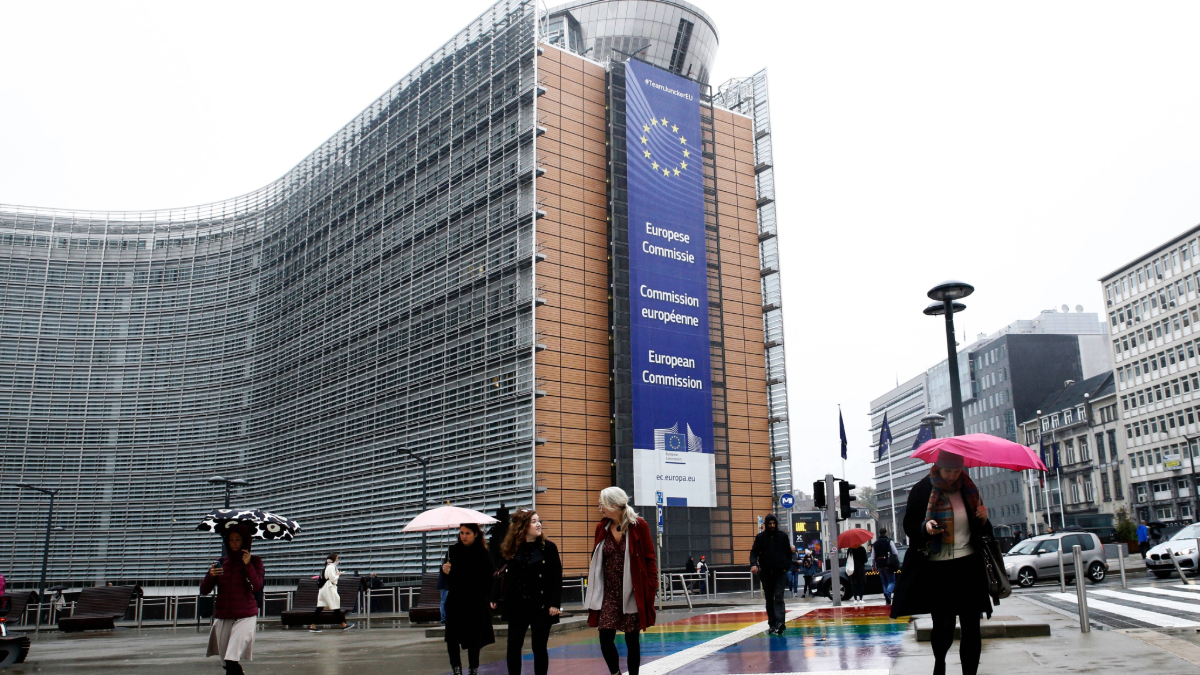
A hard rain falls on Brussels. Shutterstock
The EU’s Digital Markets Act (DMA) seeks not only to regulate gatekeeper power within the EU but also to establish global standards through a comprehensive, rules-based legal framework for digital markets. As a key pillar of digital democracy, the DMA is increasingly seen as a benchmark for governing powerful digital platforms worldwide, exemplifying what Anu Bradford describes as the EU’s use of rights-based frameworks to project regulatory influence beyond its borders.
Nevertheless, just yesterday in a US Congress House hearing, the DMA was heavily criticized as a protectionist tool, allegedly weaponized against US companies, stifling innovation, and harming consumers. Its influence in inspiring other jurisdictions to adopt rules-based legal frameworks has been depicted as an interventionist blueprint that politicizes EU competition policy and fosters regulatory hostility and tension.
The DMA may be an imperfect instrument for curbing the alarming power of big tech and preventing platform abuse, but it is a model for establishing rules-based legal frameworks worldwide to check digital power, uphold citizens’ fundamental rights and support competition and innovation. There can be disagreement on how to subject massive economic power to democratic oversight, while safeguarding citizen welfare, but weaponizing the EU legal order as a retaliatory measure eclipses constructive discussions and hampers effective implementation.
The DMA’s strength beyond the European Union has been increasingly framed through the lens of the DMA’s so-called Brussels effect, pointing to the EU’s capacity to influence legislation and regulatory frameworks outside its borders through regulatory soft power. It is indisputable that the EU’s regulatory power stands on fragile ground, exposing weaknesses in attempts to export the DMA that stem from a combination of internal constraints and external pressures.
The fragility of the EU’s soft regulatory power confirms what scholars of legal transplantation have long argued: laws and regulatory models that fail to engage with the historical, social, economic, and political realities of recipient states are unlikely to take root effectively. Brazil’s experience with digital rule export shows that the recipient countries’ political economy fundamentally influences whether, how, and to what ends EU regulatory models are adopted. Accordingly, it calls for critical reflection on the risks of one-directional and Eurocentric legal transplantation.
The EU’s status as a regulatory superpower has more recently been questioned, particularly in its export of rules in domains where it struggles to match global competitors in innovation and economic dynamism. In times of geopolitical rivalry, calls for economic autonomy and digital sovereignty, and increasingly regionalized rulemaking, the ‘Brussels effect’ is now being tested and contested. The EU’s once largely uncontested regulatory reach is facing significant constraints, in particular with the United States forcefully pushing back against EU regulation at a moment when the EU’s own confidence in its regulatory agenda appears to be weakening.
Moreover, Europe’s innovation deficit, combined with its declining economic weight, increasingly undermines its ability to maintain global influence. The EU’s regulatory power without corresponding economic strength creates a precarious foundation, limiting its capacity to influence the global order in both geopolitical and geoeconomic fields.
The EU’s difficulty in matching fast-moving technological developments through effective legal regulation is also reflected in attempts to transplant the Digital Markets Act, which has so far not translated into comparable regulatory traction.
Notably, the very same week of the DMA symposium, the ‘Brussels effect’ was declared “dead,” as the EU’s own rules-based legal and economic order for digital markets was called into question by the unveiling of the Digital Omnibus package Proposal. The EU’s simplification of digital regulation raises an important question for third countries that have implemented their own versions of the EU’s regulatory frameworks on privacy, data governance, competition, and AI regulation: how should they now approach the further implementation and evolution of these frameworks?
View from Brazil
The symposium focused in particular on Brazil and its efforts to transplant key elements of the DMA, while examining the economic constraints, such as high regulatory and compliance costs, that can hinder such transplantation. Brazil is a particularly important case, as it has become a normative reference for countries of the Global South seeking to create digital regulatory regimes from scratch.
The Brazilian experience initially appeared to illustrate regulatory convergence and Europeanization associated with the Brussels effect, presenting the EU as a unilateral soft power shaping global regulatory standards. For example, Brazilian legislation has drawn on EU-style regulatory models in areas such as data protection (GDPR-inspired rules), which was long considered a success story of the Brussels effect.
However, more recent legislation, such as Brazil’s controversial “Fake News Bill” addressing online content, disinformation, and platform governance, draws inspiration from the EU’s Digital Services Act, but diverges significantly from EU law–style safeguards, prompting digital rights protests. Similarly, the “Brazilian DMA,” which was to create a standalone regime with DMA-style regulatory tools, introducing broad designation criteria and new powers for Brazil’s telecom regulator, was ultimately scrapped following widespread criticism. Distancing itself from the DMA’s regulatory model, Bill 4675/2025 instead draws on German, British, and Japanese models as a blueprint to amend Brazil’s Competition Law (Law No. 12,529 of 30 November 2011) and grant ex-ante powers to the competition authority, CADE, rather than the telecom regulator.
Accordingly, the Brazilian experience highlights the emerging limits of EU rule export. Examined from a Global South perspective, Brazil serves as an important case study of the Brussels effect, demonstrating how EU-style regulatory models can face significant limitations when transplanted into different political economy contexts.
In an era of economic protectionism and techno-nationalism, Brazil’s experience should invite policymakers and legislators to reflect on how to balance international credibility with domestic suitability. Transplanting European regulatory frameworks can generate short-term benefits, including legal certainty, facilitating trade, improving access to the EU single market. It also signals alignment with global standards that may attract investment. Over the longer term, however, if such transplants are insufficiently adapted to local institutional capacity, economic structure, and democratic safeguards, they risk entrenching regulatory regimes that are both excessive and ineffective.
However, there is a deeper layer to the EU’s failing Brussels effect, one that goes beyond debates on geopolitics, geoeconomics, and the EU’s competitiveness. This critique underlines the ‘Brussels effect’ as Eurocentric, unidirectional, and frequently neglectful of both the capacity of recipient countries and the invisibilized local realities in which it operates. Recent developments, such as the US Congress hearing, show how the DMA can be politicized and weaponized for retaliation. This makes it all the more crucial for the EU to assert and defend its rules-based, democracy- and values-rooted approach to digital regulation.
EU digital regulation carries significant normative weight, transplanting it without responsiveness to local social, economic, and political conditions risks undermining the very democratic rights, institutional legitimacy, and constitutional values it seeks to promote.
Authors