The ‘AI Arms Race’ is Unhinged—Both US and Chinese Tech Enthusiasts Know It
Shuxian Liu, David Gray Widder / Nov 16, 2026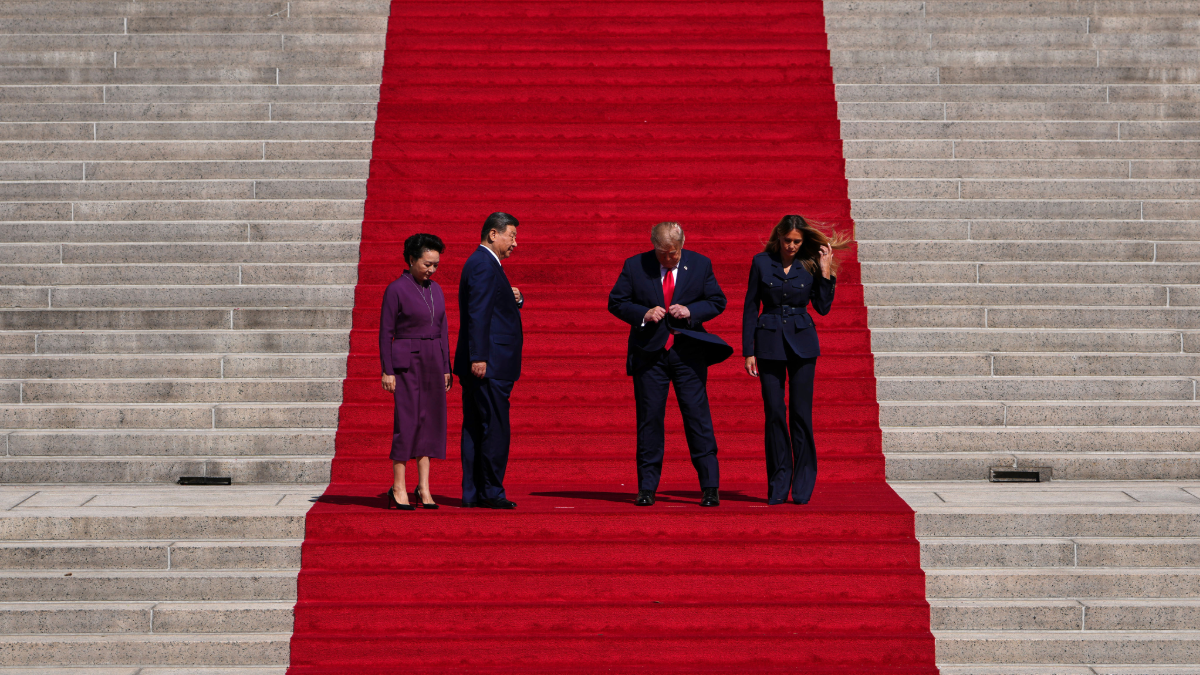
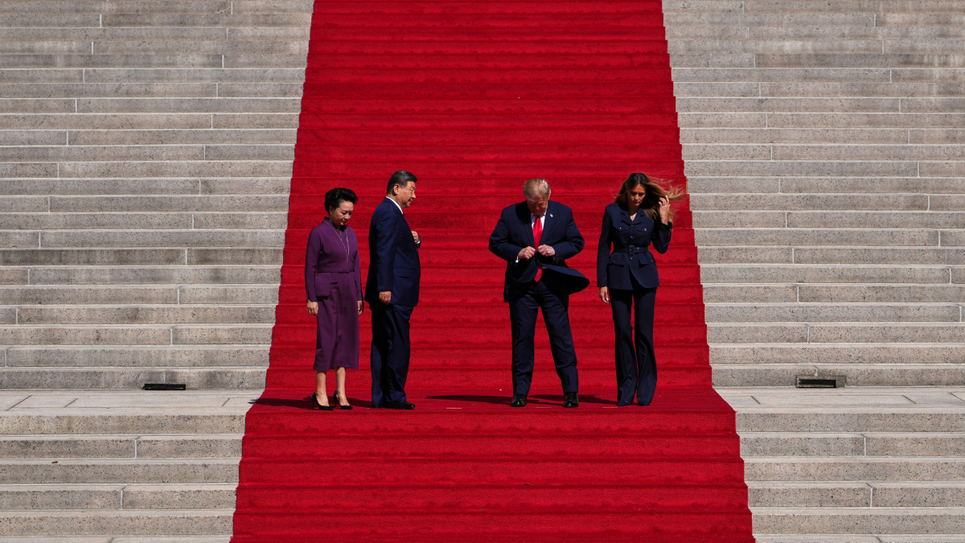
President Donald Trump, center right, first lady Melania Trump, right, China's President Xi Jinping, center left, and his wife Peng Liyuan prepare to pose for a photo on the steps of the National Archives Museum upon arriving, Friday, Sept. 25, 2026, in Washington. (AP Photo/Julia Demaree Nikhinson)
This week, United States President Donald Trump and China’s President, Xi Jinping, are set to meet on the sidelines of the APEC leaders’ summit in Shenzhen, where leaders are expected to continue their dialogue on artificial intelligence (or, as the White House has dubbed it, “superintelligence”). Questions over the “AI race” between the two countries are swirling amid rapid advances in model capability and related technologies and the stunning downfall of Nvidia CEO Jensen Huang, who resigned amid allegations he had multiple affairs, including with a suspected Chinese agent.
But how real is the “race?” The question deserves scrutiny, particularly as it is one of the most significant issues animating US-China relations.
When the Soviet Union launched Sputnik 1 in 1957, a beach-ball-sized satellite was said to be proof that the US was falling behind. Nearly 70 years later, the same was said about a large language model from a Chinese startup: Deepseek. Within days of its release in late January 2025, Senate Democratic Leader Chuck Schumer (D-N.Y.) told the Senate that it was being called AI’s “Sputnik moment”—a “wake-up call” for a country at risk of losing its lead.
On the other side of the Pacific, the Chinese state media outlet, Xinhua News Agency, celebrated R1 as héng kōng chū shì (横空出世), an “arrival out of nowhere” that had placed China in the lead, with the US left following. The same model carried two stories: a threat to be contained, and a rupture to be celebrated.
The frame has outlived the model. Each major Chinese release since, including Moonshot AI’s Kimi K3 this July, has been met in Washington and Silicon Valley with the same question: Who is winning?
In a recent study, we compared how the US government, Chinese state media and online publics in both countries talked about DeepSeek in the months after its release. The comparison suggests that “who is winning?” is the wrong question. The race is not a fact that the commentary describes, and tech enthusiasts in both countries are aware.
The chip behind DeepSeek, read four ways
What the Nvidia chips that trained R1 meant to officials and online publics in the US and China.One model, many contested identities
The echo of Sputnik is not incidental. In The Closed World, historian of science and technology Paul Edwards showed that Cold War computers were at once machines and metaphors. Military ambitions shaped the technology, and the technology made a world under total surveillance and control seem achievable.
AI works the same way today. Through our comparison of discourse from both US and Chinese officials, and with US and Chinese public discussions on Reddit and Chinese platform Zhihu, we show how discourse and infrastructure are knotted together. Claims about an “AI race” are used to authorize spending, restrictions, and institutions. Those become facts on the ground, which are then cited as proof, and the cycle begins anew. We call this recursive process “discursive-material articulation.”
DeepSeek is particularly revealing because it drew together three common narratives in AI debates: sovereignty, scale, and openness. Each ties a physical thing—a chip, a data center, a file of model weights—to a political story.
Sovereignty: What a chip is
The sovereignty circuit runs through the chip. DeepSeek trained on Nvidia H800s, processors built to reduced specifications so they could be sold in China under US export controls.
In US official texts, the chip is a chokepoint and DeepSeek is evidence of leakage. A House Select Committee report accuses Nvidia itself of designing chips “while skirting US export controls,” and asks whether restricted chips are being diverted to China through Singapore. Controls produce “downgraded” H8oo chips, a Chinese lab does well with them, and the result justifies more controls.
Chinese official discourse reaches the opposite conclusion from the same hardware. A Xinhuanet article cast US restrictions as an attempt to strangle“ (扼杀, èshā) China's industrial development and said DeepSeek had shattered the “illusion” that chip export controls could hold back Chinese AI. Sanctions, it argued, only force Chinese firms to innovate on their own. Another piece said Chinese companies had gone from beneficiaries of the open-source community to contributors, breaking through the “technology blockade.”
Engineers on Zhihu who cheered DeepSeek also noted that it remained bound to Nvidia’s CUDA software. On Reddit, the chip was tied to Nvidia’s stock: Nvidia lost nearly $600 billion in market value on Jan. 27, 2025, amid fears that efficient models would reduce demand for its chips.
The chip is: a national asset, a marker of dependency, an engineering constraint and an investor instrument, depending on who is holding it.
Scale: Improved efficiency, but more data centers?
We also saw how “scale” linked claims about AI capability to compute budgets, energy systems, capital, and geopolitical position. Before January 2025, the idea that capability comes from ever more compute was built into investment portfolios, grid planning, and export controls. The belief pays for data centers; the data centers then stand as evidence that the belief was right.
R1 reached competitive performance with a small fraction of the compute its US rivals were assumed to need. Yet neither government let go of scale. US officials absorbed the shock by doubling down, arguing that efficient Chinese models made energy dominance and faster build-out more urgent. Chinese state media first cast US brute-force scaling as a strategic miscalculation, then rebuilt the case for scale through the Jevons paradox: cheaper models bring more users, and more users need more total compute.
Users on Reddit and Zhihu described a “compute capital game” in which the demand for scale serves investors and infrastructure owners at least as much as engineering. Some made the point without arguing it — by running versions of R1 on a consumer graphics card at home.
Openness: Threat, gift, weapon, commons
The openness circuit is where the DeepSeek moment is still being fought. When DeepSeek posted R1’s weights to Hugging Face, one downloadable file became a national security threat in US official texts, a gift to the world in Xinhua, a weapon against US firms’ revenue on Zhihu and shared infrastructure on Reddit.
The sharpest dispute was over distillation — the routine practice of training one model on another’s outputs. US officials and firms described DeepSeek’s use of it as theft. Practitioners on both platforms answered by listing how common the practice is, including among US developers.
This summer the circuit turned again. After Moonshot released Kimi K3, Dean Ball, a former White House AI adviser now at OpenAI, warned that a world dominated by open-weight models leads to “full AI communism.” Days later, Nvidia, Microsoft, Meta and other companies signed a letter arguing that open weights drive “American sovereignty and prosperity.” Meta CEO Mark Zuckerberg later wrote that restricting foreign open models would centralize AI.
These ostensibly oppositional positions share a premise. The same kind of file is sovereignty in one executive’s telling and communism in another’s, and both judge openness by whether it helps the US lead. Openness is not a property of the file. It is a claim attached to it, and the claim decides what gets built, bought, and banned.
What the race narrative leaves out
Three decades ago, Richard Barbrook and Andy Cameron described the Californian Ideology as a “contradictory mix of technological determinism and libertarian individualism” that looked away from the racial and environmental costs of California’s technology economy. That optimism is far from gone. The race frame gives it a flag: more AI sooner, is the goal, and the only argument is over which country gets there first.
For policymakers, the lesson of the DeepSeek moment is practical. Export controls, data center subsidies, and rules on open weights are usually judged by one test: whether they keep one country ahead. A better first question is what each policy builds, and for whom. The loop between claim and infrastructure is hard to reverse once the chips are fabricated, the grid is extended, and the weights are out, foreclosing other possible policy paths.
It is also worth listening to the people closest to the hardware. The engineers and hobbyists in our data shared neither government’s certainties, and they tracked technical details that official accounts left out, providing some deflationary grounding for their government’s most breathless claims.
The preoccupation with who is winning the “AI arms race” leaves more basic questions unasked. By whose standards is victory defined, and who has the power to set them? Who benefits from that victory—and who bears its costs in economic precarity, labor exploitation, environmental degradation, and lives unsettled by anxiety and uncertainty? What do you think the answer is?

Authors