Technocracy Won't Debug India's Education Crisis
Amber Sinha / Aug 24, 2026Amber Sinha is a contributing editor at Tech Policy Press.

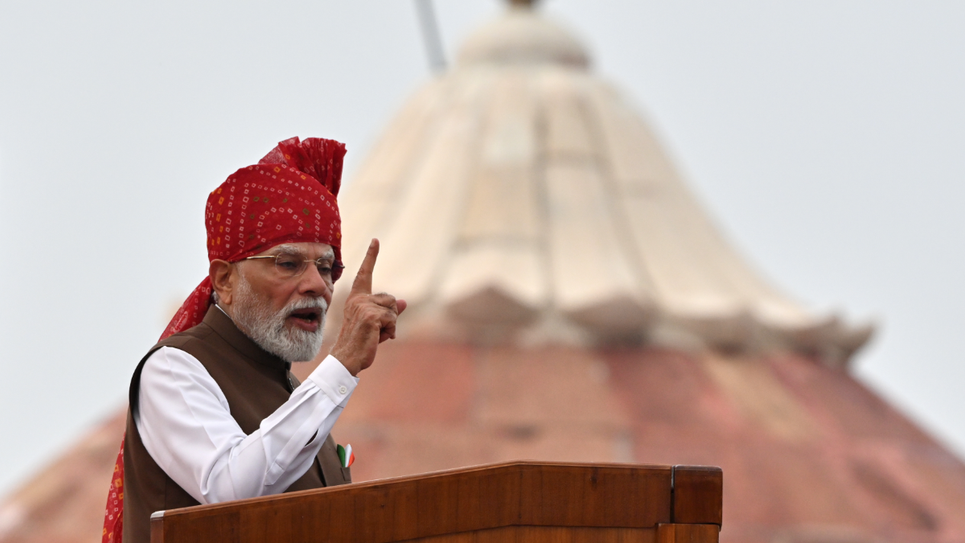
Indian Prime Minister Narendra Modi addresses the nation from the rampart of the 17th century Mughal-era Red Fort monument during the country's Independence Day celebrations in New Delhi, India, Saturday, Aug. 15, 2026. (AP Photo)
In his annual Independence Day address on August 15, Indian Prime Minister Narendra Modi announced that over ten million young people will receive AI training through a dedicated national drive over the coming year, while India’s digital public infrastructure will be harnessed to deliver free online test preparation for competitive exam candidates. This follows the government’s announcement in late July about the constitution of a high-powered task force to recommend comprehensive steps to make India’s examination system “leak-proof and technology-driven.”
These steps come on the heels of the unprecedented Cockroach Janta Party (CJP) protests that recently swept the country, driven by a massive test data scandal that exposed the severe vulnerabilities of India's centralized examination infrastructure. As millions of young people took to the streets and demanded accountability for compromised futures, the political fallout culminated in the resignation of the Union Education Minister.
Faced with a structural and political crisis of this magnitude, this response is revealing. The framing of the task force suggests that the government views the issues with the examination system as an engineering failure, a problem of insecure databases and inefficient data pipelines.
This represents a limited and extremely technocratic view that has informed education policymaking in India over the last decade. It is an approach that consistently treats pedagogical, structural, and socio-economic failures as mere data management and fraud detection problems, applying digital band-aids to a system that is fundamentally misaligned with the needs it seeks to address.
A decade of digital interventions and the employability crisis
To understand the current moment, one must look at the trajectory of education and examination reforms undertaken by the Modi government over the past decade. The state’s vision has been to leverage Digital Public Goods (DPGs) to achieve scale and efficiency. The last ten years have seen an aggressive push toward the digitization of the classroom and the examination hall.
Central to this was the launch of DIKSHA (Digital Infrastructure for Knowledge Sharing), envisioned as a national platform for school education. This was followed by the Central Board of Secondary Education’s (CBSE) implementation of the On-Screen Marking (OSM) system, designed to digitize answer scripts and streamline evaluation to prevent manual tampering and reduce logistical bottlenecks. The government also introduced the APAAR (Automated Permanent Academic Account Registry) ID, marketed under the slogan “One Nation, One Student ID.” Concurrently, there has been a significant push to integrate AI into educational delivery and assessment, promising personalized learning and automated grading.
This digital architecture often operates divorced from the material realities of the Indian education system. The technological reforms have done little to address the most glaring failure of this system: the employability crisis. India’s much-touted demographic dividend is rapidly transforming into a demographic burden. Successive iterations of the India Skills Report and data from the Center for Monitoring Indian Economy (CMIE) have repeatedly demonstrated that nearly half of all Indian graduates remain unemployable in the modern economy, lacking fundamental critical thinking, problem-solving, and communication skills.
The structural issues are glaring — a massive shortage of qualified faculty, chronically underfunded state universities, rote-learning-based curricula, and a severe lack of physical infrastructure. In this context, the government’s flagship Skill India Mission, launched to bridge the gap between education and industry needs, has largely failed to meet its ambitious targets.
The focus has consistently remained on certification and enrollment numbers rather than pedagogical quality or actual skill acquisition. Instead of addressing these root causes — which require sustained financial investment and complex institutional reform — the state has prioritized digital legibility. By focusing on metrics, dashboards, and technological interventions, the government has created an illusion of progress, while the fundamental unemployment problem and the quality of education remain disastrously stagnant.
The ideology of a single source of truth
The current approach to education reform represents a specific, highly technocratic ideology. It is a governance model that operates on a fundamental premise of trust deficit. In this worldview, students, teachers, and regional administrators are inherently prone to inefficiency or corruption, and centralized technology is the only objective, incorruptible arbiter. Consequently, the primary problem statement that educational technology seeks to solve is not how to improve learning outcomes, but how to optimize fraud detection and standardize assessments.
This ideology is most evident in the design and deployment of the APAAR ID. The state frames APAAR as a revolutionary ‘single source of truth." The objective is to replace fragmented, physical academic files with a unified, lifetime digital history, ostensibly to stop the proliferation of fake certificates and eliminate duplicate records via frictionless digital verification. However, this top-down architecture replicates the exact ideological and structural flaws of the Aadhaar project. By demanding absolute centralization and standardization, the system becomes inherently brittle and exclusionary.
This uncritical embrace of technology is equally evident in the state's recent push toward Artificial Intelligence in schools. As a recent investigation highlighted, Indian schools and state portals are embracing AI without adequate guardrails, precipitating a genuine "hallucination crisis." Ed-tech platforms integrated into state systems and automated AI tutors are generating factually incorrect information, while automated grading systems penalize students whose subjective answers do not align with the algorithmic vector space.
AI is being deployed not to augment teacher capacity, but to substitute it, driven by a desire for cost-cutting and scale. The risks of algorithmic bias — where AI systems trained on skewed datasets systematically undervalue and disadvantage students from specific socio-linguistic backgrounds — are entirely ignored in the state’s rush to present a technology-driven educational facade.
The Nilekani model
It is within this context that the appointment of Nandan Nilekani, among the chief proponents of India’s modern technocratic state, to run the task force must be seen. His trajectory—from building Aadhaar at UIDAI to his influential role at the software product think tank iSPIRT, and his championing of India Stack and Digital Public Infrastructure (DPI) — represents a very particular philosophy of governance.
This governance approach has so far reduced complex, deeply human civic and social interactions to APIs, databases, and authentication protocols. It operates on the belief that societal problems are essentially engineering problems at scale. If welfare delivery is inefficient, build a biometric database (Aadhaar). If retail commerce is skewed, build an open network (ONDC). Now, if the examination system is plagued by leaks and protests, will the response focus on building a new layer of cryptographic or biometric verification?
This model of building digital public infrastructure fundamentally alters the relationship between the citizen and the state. In this framework, citizens are reduced to data points, and systemic issues of equity, access, and democratic accountability are bypassed in favor of technological efficiency. The architecture of India Stack and similar Indian state-endorsed DPI is inherently centralizing. While it is presented globally as a benign, open-source public good, it allows the state to consolidate vast amounts of behavioral, financial, and now academic data, creating monopolies of information under the guise of public utility.
Furthermore, as scholarship on the governance of Digital Public Infrastructure has noted, this infrastructure is routinely built and deployed outside of robust legislative frameworks. The architecture precedes the law. Systems are deployed via executive mandate or public-private partnerships driven by entities like iSPIRT, leaving citizens with little democratic recourse when systems fail or data is compromised.
The experience with ID and DPI systems built and championed by Nilekani has historically prioritized state fiscal savings over basic survival rights, narrowing down to a specific and limited problem statement (identification, KYC, data exchange layers) and often proposing datafication of human interactions and behavior as a key to solving complex problems.
The limits of techno-solutionism
The constitution of the high-powered task force under Nilekani is a signal that the Indian government intends to double down on its techno-solutionist approach. What is more unlikely is a recommendation for the massive expansion of the education budget, the widespread hiring and rigorous training of teachers, or a fundamental overhaul of a pedagogical model that prioritizes rote memorization over critical inquiry.
The state will undoubtedly build a more sophisticated dashboard, and the examination system may even become more “leak-proof.” But a secure database and digitalization of student data do not lead to better education. Until the government recognizes that the crisis in Indian education is structural and economic rather than merely technological, millions of graduates will continue to emerge from this seamlessly integrated digital pipeline fundamentally unprepared for the world.
Authors