Steve Feldstein on Bytes, Bullets, Blood and Borders
Justin Hendrix / Oct 11, 2026Audio of this conversation is available via your favorite podcast service.
It’s a cliché to say that technology is changing war. But today, the pace of change is severe, not only because of advances in fields such as artificial intelligence, but also because of a range of trends and phenomena at the intersection of tech and geopolitics that are changing what it means for nations to compete, and to fight and defend themselves.
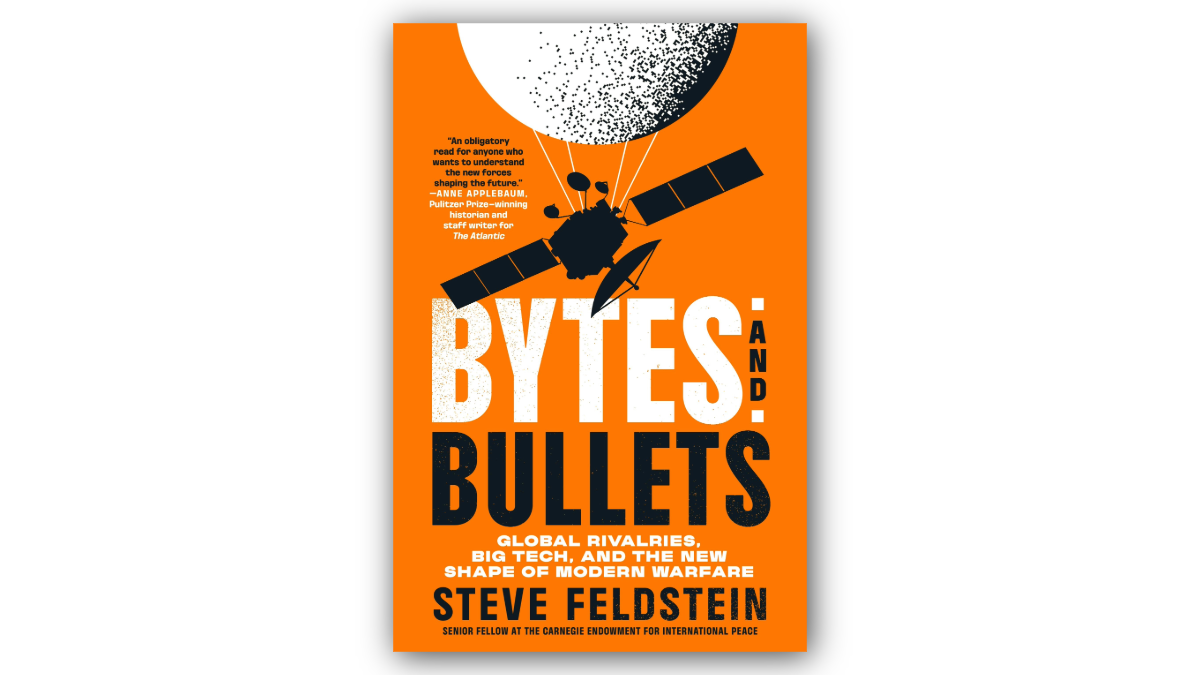
Today’s guest is Steve Feldstein, a senior fellow in the Democracy, Conflict, and Governance Program at the Carnegie Endowment for International Peace and the author of Bytes and Bullets: Global Rivalries, Big Tech, and the New Shape of Modern Warfare, published by St. Martin’s Press.
Steve Feldstein:
Steve Feldstein, I'm director and senior fellow in the Democracy Conflict and Governance Program at the Carnegie Endowment for International Peace based in Washington, DC. I am the author of Bytes and Bullets: Global Rivalries, Private Tech, and the New Shape of Modern Warfare.
Justin Hendrix:
So glad to have you on the podcast to talk about this new book, not your first book you have written in past, including On the Rise of Digital Repression. And I think most of the time when I've engaged with you at Tech Policy Press, it has been on matters around questions of authoritarianism and digital repression. I know we worked a little bit around the deconstruction of USAID and the end of so many of the United States' investments in internet freedom and efforts to counter authoritarianism and the digital sphere abroad. When did you decide to write about modern warfare?
Steve Feldstein:
It was a bit of an evolution, but I would say it was kind of part of a natural process that I thought about early on. So I mean, essentially the way it worked for me career-wise was that I was a practitioner for 13 years and I left in 2017 right when the first Trump administration started. At the time, I was in a role where I was the Deputy Assistant Secretary in the Democracy, Human Rights and Labor Bureau at the State Department. And essentially I was responsible for all things democracy and human rights related to Africa, which meant traveling back and forth quite a bit and seeing the different types of abuses that would occur by government security forces, the different types of ways they would suppress dissent, they would try to steal elections, things like that. And in particular, I saw the ways in which technology more and more was manifesting as a tool of internal repression.
And so that's what got me started on the broader question of technology and its impact of politics leading into my first book, as you mentioned, The Rise of Digital Repression. But stepping from that, I felt the story, the set of issues wasn't confined strictly to internal matters, that there was a whole set of issues related to competition between states and the role that technology's playing in shaping and directing that competition. And so as much as I was interested in the ways in which a dictator might use surveillance to monitor their citizens, I was also interested in the ways in which different types of countries would use technology to expand their influence geopolitically, to counter and push and try to gain advantages over other rival states. And then more broadly, as I looked at competitive elements, and so one aspect of the book is about more peer-to-peer competition in the economic sphere amongst technological systems and so forth, I also found that that really bled into questions of war.
And that was really hard to disaggregate the two, that if you're going to talk about geopolitical competition, it's as much about competing for chips, for different types of cloud serving computing systems as much as it is about actually manufacturing drones, using and deploying military AI systems in war. And so I found that those two issues became really intertwined and that's ultimately what got into the universe of the book that I wrote. Now the one specific thing I also want to mention is that, I mean, I would say there was probably a signal moment for me that really caused me to accelerate and think deeply about the arguments I wanted to make in the book. And that moment was the Ukraine war. So like many of us in the foreign policy arena watched very closely what was happening in the months leading up to Russia's invasion.
And when the missiles started flying and the helicopters and the tank columns started moving in, I was as surprised as anyone else by what was occurring. And I was also deeply pessimistic about the ability of the Ukrainians to withstand the Russian onslaught. Like most others, I thought that at best the Ukrainians would be able to hold out for two or three weeks, but that very quickly we would get a puppet government in place under Russian occupation and that would be that in terms of Ukraine's democracy. So as I watched with surprise as Ukrainians were able to withstand Russia's assault, stabilize the front lines, push out Russian soldiers who had made incursions into Kiev, and used drones in particular as a way to hold the line, that also I think really had an influence on me in terms of wanting to better understand how technology was playing such a critical role when it came to a country like Ukraine, a new democracy fighting to preserve its way of life amidst a very brutal invasion.
So that's a long way of answering a very short question.
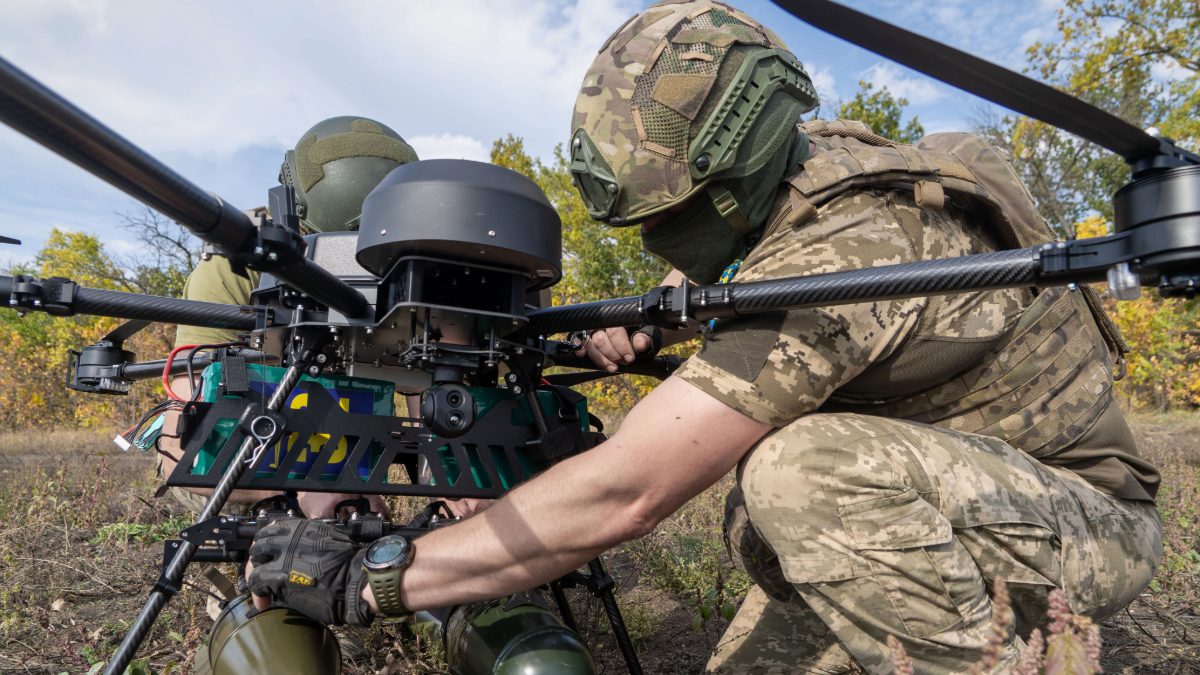
Ukrainian servicemen of the Pathfinder Unmanned Systems Battalion of the 115th Separate Mechanized Brigade attend a training with Vampire UAVs, practicing munition drops at an undisclosed location in Kharkiv region, Ukraine, Thursday, Oct. 8, 2026. (AP Photo/Andrii Marienko)
Justin Hendrix:
You talk about open innovation as a concept and the extent to which the way that we have gone about developing technology in the United States and even sharing technologies which during the Cold War were considered crown jewels, things that we would defend and not want our rivals to get hold of, that model has effectively created the conditions, I suppose, where Ukraine could look around and say, "What can we buy off the store shelves? What can we take from an open source repository? What can we do in the space of this onslaught to build a resistance?" Maybe I could ask you to just paint a picture for us, what did go into creating that moment where Ukraine was able effectively to use technology and use the resources it had at hand to create something to blunt a great power's assault?
Steve Feldstein:
Yeah. Well, great question. And I would point to two aspects, one of which is the open technological ecosystem I mentioned, which I'll talk about in a second, and the other is kind of globalization, which is very much linked to that. But the story is a really interesting one, which is that throughout the Cold War, the US essentially hosted a closed innovation ecosystem. What that meant was that by and large, most of R&D came from government sources of funding. Many of the innovations and proprietary technologies were invented in government labs or labs that were directly under government support. And these technologies weren't shared, they weren't commercialized, they were kept within a closed ecosystem. They were used to help power new weapon systems or new computing systems that were leveraged by the government, but they didn't go outside the US. Over time, that started to shift in different types of technologies, but the real big turn occurred post 1989 after the fall of the Berlin Wall when the US Congress and policymakers in the US said, "Look, we've invested all this money.
One, we can't keep investing the same sum into scientific R&D. That needs to shift. We want a piece dividend from this." And so what that means is we need to see the private sector come in and replace a large amount of the public funding that's occurred. But in return, what we're also going to promote is a model of commercialization where technologies that were innovated in government labs would now be accessible to companies to do something innovative with. So that's where you saw ARPANET becoming the internet, that's where you saw GPS become commercialized. That's where you saw a lot of things with our smartphones, Siri in terms of natural language processing, touch screens and so forth. These were all proprietary innovations that were invented in government labs that were allowed to be commercialized and turn into profits by whatever companies, whether it's Apple or someone else, however they chose to do so, particularly for consumer electronic devices.
So one thing was this big shift where we went from closed to open, and certainly one of the big beneficiaries of that were Silicon Valley firms, but it wasn't just Silicon Valley. It also meant that companies based in other countries and innovation hubs in places like Tel Aviv or Taipei or Seoul or Beijing, as it turned out, could over time also begin to flourish, could also develop their own nascent startups and eventually big companies that could do things with cutting edge technologies that would help to disperse these innovations pretty far and wide. The second corollary to this is the fact that there was also a bet that the US made as we got deeper into the peace post-Cold War where essentially we said we're the hegemon, we're the unipolar power, no one else is challenging us. The best way to keep distant rivals at bay is to bring them into the fold, to integrate them into our system as opposed to keeping them on outside.
And that's where you saw in particular a move to integrate China as well as Russia and other countries into the US orbit, particularly economically. So the bet, especially with China, was that if Beijing could be part of the US economic kind of global economic order, that integration would eventually lead to political liberalization over time or at least would set the groundwork for a lasting and enduring peace. And so there were very deliberate efforts, whether it's succession into the WTO, opening US markets to Chinese companies and so forth, where the US tried to cultivate Chinese integration into the global market. And that allowed for and helped to power the rise of Chinese companies and a host of other companies. Globalization wasn't limited to one large country. It was something that many other countries were able to take advantage of. And so as a result of that, that really changed around and led to an unprecedented open ecosystem, which has allowed for many countries, both big and small, to emerge and to rise and helps to explain to some extent many decades later, Ukraine's ability to withstand Russia.
So I've told a long story for a very specific kind of thing, but we can go into follow up on that.
Justin Hendrix:
Yeah, absolutely. I mean, I guess you've got to the point of Ukraine. We're there, we're in this moment. There's an incredible story you tell about this smuggling operation to get drones inside of Ukraine that I'm reminded of just thinking about how that came together, the extent to which it relied on, in many ways, a kind of open approach to assemble all of the resources, even the people necessarily to accomplish that particular strike inside of Russia on airfields. As you think about what created the conditions for that Ukrainian resistance, where does that leave us thinking about, I don't know, the future of warfare, the future of tech and advantage and strategic advantage? Are things now effectively kind of flattened out a bit in a way? Is that the way to think about this?
Steve Feldstein:
What's interesting about Ukraine is that it sort of showcases two very different sides to a similar story. So the story itself is one where you see the ability of a country to adapt very quickly, to leverage new innovations in ways that can allow it to survive, if not flourish. And so part of this I think is a really good news story. It's a heroic struggle, right? It's a hero's journey where essentially you see a country facing insurmountable odds, find ways out of the wilderness using the ingenuity of its people, its engineers, its computer technicians and so forth to come up with creative low-cost ways to strike back against a much more powerful foe. And it shows you very specifically how technology today can enable that kind of upsetting, that kind of upstart, that kind of David versus Goliath type of story. And so part of the narrative of the book itself talks about the possibilities that technology allows underdogs to accomplish even in a system that seems heavily weighted these days amongst superpowers in larger countries.
The flip side though to this story is one that's not so positive as well is that in many ways the Ukraine war has also unleashed a new paradigm of fighting, one that's increasingly automated, one that's based increasingly on machines where you see battlefields that are saturated by drones that have become brutal no man's lands. I mean, one of the things I tried to really describe in the book is just how violent and how horrific the kill zones along the front lines in Ukraine are in this sort of modern era of machine-based warfare where there is no hiding at any point. If you're a soldier who's unfortunate enough to be housed in an outpost somewhere in the kill zone, no part of the battlefield is safe. It is completely transparent. You have constantly different levels of drones that are buzzing overhead, whether quadcopters or higher level surveillance drones.
You step outside for a second, whether it's to obtain supplies or provisions or to relieve another soldier, you're at risk within seconds of being struck. And so the very same machines that have enabled Ukraine to survive are also, I think, the keys to a new type of really alarming, horrific warfare, one of which I worry to think about what future battlefields will look like and the effect it'll have both in terms of the combatants themselves who are fighting as well as the civilians who are unlucky enough to be around.
Justin Hendrix:
One of the characters that you bring into the book is Mykhailo Fedorov, who started out at the beginning of the war. I know he was head of digital transformation in Ukraine and went on to have other roles. And I think more recently has sort of left an official government position if I understand it, but I noted a tweet from him just the other day. I think he's helping to build up more of this sort of defense tech ecosystem for Ukraine and sourcing new weapons and things of that nature. And he posted this video, it was mostly AI generated stuff, maybe you saw this, of robots and sort of saying we want to invest in more effectively killing machines, robots that can take the battlefield and as if to bring the imagination to the screen, all these kind of very terrifying ideas about different types of robots, how they would potentially kill soldiers or intervene in battles.
I know Zelenskyy just warned a couple of days ago at the UN that we're sort of entering this new phase of automation and it seems like there's just a massive supply chain being built for this. It seems we're kind of well beyond asking the question, are we going to do this and well into its full steam ahead and these things are effectively in development.
Steve Feldstein:
Yeah, no, I think that's right. I mean a couple things. I mean, first of all, war brings out a really dark side in human nature, even if you're fighting for the right cause, no question about that. But at the end of the day, the goal of weapon systems is to punish your adversary as thoroughly as you can in order to achieve victory. And if that means entering a level of brutality within the confines, the very loose confines of the laws of war, so be it. Fedorov is a really interesting person. So he's a person who I profile in several different ways in the book. Initially, as you mentioned, he was the minister of digital transformation really young. I mean, at that point had basically just turned 30, I think. And one of the first things he did was he realized even before the war had started that there was a huge vulnerability that Ukraine had, which is essentially that its data was sort of packaged in servers and wasn't on the cloud and that one errant missile strike, or not even errant, one deliberate missile strike by Russia could wipe out reams of critical data related to Ukrainian citizens, whether it's their social security information, medical information, other identifying things, and essentially put ground the economy and the ability of people to live and work to a halt.
And so he was able to partner very quickly with several different companies, including AWS, Google, and Microsoft to essentially move out this data in these snowball trucks across the border into Europe so they could be uploaded into the cloud and therefore protected from the kinetic destruction that otherwise would potentially befall them. And as it turned out, a week and a half later when the invasion did happen, a missile did strike one of the data repositories that they had just evacuated. And so if that effort had not worked out, reams of classified and critical data would've been lost. So he's a really interesting person having the kind of prescience and awareness to foresee how important the digital would be to Ukraine and to be able to actually be in a position to do something about it. And then over time, he's taken on a really central role.
He ended up in his last job as the Minister of Defense and I think a vice prime minister in Ukraine. And essentially he's one of the main people responsible for really pushing this kind of innovation adaptation ecosystem, this defense tech drone forward approach. It's not only him, but many view him as being one of the driving, instigating forces, pushing it back against the kind of old way of doing things, the kind of stodgy sort of model of fighting into a much more innovative, adaptive model that would find new ways in which to fight the Russians. And so people give him a lot of credit for that. Since he's left, he's, as you mentioned, looking for, I think he's starting a startup in the defense tech ecosystem. I understand that he's either formed a partnership or in discussions for a partnership with Palantir. So I think there's a kind of open question about where things go next.
One other thing I'd point to as well, with the Ukrainians and drones, the survival instinct really comes down to a basic principle, which is that Ukraine doesn't have enough manpower to stave off the Russian invasion, that either they find another way to offset the asymmetry in numbers or they will lose. And so for them, the calculus is essentially, can they find ways to replace soldiers with machines in order to make up that gap? And that's why you see this kind of continued embrace of the machine-led warfare because that has been the key to survival for Ukraine. Without drones, without a way to make up that gap in resources and personnel, the prospects for Ukraine being able to maintain their country would be exceedingly low.
Justin Hendrix:
So I want to come back to the great powers or superpower dynamic between the US and China eventually, but I think I want to stay in this zone of what's going on with more middle powers. And maybe we might think of Ukraine as kind of being an example of a country that's big enough to have its own industry, its own tech innovation to some extent. Clearly in the case of this war, the motivation to invest in these things. But you spend a lot of time looking at other countries that are not the big guys, but are somewhere in between. They're stuck in between, on some level, the race between the US and China on AI. They've got their own strategic circumstances, whether it's Turkey or the UAE or Israel or Brazil or Taiwan or what have you. But I don't know, how do you think about these middle powers, where they find themselves in this moment when it comes to thinking about their own security, thinking about technology?
Steve Feldstein:
One of the arguments that I make is that for middle powers, particularly countries, I call them the rising tech powers, identify nine countries or so that are sort of doing a pretty good job, that both have a confluence of interest in wanting to have geopolitical influence and independent foreign policy while having enough of a technological base in which to project power in unique ways. And the idea there is simple, but that as we think about an international order that increasingly has become unstable, where there's a greater amount of turbulence, where frankly the stability offered by large countries, particularly the US, has started to wane and where empirically the number of conflicts and the number of people killed in conflict has risen exponentially in the past five years, there's a real need, I think, by these countries to find ways to stabilize their own positions and to project influence accordingly.
So if you're Turkey, you say, "What are some different ways that we can have influence in our region?" And one of the answers for Turkey and one of the things I profile quite a bit in the book is the export of TB2 drones. Now, the kind of argument for these drones is that they offer lots of expensive capabilities, laser guided munitions, high altitude in terms of flying other sorts of very expensive sensors and so forth, but compared to products that come from the United States or even China, other countries, they're far cheaper. And so these have ended up becoming instrumental weapons in second tier, third tier conflicts around the world. So a couple of the places I talk about, one is the war, the Civil War in Sudan. Another is Libya. A third is the fight a couple years back by Azerbaijan to overtake the enclave of Nagorno-Karabakh.
In each of these situations, you saw Turkish TB2 drones used to target, destroy, and punish soldiers and personnel from a rival military. And so what does this then give Turkey? Well, one, it allows Turkey to pick a side, especially in a conflict where the US or other countries may have less of an interest or be distracted from getting involved. Two, if the side that it picks oftentimes ends up experiencing military victories, so that then helps to enhance the influence of Turkey. And then number three, if that side ends up conquering territory, if not winning the conflict itself, Turkey can then extract concessions from that government, whether it's mineral or gold concessions or other financial incentives or something or just political favors or something else. And so you can see very quickly how a technological advantage can translate to a geopolitical set of advantages over time and allow a country that is a classic middle power, a regional power, but certainly not one that you would call a great power, how that can translate into a significant degree of influence in its own backyard.
Justin Hendrix:
Thinking beyond these middle powers, thinking more about the role of the United States, the role of China and setting some of the dimensions for the debate or the race between these various countries, I don't know, how do you think of the US role at the moment? You talk a little bit about the extent to which the US is trying to organize various countries within its orbit, as it always has done. I was reading an article yesterday about how the project of Pax Silica, for instance, has advanced that project to organize critical minerals and rare earths and to sign on other countries to essentially participate in the US supply chain. And of course, there's this major effort to get other countries to essentially agree to be in some kind of US AI tech stack, whatever that means, effectively to work with US firms as opposed to relying more on Chinese models and things of that nature.
I don't know, this kind of dimension of the US's effort to continue to corral middle powers, to continue to try to hold them in its orbit, I don't know, where are we at on that? Is it working?
Steve Feldstein:
Well, I would say it's dissolving fast. I mean, there's sort of a before and after part in the book. I was writing the book squarely as we were into the last months or last year of the Biden administration and continued writing as we got into the first year plus of the Trump administration. And I would say that certainly Biden's policies were not perfect, and there were a lot of flaws, I felt, in terms of how they were advancing their export controls agenda. And I think there were a lot of mistaken assumptions in terms of what they though they would be able to accomplish vis-a-vis China, but it was a consistency to it. I mean, there was a very kind of clear idea. The idea was essentially you build up innovation at home. And so between the CHIPS Act and the Inflation Reduction Act, you saw a significant amount of government investment, industrial policy by another name, go into either onshoring critical industries and building up American scientific R&D and so forth.
A second piece to that as well was this denial piece, ensuring that rivals, particularly China, Russia as well, wouldn't be able to access the most cutting edge innovations, particularly advanced microchips and other maybe AI models that were being invented by American companies and American labs. And then the third piece was this allies piece that you mentioned, this idea that you corral together like-minded countries, very loosely Biden classified it into democracies and autocracies, which got a little messy as you started figuring out, trying to understand where the UAE or Saudi might fit into this thing. But by and large, the idea was you have a collective of countries that see eye to eye, that have kind of shared policy objectives. You try to keep them together, you try to deny other countries from being able to tap into their supply chains and that you isolate your rivals over time, particularly China.
So now that we're in the Trump administration, how is that faring? Well, not great. On the allies piece in particular, we're apparently at war with Canada. We seemingly are skirmishing, maybe we're not completely at war with Europe. Even when it comes to other countries like South Korea, Taiwan, it's unclear exactly what our policy is, but the kind of friendly relations that we had prior to under Biden are sort of much more up in the air. In the meantime, we just had a summit where China's leader Xi Jinping came to Washington, got all of the trappings afforded to a close leader or friend of the US president without having to give up a thing. And in fact, if anything got rhetoric or was able to put out rhetoric that made it look like Taiwan was a little more off for grabs than has been in the past.
So the ally piece is messy right now. Publics in countries in Europe and other places that have traditionally held the US in high esteem no longer do so under Trump. And so that undercuts the very plank of a policy that intends to leverage allies as a way to push back against the big rivals, particularly China and Russia. So where that goes at this point, certainly there are some initiatives like Pax Silica that I think had made some inroads perhaps, or at least in trying to keep the coalition together to some degree. But will that have effect in light of the inconsistency overall of Trump's presidency? I would say no. That's technical and so much of international relations is political and personal. And right now we have really lit on fire our relationships around the world. We're watching them burn and we're trying to wait and see what happens next.
Justin Hendrix:
It does strike me that with China in particular, it's just become very, very difficult to understand exactly how to think about it if you're sort of a reasonable person who wants to, I don't know, have an informed view and yet also is aware that threats are real in the world and we are in a strategic competition with China and China has prepared, for instance, to contend with us in a more confrontational way if it has to. I don't know. What do you tell people these days if they ask you about the US-China AI race in particular? Have any of these efforts in the US to control technology, to control exports, to control chips, have they amounted to anything? Will they amount to anything? Are they worth continuing to pursue?
Steve Feldstein:
It's an issue I delve quite a bit into in the book, and I think there's a couple ways to sort of think about it. I don't think there's an easy clear cut answer, either yes, 100% in export controls or no, let them go completely. There's a muddy middle that I think we need to navigate, but it's hard to understand the nuances sometimes. So one thing I would say, and one thing I talk about in the book is this idea of technological diffusion. It's the notion that particularly in our day and age that we live in, that technology will spread more rapidly to different corners of the world, whether we want it to or not. Part of that is a function of the open ecosystem that I described earlier on. And unless we decide to go return back to a closed ecosystem, which for many reasons would be impossible, in an open ecosystem, it really is hard to decide you want to restrict certain things from spreading while allowing other things to spread.
I know that you saw the September threat assessment report from OpenAI, and there were a lot of eye-opening examples in that. One of the things that I saw that was eye-opening was the fact that groups like the Houthis, individuals in very under-resourced governments like Mali, proxy groups associated with Iran, were able to do all kinds of things using a frontier model, whether it's testing rocket guided missiles, trying to implement a mass surveillance system in Mali, or creating other types of weapon systems and actually trying to track US naval ships using satellite imagery and transponder data as well as photographs in the case of the Iranian proxy group. So these technologies are being accessed by all sorts of actors all around the world. And this idea that we can find a way to put a halt to diffusion, I think defies the trajectory of the times that we live in.
At the same time, there are specific pieces of hardware, leading-edge chips in particular where preserving more of those for the United States as opposed to its rivals, particularly the highest end Nvidia chips, is probably not a bad idea. I mean, it probably is the one thing that has allowed the US to maintain a seeming lead from an innovation standpoint when it comes to China because of essentially the chip scarcity idea. And even if you were to take a step away from strategic competition and say, "Well, what are we competing for?" What it ought to allow the leading country to do is set the terms and the norms about how that technology will be used. And if you feel that frontier AI is accelerating too quickly and that we need to find ways to slow it down and we need to manage it responsibly and that the US government is in a better position ostensibly to do that than another government, then it's probably a good thing that we've restricted those very high-end chips.
But overall, the overall picture is that restrictions in an open age of technological diffusion will have limited impact in terms of what you can accomplish.
Justin Hendrix:
The technology has moved very, very quickly even since you would've turned this book into the publisher. Are there any assumptions that you had about any of these questions that have changed in watching just the last few weeks, few months of developments, particularly around agentic AI? Things like, for instance, it now doesn't seem crazy to me that nearly anyone could have AI targeting by stitching together an open source model with some sort of mapping technology. I just wonder to the extent that thinking about restrictions in a way ignores the fact that the genie is very much out of the bottle with regard to some of these technologies and we don't exactly know how people are going to mix and match. Going back to your earlier idea about open innovation, we don't exactly know how people will mix and match off-the-shelf models with off-the-shelf technologies to invent new types of weapons, new types of tactics.
Steve Feldstein:
I would divide it into a software versus hardware to be a little bit overly simplistic, but I would divide that into that kind of dichotomy. I think software has accelerated far beyond what I anticipated and continues to accelerate in ways that seem to be going out of the control of even our top developers and leading companies. As you see constantly with new disclosures from OpenAI, Anthropic and others, our ability to control autonomous agents is becoming more and more limited, and that's a software issue by and large. On the hardware side, I think there are specific physical world limitations that prevent even the most adaptive actors from doing as much as they would like. So let's take the AI targeting issue, for example. I wrote a piece about this a couple months ago for the Bulletin of Atomic Scientists about AI targeting systems. And what I found is that certainly when it comes to the software end of it, whether it's having a system that works similar to what Palantir's Maven does in terms of providing a targeting interface or whether it means having a model like Anthropic's Claude that works good enough, that side is probably replicable.
What I think remains a constraint is one, you need to have the right sensors and ability to collect all sorts of ISR data, intelligence, reconnaissance, surveillance data. If you want to be able to strike targets, you need to know where those targets are, you need to have some granularity, and that requires collecting data, so you need to have the equipment to do that and then a place to store it and process and analyze it. And that takes a lot of compute. That's not something that necessarily the Houthis in a garage can replicate overnight. So the idea that they would have a military AI targeting system like that to me is still a far stretch, but that doesn't mean that it's a far stretch for the UAE, which does have those compute facilities or Saudi or Turkey or India or Brazil to be able to get those.
So there is a bit of a two-tier aspect to something like that. And I think still the hardware constraints present a bit of a barrier when it comes to the type of diffusion we've mentioned. Now, I mean, where you're starting to see that made up, and I talk about this in a chapter in the book, is when you have 3D printing and the ability to retrofit and enhance quadcopters and other sorts of low-end technologies, drones and so forth, that's where I think you can start to see more disruption and leaps and bounds. But the big systems that we've described, the mavens and so forth, I think there for now remains a limitation when it comes to replicating those at scale for lots of other actors beyond the next tier of advanced middle powers.
Justin Hendrix:
So you, at the end of the book, talk about managing the future, where we go from here, and some of these big unanswered questions about how the rivalry will play out between the US and China, how some of these questions about how we manage technology will play out. But I wonder when you think about civil society organizations, when you think about others, experts in this field, when you think about just regular people who are living their lives, what are the unanswered questions that you think we need to work hardest on right now that we need to solve to avoid really bad outcomes?
Steve Feldstein:
I thought a lot about that, and I think I do have an answer for that, which is that I think we're living in a moment of significant norm degradation. And what I mean by that on human rights, and what I mean by that is that people no longer understand, believe in, or are as willing to fight for human rights as they were in the past. And there's lots of potential reasons for that. The system that we had post World War II in terms of the Geneva conventions and the horrors that we saw from millions dying in that war, I mean, some of those lessons have faded over time. In an age of insecurity where people are worried about economic turbulence, it's hard to focus on universal issues when you're worried about pocketbook issues at home. And then we're also living through an authoritarian resurgence where many more people are living under dictators today than they did 20 years ago.
We have a resurgence in anti-democratic leaders, and that means that there's less of a population available out there to fight for these issues. So one thing I would say is that we need to reverse this degradation of norms. We need a recommitment in younger generations to fight as hard as they can to preserve things like international humanitarian law, which is how you fight conflicts in unjust ways. You need to fight for international human rights and you need to push governments to develop systems, whether it's weapon systems or other types of computing systems in responsible ways that will adhere to international human rights protections. And I do believe that a movement like that can revive. I have seen lots of indications of younger generations waking up to these issues and saying, "Wait a second, if we don't act now, we're going to lose something very precious that the peace we've taken for granted globally, which we are starting to see dissipate before our eyes is something that we can still rescue, but it'll take putting our lives on the line.
It'll mean pushing and mobilizing, acting collectively and holding our governments accountable for that. So I think what we need is a rebirth of a movement for this, not necessarily a traditional peace movement per se, but a movement of accountability for very terrifying weapons for an age of autonomy where private companies, unaccountable governments and leaders are increasingly willing to push the boundaries of what they can do, except for say for a public that will not allow them to undertake that.
Justin Hendrix:
We're a couple of days out from the end of the UN General Assembly and a lot of the right sounds were coming out of leaders at the meetings in the Security Council and the General Assembly Hall saying in some ways similar things to what you're saying. And yet, I don't know, I kind of found myself reflecting on the fact that so much more attention perhaps was placed on what was happening in Washington, the meeting between Trump and Xi, so much more emphasis in the headlines about what's happening in Silicon Valley, certainly. It's almost like that UN, which I suppose we would all generally think of as being the high church of considerations around human rights and being concerned about international collaboration and diplomacy as opposed to conflict and war, just sort of seems almost to happen in the bubble and hardly anyone's paying attention outside the bubble.
I don't know if you have that same view, if you have this feeling of this sort of discourse or the champions of this discourse very much waning or how do we bring that back or how do you reassert perhaps that institution or other institutions that advance human rights in this moment?
Steve Feldstein:
I completely agree with you. Look, what I'm going to say is harsh, but I think we have to really be honest with ourselves. I mean, the UN is not fit for purpose in the age that we're living in to confront the challenges that we needed to confront. I don't think, look, it's a fairly stodgy 20th century institution. I grew up being a huge admirer of the UN. I've spent part of my career working directly with UN institutions on high level reform projects and so forth. And right now, the direction in which the world is going, the UN is becoming irrelevant. And there are a lot of reasons for that and a lot of tragic reasons for that, but I don't think we can look to the UN itself or the system to be the savior for where we need things to go. I do think that there, look, we communicate in new ways, we organize ourselves in new ways.
We need to find new ways to collectively come together through transnational movements, digitally and otherwise to affect change. I think the UN can be reformed. I think it can become more supportive of some of these movements, but I don't think I wouldn't look to the UN to be the leader of that. I don't think it'll be at the forefront. I think that'll become with a new generation and new types of mobilization in the face of vast challenges that we desperately need to tackle in real ways.
Justin Hendrix:
There are so many stories in this book and just small details. One that I think you had a picture of even that struck me as just extraordinary the first time I saw it was the necessity in Ukraine of having drones that have these kind of spools of fiber optic cable to avoid the jamming. And I know I recently saw some video of, as you say, the kill fields between the two sides just literally covered in fiber optic cable glistening in the sun from the, I suppose, thousands and thousands of drone journeys where they've launched out over the fields and released their spool as they've gone along. Are there other, I don't know, just images like that in your head from the book that really stand out to you that, I don't know, point towards the future that we're headed towards?
Steve Feldstein:
The fiber optic drones is really a pretty wild one. And what's even wilder about that is they've now made their way to Southern Lebanon where they're being used by Hezbollah to target IDF personnel. And they've even made their way to the Sahel where you have Tuareg insurgent groups, the FLA that are using them, I guess apparently with some Ukrainian assistance to target Malian government forces and Russian mercenaries. So that not only is it kind of a chilling image, but it also is a great illustration of the nature of military diffusion in our current moment. I mean, I think quadcopters themselves are kind of similar in kind. In fact, I bought a quadcopter not that long ago online from a website and I ended up having to import it from China. So it took about three weeks for me to get it, but I got it and it's the same type of quadcopter that's been retrofitted and used, especially in the early days of the Ukraine war to fight back against Russian troops.
And I sometimes will bring it to talks. It's sitting at my desk at home. I look upon it. It's really wild to me. It's not very big. It's pretty simple. And yet something like that is so accessible has also proven to be a game changer to many different movements around the world. So that's another thing that I look to quite a bit when I think about tangible illustrations of this new disruptive moment that we're living in.
Justin Hendrix:
A lot more in this book. It's called Bytes and Bullets: Global Rivalries, Private Tech and the New Shape of Modern Warfare. Steve Feldstein. Thank you so much.
Steve Feldstein:
Thanks for having me, Justin. I really enjoyed the conversation.
Authors