Riverdance Inside, Protestors Outside at Ireland’s Big AI Branding Bash
Liz Carolan / Oct 14, 2026Liz Carolan is a fellow at Tech Policy Press.
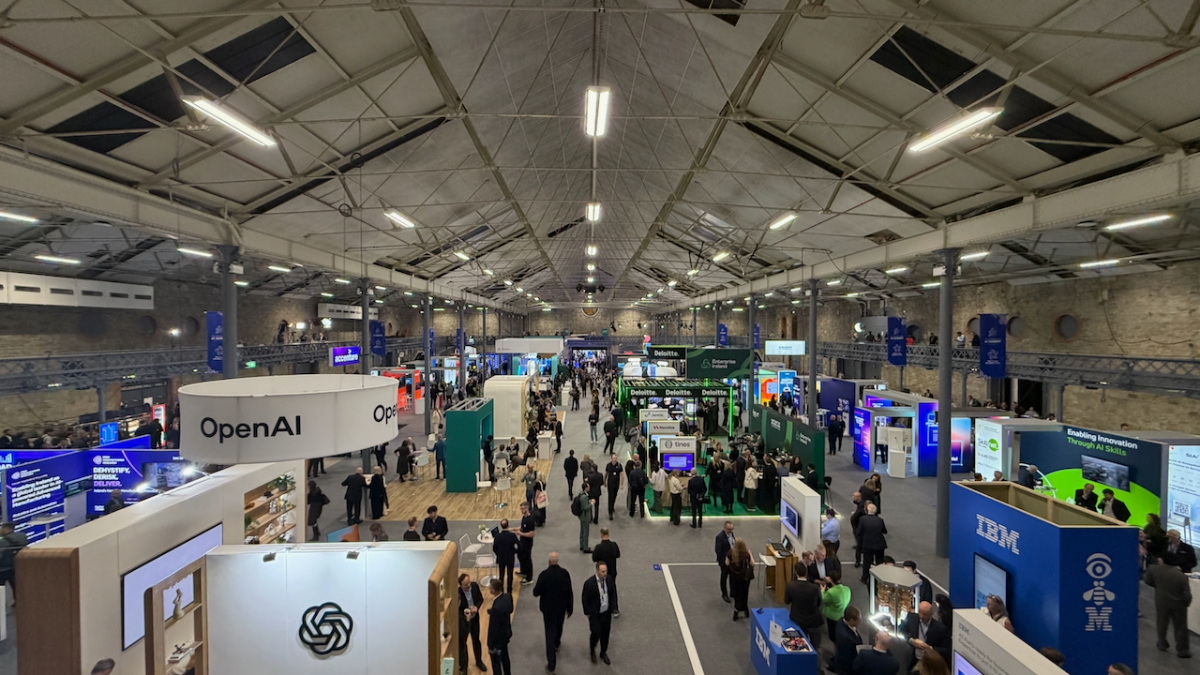
The International AI Summit exhibitors floor in Dublin, Ireland on October 14, 2026. Liz Carolan/Tech Policy Press
To get into today’s International AI Summit in Dublin, delegates had to pass a picket of striking public sector workers, a cluster of protesters, and two layers of security and identity checks. Once inside, however, a companionable air of professionalism reigned as Irish and European Union officials mingled with tech executives and a select handful of journalists over compostable paper coffee cups, amid a showcase featuring robots, Meta smart glasses, quantum computing racks and corporate-branded tote bags.
The conference was organized by the Irish government. A flagship event of its Presidency of the Council of the European Union, Ireland billed it as a showcase of innovation and the possibilities of "harnessing AI to revolutionize Europe’s competitiveness.” The government used the event to launch a number of initiatives including a new startup incubator, a cabinet subcommittee and the “Dublin Declaration,” a new document described as a “shared vision for advancing trusted, safe and sovereign AI across Europe.”
In her opening address, European Commission Executive Vice President Henna Virkkunen read out her vision for Europe becoming the “AI continent” and highlighted the EU’s investments in infrastructure projects such as “AI factories.” She ended by referencing the work of Irish Nobel Laureate Seamus Heaney, whose poem “Digging” compares the poet’s own use of the pen to his father and grandfather's use of a spade to cut turf and till land for potatoes. Every generation needs its tools, Virkkunen said, and ours will be AI. (She did not reference the deeper themes of the poem, which dissects Ireland’s complicated history of struggle between labor, artistic creation and violence, and depict the poet’s pen as resting “snug as a gun” between his finger and thumb.)
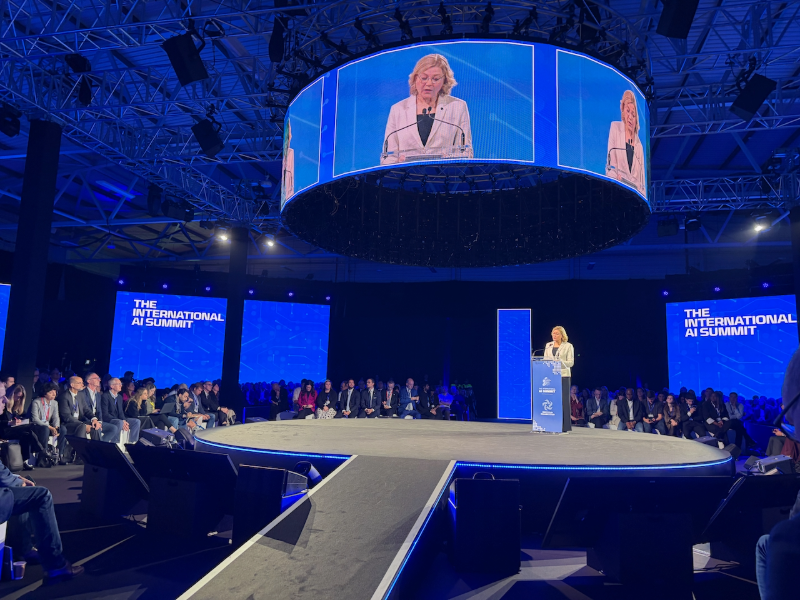
European Commission executive vice president Henna Virkkunen speaking at the International AI Summit in Dublin, Ireland on October 14, 2026. Liz Carolan/Tech Policy Press
As previously reported by Tech Policy Press, the day’s agenda was dominated by industry executives who occupied a stage fully encircled by seating. The panopticon-like room had all the trappings of a tech industry showcase, with dimmed lights and smoke machines strategically placed between oversized screens. These touches — along with an early morning, high-energy Riverdance-style dance routine complete with flashing lights, live drumming and a sound track including U2 and Stevie Nicks — were not enough to move the audience, which was mostly middle-aged policy professionals in muted suits and sensible footwear.
Throughout the morning a number of Irish political figures took on the role of introducing speakers. The Irish Minister of State for AI introduced the morning’s keynote speaker, Microsoft’s Brad Smith. Mairead McGuinness, a former first vice president of the European Parliament for the European People’s Party and later the EU’s commissioner for financial stability, chaired a discussion of European corporate leaders that included Siemens, Zalando and Ericsson, asking them, among other things, for their views on the kind of regulation Europe should pursue.
Protestors outside carried placards on the environmental, social and military uses and impacts of AI, and were among those criticizing the event for its lack of independent or critical voices. One union representative was added to the agenda in the weeks leading up to the summit. Tech Policy Press has learned that the addition came after Irish lawmakers challenged the minister in charge on the lack of worker representation at a committee hearing a few weeks prior. A parliamentary question from Sinéad Gibney, a Social Democrats lawmaker and committee member, revealed that the government had allocated €341,000 to the summit from the state’s budget for the Presidency, though the amounts contributed by two other state agencies involved were not disclosed.
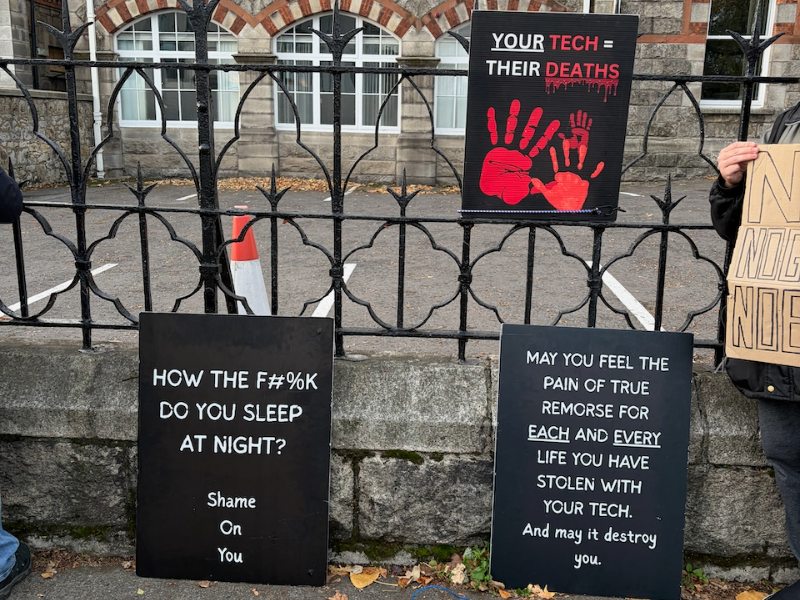
Protest signs outside the International AI Summit in Dublin, Ireland on October 14, 2026. Liz Carolan/Tech Policy Press
Ireland’s Taoiseach, who opened the event, slipped away once Commissioner Virkkunen finished her remarks, likely pulled back into the mundanity of Irish politics. Today that featured a large-scale public sector strike that saw the nation’s schools close and the picketing of public buildings, including those within earshot of the summit. The Irish government will likely be happy that it achieved its main goal, which multiple attendees told Tech Policy Press they surmised was mostly a national branding exercise: making sure the country is seen as innovative, and far removed from the “potato drills” of Heaney’s forefathers.
Authors