‘Pax Silica’ and Pursuit of Greenland Give Shape to Trump’s Imperial AI Ambitions
Justin Hendrix / Jan 20, 2026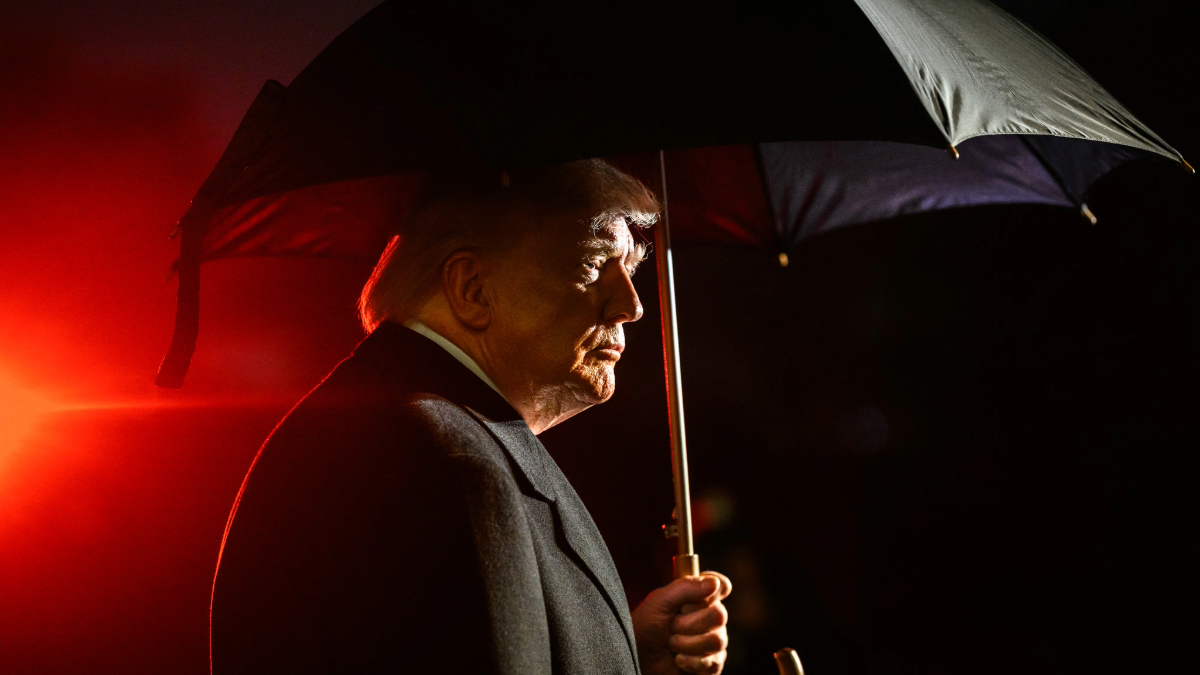
President Donald Trump speaks with members of the media before boarding Marine One on the South Lawn of the White House en route to Joint Base Andrews, Maryland, Friday, January 9, 2026. (Official White House photo by Molly Riley)
From the ascension of emperor Augustus in 27 BC through the death of Marcus Aurelius in 180 AD, historians say the Roman empire enjoyed a period of relative peace and prosperity known as Pax Romana. Now, the Trump administration says it intends to organize the AI age the way Rome ‘organized’ the ancient world. Access to critical minerals underlies these efforts.
In December, the United States Department of State launched “Pax Silica,” a diplomatic initiative to organize a coalition of countries in order to establish a “new economic paradigm” built on “secure supply chains, trusted technology, and strategic infrastructure,” including such things as rare earths, semiconductors, and data centers. And now, President Donald Trump is ratcheting up threats to take control of Greenland, in part on the strategic rationale that it holds substantial critical minerals deposits.
The growing urgency to secure critical minerals is consistent with Trump’s stated intention “to achieve and maintain unquestioned and unchallenged global technological dominance,” which the administration and its patrons believe is crucial to securing American security and economic prosperity.
The carrot: Pax Silica and the AI supply chain
The State Department says Pax Silica is “American AI diplomacy at its best: building coalitions, shaping markets, and advancing our national interests.” Under Secretary of State for Economic Affairs Jacob Helberg, who leads the initiative, calls Pax Silica a “prerequisite for national survival.” He says the aim is "to create a competitive edge so steep, so insurmountable that no adversary or competitor can scale it” in order to “make America the arsenal of AI in this century.”
The initiative kicked off with the Pax Silica Summit on December 12, at which participating countries including Australia, Japan, South Korea, the United Kingdom, Singapore, and Israel joined the US in signing the “Pax Silica Declaration.” The signatories aim to collaborate to realize growth “across all levels of the global AI supply chain, driving historic opportunity and demand for energy, critical minerals, manufacturing, technological hardware, infrastructure, and new markets not yet invented.”
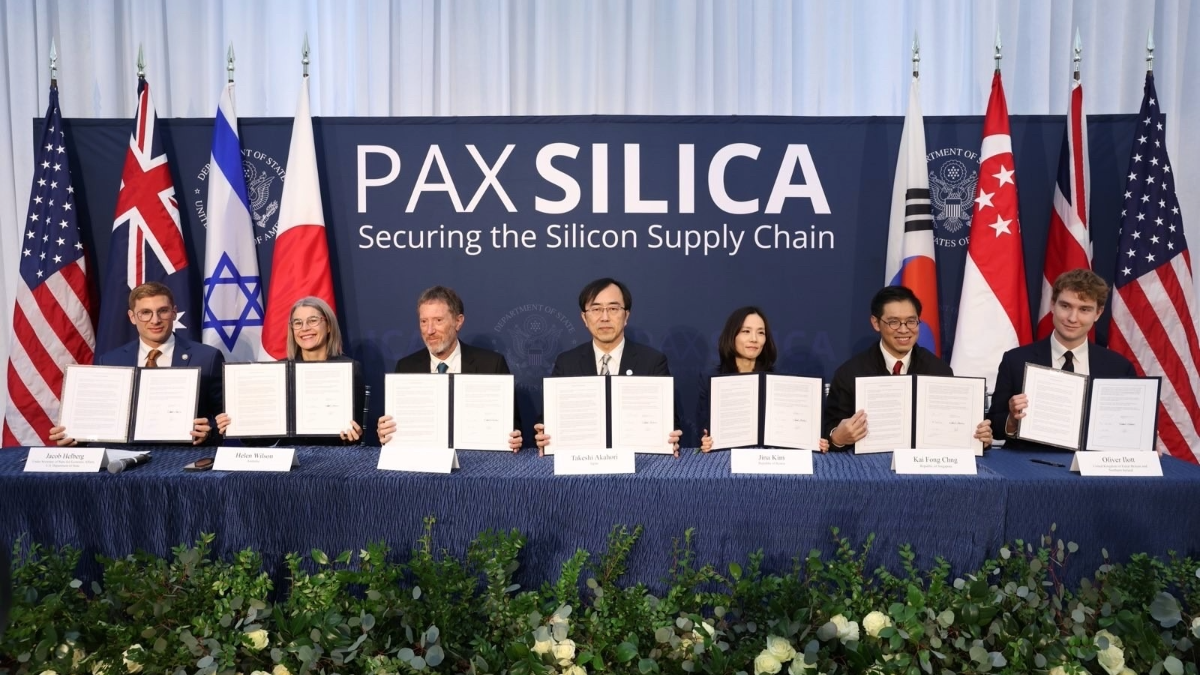
Signatories of the “Pax Silica Declaration” join US Undersecretary of State for Economic Affairs Jacob Helberg (far left) at a signing ceremony at the recently renamed Donald J. Trump US Institute of Peace. (Source: State Department)
In short order, the State Department has recruited multiple additional signatories to the declaration, including Qatar and the United Arab Emirates, which joined last Wednesday. India is slated to join next month. The European Union, Canada, and Taiwan are also involved in the discussions, according to the State Department.
The declaration is not a formal treaty with enforcement mechanisms—it's more like a “statement of shared principles” and intentions. For the US, the goal is straightforward. Right now, China controls about 90% of rare earth processing, most of the world's advanced manufacturing capacity, and has been aggressively investing in AI. The administration sees this as an unacceptable threat, so it is trying to organize America's allies into a parallel system that excludes China and creates supply chains that run through its partners instead.
The framework involves the US providing advanced technology, security guarantees, and market access, while allies provide capital, manufacturing capacity, and natural resources. As noted by Rest of World, Qatar and the UAE bring sovereign wealth funds, energy, and strategic location. Japan and South Korea bring semiconductor and advanced manufacturing expertise. Australia brings minerals and technology. Israel and Singapore bring tech innovation. In this paradigm, the US sits at the top, setting standards and controlling access to the most critical AI technologies.
While the rhetoric around Pax Silica is new, the pursuit of “adequate, stable, and reliable supply of materials for US national security, economic well-being, and industrial production” has long been the policy of the federal government, as evidenced in recent years by both the Biden administration and the first Trump administration.
For instance, President Joe Biden used the Defense Production Act to bolster the critical minerals supply, and his administration also developed partnerships with multiple countries to finance minerals projects. During the Biden administration, Congress allocated $500 million for the State Department to forge international semiconductor partnerships under the CHIPS Act, and Biden proposed the "Chip 4 Alliance" with Japan, South Korea, and Taiwan. And just as Trump’s Commerce department recently conducted a review of the critical minerals supply chain under Section 232 of the Trade Expansion Act, the Biden administration also announced new efforts to secure rare earths on the back of a Section 232 review.
But reflecting a particular sense of urgency, the Trump administration is increasingly using every tool at its disposal to make deals on critical minerals, including securing critical minerals deals with countries from Kazakhstan to Malaysia, taking direct equity stakes in mining companies, and using Treasury tools to guarantee prices for strategic minerals. On January 14, Trump issued a proclamation on “Adjusting Imports of Processed Critical Minerals and Their Derivative Products into the United States.” The proclamation instructs the Secretary of Commerce and the US Trade Representative to “pursue negotiation of agreements” and “consider price floors for trade in critical minerals and other trade-restricting measures” to address supply.
In Science, Alondra Nelson, a scholar at the Institute for Advanced Study and the former Acting Director and Principal Deputy Director of the White House Office of Science and Technology Policy under Biden, says many observers think first of ‘deregulation’ when they think about the Trump approach to AI. But Nelson describes the full scope of the Trump approach to AI as “intensive state intervention operating through industrial policy, trade restrictions, immigration controls, equity stakes in private firms (selected by the state), the redirection of research funding, and the strategic preemption of state authority.”
Perhaps it’s hard for many domestic observers to climb to a high enough vantage to see all of the pieces that are moving when there are seemingly more urgent issues to consider, whether it’s the administration’s effort to neuter state AI legislation or to defang European regulators. That may explain why there is more media coverage of Pax Silica outside of the United States than from within it. In India, for instance, Pax Silica is commanding headlines as officials there try to sort out what the country’s entry into the group might mean for the broader Indo-US relationship. And observers in Singapore see that nation’s involvement as proof its AI ambitions are paying off.
Yet its diplomatic and trade initiatives are only part of the story of how the Trump administration plans to secure critical minerals.
The stick? Greenland and the pursuit of critical minerals
What makes the language around Pax Silica particularly significant now is how it connects to other elements of what experts regard as a more nakedly imperialist US foreign and industrial policy across the board. The pursuit of AI supremacy arguably may offer a unifying principle for how the Trump administration thinks about America's role in the world. It helps explain, at least in part, Trump's conviction that the US must control Greenland, given it has the world's eighth-largest rare earth reserves and potentially the largest single rare earth deposit anywhere.
"For purposes of National Security and Freedom throughout the World, the United States of America feels that the ownership and control of Greenland is an absolute necessity," Trump wrote on his social media site, Truth Social, a month before his second term. Earlier today, he posted an image depicting himself planting the American flag on Greenland and said "there is no going back" on his goal to control the island. Along with access to Arctic shipping routes, “Greenland’s potential as a source of critical minerals also has been cited within Trump’s camp as a reason for its strategic value,” according to Bloomberg. Following Trump’s expression of interest in Greenland, American tech elites including Jeff Bezos, Sam Altman, Marc Andreessen and Bill Gates started investing there, with some taking stakes in the mining company KoBold Metals, which is prospecting for rare earths on the island.
Apart from various oligarchs, it appears that few people in Greenland, Denmark, Europe, or even the US support the idea of an American takeover of Greenland, but Trump appears increasingly willing to risk the Western alliance over it. (The Kremlin, it is reported, is “gleeful” at the prospect.) Over the weekend, Trump raised the stakes by announcing tariffs on the UK and European nations that oppose his takeover bid. And on Monday, Trump apparently told the prime minister of one of those nations, Norway, that because he did not win a Nobel peace prize he no longer feels obligated to think of “peace” when it comes to his interest in Greenland.

A demonstration under the slogans 'hands off Greenland' and 'Greenland for Greenlanders' takes place in Copenhagen, Denmark, on January 17, 2026. The demonstration aims to show solidarity with Greenland, the Greenlandic people, and 'Rigsfaellesskabet.' (Photo by Kristian Tuxen Ladegaard Berg/NurPhoto via Getty Images)
In this context, it’s worth noting that the Pentagon has also made securing critical minerals a top priority. In a speech last week delivered alongside Elon Musk at SpaceX, Secretary of War Pete Hegseth announced the “Department of War” had deployed over $4.5 billion in five months to close six critical mineral deals to help address a “major problem that President Trump has directed us to confront and solve across this administration, ending our reliance on competitors for access to rare earth and critical minerals.” Hegseth declared the goal is to transform the military into an “AI first warfighting force across all domains, from the back offices of the Pentagon to the tactical edge on the front lines.”
Such language suggests Trump’s Greenland offensive and initiatives like Pax Silica are just strands of a broader narrative about American dominance in the world. The pursuit of AI supremacy is a justification for tangible actions, from mineral deals to territorial ambitions, since AI supremacy is a prerequisite for American supremacy. But like earlier imperial visions, advancing the narrative may depend more on perception than on material transformation.
One quote attributed to Caesar Augustus speaks to such ambitions: “I found Rome a city of bricks and left it a city of marble.” Researchers have found that very few buildings were actually converted to marble: “Romans were under the impression that the city had transformed, but it was mostly an illusion.” Yet that illusion proved sufficient to help Rome consolidate power and shape the terms of its empire. Trump may recognize that in empire-building, appearance and reality need not align.
Authors