Past Debates Over Satellite Broadcasting Hold Lessons for Dialogues on AI and Digital Sovereignty
Emrys Schoemaker / Apr 9, 2026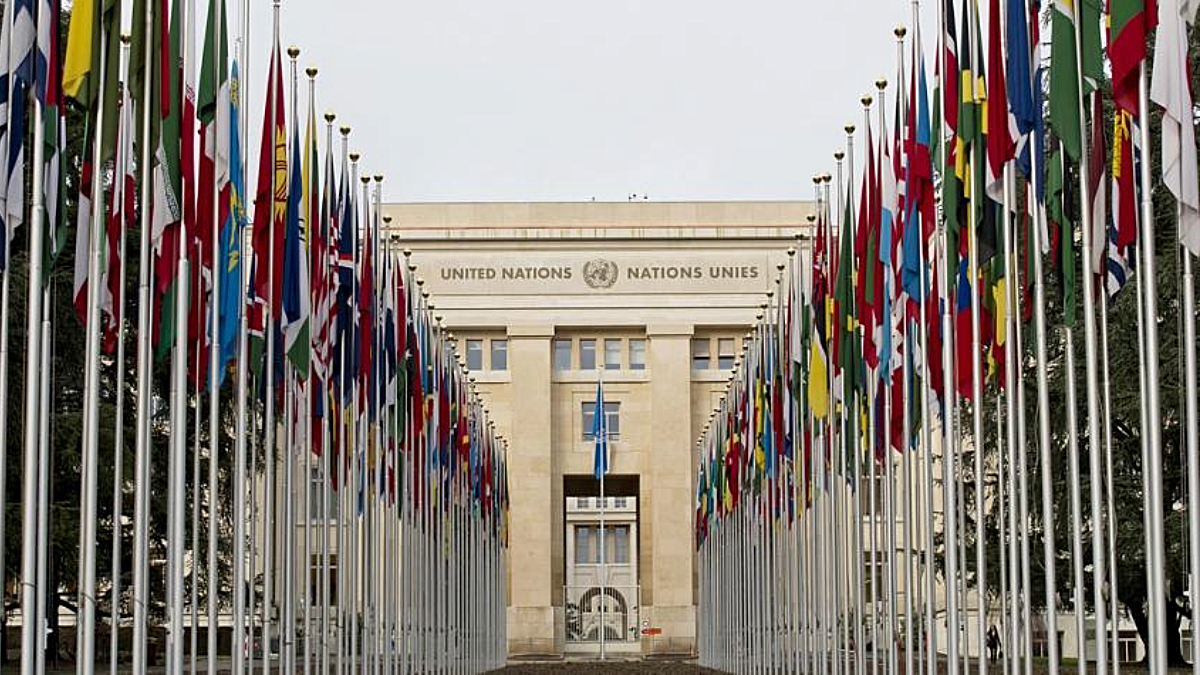
The exterior of the United Nations in Geneva, Switzerland. UN photo/Jean-Marc Ferré
It is an unusually intense period in the evolution of global digital governance. This month, the United Nations Commission on Science and Technology for Development convenes its 29th session in Geneva, with its Data Governance Working Group wrestling with some of the most contested questions in international digital policy. Among them are questions of digital sovereignty—including what it actually means, and what purposes it serves. Additionally, in the coming months, the UN’s Independent International Scientific Panel on AI will meet to prepare assessments to the UN Global Dialogue on AI Governance that will meet in July in Geneva, while next year Switzerland will host the next AI Safety Summit.
The questions running through all of these processes—about power over digital infrastructure, about who sets the norms governing AI, about the relationship between national sovereignty and global interoperability—are among the defining governance challenges of our time.
It is precisely in moments like this that history is most worth consulting.
The past in the present
A small number of powerful states and corporations control the dominant communication infrastructure on much of the planet. Developing countries find themselves dependent on systems they did not build, governed by norms they did not set. Governments call for greater sovereignty over information flows. Others warn that sovereignty is a cover for censorship and state control. Definitional battles break out over what "free flow" actually means, and for whom. The debate hardens into a binary, openness versus control, that forecloses every pragmatic option in between.
This is not a description of today's arguments about platform regulation or AI. It is a description of the international debate over cross-border satellite broadcasting and global communication infrastructure that consumed the international community across the 1970s and 1980s, a debate we remember, imperfectly, as the New World Information and Communication Order (NWICO).
The MacBride Commission's 1980 report, Many Voices, One World, captured these concerns with an analytical precision that remains striking today. The NWICO’s concerns were right. The governance model was not.
NWICO failed because of how power was actually distributed in the debate. The Reagan administration, acting in alignment with US wire services, broadcast networks, and media conglomerates who stood to lose from any international regime regulating information flows, framed NWICO as a threat to press freedom and withdrew from UNESCO in 1984. The UK followed in 1985. The irony is sharp: NWICO was attacked as state-centric and anti-democratic, yet the opposition was itself a defence of concentrated corporate power, dressed up in the language of free flow. Academics Robin Mansell and Kaarle Nordenstreng observed in 2006 that the underlying tensions were never resolved, but instead migrated into new institutional venues, carrying their structural contradictions with them. The market filled the vacuum, and the asymmetries NWICO sought to address were inherited by the digital age.
The same fault lines, new vocabulary
The parallels are not superficial. Concentration of wire services has become the concentration of cloud computing, foundation AI models, and training data in a handful of US and Chinese corporations. As Nick Couldry and Ulises Mejias argue, the extractive logic of the colonial information economy has been repackaged as data colonialism, and the infrastructure remains concentrated in the Global North. Digital sovereignty (Pohle and Thiel, 2020) is doing the same political work NWICO-era demands did, invoked simultaneously by data localization advocates, cybersecurity nationalists, and development-focused reformers with genuinely different concerns. The question is whether the governance processes addressing these tensions will repeat NWICO's mistakes, or learn from them.
In at least one corner of Geneva, there are grounds for cautious optimism.
The DGWG as proof of concept
As Milton Mueller documented in 2010, governance outcomes are often shaped less by the substance of what is negotiated than by the institutional design of the forum doing the negotiating. The Commission on Science and Technology for Development (CSTD) Digital Governance Working Group (DGWG) is, in this context, quietly significant. It is one of the very few digital governance forums that is genuinely multistakeholder in design, bringing governments, civil society, technical experts, and the private sector together not as observers but as participants in defining shared terms. That the DGWG is attempting to hold together the contested meanings of "digital sovereignty" in a forum where non-state actors have a real voice is not a procedural detail. It is the lesson of the 1980s, applied. Its definitional work is not a prelude to the real negotiation. It is the real negotiation.
The ecosystem, and its enemies
The NWICO story also teaches something about governance architecture more broadly. NWICO failed partly because routing the debate through a single intergovernmental forum made it easy for powerful state-corporate interests to capture the process and, when capture proved incomplete, to destroy the forum. A single institution can be lobbied, delegitimized, and abandoned. A dense, multistakeholder ecosystem is harder to kill.
That ecosystem is now under pressure from two directions. The Global Digital Compact, negotiated through UN General Assembly machinery in New York, risks pulling digital governance norms toward a predominantly intergovernmental process where, as Anita Gurumurthy and Nandini Chami have argued, the progressive shift away from inclusive multilateral spaces systematically marginalizes developing countries and civil society. Meanwhile, the UN80 reform initiative—however necessary its diagnosis of fragmentation—risks rationalizing the specialist digital governance capacity in Geneva's institutions in ways that reduce ecosystem density without anyone intending that outcome. Both pressures treat governance architecture as an administrative variable. It is a political one, determining who gets to participate and whose interests get built into the resulting norms.
What the digital and AI governance fields should take from this
The DGWG model does not automatically extend to the rest of the digital and AI governance landscape. The UN’s Independent International Scientific Panel and Switzerland's AI Safety Summit in 2027 vary considerably in how multistakeholder they are and how well they integrate technical and normative work. One concrete recommendation for both the Dialogues and the Summit: establish a dedicated citizens track. The lesson from NWICO is not that ordinary people lacked a voice—the debate was principally a fight between states and the corporate interests some states were protecting. It is that governance processes without genuine public interest representation are vulnerable to capture. The platform corporations and foundation model developers whose systems are being governed are sophisticated participants in every relevant forum; the communities most affected, workers facing automation, populations subject to algorithmic decision-making, users in low-income countries with limited regulatory protection are largely not. A citizens track is the structural counterweight to capture, not a peripheral add-on.
Process is never neutral
Digital technologies, as Melvin Kranzberg observed in 1986, are neither good nor bad—but never neutral. The same is true of governance processes. NWICO is a warning embedded in Geneva's institutional memory. The DGWG is quiet evidence that the warning has been partially heard. The challenge now is to extend that model into the AI governance field before the pattern of fragmentation, polarization, and exclusion reasserts itself. The concerns driving today's debates were legitimate in the 1970s too. What was missing then was not the will to address them but the governance architecture to do so inclusively. Building that architecture is the work of the next few years. The DGWG shows what it can look like.
Authors