No Data Centers in Anyone's Backyard
Vignesh Ramachandran, Inayat Sabhikhi / Jul 2, 2026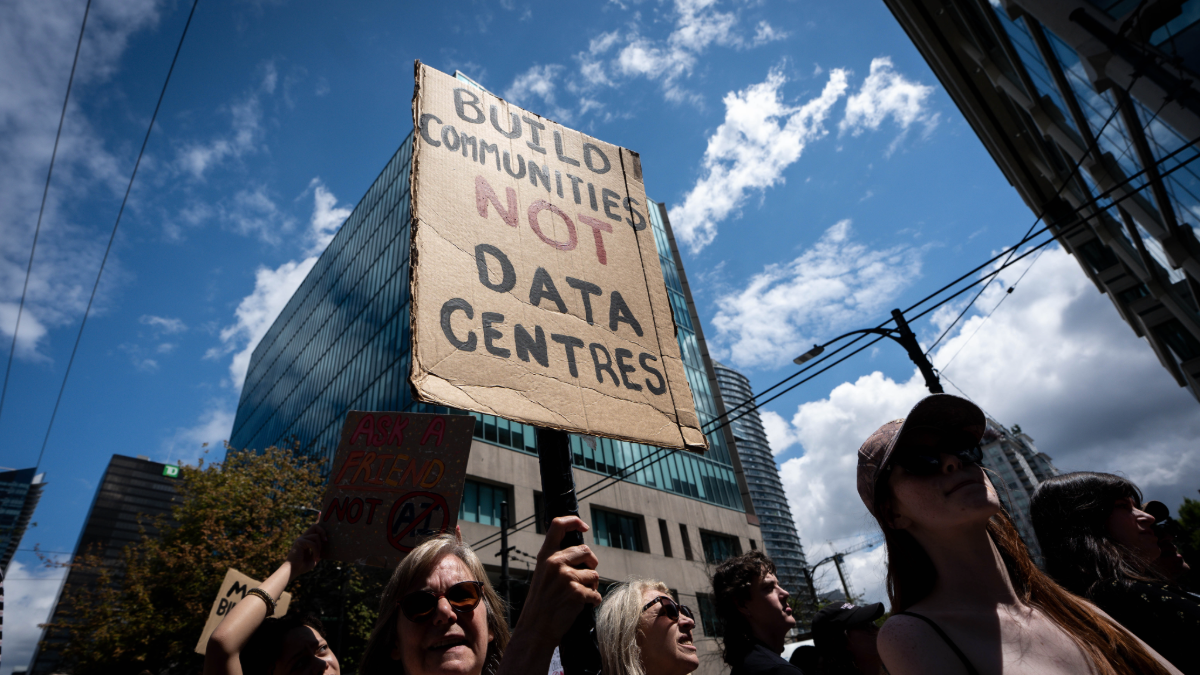
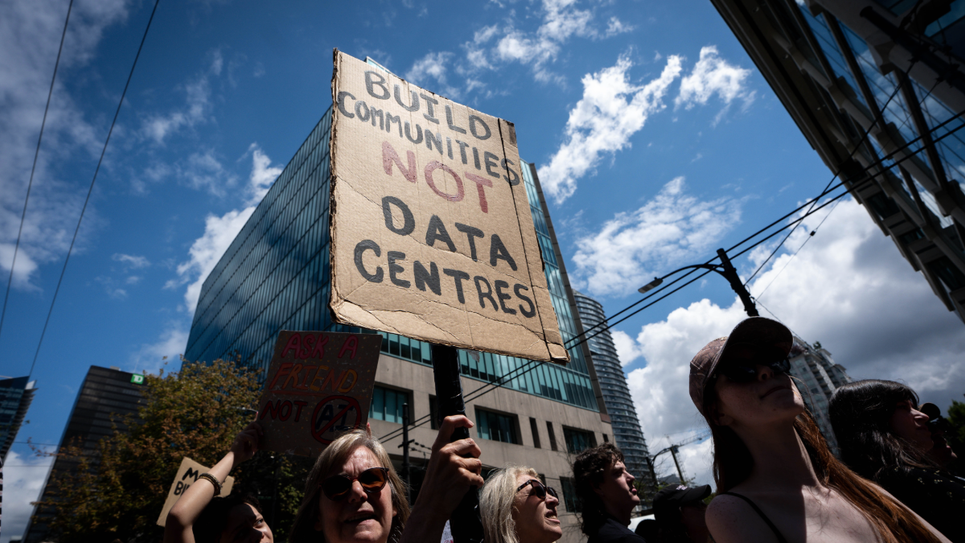
A sign opposed to data centers is held during a protest against AI data centers in Vancouver, British Columbia, Canada, on Saturday, June 27, 2026. (Ethan Cairns/Bloomberg via Getty Images)
In the United States, inspiring and steadfast local organizing by communities against data centers has created an incredible moment of leverage against all-powerful tech companies. While hugely consequential, stopping data centers in the US means little for the planet if they simply shift to Global Majority countries.
Thanks to the courage of local communities and formations such as the No Desert Data Center Coalition and Memphis Communities Against Pollution, the widespread local and global harms of data centers—such as over-extracting water resources, exacerbating air pollution, and intensifying long-standing environmental inequalities—have come to light.
None of these consequences change if the data center is moved from Virginia to Visakhapatnam; but faced with domestic opposition, the US government and tech companies are pitching data center development to Global Majority countries, where governments are rolling out red carpets and favorable regulations, like in the United Arab Emirates. Brazil recently launched a proposal to attract data centers, South Africa just changed policy to put data centers on par with ports, and in India, the government announced further land allotments for Google’s flagship AI Hub data center.
Google’s India data center has followed the trend of its behaviors in the US: no public consultations, inflated job claims and thin transparency on energy and water consumption. However the difference is that avenues of pushback—journalism and citizen petitions—are promptly shut down. Just as an investigation by Dirty Data and Environmental Reporting Collective on contested land acquisition got some traction on Instagram, it was blocked from view in India on the request of law enforcement. Similarly, the local police department reached out to X to restrict a post by the Human Rights Forum circulating a petition calling for an immediate halt to the project and an independent environmental impact assessment.
Obstacles to organizing in the Global Majority
In Global Majority countries, data centers are part of a longer arc of people being dispossessed of their land for industrial development, actively facilitated by the state. Small parcels of land held by some of the poorest and most marginalized in society, often without documentation, are prime targets for industrial development.
In India, at least two major data centers have run into land conflicts. The aforementioned Google data center in Andhra Pradesh, in partnership with AdaniConneX and Airtel, has put out staggering numbers about itself—$15 billion investments, 600 acres of land, 188,000 jobs. But verifying claims is harder than making them. The government denied a right to information application filed by Human Rights Forum and the United Forum for RTI Campaign seeking the memorandum of understanding between authorities and these companies. Even with limited information in the public domain, journalists and citizens have intrepidly fact-checked this figure of job claims to actually be just 1,225.
Defending one's land against corporations and foreign investment promoted by state officials means confronting a brick wall of corruption as well as threats, intimidation, and arrests. As per Global Witness, in 2024, 146 land and environmental defenders around the world were murdered or disappeared after speaking out or taking action to defend their right to land and a clean, healthy, sustainable environment. This is one of the most dangerous beats for journalists, with UNESCO reporting 70 percent of environmental journalists being attacked for their work.
The threat of violence continues. In Ceará, a state in northeast Brazil, seven people from the Anacé Indigenous group have been placed in a protection program for environmental defenders because of their opposition to a data center for TikTok. Facing death threats, the Anacé have brought a formal complaint before federal authorities, asking them to halt the development of this data center. Like in Andhra Pradesh, this is not the first time that their land has been eyed by industry for developments including oil refineries and thermal power plants.
Most recently in South Africa, the Housing Assembly, a social movement representing over 20 communities in the Western Cape of South Africa have brought a lawsuit against a data center planned by Equinix, a US-based firm. The objection is that the land use application should be refused by the City of Cape Town as it has no required details on emissions, electricity, diesel generators, nor on the buildings themselves.
Stop exporting discredited ideas
Relocating discredited and polluting industries from the United States to countries with less regulation is a tried and tested playbook. Data centers are just the latest chapter. Building data centers outside of the US does not change the environmental consequences, from the depletion of groundwater to air pollution and dangerous heat islands; it merely shifts suffering to communities who are less able to speak out without repercussions.
Past improvements to the standards of US companies overseas required mammoth effort on the part of organizers with severely limited resources, operating in much worse conditions than US based organizers. The best examples often follow major disasters like Rana Plaza in Bangladesh or scandals like Nike’s sweatshop factories.
For those of us in the Global North, let's not wait for these foretold disasters. Stopping data centers as communities in Tucson and New Brunswick have is an incredible victory against some of the most powerful fused interests of state and capital. We can use this momentum to not just block data centers here, but also connect with the rich legacy of movements against extractive industries in the Global Majority to make this a truly international fight.
This moment presents a generational opportunity to build an international movement of organizers and policymakers for a just transition and a global green new deal. Success will require solidarity, new relationships, and the combined intelligence and resources of connected organizers worldwide. The same companies building hyperscalers in the United States are present everywhere from Chile to Indonesia. Organizers in the Global North should extend their analysis of the opposition beyond individual sites to the full picture of Big Tech’s global footprint. Communities should ask: if we win this site fight, is this data center likely to be relocated outside the US? This internationalist frame should be part of political education and public facing commentary so that anyone in the US opposing a site in their locality will stay activated to oppose it in other places as well.
US activists should commit to building relationships with peers outside the US; though those relationships may initially be awkward and stilted, they will help create enough mutual legibility and respect for a joint strategy to emerge. From there, activists across borders can seek new policy levers and legal mechanisms to regulate data centers in the interest of the people rather than capital.
Authors