Microsoft Outage Raises Questions Over UK Control of Critical Digital Infrastructure
Evie Breese / Nov 19, 2026Evie Breese is a UK Reporting Fellow at Tech Policy Press and openDemocracy.
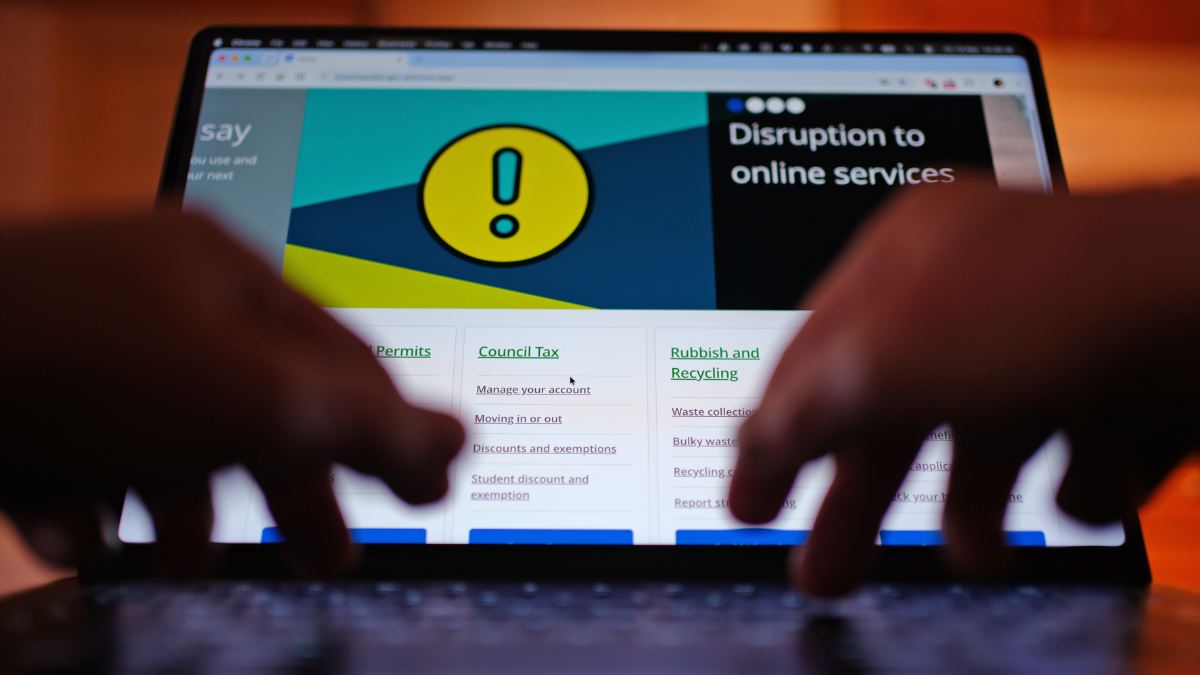
A warning is displayed of disruption to online services, on the homepage of the website for the London Borough of Tower Hamlets, on a laptop screen in London on Friday November 13, 2026. Photo: Yui Mok/Press Association TECHNOLOGY (Press Association via AP Images)
The full effects of the global Microsoft outage, which lasted a few days, are now coming into sharp focus. Alongside much of the world, millions of users across UK institutions, including schools, hospitals, police forces, and government agencies, lost access to Microsoft 365, Outlook, Teams, and the generative AI assistant Copilot, disrupting essential and non-essential services.
Almost all NHS Trusts suffered email outages, leaving some medical staff resorting to paper records to deliver healthcare in hospitals and GP surgeries. Some medical appointments and operations, including caesareans, had to be canceled. Police forces were unable to receive online crime reports, urging members to report urgent and non-urgent information by phone instead.
In the justice system, cases set to be heard at magistrates', Crown, and civil courts were canceled or delayed, including the Manchester-based trial of nine men accused of raping a woman who was drugged by her husband. Even the machinery of government itself ground to a halt, given that as many as 99% of civil servants use Microsoft for communications, including the Ministry of Defence and the Department for Work and Pensions.
“Eleanor in the UK could not send urgent cancer referrals. Hugo could not pay his staff, who live paycheque to paycheque. Mohamed, a pharmacist, could not dispense prescriptions,” Victoria Collins, Liberal Democrat Spokesperson, described to Parliament three days later.
In the House of Commons on Nov.16, Ian Murray, Minister for Creative Industries, Media, and Online Safety, delivered a speech reassuring parliamentarians that “emergency departments remained open” and there were “no major critical service impacts, and public sector resilience plans were in place.” He admitted the “incident could have been more serious if it had lasted longer.”
“No single provider should have such a major impact across the NHS, police and other frontline services,” said the Liberal Democrats Cabinet Office spokesperson Lisa Smart in a statement on 13 November. “The Government must urgently set out a plan to secure our digital sovereignty and stop relying on a few big US tech firms,” she added.
The UK’s digital sovereignty gap
The UK currently does not have a defined digital sovereignty strategy, although the government has invested in domestic technology to reduce dependence on foreign suppliers. “We have put £500 million in the sovereign AI fund, £1 billion into the AI hardware plan and £2 billion into quantum investment, so that the Government can be a first customer for some of these technologies, giving them routes to market,” said Murray, in response to calls from the Liberal Democrats to publish a digital sovereign strategy following the outage.
Murray recognized that reliance on a small number of technology suppliers “can create risks to resilience, competition and value for money”, summing up the government’s approach as “keep(ing) access to the best technology, while building greater choice and stronger UK capability.”
“It is really important that our public sector has access to the best technology, and for now, there isn't necessarily a British version of that to buy that would be good enough,” Roa Powell, senior research fellow at the Institute for Public Policy Research (IPPR), told Tech Policy Press.
The think-tank defines sovereignty broadly as “the ability for a country to control and shape the technology it relies on,”. The recent Microsoft outage specifically highlighted the UK’s lack of what IPPR terms “operational resilience”: the ability to keep “critical systems working if access, terms or suppliers change.”
IPPR broadly agrees with the government that building capability through industrial strategy is a priority, but with less than £1 in £6 spent by the public sector with its biggest technology suppliers going to British companies, far greater investment is needed to tip the scales in favor of British technology.
France, for example, has for years pursued a strategy of building technology in-house — such as La Suite, a French, open-source digital workplace used by public servants — and diversifying its supply chains, “so that if you do see a failure like this, not everyone's on Microsoft,” added Powell.
A further weakness highlighted by Powell is that the UK’s sovereign technology strategy has “been largely focused on AI, which does, to an extent, neglect some of the really deeper, long-standing problems, especially in cloud,” she said, “which is one of the most concentrated markets and most fundamental to how the public sector operates.”
The UK government is in agreement with its critics that the country’s lack of digital sovereignty limits control over its digital infrastructure. While efforts to build British infrastructure are underway, the market concentration held by Microsoft and a handful of other US-owned Big Tech providers compounds this dependence.
Sovereignty requires more than homegrown technology
Building British technology would increase control over the country’s tech stack, but replacing one monopoly with another would still leave services vulnerable to widespread outages.
“Sovereignty is actually about building resilience, and the best way to do that is through diversification,” Taylor Gese, UK lead at European think-tank Future of Technology Institute (FOTI), told Tech Policy Press.
“We're not asking the government to quit Microsoft and Amazon tomorrow — it would be totally impossible to do so — but if you diversify your critical national infrastructure across a couple of cloud providers, at least a couple more, then when the Microsoft outage happens again, hopefully your hospitals and schools make it through all right.”
Microsoft confirmed the outage was a “technical issue”, not a cyber attack, attributing the incident to problems involving its network infrastructure, rather than malicious activity.
The fact that UK services could be disrupted by a technical error points to overreliance on a concentrated market as a significant risk to digital sovereignty, not simply the location of technology providers or geopolitical tensions.
The Competition and Markets Authority (CMA) identified this vulnerability last year in its investigation of the UK cloud infrastructure market. Its findings showed that Microsoft and Amazon Web Services (AWS) each hold up to 40% of UK cloud customer spend. The regulator concluded that with the market so highly concentrated, “competition is not working well.”
In a speech delivered at Chatham House four days after the outage, Sarah Cardell, the CMA’s chief executive, argued that the issue is not that Microsoft is so widely used, but whether “the strength of the ecosystem makes it harder for organizations to switch, or to combine Microsoft products with those of other providers.”
As Copilot becomes ever more embedded in the everyday technology used by government and public services, the risk is that this dependence “determines the AI technologies it can use in future,” she said.
Powell described this as one of the more “insidious harms” resulting from a lack of digital sovereignty. “Microsoft knows that when they dominate the market, they can charge higher prices. They can bundle together their AI with their software. Like that's the reason why so many people in government use Copilot, right? Because it's not the best AI tool, it's not necessarily the cheapest, but it comes easily available with existing Microsoft services.”
The CMA ultimately concluded its three-year cloud market investigation in March 2026 by accepting voluntary commitments from Microsoft and AWS to lower barriers to switching and multi-cloud adoption, rather than pursuing legally binding obligations. This decision diverged from recommendations made by the CMA's own investigation board, leaving critics questioning whether the regulator has the teeth to address structural competition problems in a sector that underpins critical infrastructure.
An openDemocracy investigation earlier this year questioned whether the appointment of ex-Amazon boss Doug Gurr to the CMA could shape its “priorities, framing, and appetite for intervention.”
“Now is the time for the government to signal to the CMA that they should take action,” said Jim Killock, executive director of digital rights campaigning organization Open Rights Group.
The CMA, IPPR, and FOTI all agree that the UK government can, and should, use its purchasing power to actively shape markets. UK government spending accounts for up to 10% of UK demand for cloud infrastructure services, giving the government considerable purchasing power. The government has already committed to spending £9 billion on Microsoft products and services between 2024 and 2029.
At present, government departments are responsible for contracting services separately, but buying technology as one customer, or pooling budgets with the EU as recommended by IPPR, could force acquiescence to more favorable terms and conditions until the UK can diversify its tech stack with homegrown tech or the best products from different providers.
“That doesn't just mean cheaper technology; it might mean terms where the UK government has more control over their settings, control over where their data ends up being processed, control over how much notice they have to give to Microsoft before they switch to a new supplier,” said Powell.
“All of these are things that give the government way more flexibility in how they respond, both in an emergency, but more so in kind of long-term decisions so you don't get locked in in the way that you do with Palantir.”
Palantir’s contract to deliver a federated data platform to NHS England has raised widespread concerns over vendor lock-in, clauses in the contract that would make it difficult for the NHS to withdraw data from the platform, or switch to another supplier. Days after the Friday, Nov. 13 Microsoft outage, health ministers announced that the contract between controversial US technology firm Palantir and the NHS would be extended until 2029, after which a new procurement process would allow UK companies to bid for the £330 million contract. Health minister James Frith said the decision was made to reduce “over-dependence” on one supplier and boost UK sovereignty in health technologies.
Many campaigners, including Open Rights Group, expressed disappointment that the government didn’t utilize the Spring 2027 break clause. While British companies are lining up to bid for the lucrative contract, without the right T&Cs, any alternative could become even further embedded into the UK health service.
The Microsoft outage was the latest reminder of the risks of relying on a small number of technology providers, following the Google outage in October, and the AWS outage a year prior.
The Conservatives and Liberal Democrats have each told the government that the incident must be a “wake-up call” about the nation’s lack of digital resilience. But unless the government translates that warning into procurement reform to improve market competition, immediate turning points appear unlikely.
Authors