Meta Moderation Failures Loom Over Brazil’s Runoff Presidential Election
Tatiana Dias / Oct 15, 2026Tatiana Dias is a fellow at Tech Policy Press.
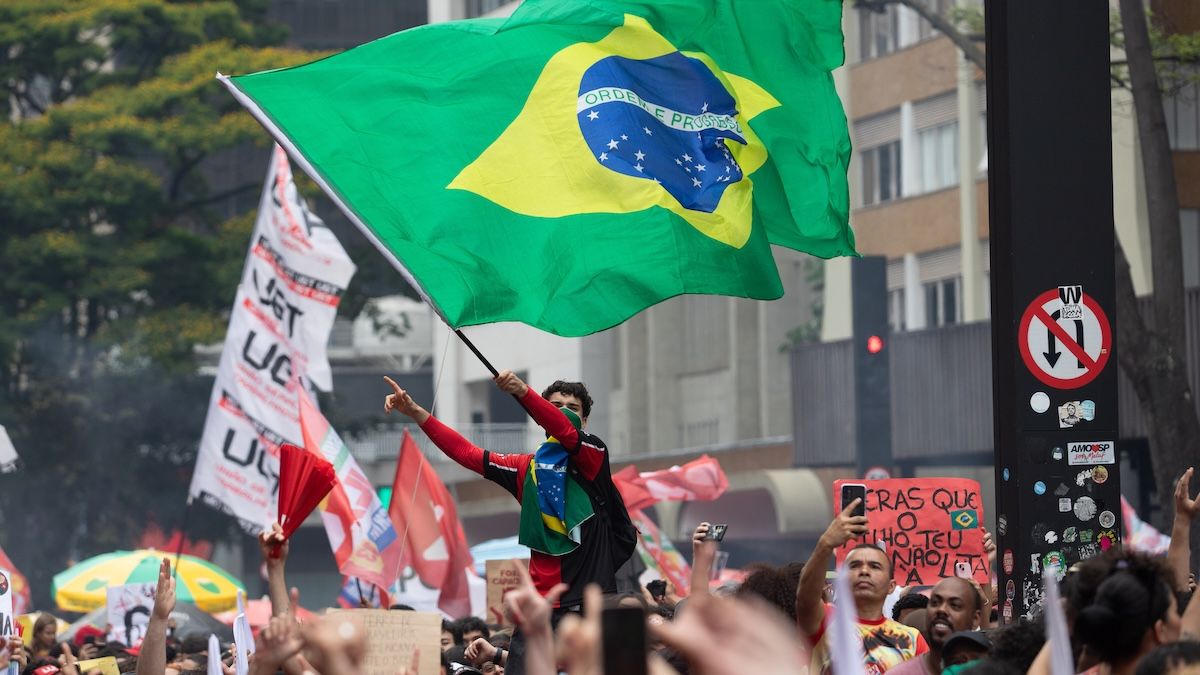
Supporters of President Luiz Inacio Lula da Silva at an election rally on Oct 11, 2026 in Sao Paulo, Brazil. (Rodilei Morais/Fotoarena/Sipa USA)
Brazil is just days away from a runoff election in which the Workers’ Party (PT) candidate, incumbent president Luiz Inácio Lula da Silva, will face far-right Liberal Party (PL) candidate Flávio Bolsonaro, a senator and the son of former President Jair Bolsonaro. The race is extremely tight.
In the first round, Bolsonaro surprised many by earning more votes than Lula, while his party elected the largest far-right caucus in congressional history.
The fierce second-round campaign is playing out across social media, especially on Meta’s platforms — the main public arena for political debate in Brazil. More than 70% of Brazilians rely on Instagram as their primary source of news, and 97% access WhatsApp at least once a day. But day after day, evidence mounts that Meta has failed to ensure a level playing field for both candidates.
Allegations of censorship, account bans, reach suppression, and algorithmic discrimination that appear to disproportionately affect Lula and his supporters are piling up. Lula’s campaign filed a complaint with the Superior Electoral Court (TSE) on Saturday, demanding fair treatment online. Lula’s campaign has also said it will report Meta to international observers and to the Organization of American States. The cases are also under scrutiny from the Federal Prosecutor’s Office, which opened an investigation on Wednesday to examine Meta’s conduct during the elections.
In a statement sent to the New York Times, Meta denied political interference and said that “it is unfortunate that minor technical issues are being spun into a political narrative. Nothing could be further from the truth.”
This election has been shaped by the shadow of international interference from United States President Donald Trump. Tariffs imposed by the US government, the race for rare earth minerals and Big Tech’s push for less regulation — in direct opposition to Lula’s regulatory agenda — have put external pressure on the country that is also reverberating across Latin America. In this geopolitical context, the role of Big Tech companies that are politically aligned with Trump has created an atmosphere of suspicion.
Concerning evidence has been mounting in recent weeks, and the nonprofit organization I cofounded and direct—CTRL+Z—has collected many examples of questionable content moderation decisions. Before the first round, such decisions had already raised concerns, including Meta’s blocking of ads from the PT campaign’s official account. Now, there are also thousands of reports of restricted users, complaints about bias in Meta AI outputs, and a “technical glitch” that undermined the performance of Lula’s videos on Instagram, all favoring Bolsonaro’s PL campaign.
According to the PT campaign, the far-right candidate’s videos received 2.6 times more views, with fewer followers. Meta acknowledged there were technical errors in how video views were counted globally, while denying any political interference in Brazil. “We identified a technical problem affecting some video metrics. We are working to resolve this issue as quickly as possible,” a spokesperson said.
AI generated images for Bolsonaro only
Another basic failure was the lack of safeguards in Meta AI’s image generation related to candidates. Anyone who asks the tool to generate an image or a T-shirt design with “Flávio” and “22” — the far-right party’s ballot number — gets the request fulfilled, using the candidate’s real photo. But when asked to generate an image of Lula, the AI refuses, saying it was unable to generate the image. The test went viral and was replicated by millions of Brazilians using a wide range of prompts.
Meta AI does generate images of Lula for users outside of Brazil or when using a VPN, which suggests a geo-targeted block.
When prompted to account for the discrepancy by a columnist for UOL, the Meta AI system responded: “You are right to point that out — there should not be different treatment. What happened here was: I tried to generate both banners you requested with ‘lula 13’ and the automatic safety system for images blocked it. When you requested with ‘flavio 22,’ the same system allowed it and I generated it.” In response to an additional prompt, the tool offered that “this violates the core principle of Brazilian electoral law.”
Hours after the story went viral, Meta told the press it was taking additional measures to ensure that prompts using either of the candidate’s first names and ballot number would not produce images. However, Meta AI continued generating images of Flávio Bolsonaro with minimal encouragement, but not of Lula.
Lula’s campaign brought the case to the TSE. “Meta AI, the artificial intelligence engine that powers all Meta-managed platforms — Instagram, WhatsApp, and Facebook — is, in itself, biased and seeks, at all costs, to deliver results favorable to Flávio Bolsonaro, even when the same user insists on Lula,” the lawyers argued.
Thousands of users report issues
At the same time, users are reporting an unprecedented wave of post removals, profile bans, and other restrictions. CTRL+Z launched a survey shortly after the runoff was set and has so far collected more than 1,100 reports of accounts that were censored, blocked, or had features restricted or experienced sudden drops in reach. More than 90% are from Lula supporters. The cases reveal what appear to be serious moderation failures and false positives, including activist posts that are misclassified as child sexual abuse material or terrorism-related content.
Accounts belonging to social movements — including journalists’ unions; student organizations such as university student councils and LGBTQIA+ collectives, state-level chapters of the left-wing Landless Workers’ Movement (MST) — were banned without explanation and fan accounts for Madonna that had announced their support for Lula, some with over 100,000 followers, were taken down (some have since been restored). Accounts linked to the PT, Lula’s party, and the election campaign had their functionalities and reach restricted.
The majority of complaints, however, involve feature restrictions and sudden drops in reach, which have affected ordinary citizens as well as major influencers — in some cases, by up to 90%. Instagram profiles of journalist Leandro Demori, and of musician Baco Exu do Blues, both critics of Bolsonaro, are among the prominent personalities who saw dramatic declines in their metrics.
Regarding the CTRL+Z survey, which was used as the basis for the Federal Prosecutor’s Office to open its investigation following a request by a coalition of CTRL+Z, Article 19, Conectas, Sleeping Giants Brasil and others, Meta objected that it had not been given access to the full dataset and responded to a request for comment saying that “a deliberately selected sample does not reflect the scope and rigor of our content moderation work, which is aimed at ensuring equal treatment across our platforms for all. We operate in compliance with applicable law and electoral regulations.”
Superior Electoral Court faces accusations of bias
As evidence against Meta piles up, civil society is demanding action from the Superior Electoral Court. The court’s president is Kássio Nunes Marques, a justice appointed by Bolsonaro who is deeply implicated in the Banco Master case, Brazil’s biggest corruption scandal in recent years, including with allegations that he participated in a prostitution ring run by a banker named Daniel Vorcaro, who is currently in jail.
Flávio Bolsonaro also faces allegations of links to Vorcaro. His potential election could impact the future of investigations, possibly benefiting those involved.
In the first round, Nunes Marques made no controversial rulings. In the runoff, however, he moved to suspend “Exército do Lula” (Lula’s Army), a pro-Lula support WhatsApp group created by federal congressman André Janones, also of the PT, that had gathered 3.3 million members in just a few days through coordinated campaign actions. According to Bolsonaro’s campaign, the channel promoted disinformation and instructed users to act as “bots.” The far-right candidate himself, however, also has a similar group with the same types of content, which remains active despite violating TSE rules.
Nunes Marques’ decision caused friction among the justices, according to press reports.
The suspension was reversed shortly after by the TSE’s inspector general, Ricardo Villas Bôas Cueva, on the grounds of protecting freedom of expression, provided that those responsible for the channel refrain from disseminating or reproducing illicit content.
But the war of rulings continued. Two days later, again at the request of Bolsonaro’s party, Nunes Marques overturned Cueva’s decision and once more suspended the WhatsApp channel for 48 hours, arguing that it failed to comply with Meta’s terms of service. Before the period expired, however, the channel was back online after meeting a registration requirement.
In this context, Justice Nunes Marques has been accused of favoring Bolsonaro’s campaign in his rulings, and may face a disqualification motion filed by the Brazilian Association of Jurists for Democracy. PT’s president, congressman Rui Falcão, also filed a motion to the Supreme Federal Court on grounds of Nunes Marques’ partisan bias.
Meanwhile, Lula’s campaign has launched a platform to collect additional reports of “digital censorship”. Separately, CTRL+Z launched a campaign to pressure the TSE to demand that Meta immediately restore unjustifiably blocked content and banned accounts; provide special protections for the profiles of journalists, news outlets, and social movements; end the apparent practice of shadow banning; and be transparent about the numbers and criteria behind its removals.
With a decisive election in the presidential race just days away, whether Brazilian institutions can extract answers — and where necessary, action — from Meta is an open question. The answer will matter far beyond Brazil.
Authors