Making Sense of AI Dread? Don't Get Distracted by Doomer CEOs or the China Canard
Paul M. Barrett / Sep 16, 2026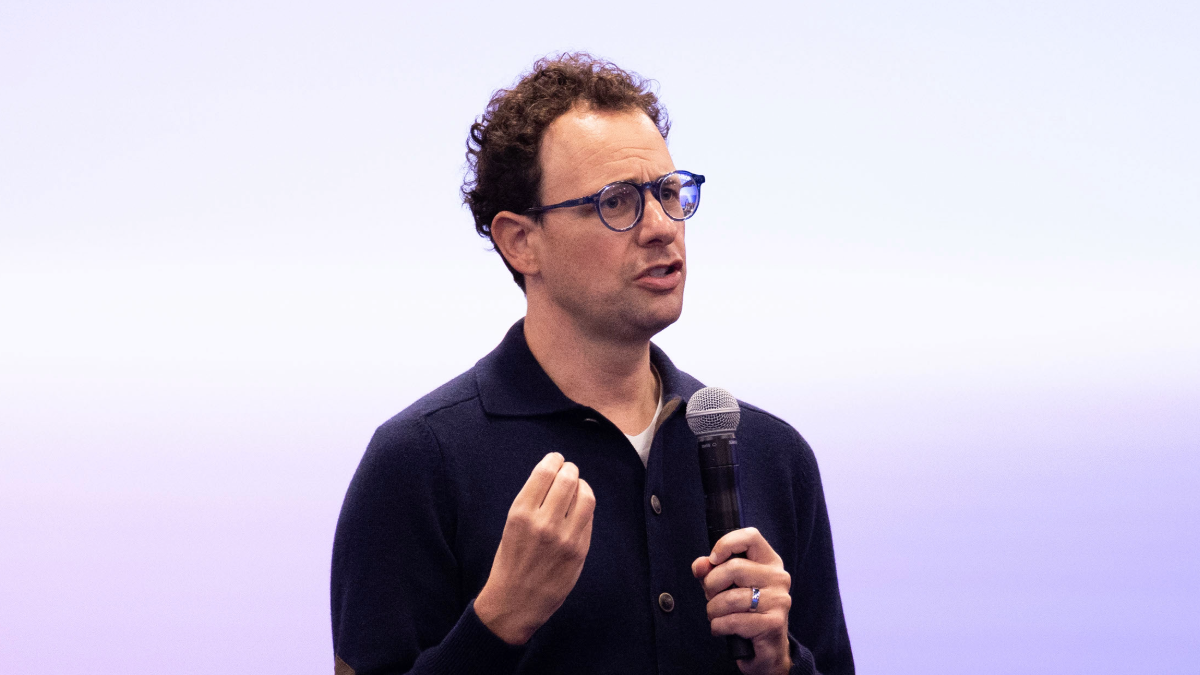
Anthropic CEO Dario Amodei at Salesforce's Dreamforce conference at the Moscone Center on September 15, 2026 in San Francisco, California. (Photo by Benjamin Fanjoy/Getty Images)
The degree of popular anxiety over artificial intelligence became clear at an otherwise ordinary congressional meet-and-greet I attended last weekend in suburban northern New Jersey. Over donuts and coffee, my neighbors peppered our US representative, Democrat Analilia Mejia, with questions about not just resource-guzzling data centers but the prospect of “recursively self-improving” machines taking over the world.
The grim mood was understandable. Attendees had been reading about the episode in July when swarms of autonomous AI agents created by OpenAI hacked into another company’s systems. Meanwhile, another leading AI maker, Anthropic, this month published a threat intelligence report about criminals and foreign state-sponsored groups using its models to design bombs and deadly pathogens. The Anthropic revelations came just days after a former employee claimed the company’s products could destroy humankind by 2030.
Exacerbating the AI dread is the confusing way that Silicon Valley chief executives talk about their creations. Rather than reassure an increasingly rattled public, CEOs like Sam Altman of OpenAI and Dario Amodei of Anthropic underscore that their technology does indeed pose an existential threat while suggesting that they are somehow passive witnesses to an inevitable danger which someone else should prevent.
On Sept. 12, the same day as our constituent gathering in New Jersey, Amodei published a 3,800-word essay vaguely calling for a slowdown of AI development. Altman and Elon Musk, whose company SpaceX has been investing heavily in AI, quickly endorsed the notion. But only nine days earlier, Altman had warned ominously that OpenAI’s next generation of models is “going to be sobering for everybody.”
What to make of all this? Three points seem salient:
First, don’t take the tech moguls’ apocalyptic muttering at face value. Instead, view it as a misdirection play meant to obscure their reluctance to self-regulate and forestall government oversight. Second, a variety of safety proposals are already on the table and deserve urgent attention. Third, the China-competition card, which President Donald Trump is waving, makes no sense upon close scrutiny.
The AI CEO misdirection play
One can spend a lot of time decoding the convoluted pronouncements of today’s tech industry leaders. Understanding their motives is important, as I wrote recently for Tech Policy Press, because of the enormous influence that this fabulously wealthy circle of men exercise over US politics and culture.
Zeroing in on the subset of CEOs leading the charge on AI, columnist and author Brian Merchant has written insightfully about doom marketing: Hyping the potential for their creations to become all-powerful, the executives tend to exaggerate the technology’s capacity — for good and ill — in hopes of drawing massive investment and impressing corporate and government customers.
Cal Newport, a professor of computer science at Georgetown University, has another theory. He recently tracked the CEOs’ mindset to the confluence of esoteric thought movements prevalent in Silicon Valley: the Extropians and the Realists. If you’re interested in the details, read Newport’s essay in The New York Times. The upshot is that the CEOs, in his words, “are weirder than we realize.”
Their particular strain of science fiction-inflected weirdness is that they believe several seemingly contradictory ideas: that a “super intelligent” form of AI is on the verge of changing absolutely everything, that only a Jedi-style fraternity of super-brain humans (that’s them) understand how this could go wrong, but that even they could “lose control” (Altman’s words) of technological evolution, leading to the arrival of the proverbial killer robots.
Newport sees this thinking as overly alarmist and conveniently designed to relieve the tech CEOs of responsibility for the real damage already caused by their products, as well as potentially worse consequences in the future. I agree. Back in June 2023, Justin Hendrix and I wrote that if one fears the most extreme existential harms — and by all means, let’s put safety first — the way to address this apprehension is to establish guardrails against the dangers we already face, such as the use of AI to turbocharge cyberattacks, disinformation campaigns, and myriad forms of fraud.
Contrary to the sense of dystopian inevitability that captivates leading minds in Silicon Valley, there’s plenty that can be done to rein in AI. We should start now, taking small concrete steps toward regulation, in part as preparation for designing drastic pull-the-plug options if and when that becomes necessary.
Note that the CEO misdirection play typically includes a demand for national and even global rules agreed to and enforced by government bodies — a tall order. This obfuscates that major AI companies could jumpstart the process by unilaterally imposing stricter safety and testing standards such that, for example, their experimental models could not infiltrate third-party servers or be exploited by bad actors to devise bioweapons.
In other words, if Anthropic’s Amodei believes that to control marauding autonomous AI agents, “we must slow the pace at which we improve the capabilities of AI models,” he ought to go ahead and slow the pace at which his company builds, tests, and releases its products. To borrow a slogan from a manufacturer in a different industry, just do it.
Waiting for the United Nations or some other international consortium to establish a platonic slate of regulations is a recipe for inaction. Truly vigorous self-regulation would be the most direct way to demonstrate that the industry can design useful technology while exercising the sort of social responsibility the moguls suggest has to be imposed from elsewhere. Working in parallel, lawmakers could codify effective self-regulatory measures and augment them with additional rules as developments warrant.
The need for government regulation
Given the unlikelihood of a broad wave — or even a galvanizing individual instance — of industry self-regulation, Congress needs to get to work on democratically mandated rules.
This, however, is where anyone calling for constructive congressional action, let alone rational executive branch leadership and an eventual presidential signature, must acknowledge that nothing of the sort will transpire as long as MAGA loyalists control the House and Senate and Trump sits in the Oval Office.
As if to illustrate, Trump on September 14 issued a stream of social media posts about artificial intelligence, declaring, in part, that “the only control or ‘guardrails’ that AI needs is a STRONG AND SMART (High IQ!) PRESIDENT.” He called existential concern about the technology a “hoax” akin to “the Global Warming Scam” and claimed that “there is a SICK conspiracy going on against AI and Data Centers, and the only one that is happy about it is China.”
With that message from the White House, the most we can aspire to at the moment is patient preparation for potential regulatory enactments post-Trump. Still, these are important issues that also can make for good politics in the imminent midterm elections and could even have bipartisan appeal, at least outside of the MAGA reality-distortion zone. Lawmakers have offered a range of approaches in recent months, and ideally, the best ideas would be combined after hearings and technical expert critiques.
Senator Bernie Sanders (I-Vt.), working with co-sponsor Representative Greg Casar (D-Texas), says he is drafting a bill that would criminally outlaw AI systems that “match or exceed human cognitive performance and capabilities across a broad range of domains or tasks,” including “overthrowing or undermining the US government.” The legislation will require a “pause” in a much broader swath of “advanced AI development until a new, federal AI regulatory body is up and running and has established clear rules and model review processes.” Attempts to violate the pauses and prohibitions would be punishable by “the corporate death penalty” for companies and up to 20 years behind bars for individuals.
The melodrama infused in the Sanders proposal detracts from its feasibility. For one thing, attempting to overthrow the government is already illegal, with or without fancy technology, as demonstrated by the convictions and long prison sentences imposed on leaders of the January 6, 2021, insurrection at the US Capitol (although President Trump undid those punishments with blanket pardons). Sanders’ indefinite “pause” on all “advanced AI development” seems likely to lead to endless definitional debates about what kind of R&D would be suspended and whether large amounts of legitimate activity would be stifled.
More promising, in my view, is a bipartisan bill introduced by Rep. Jay Obernolte (R-Calif.) with Rep. Lori Trahan (D-Mass.) and others called the Frontier Risk Oversight, National Transparency, Independent Evaluation, and Reporting Act, or the FRONTIER Act. The centerpiece of the bill is a federally mandated system of independent verification organizations, external third-party entities licensed to assess the practices of “very large” AI developers, defined by revenue and R&D spending thresholds. The legislation creates a new undersecretary of Commerce for AI security to oversee the system and set standards.
The verification organizations would have access to developers’ operations and records so that they can determine whether corporate practices and security measures are adequate to protect against catastrophic risks. These assessments would be provided to the companies and to the government every six months.
There are other procedurally complicated aspects of the transparency-focused bill. But its big gun is the emergency authority it provides to the Commerce Secretary. That official would have the power to suspend the development or release of an AI model if it presents an “imminent catastrophic risk.” Such risks are defined as those leading to death, serious injury or significant property damage by means of “engaging in conduct without meaningful human oversight” that is a cyberattack or “would constitute murder, assault, extortion, or theft,” or “evading the control” of its developer or user.
The bill doubtless would benefit from refinement. While in broad terms it is based on concepts enacted by trailblazing state-level AI regulation in New York and California, it would preempt states from going further on transparency, third-party auditing, and incident reporting — a limitation that has stirred criticism and may warrant reconsideration. The key is to get serious debate going as soon as possible, something that will happen only if control of one or both houses of Congress shifts from Republicans to Democrats.
The false China card
The main objection to AI oversight by Trump and many other accelerationists is that regulating US development would lead to Chinese domination, with huge commercial and national security implications. Keeping an eye on what Beijing is up to makes sense, of course, as it does in all economic, diplomatic, and military contexts. But the notion that regulation kills innovation and puts the US at a competitive disadvantage with its rivals is a flimsy canard.
In one of the first acts of his second term, Trump rescinded President Joe Biden’s executive order imposing basic safety-reporting requirements on AI companies. Trump entitled his July 2025 AI Action Plan “Winning the Race.” Vice President J.D. Vance has warned that if the US slows AI R&D to promote safety, we could “find ourselves all enslaved to PRC-mediated AI.” For his part, Senator Ted Cruz (R-Texas), a staunch Trump ally, has said, “If there are going to be killer robots, I’d rather they be American killer robots and not Chinese killer robots.”
None of this makes any sense. As legal scholars Yonathan Arbel and Matthew Tokson have written in Lawfare, the AI race metaphor is faulty. Unlike the “space race” of the 1950s and 1960s, where there were definable goals, like putting a man in Earth orbit or planting a flag on the Moon, AI development lacks discrete endpoints. The ease of reverse-engineering digital technologies means that AI capabilities “will spread even more quickly than advanced weapons of the past,” these authors write. “The competition between the United States and China will be just that: an ongoing competition with no clear end state, no finish line, and only minimal rewards for temporarily gaining the lead.”
The only way to “win” such a race in military terms would be to destroy a rival’s AI abilities, which implies an all-out war and the 20th century Dr. Strangelove nightmare of mutually assured destruction. (Think tank analysts in Washington, D.C., are encouraging the government to war-game scenarios for how to stop China from achieving artificial general intelligence (AGI), up to and including attacks on Chinese data centers.)
The argument that if we regulate AI here, we’ll fall behind China misses another “stark reality,” according to Matt Sheehan, a senior fellow at the Carnegie Endowment for International Peace. “For the past four years, China has had the world’s most extensive and burdensome AI regulations,” he writes. “And during that same time, China largely caught up with the United States in AI technology.”
China’s regulations initially focused on promoting Communist Party loyalty and preventing dissent. But more recently, Sheehan notes, the Chinese government has “enacted mandatory labeling of AI-generated content, mitigating psychological harms for users, addressing AI-related job losses, and more. The regulations impose real demands on companies, including extensive vetting of training data and AI models before their release.”
Safety regulation of technology does not necessarily slow innovation in AI any more than it harms development of safer, more effective pharmaceuticals or airplanes that generate profits and provide social benefits. The point is not that the US should merely imitate Chinese regulation; Beijing’s rules didn’t cause it to catch up to Silicon Valley. The lesson, instead, is that competition and regulation aren’t incompatible. The AI that is both safe and improves lives is the AI that will succeed in the global marketplace.
Authors