Japan's Team Mirai Uses Tech to Bolster Democracy, Not Undermine It
Nathan Sanders, Bruce Schneier / Mar 17, 2026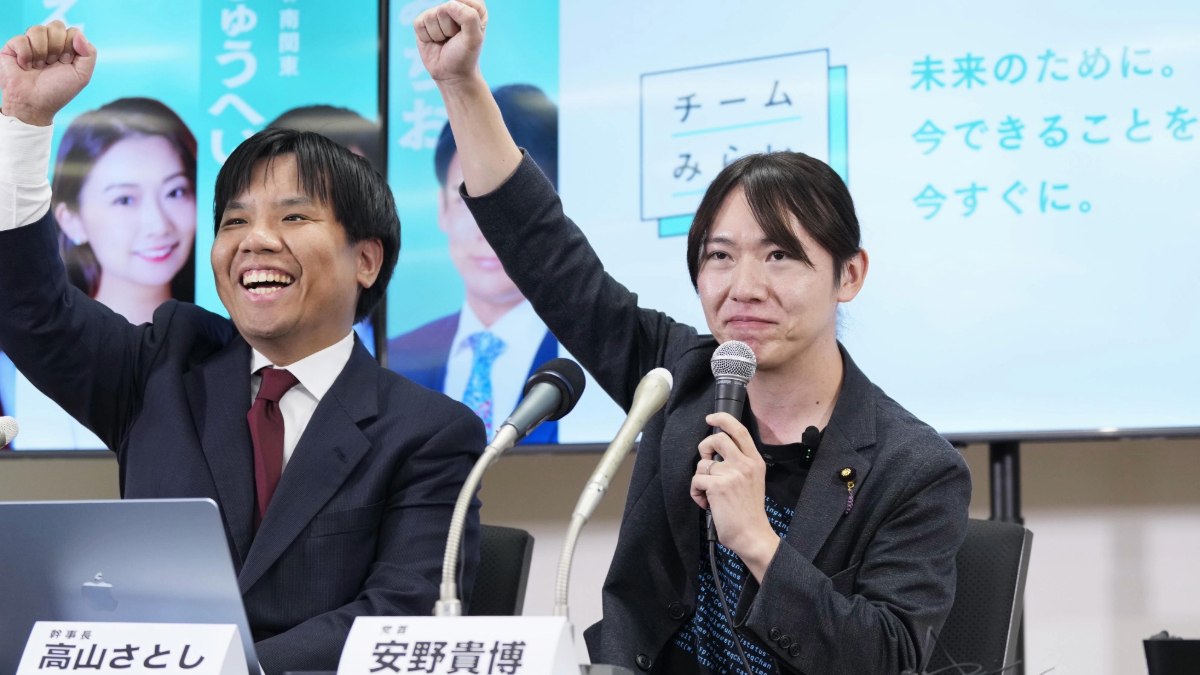
Team Mirai leader Takahiro Anno (R) reacts to early returns from the House of Representatives election in Tokyo on Feb. 8, 2026. (Kyodo via AP Images)
Japan’s election last month and the rise of the country’s newest and most innovative political party, Team Mirai, illustrates the viability of a different way to do politics.
In this model, technology is used to make democratic processes stronger, instead of undermining them. It is harnessed to root out corruption, instead of serving as a cash cow for campaign donations.
Imagine an election where every voter has the opportunity to opine directly to politicians on precisely the issues they care about. They’re not expected to spend hours becoming policy experts. Instead, an AI Interviewer walks them through the subject, answering their questions, interrogating their experience, even challenging their thinking.
Voters get immediate feedback on how their individual point of view matches—or doesn’t—a party’s platform, and they can see whether and how the party adopts their feedback. This isn’t like an opinion poll that politicians use for calculating short-term electoral tactics. It’s a deliberative reasoning process that scales, engaging voters in defining policy and helping candidates to listen deeply to their constituents.
This is happening today in Japan. Constituents have spent about eight thousand hours engaging with Mirai’s AI Interviewer since 2025. The party’s gamified volunteer mobilization app, Action Board, captured about 100,000 organizer actions per day in the runup to last week’s election.
It’s how Team Mirai, which translates to ‘The Future Party,’ does politics. Its founder, Takahiro Anno, first ran for local office in 2024 as a 33 year old software engineer standing for Governor of Tokyo. He came in fifth out of 56 candidates, winning more than 150,000 votes as an unaffiliated political outsider. He won attention by taking a distinctive stance on the role of technology in democracy and using AI aggressively in voter engagement.
Last year, Anno ran again, this time for the Upper Chamber of the national legislature—the Diet—and won. Now the head of a new national party, Anno found himself with a platform for making his vision of a new way of doing politics a reality.
In this recent House of Representatives election, Team Mirai shot up to win nearly four million votes. In the lower chamber’s proportional representation system, that was good enough for eleven total seats—the party’s first ever representation in the Japanese House—and nearly three times what it achieved in last year’s Upper Chamber election.
Anno’s party stood for election without aligning itself on the traditional axes of left and right. Instead, Team Mirai, heavily associated with young, urban voters, sought to unite across the ideological spectrum by taking a radical position on a different axis: the status quo and the future. Anno told us that Team Mirai believes it can triple its representation in the Diet after the next elections in each chamber, an ostentatious goal that seems achievable given their rapid rise over the past year.
In the American context, the idea of a small party unifying voters across left and right sounds like a pipe dream. But there is evidence it worked in Japan. Team Mirai won an impressive 11% of proportional representation votes from unaffiliated voters, nearly twice the share of the larger electorate. The centerpiece of the party’s policy platform is not about the traditional hot button issues, it’s about democracy itself, and how it can be enhanced by embracing a futuristic vision of digital democracy.
Anno told us how his party arrived at its manifesto for this month’s elections, and why it looked different from other parties’ in important ways. Team Mirai collected more than 38,000 online questions and more than 6,000 discrete policy suggestions from voters using its AI Policy app, which is advertised as a ‘manifesto that speaks for itself.’
After factoring in all this feedback, Team Mirai maintained a contrarian position on the biggest issue of the election: the sales tax and affordability. Rather than running on a reduction of the national sales tax like the major parties, Team Mirai reviewed dozens of suggestions from the public and ultimately proposed to keep that tax level while providing support to families through a child tax credit and lowering the required contribution for social insurance. Anno described this as another future-facing strategy: less price relief in the short term, but sustained funding for essential programs.
Anno has always intended to build a different kind of party. After receiving roughly $1 million in public funding apportioned to Team Mirai based on its single seat in the Upper Chamber last year, Anno began hiring engineers to enhance his software tools for digital democracy.
Anno described Team Mirai to us as a ‘utility party;’ basic infrastructure for Japanese democracy that serves the broader polity rather than one faction. Their Gikai (‘assembly’) app illustrates the point. It provides a portal for constituents to research bills, using AI to generate summaries, to describe their impacts, to surfacing media reporting on the issue, and to answer users’ questions. Like all their software, it’s open source and free for anyone, in any party, to use.
After last week’s victory, Team Mirai now has about $5 million in public funding and ambitions to grow the influence of their digital democracy platform. Anno told us Team Mirai has secured an agreement with the LDP, Japan’s dominant ruling party, to begin using Team Mirai’s Gikai and corruption-fighting Marumie financial transparency tool.
AI is the issue driving the most societal and economic change we will encounter in our lifetime, yet US political parties are largely silent. But AI and Big Tech companies and their owners are ramping up their political spending to influence the parties. To the extent that AI has shown up in our politics, it seems to be limited to the question of where to site the next generation of data centers and how to channel populist backlash to big tech.
Those are causes worthy of political organizing, but very few US politicians are leveraging the technology for public listening or other pro-democratic purposes. With the midterms still nine months away and with innovators like Team Mirai making products in the open for anyone to use, there is still plenty of time for an American politician to demonstrate what a new politics could look like.
Authors