India’s Data Center Boom Should Learn from its Dams
Udisha Saklani , Astha Kapoor / Sep 10, 2026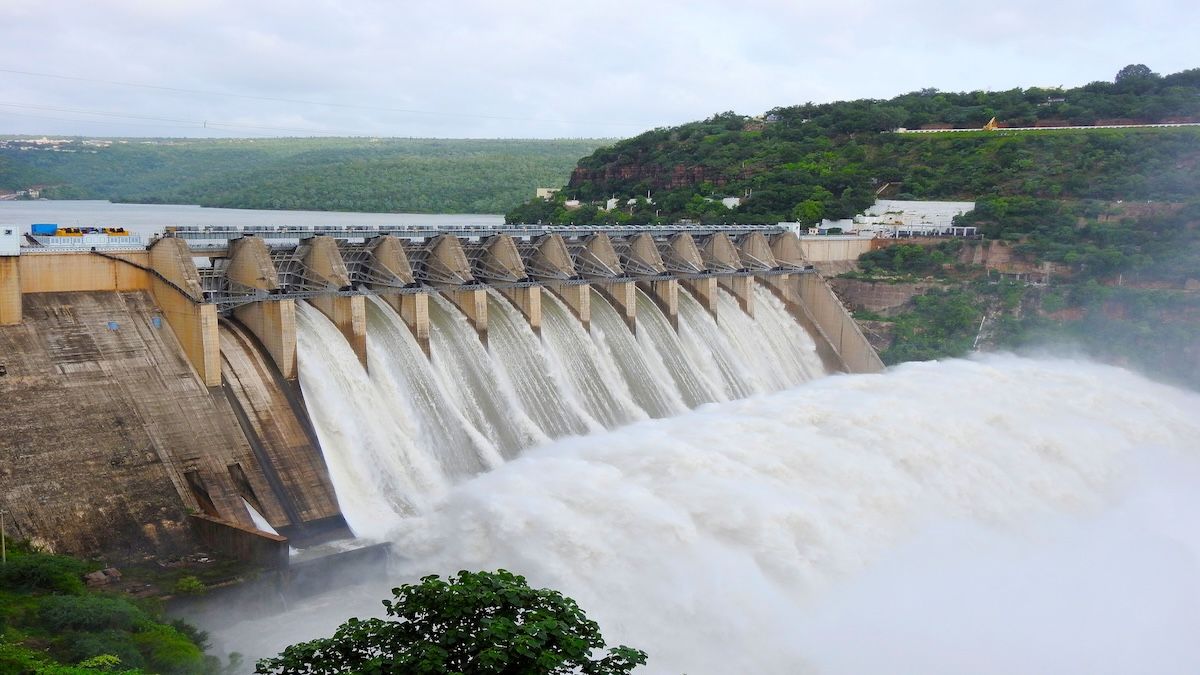
Water flowing over Srisailam Dam in Andhra Pradesh, India in Aug. 2019. Photo by Sharath G. from Pexels (CC-licensed)
India's AI ambitions increasingly depend on physical infrastructure. Across the country, state governments are competing to attract data center developers with offers of subsidized land, infrastructure status, tax incentives, and commitments to expand electricity supply. Cumulative investment commitments exceeded US$126 billion by the end of 2025 and are projected to surpass US$180 billion in 2026, while installed capacity is expected to grow almost fivefold by the end of the decade. States including Maharashtra, Tamil Nadu, Karnataka and Andhra Pradesh have launched dedicated policies or large investment packages as they compete to become India's leading AI infrastructure hubs.
This is not the first time India has invested so heavily in infrastructure to drive economic transformation. India's first Prime Minister, Jawaharlal Nehru, described large dams as the "temples of modern India" in 1954, underscoring the central significance of large infrastructure projects in the country's development strategy after independence from British rule. The scale of this push was enormous: India had fewer than 300 large dams at independence in 1947, but more than 4,000 by the year 2000, with over half constructed between 1971 and 1989.
Today's data centers are assuming a comparably important role. They sit at the center of India's AI ambitions and are being actively promoted through industrial policy. Like the large dams of the post-independence era, data centers are ambitious, capital-intensive projects intended to reshape the national economy. Both depend on significant state support and primarily promise benefits to the nation as a whole, rather than to local economies.
Looking at data centers through this longer history of infrastructure development in India raises familiar questions. How should projects of this scale be governed? How should environmental and social costs be weighed against national objectives? And how should their benefits be shared?
National ambitions, local costs
The promises surrounding large infrastructure are often framed at the national scale. Projects such as the Bhakra Nangal and Sardar Sarovar dams were presented as investments in electricity generation, irrigation and national development. Data centers are expected to deliver digital sovereignty, attract investment, create jobs, and provide the computing capacity needed for an AI economy. State governments increasingly present them as anchors for wider digital and industrial development, even as growing concerns about their environmental impacts have prompted protests and legal challenges in India, and calls for moratoriums elsewhere.
These ambitions are important, but India's experience with earlier infrastructure projects suggests they tell only part of the story. Large infrastructure often distributes its costs and benefits unevenly. National gains may be measured through investment, economic growth and new forms of connectivity, while host communities experience projects through negative changes in land use, water availability, electricity demand and environmental conditions.
The experience of large dams makes this geography particularly visible. Dams generated electricity and irrigation for regions far beyond the valleys where they were built, while displacement and environmental change were borne largely by nearby communities. Data centers create a different pattern, but they too concentrate investment, resource use and environmental pressures in particular places while delivering benefits much more widely. Mumbai and Chennai together account for roughly two-thirds of India's data center capacity, and many existing and proposed facilities are located in regions already experiencing water stress.
Mumbai illustrates the wider implications of this concentration. The city has become India's leading data center hub through its connectivity advantages and sustained policy support, yet its rapid expansion has also intensified debates over electricity demand, public subsidies, and the allocation of scarce urban resources. Where dams displaced entire communities in the service of new reservoirs and electricity generation, data centers compete more quietly for land, water allocations, and subsidized power. Host regions therefore bear concentrated resource demands while many of the resulting economic benefits accrue elsewhere — in the profits of technology firms and investors, or in digital services consumed far beyond the communities hosting the infrastructure.
This matters because AI infrastructure depends on resources that are not evenly distributed. India is home to around 18 percent of the world's population, but has only around 4 percent of its freshwater resources. Data center water demand is projected to more than double over the next five years, from roughly 150 billion liters in 2025 towards 358 billion by 2030, while electricity consumption is expected to rise from about 0.8 percent of demand to over 2.5 percent, placing additional pressure on a power system that remains heavily dependent on coal. These pressures will be experienced most directly by the regions that host this infrastructure rather than by the users who ultimately benefit from it.
Rather than asking only how many data centers India should build, policy discussions therefore need to consider where they are located, how resources are allocated, and how host communities share in the benefits they generate.
Governing infrastructure
Questions of governance become particularly visible once projects move from announcement to implementation. A large AI data center project underway in Visakhapatnam illustrates why. Its environmental clearance was challenged after it was approved without a public hearing, having been classified as a building project rather than as infrastructure requiring a more extensive environmental review. The case raises broader questions about whether existing regulatory frameworks are equipped to govern infrastructure of this scale.
Similar debates surrounded many of India's large dams. The Sardar Sarovar project, for example, faced decades of legal challenges, environmental scrutiny, and conflict over displacement and rehabilitation before it was completed. Such conflicts were not simply obstacles to infrastructure development. They also forced questions about who should bear its costs, whose voices should count in decision-making, and what responsibilities states and developers have towards affected communities.
The analogy has limits
Despite the similarities in the “mega infrastructures” of dams and data centers, the differences between them reveal the extent of India’s shift towards market led development.
First, funding. The Government of India has historically been a major financier and developer of large dams. Data centers, by contrast, are largely financed by private corporate capital, including American Big Tech companies and Indian conglomerates, such as the Adani Group, while governments provide land, tax incentives and power. The state has therefore shifted from owner-financier to facilitator of privately financed infrastructure.
Second, control over output. Dam electricity entered publicly regulated systems of distribution. Data centers produce privately controlled computing capacity whose distribution stays opaque. Will it be made available to Indian startups and institutions or primarily serve the companies that own it? What claim does the public have over infrastructure enabled by subsidized land, water, and electricity?
Third, contestation. Protests against the Sardar Sarovar Dam eventually forced recognition of displacement and resettlement of communities. Opposition to data centers, by contrast, has been more readily stifled or recast as resistance to development itself — or even "anti-national."
Data centers, then, sit comparatively closer to India’s “Special Economic Zones”, state-based enclaves that use land, infrastructure, tax concessions, and regulatory advantages to attract private investment, and that have themselves generated some of India’s bloodiest protests. In India, these zones became particularly important to the growth of the globally oriented service economy. Data centers extend this model into the digital economy, with public resources, again, mobilized for privately controlled infrastructure.
Governing the next infrastructure transition
Aside from the question of whether India should build data centers, is how these projects should be governed. The rapid expansion of AI has created pressure to move quickly. Governments are competing to attract investment, while developers are racing to build capacity. Yet India's infrastructure history suggests that governance questions rarely disappear when postponed; they re-emerge later through litigation, public opposition, environmental conflict, or expensive policy corrections.
India has considerable experience confronting the social and environmental challenges of large infrastructure projects. Conflicts over dams helped shape debates and policy around environmental assessment, public hearings, rehabilitation and compensation. There is a history of learned best practices to draw on.
Elsewhere, governments have experimented sharing infrastructure benefits more directly with communities. Nepal has introduced local share ownership and royalty payments for hydropower projects, while Wales is considering community ownership requirements for large renewable energy developments. These are not ready-made solutions for data centers, but they demonstrate that who benefits from infrastructure is a matter of policy design, not an inevitable outcome.
As India's AI infrastructure expands, the challenge is therefore not simply to accelerate investment but to govern it well. That means recognising the demands data centers place on land, water and electricity; requiring greater transparency around their environmental performance; ensuring meaningful consultation before approvals are granted; monitoring environmental and community impacts throughout their operation; and exploring ways for communities hosting data centers to share more directly in the benefits they generate.
It also means leaving space for public scrutiny and contestation. As earlier infrastructure conflicts in India have shown, resistance can expose overlooked costs and force questions of accountability and transparency into public debate.
The technologies may be new, but the governance challenges are not. India has built transformative infrastructure before. Its experience shows that the real test is not simply how quickly infrastructure can be built, but how its costs, benefits and risks are shared once it arrives.
Authors