How to Reclaim the Future from Strongmen and Oligarchs
Justin Hendrix / Oct 25, 2026The Tech Policy Press newsletter is published every Sunday. Subscribe here to receive it in your email inbox.
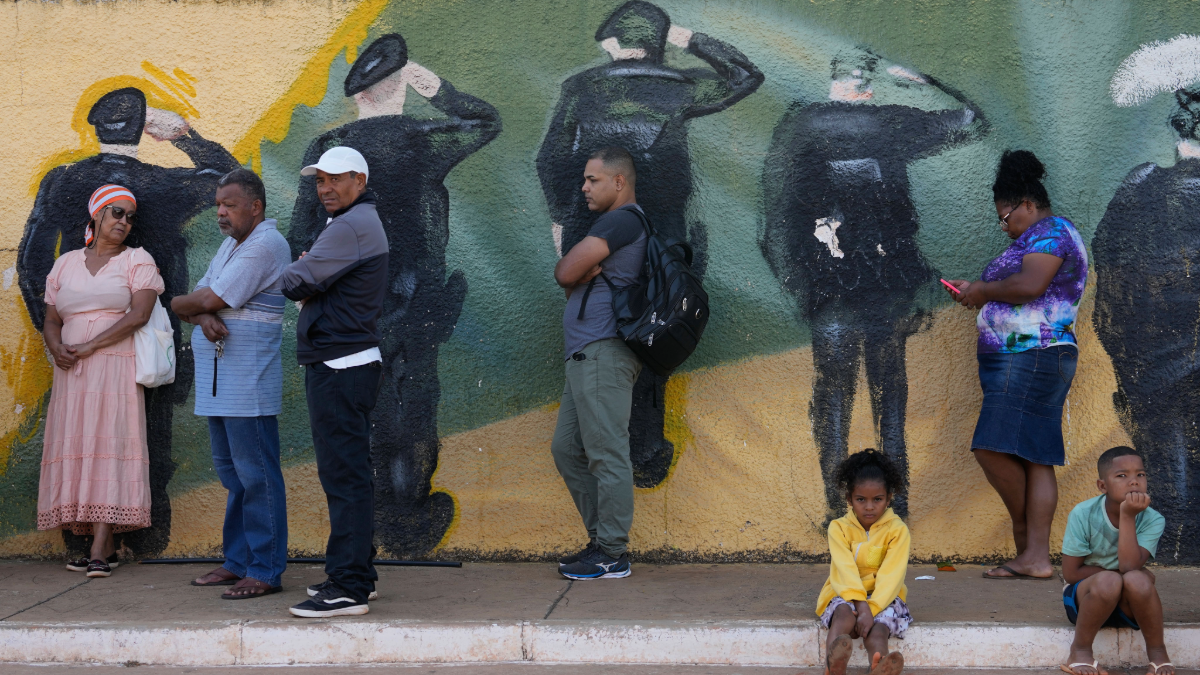
Voters line up at a polling station during the presidential runoff in Brasilia, Brazil, Sunday, Oct. 25, 2026. (AP Photo/Eraldo Peres)
Good morning!
I had the good fortune to see many in the Tech Policy Press community this week in Montreal at Attention: Democracy Rebuilt, a conference hosted by Paradigms, McGill University, the Max Bell School of Public Policy, and the Centre for Media, Technology and Democracy.
In his opening remarks at the conference, host Taylor Owen made the case that democracy requires citizens to have both knowledge about and the means to participate in the development of the technologies that define the information environment and so much about how society works.
And Nobel laureate Maria Ressa, in her remarks, reminded us why authoritarians want to cut the people out of the picture. “The strong man needs the tech oligarch,” she said. “The tech oligarch needs the strong man. The strong man weaponizes the law. The oligarchy gives the strong man reach. The strong man gives the oligarchy protection.”
I ducked out of the conference briefly on Thursday to cohost a virtual event with Emily Tucker, the executive director of the Privacy Center at Georgetown Law. Together, we launched a new bimonthly series of events we’re calling The Edge Dialogues with our first guest, Dr. Alondra Nelson. In her remarks, Dr. Nelson argued that a shrinking group of very powerful people is staking a claim to the future and deciding what it looks like before the rest of us get a say, and that the public must reclaim that power as “something that belongs to all of us.” You can listen to or read her remarks here.
I’m looking forward to continuing the conversation with the community next week in Barcelona at the Mozilla Festival. And a reminder that we’re looking for your feedback — take our short reader survey here. It will only take a few minutes!
Elections vs. Big Tech — in Brazil and beyond
- Today’s vote decides who leads Brazil — but questions about tech companies including Meta as “stewards of civic spaces” will outlast the election and reverberate well beyond Brazil, writes Daniel Arnaudo, researcher at the School of Communication, Media and Information at Fundação Getulio Vargas.
- On Wednesday, Brazil’s Federal Prosecution Office gave Meta 48 hours to say whether it will comply with recommendations on content moderation ahead of the presidential runoff, Brazilian journalist Laís Martins reports.
- With midterm elections looming in the United States, Abdiaziz Ahmed, technology policy strategist in the Brennan Center’s Elections and Government Program, reports that every AI tool tested produced convincingly false election content—including a fake image of ballot stuffing and a fake federal memo—and that most chatbots couldn’t identify AI-generated media, even when they had created it themselves.
The view from Europe
- A former MEP who served on the committee investigating spyware abuse is the latest target of spyware. Despite evidence of widespread targeting within EU institutions, the EU has yet to propose legislation specifically addressing spyware misuse, writes Tech Policy Press fellow Vas Panagiotopoulos.
- EU member states have proposed a 30% cut to the bloc’s sole public funding program for civil society, even as Europe’s digital sovereignty agenda depends on those same groups to enforce its digital rulebook, writes Tech Policy Press contributing editor Mark Scott.
- The European Parliament debated global AI governance in Strasbourg on Thursday. Lawmakers backed cooperation with the US and China but clashed over regulation at home, freelance journalist Joana Soares reports.
- The EU Kids Act proposes privacy-preserving age verification for gaming platforms, but some methods may still involve processing identity documents or facial images, writes Konstantin Levinzon, co-founder of Planet VPN. He argues clear safeguards are needed, particularly when third-party providers are involved. “A system intended to protect children could create new stores of sensitive information that cybercriminals may target. Stricter identity checks do not automatically mean safer online experiences,” he writes.
Data centers, dissent, and protests under surveillance
- Police in Delhi are skillfully using automated surveillance to suppress the constitutional right to assemble peacefully at scale, writes Tech Policy Press contributing editor Amber Sinha. “The methods deployed in Delhi demonstrate how physical policing and digital monitoring have converged into a singular apparatus of civic discipline,” he writes.
- Protests over wages, rents and education spread across France, Italy, Belgium, Portugal, Spain and Albania this month. The surveillance tools governments are using in response deserve as much scrutiny as the unrest itself, writes Lauren Mushro, non-resident fellow in the Technology and Democracy subgroup at Cornell's Center on Global Democracy.
- Protests are intensifying against the Google-Adani data center campus near Visakhapatnam in India. Vaishnavi Patil, senior associate at Aapti Institute, writes that India’s Forest Rights Act offers lessons for communities facing data centers across the country.
Freedom on the net
- As authoritarianism continues its advance across the planet, global internet freedom declined for the 16th consecutive year, according to Freedom House’s new Freedom on the Net report. Deputy editor Ramsha Jahangir and I broke down the findings, from age checks to AI regulation. “The report warns that age checks relying on facial scans, government-issued identification or other sensitive personal data can threaten privacy and anonymity. It also points to evidence that children have continued to access social media despite new restrictions,” we wrote.
- A CELE research project has identified 77 bills and statutes that treat technology as risky and in need of restriction. CELE senior researcher Ramiro Álvarez Ugarte wrote about what the public health framing justifies and where constitutional limits are emerging.
The evidence gap and governing on assumptions
- A city chatbot is no substitute for actually listening to citizens, writes Boston University professor Eric Gordon, suggesting pathways for using data and AI to build trust between people and governments. “People don't trust information; they trust messengers. And messengers become trustworthy when they authentically listen before they speak,” he writes.
- Jen Rosiere Reynolds, senior partner at AJAC Info Integrity, argues that the public and policymakers can’t judge AI risks without independent research access to data and models, and that lessons from two decades of struggling to study social media are at risk of being forgotten. “There is currently no sanctioned route to independently study AI systems or tools at scale — not to mention their impact on people, economics, and society,” she writes.
- Congress and the president remain divided on government’s role in AI, even as frontier developers sound the alarm. Zoë Baird, senior fellow at the Center for American Progress, says history offers a model: commissions that built rapid consensus after the Cold War ended and after 9/11.
Google and competition in the AI era
- Two federal judges found Google to be an illegal monopolist, but neither broke up the company. I spoke with Barry Lynn of the Open Markets Institute and Princeton CITP’s Mihir Kshirsagar about what the remedies mean for competition in the AI era.
What we’re watching
- Anthropic is shopping a draft frontier AI safety bill to Congress that would let the government block a model’s release or use only if it posed a foreseeable, imminent risk of more than $1 billion in damages or of killing or seriously harming more than 50 people.
- At the United Nations, the UN Institute for Disarmament Research launched what it called the first international forum on military uses of AI on Oct. 22.
- And in Brussels, the European Commission published the first harmonized standard under the AI Act on Oct. 14. If you’re writing about any of these issues, be in touch.
I wish you all the best for the week ahead!
-Justin
Authors