How the US and China Can Step Back from the Battle for AI Model Supremacy
Mark MacCarthy / Jul 14, 2026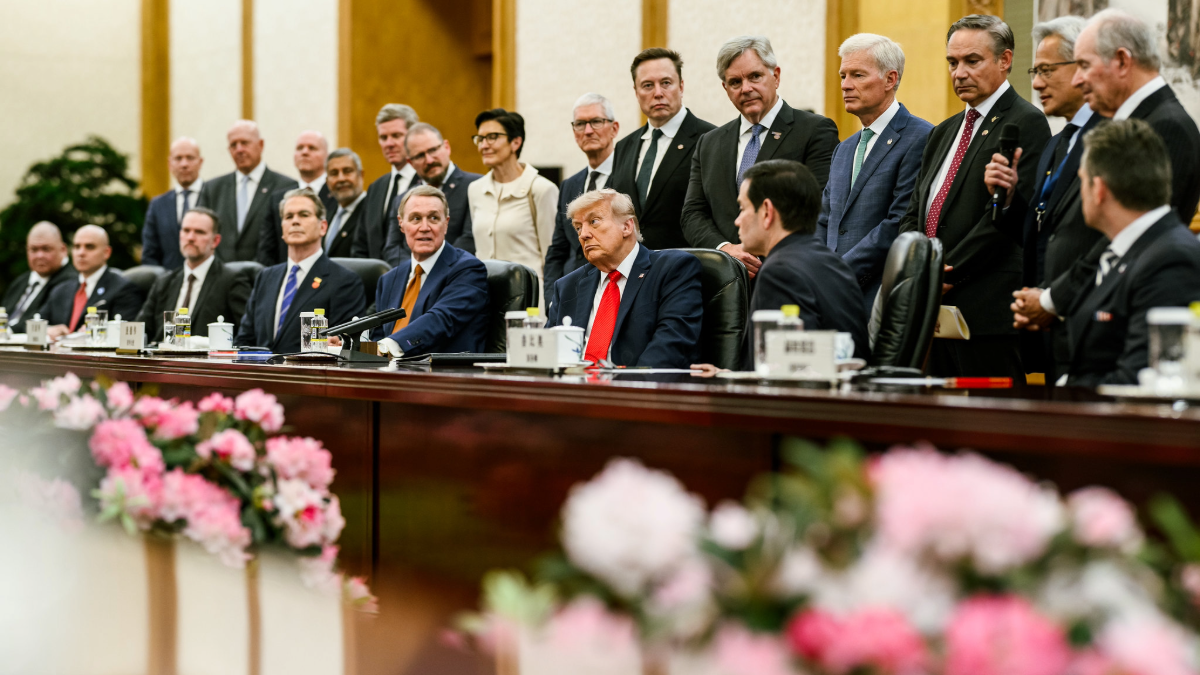
President Donald J. Trump participates in a bilateral meeting with President Xi Jinping of the People’s Republic of China, Thursday, May 14, 2026, in the Great Hall of the People in Beijing, China. (Official White House Photo by Daniel Torok)
The US and China are engaged in a battle for AI supremacy, with each country attempting to secure advantage over the other. The upcoming US dialogue on AI governance offers an off-ramp from this escalating conflict that both sides should be eager to embrace.
In its bid to secure "unquestioned and unchallenged global technological dominance,” the US has established a de-facto licensing regime for US AI models, where US authorities use export controls to decide which models are released to the general public, which are banned, and which are accessible just to users approved by the US. At least part of the reason for US officials to use this AI model chokepoint was the suspicion that entities in China could access advanced American models and use them to attack critical US infrastructure.
China is moving toward a similar control mechanism, requiring its most capable AI models to be closed, instead of the typical practice of Chinese AI companies of allowing open access to model weights, and restricting access to approved users. China’s leaders have parallel fears that the US could use these models to attack their own networks and systems. China already has a pre-deployment review system set up to control AI-generated content and it is easily adaptable to restrict AI models for safety reasons.
Although China has not approved any US models for use in China and US AI companies officially do not allow access by Chinese users, US models are popular among Chinese researchers and company experts through overseas proxies, a practice implicitly tolerated by Chinese authorities. But recently, these authorities have instructed Chinese users to uninstall and avoid models from the American AI company Anthropic, citing security flaws that allow US surveillance of user activity. This seems to be just the beginning of a more serious crackdown on the availability of American AI models in China.
For their part, US authorities are moving toward blocking US government agencies and companies from using Chinese AI models. An ongoing investigation by two House committees focuses on the national security and cybersecurity risks from Chinese-developed AI models. US authorities have accepted and amplified industry reports of theft of AI models by Chinese developers. The State Department has even instructed US embassies around the world to trumpet the dangers of using Chinese AI models. The Defense Department and other agencies already ban the use of Chinese models in government systems, and some state Attorneys General are urging Congress to ban Chinese models on all government devices and systems, citing restrictions on TikTok as precedent. Industry analyst Paul Triolo suggests that a possible executive order restricting the use of Chinese AI models could be based on federal procurement and government-use prohibition, a technology supply chain restriction, a national emergency order under the International Economic Emergency Powers Act, a prohibition just on critical infrastructure and high-risk uses or through federal contracting leverage. The writing is on the wall, and only a change in direction can prevent the move to a ban.
These bans on rival countries’ most capable models would be costly. Chinese open AI models are widely used by US companies. Airbnb reportedly uses Alibaba’s Qwen for one of its customer service applications. Perplexity also uses Chinese models, as does the coding application Cursor, the delivery company DoorDash and the legal services firm Harvey. Industry analyst Paul Kedrosky reports that Chinese open models now have more than a third of enterprise use of AI models through OpenRouter, a service that provides developers with access to a range of models, so a ban on their use “would affect real US enterprise workflows, costs, and vendor architecture.” The US startup market is even more dependent on Chinese AI. Over a year ago, a partner in the venture capital firm Andreessen Horowitz said there was an "80% chance" that US startups were using “a Chinese open-source model.”
But without security guarantees, cross-border access to AI models cannot continue. If the US thinks Chinese systems are unsafe, leading to cybersecurity threats, dangerous bioweapons or a loss of human control, the US won’t allow access to them and US consumers and companies will be worse off. And similar security concerns will push China toward a ban of US AI models, even for research and development purposes.
Of course, the US might want that as a way to protect US AI companies, in the same way that the US protects US automakers by imposing prohibitively high tariffs on the affordable, environmentally-friendly high performance electric vehicles coming out of China. This protectionist impulse could drive US policymakers to attempt to organize a world-wide boycott of Chinese AI models, the way they did to drive Huawei equipment out of allied telecom and computer networks. But given the recent surprise revelation of an effective kill switch for US AI models through export control directives, it will be hard to convince other countries to give up all reliance on Chinese models, when US AI models might vanish overnight for undisclosed security or foreign policy reasons.
So that is the choice for US policymakers. An explicit protectionist policy for US AI models, leading to a hard-to-secure and even harder-to-enforce global boycott of Chinese AI models, versus a cooperative strategy of reducing AI risks for all providers of AI models, allowing global AI competition on the merits.
The key to a cooperative approach is pre-deployment review of models for agreed-upon problem areas including cybersecurity, bioweapons and loss of human control. This is the general approach taken in several state AI safety laws and a recent draft House AI bill, titled the “Great American AI Act.” Some neutral technical standards body would set standards for AI risk reduction in these three areas, allowing authorized auditors to test AI models against these standards, giving rise to a certification. Crucially, this testing regime would apply to all AI models, including open source Chinese models. The US could enforce compliance for open source models by requiring entities that distribute AI models (like cloud providers, GitHub, or Hugging Face) to ensure foreign-origin open models pass specific US safety certifications before hosting them. China might be encouraged to adopt a similar safety regime, or piggy-back off the US system.
The first steps toward such a system could be made with confidence-building measures at the upcoming US-China AI dialogue that might commence just before the World AI Conference in Shanghai, now set for July 17-20. The dialogue could begin with information sharing about AI risks and methods of assessing and mitigating them, with no expectation at this stage of reaching any agreement. But the AI dialogue could be a step back from the brink of all-out battle for AI supremacy, with the US and China both choosing the path of safety and cooperation, not security and confrontation.
Authors