How Might Trump’s AI Executive Order Impact State Laws Regulating Nonconsensual Deepfakes?
Jasmine Mithani / Dec 19, 2025Jasmine Mithani is a fellow at Tech Policy Press.
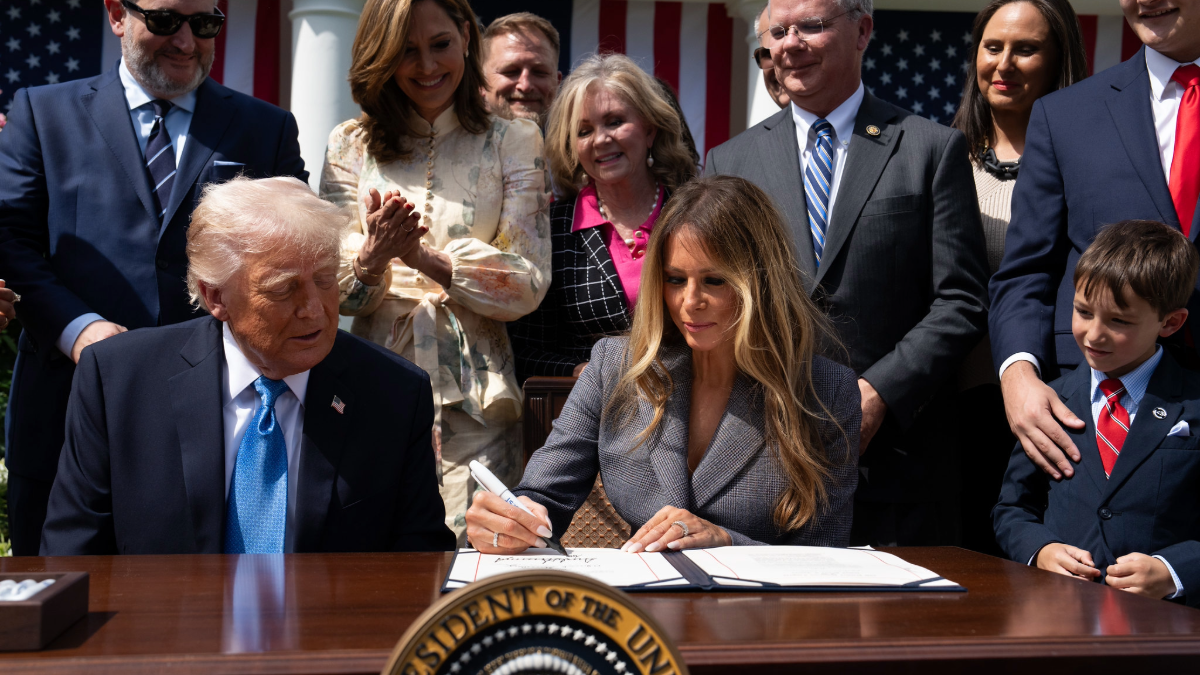
President Donald Trump and First Lady Melania Trump participate in a bill signing ceremony for the Take it Down Act, Monday, May 19, 2025, in the White House Rose Garden, which has since been converted into the Rose Garden Club. (Official White House photo by Andrea Hanks)
On December 11, President Donald Trump signed an executive order meant to limit state-level regulation of artificial intelligence. The directive instructs the Department of Justice to create an “AI Litigation Council” to investigate “onerous” state laws that are not aligned with the White House’s priorities.
States enforcing AI regulations not aligned with a “minimally burdensome national policy framework” will be ineligible for funds for a program meant to expand high-speed internet access throughout the country.
There are a few vague exceptions in the order exempting laws such as those addressing child safety, and the AI Litigation Council appears to have broad discretion in terms of what laws it will direct the Justice Department to target. But experts and advocates working with survivors of nonconsensual intimate imagery are concerned how the order could impact their cause.
State-level laws were some of the only ways victims of AI-generated nonconsensual intimate imagery could pursue justice until the federal TAKE IT DOWN Act, which was championed by the White House, was passed this spring. Forty-four states have laws regulating AI-generated nonconsensual imagery, regardless of victim age.
While the executive order may not survive legal scrutiny, experts agree it may discourage states from advancing legislation related to artificial intelligence.
Offenders said the largest deterrent to distributing nonconsensual intimate images would be jail time, according to a 2017 report from the Cyber Civil Rights Initiative. But there are many other routes legislation can take in order to curb the creation or dissemination of nonconsensual explicit deepfakes. Some of those, like model guardrails, could run afoul of this executive order.
Tech Policy Press reached out to a variety of legal and policy experts for their reactions to how the newest executive order will impact the movement against digital sexual violence.
Part of the reason state laws are so important is because they are tailored to the needs of each community, said Omny Miranda Martone, the CEO and founder of the Sexual Violence Prevention Association.
Martone pointed to data released by the Centers for Disease Control in December showing rates of different types of sexual violence vary greatly by state.
The Sexual Violence Prevention Associate actively advises on AI legislation. Martone said the group contributed with the TAKE IT DOWN Act, the DEFIANCE Act and the AI LEAD Act, and state laws were essential references to interrogate.
“What's working? What language did they use? Can we borrow some of that language? Can we do something similar?” are some of the questions Martone said they asked. “And also, how is that manifesting in case law? How is that working in the courts? Is that working? Should we change stuff? Should we pivot?”
Even when federal laws end up pulling from the statehouses, several experts said state-level laws remain key for survivors. Nonconsensual intimate imagery “is a perfect example of a situation where Congressional action simply cannot make up for the importance of state level law,” said Adam Billen, vice president of public policy at Encode AI.
Billen said the TAKE IT DOWN Act might not be as actionable for survivors due to the limited capacity of federal prosecutors.
That’s part of the reason nonprofit MyOwn Image has worked with several states to pass comprehensive laws that are realistic in their consequences for child offenders and give survivors of many different types of image-based sexual abuse tools for civil liability.
Susanna Gibson started the organization after nonconsensual sexually explicit recordings of her were publicized while she was campaigning for a Virginia Assembly seat. She narrowly lost the general election in a competitive district.
“At a moment when AI is already being weaponized against women, girls, LGBTQ+ individuals, disabled individuals, and other marginalized communities, stripping states of their ability to act is not innovation, it is obstruction,” Gibson said. “States have been responding to this exponential increase in abuse and exploitation in real time and responding because Congress hasn’t.”
Congress did move fast to pass the TAKE IT DOWN Act this year, despite taking years for a bill to gain critical mass. Trump signed the bill five months after it was introduced by Sen. Ted Cruz, a Republican from Texas, in January.
The law makes it a crime to distribute nonconsensual intimate images and requires online platforms to have an accessible place to request media removals.
The authors pulled from a brain trust of advocates who passed laws at the state level over the past decade. The definition of image-based sexual abuse has evolved since the first "revenge porn" law was passed in New Jersey in 2013, making laws more applicable to changing technologies — like AI-powered image generators.
But what about implementation? Are laws about explicit deepfakes actually going to be targeted by the “AI Litigation Council” created by the executive order?
Riana Pfefferkorn, a policy fellow at the Stanford Institute for Human-Centered Artificial Intelligence (HAI), doesn't think so.
The council is unlikely to target laws around AI-generated child sexual abuse material, she wrote in her analysis of the executive order on a Stanford Law School blog.
Those laws are in line with the administration’s priorities, Pfefferkorn argued. She also points out attacking laws against child sexual abuse material would be an unflattering public move, especially while the Epstein files loom large.
Mary Anne Franks, president and legislative and tech policy director at the Cyber Civil Rights Initiative, also pointed out that the executive branch does not have the authority to ban or preempt any law. But that doesn't mean this decree is harmless.
“To the contrary, it's a mafia-style warning to state lawmakers that if they pass AI regulations that Trump and the AI industry does not like, they will be punished with investigations, litigation, and the loss of federal funds,” Franks said.
The executive order could create a chilling effect on any future state legislation even if it is ultimately blocked.
“The clear intent of the order is to discredit and deter the kind of forward-thinking, big-picture, innovative regulation needed to address the harms of the accelerating AI crisis, including image-based sexual exploitation,” Franks said.
"Everyone should be asking those in Congress working on AI legislation: whose perspectives inspire their work?” said Stefan Turkheimer, vice president of public policy at RAINN, an anti-sexual violence nonprofit.
Turkheimer said RAINN helped pass laws in 19 states that address the harms of tech-enabled sexual abuse in addition to supporting the TAKE IT DOWN ACT. All of their legislative efforts are inspired by what survivors tell RAINN they need, he said.
Martone, at the Sexual Violence Prevention Association, said advocates were going to have to spend precious time fighting this executive order.
"Ultimately, we should be more concerned about preventing the harms of AI than preventing the laws stopping them," said Turkheimer.
Authors