How Cal State Became Ground Zero for the Fight over AI in Higher Education
Chris Mills Rodrigo / Mar 18, 2026Chris Mills Rodrigo is a fellow at Tech Policy Press.
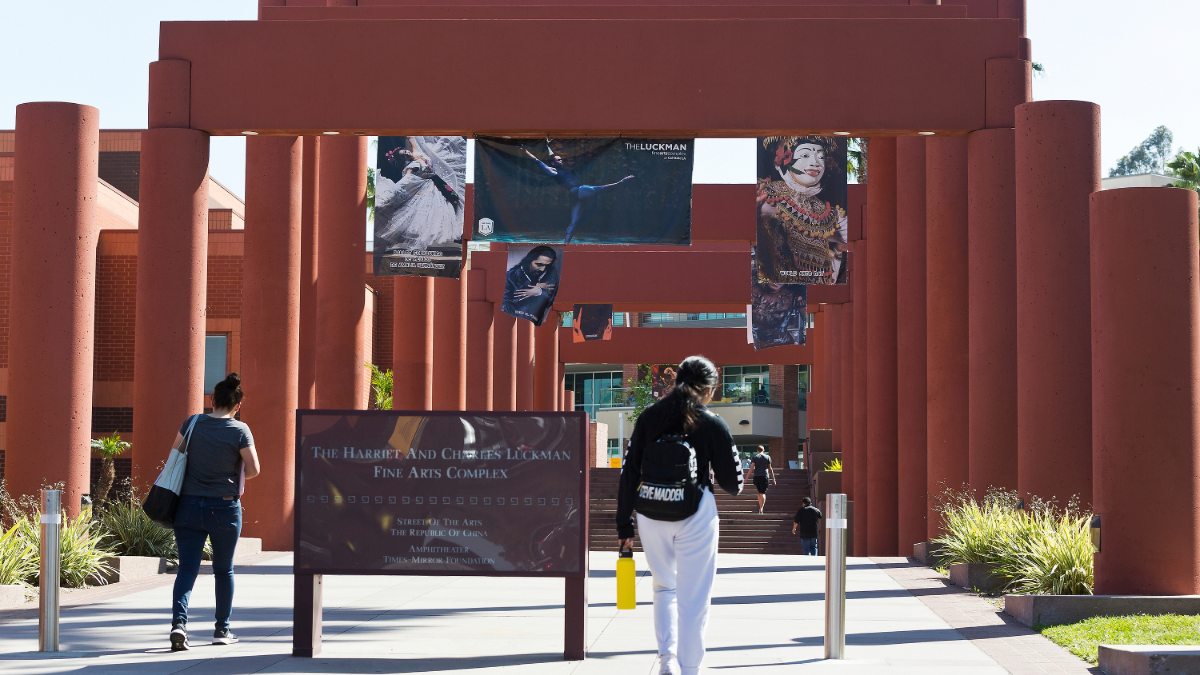
Students walk past the Harriet and Charles Luckman Fine Arts Complex at the California State University, Los Angeles on April 25, 2019. (AP Photo/Damian Dovarganes, File)
Last February, California’s biggest public university system announced a first-of-its-kind deal with OpenAI to bring an educational version of its signature ChatGPT product to its 23 campuses.
A little over a year later, over 1,600 faculty, students and alumni from California State University (known as Cal State or CSU) have signed an online petition urging the school system’s chancellor not to renew the contract when it expires this summer, according to data shared by organizers. In total, more than 3,000 have backed the effort.
Critics of the $17 million deal argue that not only is the artificial intelligence tool unhelpful at best and actively detrimental for education at worst, but that the investment is financially irresponsible for a public university that is actively cutting staff and full departments and merging campuses in an effort to cut costs.
“Introducing generative AI, which is not an educational technology, into a university system that is really, really crumbling under austerity right now is just a recipe for disaster,” San Francisco State University (SFSU) professor Martha Kenney, whose school is part of CSU, told Tech Policy Press. “To put a broken technology into a broken system can only break it further.”
The fight over AI use in the United States’ largest university system presages similar battles to come at higher education institutions across the country, in some cases pitting staff trying to preserve their livelihoods and way of teaching and administrators not wanting to miss out on the potential of a popular new tool.
In a statement announcing the deal, Cal State touted that ChatGPT Edu featured “advanced tools, security, and controls for educational institutions” compared to the product’s free version, which students across the country rapidly adopted after its launch in late 2022.
The deal is part of a broader collaboration with several major tech companies to prepare staff and students “to meet the rapidly changing education and workforce needs of California,” including Google, Amazon Web Services, Microsoft and Meta. But much of the outrage from students and staff has zeroed in on the partnership with OpenAI because it’s the only major financial arrangement that’s been disclosed as part of the initiative.
According to Cal State planning documents, obtained through a public records request executed by a former student and shared with Tech Policy Press, the university is counting on Big Tech companies to play a key role in creating an “AI-Empowered CSU” that will help build “California’s future workforce.”
That would include AI-focused training sessions and apprenticeship programs at participating tech companies that “will serve as a pipeline of AI-skilled graduates ready to meet the demands of California’s future economy.” These documents were first reported on by The New York Times.
In a statement emailed to Tech Policy Policy, CSU director of media relations and public affairs Amy Bentley-Smith said the system “is focused on ensuring our universities have the tools and resources to meet this moment and lead in the educational application, preparation, and ethical and responsible use of AI.” Bentley-Smith added that access to “relevant technologies” allows faculty and staff “to work together on solutions for the benefit of our students’ education and the broader academic community.” OpenAI did not respond to a request for comment.
But according to some professors, integrating AI into classrooms has not been as seamless as Cal State may have hoped for.
Several professors that spoke to Tech Policy Press said they have received limited direction from campus and system administrators on how best to utilize the tools, with workshops offered to faculty largely focused on general applications of generative AI rather than suggestions on how to use it in the classroom.
Because professors have been given significant discretion in how to use the tools, AI policies have been inconsistent across classrooms. Different disciplines have approached the technology in vastly different ways, from encouraging its use to banning it outright, they said.
“Every professor is left to fend for themselves and come up with policies for their classrooms, and that can be very confusing for students who are allowed to use AI in one classroom and not in another,” said Kenney, who recently served at the chair of the Women and Gender Studies department at SFSU.
Beyond inconsistencies from class to class, Cal State’s embrace of AI has made it harder for professors that believe it should not be used in the classroom to push back against its adoption. Critics argue that using AI to summarize readings or complete assignments diminishes the skills and knowledge development that students are meant to take away from their programs.
“We’re trying to counter that spread among our students, but now our bosses are lined up against us too,” said Brian Dolber, an associate professor of Communication and Media Studies at Cal State San Marcos.
Cal State students that signed the petition pointed to studies linking use of AI with decreased cognitive capability, problems with accuracy and environmental concerns tied to energy and water use as reasons not to renew the contract with OpenAI, which expires June 30.
OpenAI’s recently-announced deal with the Department of Defense, coming amid the United States- and Israel-led war on Iran, has further exacerbated concerns among faculty and students, despite the company’s pledge to maintain “red lines” in what it will allow the government to use its technology for. Over 250 CSU faculty, students and alumni signed onto the petition in the two days after the agreement became public, organizers said.
“Continuing to partner with a company run by a fascist who has decided to partner with our government on an illegal ‘war’ is deeply immoral, and frankly, disgusting,” said Kate Steffens, a senior assistant librarian at San Jose State who signed onto the petition.
Beyond their concerns with the technology itself, those fighting the contract’s renewal argue that the $17 million dedicated to it would be better served addressing Cal State’s dire financial situation.
The statement announcing the collaboration touted that the technology will be available at all 23 Cal State campuses, but in the year since it was issued, the school system began to merge two of its universities, CSU Maritime with Cal Poly San Luis Obispo.
The decision was made because of a “dire, binary choice: integrate the two institutions or initiate immediate steps for the closure of the Maritime Academy,” according to Cal State’s committee on Finance and Educational Policy. Three other campuses based in the Bay Area pitched merging administrative tasks to save money last year ahead of a predicted $375 million budget cut.
That figure was revised down to a $144 million cut to this academic year’s budget, but financial concerns remain. Departments are being shuttered across CSU schools, which serve 460,000 students, and layoffs are being proposed at several campuses.
“The California State University system is currently facing deep austerity; across campuses, we have seen program closures and faculty layoffs,” said SFSU professor Martha Lincoln. “That makes it a strange time to be spending $16.9 million on ChatGPT Edu, which is a version of a free chatbot that lacks any special customization for education. That money is being thrown away.”
The California Faculty Association, the union representing professors, lecturers, librarians and other workers in the Cal State system, is in the midst of negotiating a contract that expired last summer. The contract with OpenAI, as well as AI integration more broadly, has become a key labor issue for them.
In addition to fighting for a cost of living adjustment, the union is pushing for the right to opt-out of new technologies in the classroom, data protection rules and, perhaps most importantly, guarantees against their jobs being replaced by AI.
“You throw AI into that mix and we're in a very, very precarious position because we're now being told that in order for our students to be successful they need to learn how to use tools that displace our own labor,” Dolber, part of the CFA’s bargaining team, said.
This combination of austerity measures and the introduction of new AI technologies is not limited to Cal State.
The state’s community college network has inked its own deal with Google to provide chatbot services to its 2 million faculty and students, while the San Francisco Unified School District signed a contract with OpenAI last month.
The University of California — another public higher-education system that includes well-known campuses in Los Angeles and Berkeley — has yet to reach a similar agreement, but professors like UC San Diego’s Lilly Irani said she is ready to oppose one if it does.
“To introduce AI as a general tool for students, staff, and faculty to use unreflectively or unaccountably is a complete abdication of the responsibilities of an education system to society,” she said to Tech Policy Press.
Some national educator unions are gearing up for a fight, too. The American Association of University Professors (AAUP), which represents tens of thousands of faculty and other academic professionals, has created sample contract language for its members to help protect against AI-related job losses and push back on educational tools they see as harming learning.
“We’ve needed to have better policy around technology in higher education for 15 years, if not longer,” Britt Paris, a professor at Rutgers University and chair of AAUP’s ad hoc committee on AI, said. “With the advent of generative AI, it's become impossible to ignore.”
Authors