House GOP Moves Ahead with Kids Online Safety Package as Democrats Balk
Cristiano Lima-Strong / Mar 5, 2026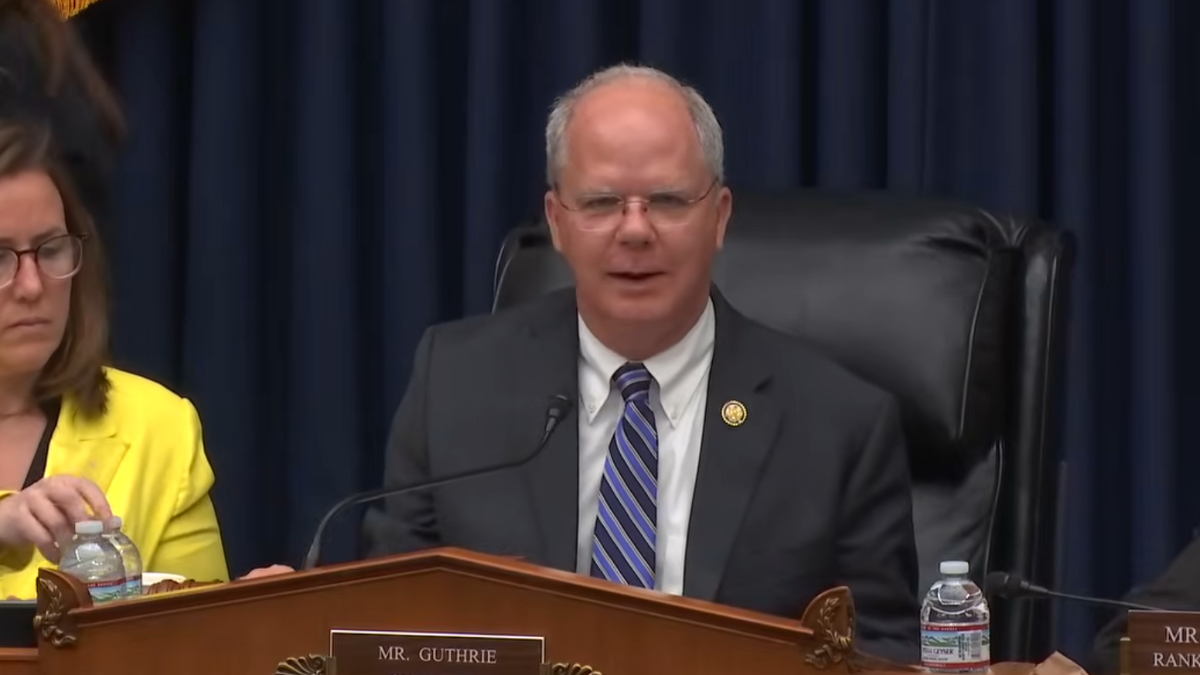
House Energy and Commerce Chairman Brett Guthrie (R-Ky.) delivers his opening remarks at the markup on Thursday. (Screengrab)
Republicans on the House Energy and Commerce Committee forged ahead with legislation expanding protections for children online on Thursday, bucking opposition from Democrats who assailed what they called a diluted package that would instead put kids more at risk.
The GOP-led committee advanced on a largely partisan basis three bills that together would require companies to implement policies shielding kids from threats of violence, exploitation and other harms; to conduct third-party safety audits; to create mechanisms allowing users to report harms; and to ensure that artificial intelligence chatbots disclose to users that they are not human. It would also create a new age verification regime enforced by app stores.
Chairman Brett Guthrie (R-Ky.) called the centerpiece of the package, the Kids Internet and Digital Safety (KIDS) Act, “the most serious, comprehensive piece of legislation to address online safety to date.”
It incorporates aspects of numerous proposals that have been under consideration on Capitol Hill for years, including the Kids Online Safety Act (KOSA), the SCREEN Act, the Safe Messaging for Kids Act, the SPY Kids Act, the Safer GAMING Act and the SAFE BOTs Act.
Guthrie said that the panel had to move ahead on the pressing issue at hand, with or without Democratic backing. “We worked hard to try to make these bills bipartisan … but the absence of a bipartisan consensus cannot be an excuse for inaction,” he said in his opening remarks.
Democrats primarily took aim at two aspects of the main bill: the federal preemption language, which they argued was far too broad and would upend stronger protections at the state level, and the removal of the duty of care provisions, the hallmark of the Senate version of KOSA that would create a legal obligation for companies to look out for the best interests of children.
“Unfortunately committee Republicans have chosen to move forward with a set of partisan bills that simply do not meet the mark for kids safety, and if they become law, would leave kids and their parents worse off than they are today, in my opinion,” said Rep. Frank Pallone (D-N.J.), the ranking member of the committee.
Some Democrats also spoke out against another proposal, known as the App Store Accountability Act, placing age verification obligations on app stores, arguing it amounted to a handout to Facebook-owner Meta and other major platforms.
Rep. Jake Auchincloss (D-Mass.) referred to the session as a “Meta markup” and called the proposal a “false flag operation by Meta.” Meta and other platforms have championed the approach as an alternative to proposals requiring that individual sites and apps verify users’ ages, arguing such a regime would be impractical and vastly expand data collection.
Auchinloss has introduced a separate bipartisan age assurance bill that would have parents inform app stores of the age range of their children. That information would then be transmitted to individual apps and used to restrict their access to age-appropriate services.
The markup kicked off in an auspicious fashion, with Guthrie preemptively asking those in attendance to maintain “order” during the discussion, citing that many of those involved in the debate are passionate about the subject matter.
Ahead of the markup, children’s safety advocates who supported the Senate versions of many of the bills publicly whipped lawmakers to vote against the latest package and a group of parents who have lost children due to online harms huddled outside the markup room with members of the press. Over a dozen of the parents, who have become a fixture in Washington as they push for congressional action, sat in attendance holding pictures of their children.
By advancing the measures out of committee, House lawmakers can now tee it up for consideration before the full chamber. If passed, it would be the first time a major online safety package of any kind has made it through Congress’ lower chamber.
But the prospects for Senate passage appear dim, with key senators who have led online safety negotiations repeatedly denouncing House changes to the proposals, including on Thursday.
In a tacit rebuke, the Senate on Thursday unanimously passed legislation to expand federal privacy protections for kids, the Children and Teens' Online Privacy Protection Act (often referred to as COPPA 2.0), while the House markup was still going on.
According to Punchbowl News, Sen. Ed Markey (D-Mass.), who has led the push to update federal children’s privacy law, slammed the version advanced by the House in remarks on the Senate floor, saying it "undermines strong bipartisan compromise."
The committee was slated to consider the House version of COPPA 2.0 on Thursday, but Guthrie said he decided to pull it from consideration so that bipartisan negotiations on the committee could continue, boosting the measure’s overall prospects.
“Our staffs will continue to work in the coming days,” he said.
Authors