Guilty Until Proven Peaceful Under India’s Preemptive Policing Crackdown
Amber Sinha / Oct 20, 2026Amber Sinha is a fellow at Tech Policy Press.
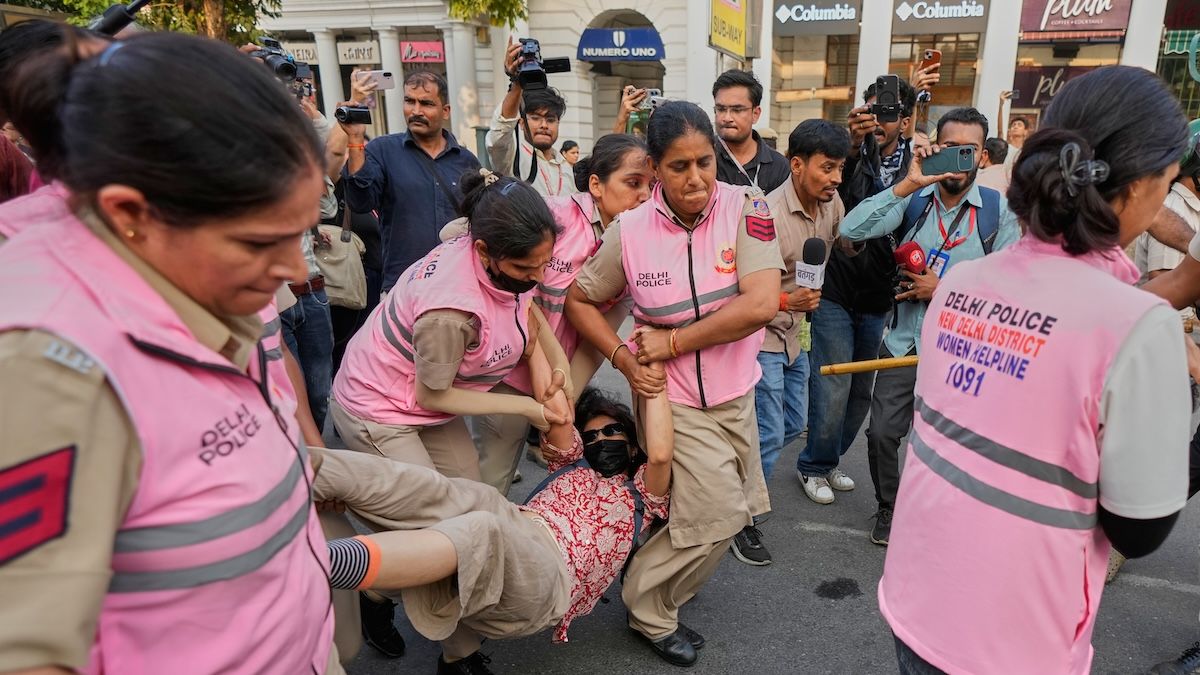
Four policewomen detain and carry a protester during a demonstration demanding the resignation of Chief Election Commissioner Gyanesh Kumar in New Delhi, India, Saturday, Oct. 10, 2026. (AP Photo/Manish Swarup)
India’s constitutional guarantee of peaceful assembly is under threat from police who use surveillance technology to crackdown on protesters — before they protest. Since June, protests across the country have brought thousands to the streets in defense of the right to vote. On October 10, ahead of a demonstration in India’s capital New Delhi, over 5,000 people were detained, train stations were closed, and people received targeted warnings.
This was not a conventional exercise in crowd management, nor was it a routine application of riot control protocols. The Delhi Police, which falls under the Ministry of Home Affairs, deployed an integrated technical and administrative apparatus designed to preempt and stop people from exercising their rights to peaceful protest. By the time the assembly was to have begun, thousands of prospective demonstrators had been intercepted, transit arteries were frozen, and the primary organizers had been detained in their homes, at transit junctions, and at airport terminals before a single slogan could be uttered or a banner unfurled.
This operational shift reflects an accelerated institutional learning curve. In a previous article following student led demonstrations in Delhi in July 2026, I observed that law enforcement operated through blunt, reactive mechanisms — relying on indiscriminate mobile network shutdowns and by chasing down peer-to-peer mesh networks. What we are witnessing now is neither clumsy nor retrospective. It is preemptive, granular, and happening at scale.
The fundamental right to assemble peacefully without arms, guaranteed under Article 19(1)(b) of the Constitution of India, is no longer respected as a baseline democratic entitlement subject to narrowly tailored exceptions. Instead, it is being subordinated to an elastic and vague conception of ‘public order’ that treats the desire to protest as a latent security threat. With its automated surveillance and preemptive detention statutes, the state has inverted the traditional legal paradigm, creating a presumption of guilt where citizens must affirmatively establish their harmlessness before they exercise a fundamental right.
The infrastructure behind preemptive policing
This month’s police suppression was facilitated by intrusive and expanding digital infrastructure. As reported by The Hindu on October 17, specialized intelligence units initiated a comprehensive digital surveillance operation that tracked at least 200 public and semi-private messaging groups across WhatsApp, Telegram, and Instagram. These channels, used by student unions, civil rights organizations, and agrarian collectives, were systematically scraped to build an actionable profile of the mobilization.
Based on this, law enforcement compiled a central database cataloging approximately 500 individuals identified as organizers, alongside a secondary watchlist of roughly 100 independent reporters and twenty digital broadcast channels. In prior years, most visibly during police investigations into riots in Delhi in 2020, such electronic footprints were extracted post-facto to reconstruct networks and fashion broad conspiracy charges. This time, however, the data was deployed prospectively. Law enforcement used the intelligence to launch a coordinated campaign of deterrent telephone calls and unannounced home visits, warning citizens and politicians against traveling toward central Delhi.
When digital intimidation proved insufficient to dissuade participation, the state resorted to unprecedented physical interdiction. Using sweeping preventive detention provisions introduced in India’s recently updated code of criminal procedure, the Bharatiya Nagarik Suraksha Sanhita (BNSS), police units arrested movement leaders at their residences in the pre-dawn hours. Organizers and student activists traveling from other states were intercepted and detained directly from arriving flights at Delhi Airport or pulled from railway coaches before they could reach city streets.
These high-profile arrests formed only the tip of the spear. Across the broader National Capital Region, thousands were placed under custody, held in makeshift detention centers and local police stations across the city. Most were detained as they attempted to reach the capital. In several cases, organizers and alleged protestors travelling to Delhi from hundreds of kilometers away were picked up from trains by local law enforcement. Preventative detention, conceived within constitutional jurisprudence as an extraordinary safeguard against imminent and severe threats to national security, has long been normalized as an administrative convenience to unreasonably restrict peaceful opposition. But, even by those low standards, the scale of preemptive detention was extraordinary for the Indian capital.
The methods deployed in Delhi demonstrate how physical policing and digital monitoring have converged into a singular apparatus of civic discipline.
Over 35,000 security personnel were supported by an extensive network of digital surveillance intelligence. Surveillance cameras and automated facial recognition systems (AFRS) at critical urban choke points across public spaces were used to identify thousands of protestors. In India, facial recognition technology operates in a statutory vacuum. There is no parliamentary legislation governing its deployment, no published technical benchmarks regarding its error rates, and no public registry documenting the legacy databases against which real-time biometric feeds are cross-referenced. When applied to public assemblies, AFRS operates not merely as an investigative aid, but as an engine of political sorting. By capturing the biometric credentials of commuters and cross-referencing them against police watchlists, individuals flagged by an unverified algorithm or logged as an active participant in an organizing chat group cease to enjoy the constitutional presumption of innocence. Their physical presence in the city is immediately rendered suspicious, shifting the burden of proof onto the individual to demonstrate that their journey is lawful and apolitical.
These steps were reinforced by the infrastructural enclosure of public transport. The Delhi Metro Rail Corporation, acting on direct executive instructions, closed access to 57 metro stations across Central and New Delhi. Automated ticketing barriers were deactivated, gates were shuttered, and train lines bypassed central hubs entirely. Combined with localized cellular data throttling and signal jammers deployed around protest sites, the state effectively isolated the civic sphere from the digital network.
On July 30, Delhi Police had floated a ₹156.6 million tender for 338 facial recognition cameras, specifically mapping high-density camera installations at critical transit gates and the perimeter of Ramlila Maidan, a large festival ground. Just 10 weeks after initiating this procurement call, Jantar Mantar, an 18th Century astronomical observatory in Central Delhi located close to the Indian Parliament, which has served as a designated protest site for over three decades, was denotified as a protest site by the Delhi Police. Three other grounds, further away from the seat of power, including the Ramlila Maidan were instead offered as sites for protests. In other words, public dissent was routed into a pre-engineered digital enclosure complete with automated biometric detection and ambient audio recording. In parallel, according to Right to Information disclosures published by the Internet Freedom Foundation, the Delhi Police spent ₹1612.7 million between July 2024 and May 2026 to procure 34 vehicle-mounted and stationary signal-jamming systems, while treating the protocols and operational thresholds governing their use as "highly confidential."
Parallels to the SIR Exercise
The presumption of culpability and the shifting of the burden of proof onto the citizen, mirrors a broader and deeply troubling pattern across contemporary Indian public administration. It is especially visible in the mechanisms governing the Special Intensive Revision (SIR) of electoral rolls.
Historically, a citizen registered on the voter list was presumed to possess the franchise unless the state discharged the evidential burden of demonstrating disqualification. However, as documented in an investigative analysis by the Internet Freedom Foundation, this foundational assumption has been systematically inverted through what amounts to a coercive data collection exercise. Rather than functioning as an administrative upgrade, digitization — which promised to deliver convenience and democratic inclusion — has been weaponized into a tool to disenfranchise the electorate at a massive scale.
Operating through undisclosed software systems and opaque algorithmic sorting, the SIR exercise facilitated the removal of an estimated 130 million names from India's voter rolls nationwide. The systemic violence of this administrative purge is particularly evident in regional data: Delhi, for instance, recorded the highest draft-stage deletion rate of any State or Union Territory, deleting 32.78% of its electorate. The inherently flawed and presumptive nature of these mass exclusions is laid bare when subjected to scrutiny. According to a Right to Information (RTI) response obtained from West Bengal, a staggering 91% of appeals decided by appellate tribunals resulted in the restoration of the previously excluded electors.
Within the framework of the SIR, long-standing inclusion on electoral registers is no longer treated as sufficient proof. Instead, the administrative apparatus casts immediate doubt upon the voter’s status, shifting the burden entirely onto the electors by subjecting them to intense documentary demands and administrative pressure. People are compelled to navigate a coercive bureaucratic maze, forced to produce extensive paperwork simply to establish their legitimacy against an inherently suspicious state machinery.
The preemptive policing model deployed in Delhi over the past week operates on the exact same premise. Just as the undisclosed software driving the SIR exercise refuses to recognize existing electoral inclusion as a presumption of legal standing, the preemptive security regime refuses to treat the presence of a citizen in public space as a presumption of lawful civic participation. Through the intrusive monitoring of WhatsApp groups and the deployment of biometric cameras, mere association with an organizing forum is converted into prima facie evidence of a conspiracy to breach the peace. In both domains — the verification of the voter and the regulation of the demonstrator — people’s standing and intention in the political system are presumed illegitimate by default.
‘Public order’ and judicial abdication
In Himmat Lal K. Shah v. Commissioner of Police (1973), the Indian Supreme Court affirmed that the right to assemble in public streets and spaces is an essential facet of a democratic society, establishing that the power to regulate public assembly does not encompass the power to prohibit it entirely. This principle was reiterated in 2018 where the court explicitly recognized that the state has an affirmative obligation to facilitate peaceful protest, balancing the rights of demonstrators with the convenience of local residents, rather than imposing blanket bans on public dissent.
Over the past week, however, "public order" was invoked not to manage an existing, observable disruption, but as an all-encompassing justification for preventive prohibition.
When executive overreach of this magnitude occurs, constitutional theory expects the judiciary to act as an immediate institutional counterweight. This duty became urgent over the weekend, as civil rights groups approached the Supreme Court in an emergency Sunday session on October 11 to challenge the mass preventive detentions, the closure of metro transit lines, and the pervasive surveillance apparatus deployed by the Ministry of Home Affairs. As chronicled in live court reporting, a bench comprising Chief Justice Surya Kant, Justice Joymalya Bagchi, and Justice V. Mohana assembled to hear urgent pleas challenging the executive lockdown of the capital. Petitioners placed extensive evidence before the bench documenting the arbitrary nature of the home detentions, the extraction of passenger manifests to detain activists at transit hubs, and the sweeping disruption of urban mobility.
The court’s eventual response, however, underscored the structural reluctance of the higher judiciary to directly confront the executive’s security apparatus. A petition filed by Member of Parliament Manoj Kumar Jha documented the disproportionate use of force and the harassment of women demonstrators by police. The Supreme Court Bar Association (SCBA) intervened directly, demanding a status report on the detention of advocates intercepted near the court premises, calling for the disclosure of officer identities, and seeking urgent preservation of CCTV and body-camera footage to prevent the destruction of evidentiary records. Simultaneously, the Network of Women in Media, India (NWMI) sought judicial safeguards to protect women journalists facing physical intimidation while reporting on the ground.
Yet, the government’s positions during the Sunday sitting revealed a continuing indifference to the constitutional gravity of these violations. Solicitor General Tushar Mehta argued that because many detained individuals had since been released, the petitions had effectively become infructuous and required no urgent intervention. This argument runs directly counter to established constitutional jurisprudence. In the historic 1985 case of Bhim Singh v. State of Jammu & Kashmir, where an elected legislator was unlawfully detained by police to prevent him from attending an assembly session, the court firmly rejected the notion that subsequent release cures an illegal detention, declaring that the constitutional mischief and malice cannot be washed away or wished away simply because the individual is set free. To treat arbitrary detention as moot the moment a citizen is released is to grant the executive a free hand to deploy temporary incarceration as a routine mechanism of crowd suppression.
The court’s response, while ordering the removal of unnecessary barricades and directing the restoration of normal metro services, retreated when addressing the broader legality of the police crackdown. The bench observed that while citizens have a right to protest, that right must strictly "comply with the law" and operate within the confines of police regulations.
When the central grievance before the court is that the police are interpreting their statutory powers under the BNSS and the Delhi Police Act in a manner that extinguishes fundamental rights, directing citizens to comply with the law is an empty tautology. The executive maintains that its actions are entirely lawful precisely because they are issued under statutory provisions governing preventive arrest and public order. By refusing to test these actions against constitutional limits, the court leaves the definition of the law to the very authorities accused of violating it.
As mentioned above, on the same day of the Sunday sitting, the Delhi Police Commissioner signed a formal standing order de-notifying Jantar Mantar as a designated protest site. In effect, his executive order decisively settled a question that was actively sub judice before the court in another matter. In 2018, the Supreme Court had explicitly rejected a blanket ban on protests at Jantar Mantar, distinguishing between legitimate regulation and total prohibition, observing that peripheral locations like Ramlila Maidan might not be sufficient.
The police exploited a passing observation in the court's October 9 order — which had merely directed authorities to consider suitable alternative venues equipped with basic amenities — to justify extinguishing Jantar Mantar entirely. The standing order, now under a new judicial challenge, deliberately routed assembly into spaces like Ramlila Maidan where the state had already spent weeks planning a pervasive ring of facial recognition cameras. The executive did not merely evade judicial scrutiny; it actively instrumentalized the court's procedural ambivalence to entrench its surveillance architecture.
A quote by the late politician Somnath Lahiri has been repeated often in recent years. Lahiri famously cautioned, during the Constitutional Assembly Debates in the 1940s, that the draft provisions on fundamental rights appeared to have been framed from the perspective of a police constable, weighed down by broad caveats and executive reservations. An excellent essay by Abhinav Sekhri from 2020 observes that the early republic witnessed a determined effort by constitutional courts to resist this outcome. In the landmark 1950 decision of Brajnandan Sharma v. State of Bihar, the Patna High Court struck down preventive restrictions on movement under the Bihar Maintenance of Public Order Act, and held that the requirement of "reasonableness" under Article 19 should never be satisfied by a law that subjected a fundamental right to the purely subjective satisfaction of an executive official.
By failing to subject the Delhi Police’s actions to established proportionality standards under Indian jurisprudence, the Indian Supreme Court ignores its constitutional responsibility. A prompt Sunday sitting earns public confidence only when it produces enforceable safeguards that bind the executive, not when the boundaries of democratic assembly are determined by the subjective convenience of the digital control apparatus of the state.
Authors